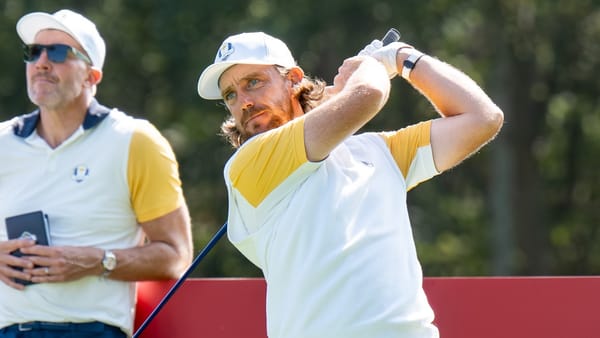
Four days out from the biggest team event in women’s golf, the storylines are stacking up fast: a first-time European captain, a defending U.S. team looking to hold serve on Dutch soil, and a format that turns 24 of the best players in the world into partners instead of rivals for three days.
The 2026 Solheim Cup runs September 11-13 at Bernardus Golf near ’s-Hertogenbosch, Netherlands, with Europe defending home continental turf against a U.S. team chasing back-to-back wins.
Anna Nordqvist captains Europe for the first time, facing U.S. captain Angela Stanford, whose team enters as the defending champions after winning 15.5-12.5 in 2024.
28 points are on the table across foursomes, fourballs, and singles; 14.5 wins the Cup outright, and a 14-14 tie means the reigning champion keeps it.
The U.S. leads the all-time series 11-7-1, but Europe has won or retained the Cup in three of the last four editions, so recent form and history point in different directions.
Coverage airs on Golf Channel and NBC, with Peacock streaming, and the early European tee times mean U.S. viewers are watching before sunrise all three days.
What the Solheim Cup actually is
The Solheim Cup is the LPGA and Ladies European Tour’s answer to the Ryder Cup: a biennial team match between 12 American players and 12 European players, contested every two years since 1990. It’s named after Karsten Solheim, the founder of PING, who agreed to bankroll the event on the condition it ran for at least 10 editions, and it started small: the U.S. won the first Cup 11.5-4.5 at Lake Nona in Florida in 1990. There’s no prize money and no individual leaderboard now. Players who spend most of the year competing against each other for their own paychecks instead play as partners and are scored purely on whether their team wins, halves, or loses each match. That structural switch, plus the fact that a Cup can be won or lost on a single missed putt with a continent watching, is what makes it play so differently from a normal tour stop.
How the format works
Three match types decide the 28 points up for grabs. Friday and Saturday each carry four foursomes matches (alternate shot, where partners hit every other stroke with one ball) in the morning and four fourball matches (better ball, where each player plays her own ball and the lower score counts) in the afternoon, for eight points a day. Sunday closes with 12 singles matches, one American against one European, worth a point apiece.
Add it up and the Cup comes down to 28 total points. Whichever team reaches 14.5 first wins outright. If the score finishes tied at 14-14, the Cup doesn’t change hands. It stays with whichever team held it coming in, which this year is the U.S. following the 2024 result.
The captains and rosters
Anna Nordqvist takes over as European captain for the first time, having played on nine Solheim Cup teams herself before moving to the leadership role. Her side is built around eight automatic qualifiers: Charley Hull, Esther Henseleit, Lottie Woad, Maja Stark, Celine Boutier, Carlota Ciganda, Linn Grant, and Nanna Koerstz Madsen, joined by four captain’s picks in Leona Maguire, Julia Lopez Ramirez, Nastasia Nadaud, and Mimi Rhodes.
Angela Stanford leads a U.S. team anchored by world No. 1 Nelly Korda, alongside automatic qualifiers Angel Yin, Jennifer Kupcho, Yealimi Noh, Auston Kim, Lauren Coughlin, Allisen Corpuz, Andrea Lee, and Alison Lee. Stanford’s three captain’s picks, Lindy Duncan, Rose Zhang, and Megan Khang, round out the 12, with Duncan making her Solheim Cup debut as a rookie.
Storylines worth watching
The series history cuts both ways. The U.S. holds a commanding 11-7-1 edge across every Solheim Cup played since 1990, but the more recent stretch favors Europe, which has won or retained the Cup in three of the last four editions. The U.S. broke that trend with its 15.5-12.5 win in 2024, so this week is as much about which trend actually holds as it is about which team plays better golf over three days.
Nordqvist’s move from player to first-time captain is its own story. She’s been in the team room as a competitor through some of the most emotional Solheim Cups of the last decade, and translating that experience into pairing decisions and momentum management, rather than her own ball-striking, is a different kind of pressure entirely. I’ll admit that as someone who’s watched more than one rookie captain get outmaneuvered on pairings alone, Nordqvist’s playing resume doesn’t guarantee she reads a Sunday singles board any better than a first-timer usually does.
Bernardus Golf itself adds a variable neither team has fully tested under Cup pressure. It’s the first Solheim Cup played in the Netherlands, and the course is a relatively new one: an 85-hectare heathland layout designed by American architect Kyle Phillips, the same designer behind Kingsbarns in Scotland and Yas Links in Abu Dhabi, that opened in 2018 and has already hosted the men’s Dutch Open. Few players on either team have significant competitive rounds there, which flattens some of the usual home-continent course-knowledge edge Europe has enjoyed in years the Cup has visited more familiar venues.
The U.S. picks tell their own story. Rose Zhang needing a captain’s selection at all is notable given how quickly she’s established herself on tour since turning pro, and it says as much about the depth of the American automatic-qualifying list as it does about her form. Lindy Duncan’s rookie debut is the other side of that coin: a player who’s waited years for a Cup roster spot finally gets one, on the away team, in front of a crowd that will be firmly against her from the first tee.
When and how to watch
All three days are played in the Netherlands, which puts the early match sessions well before dawn on the U.S. East Coast. Friday and Saturday coverage runs roughly 1:30 a.m. to 1 p.m. ET, and Sunday’s singles session runs from around 5 a.m. to noon ET. Golf Channel carries all three days in the U.S., with NBC also in the mix and Peacock handling the streaming side for anyone not near a television at that hour.