How to Plan a Home Golf Simulator Room: The Complete Budget Breakdown (2026)
What does a home golf simulator actually cost? James Whitfield breaks down room dimensions, component costs, the three budget tiers, and the consumable ball expense nobody talks about.
A home golf simulator costs between $2,000 and $25,000 or more, all-in. That number depends on your launch monitor choice, room size, and how much of the build you're willing to DIY. Most guides break costs down by component, which is useful right up until you realize they've left out the $200-$400 per year you'll spend on radar-compatible balls, software renewals, and turf mats that start showing wear after 18 months.
This guide covers the complete picture: room dimensions, every component with realistic price ranges, the ongoing costs competitors quietly omit, and three budget tiers with named product picks. The goal is a single number you can hand your partner and say "this is what it actually costs."
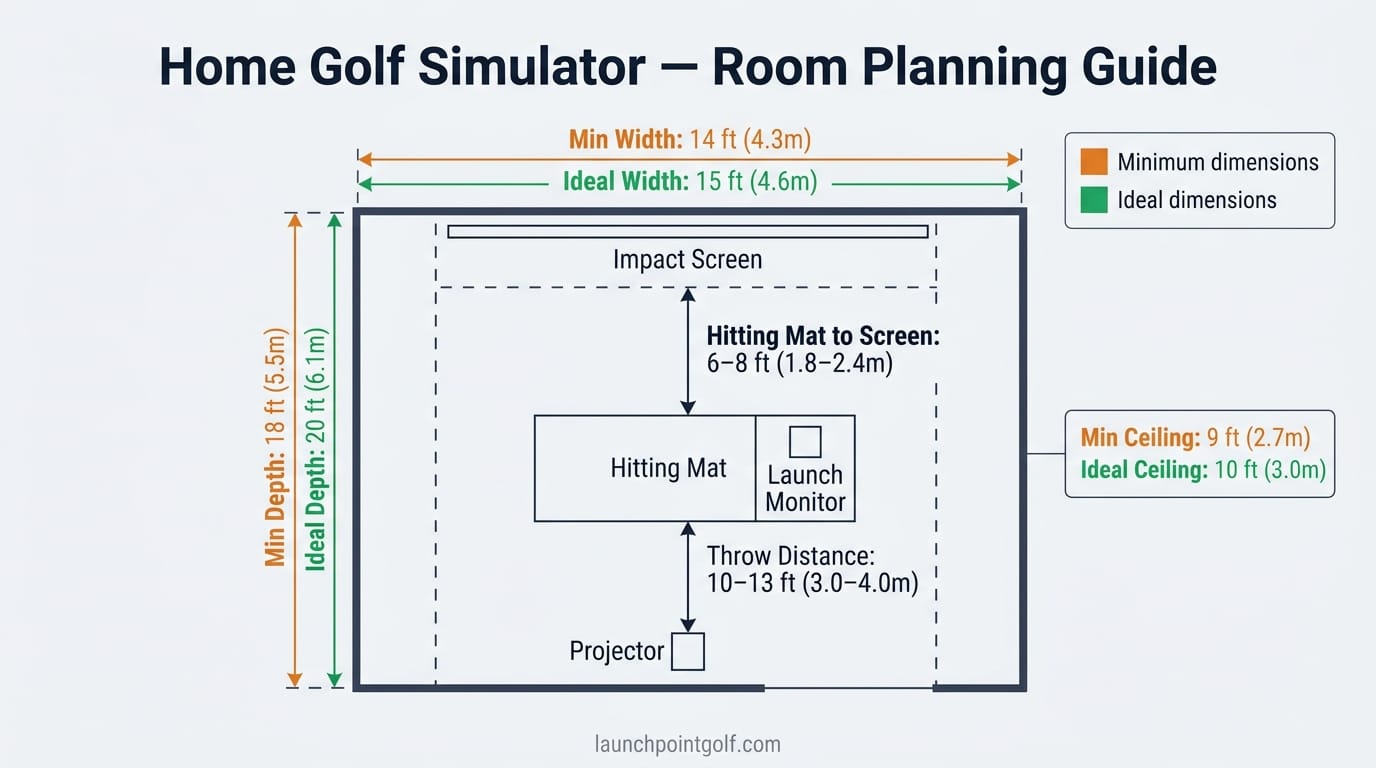
Home Golf Simulator Room: Minimum and Ideal Dimensions (launchpointgolf.com)
Room Dimensions: Measure Twice, Buy Once
The minimum workable room size for a home golf simulator is 10 feet wide, 15 feet deep, and 8.5 to 9 feet of ceiling height (about 3 by 4.6 by 2.6 to 2.7 meters), per Carl's Place. The recommended target is more spacious: 14 to 15 feet wide, 18 feet deep, with a 10 foot ceiling (about 4.3 to 4.6 by 5.5 by 3 meters), per Trackman and Carl's Place. Some setups go even larger, up to 15 feet wide and 20 feet deep with the same 10 foot ceiling, though that's beyond what the recommended target requires.
Ceiling height kills more simulator projects than budget does. At 9 feet (2.7m), most golfers can swing a 7-iron without issue. But if you're over 6'1" (1.85m) or have a steep, upright swing plane, you'll want 10 to 11 feet (3.0 to 3.4m) of clearance. Several independent builders recommend this range for taller golfers. The problem is that standard basement ceilings sit at 8 feet (2.4m). If that's your space, you're looking at either a costly ceiling raise or accepting that driver swings will feel restricted.
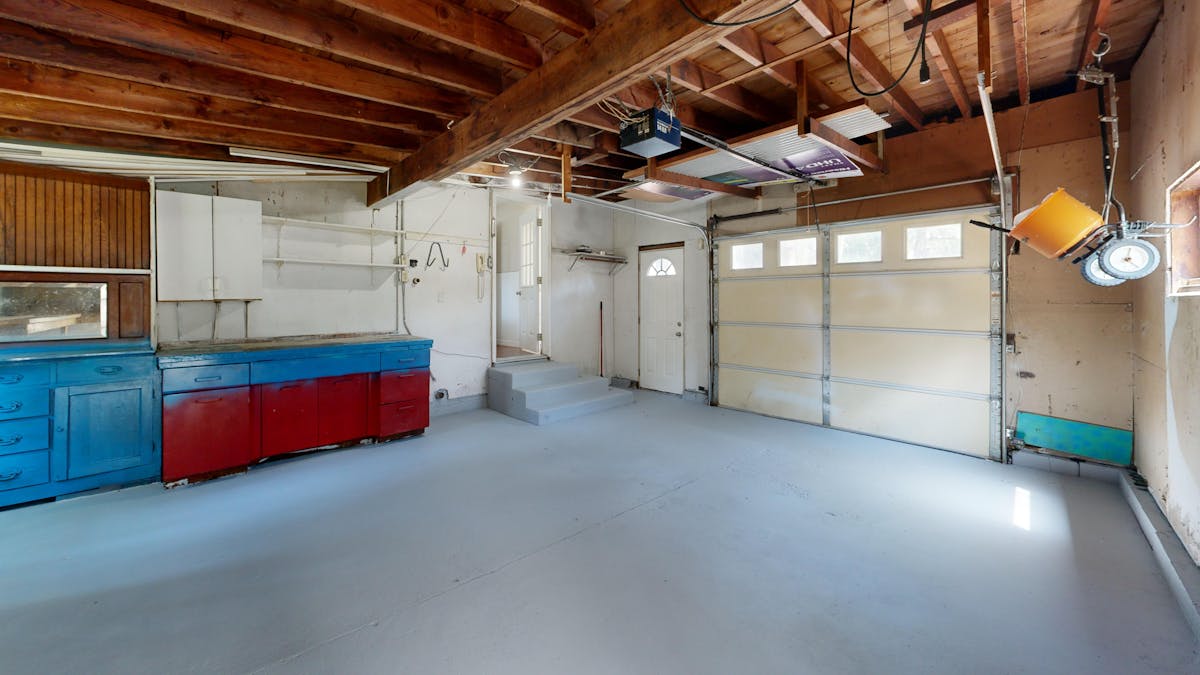
Garages are the most popular conversion space because they already have the depth and width. A standard two-car garage runs roughly 20 feet (6.1m) wide by 20 feet (6.1m) deep, which is generous. Ceiling height varies, so measure from the finished floor to the lowest obstruction (garage door track, light fixtures, ductwork) rather than the ceiling itself.
Width matters more than people think. At 14 feet (4.3m), you've got room for the screen, enclosure frame, and a narrow side gap. Go to 15 feet (4.6m) or wider and you can add a side net for shanked shots, plus space to stand beside a mate watching your session. Depth dictates projector placement. Most short-throw projectors need 10 to 13 feet (3.0 to 4.0m) of throw distance, and you need 6 to 8 feet (1.8 to 2.4m) behind the hitting mat for your stance and the launch monitor's capture zone.
Component Cost Breakdown
Every component below is priced at the range you'll find across major retailers and direct manufacturers in 2026. Sources include Optishot, Carl's Place, GolfJoy, and Rain or Shine Golf.
Component
Low End
High End
Notes
Launch monitor
$300
$20,000
Single biggest cost variable. $300 gets a Swing Caddie SC200+. $20K gets a Foresight QuadMAX. The sweet spot is $2,000-$7,000.
Hitting mat and net
$300
$1,000
Don't cheap out on the mat. Thin mats cause wrist and elbow strain over hundreds of sessions. Country Club Elite and FiberBuilt are the go-to names.
Screen and enclosure
$700
$5,000
Carl's Place is the default recommendation for most builders. The DIY route saves $1K-$2K but takes a full weekend.
Projector
$400
$2,000
Short-throw is non-negotiable for most rooms. Budget $800-$1,200 for a projector that won't wash out in ambient light.
PC and software
$800
$5,000
Some launch monitors (Garmin R50, SkyTrak) don't need a PC. If you go PC-based, $1,500 gets you a rig that runs GSPro at solid frame rates.
Electrical work
$200
$1,000+
New dedicated circuit, dimmer lighting, possible HVAC adjustments. Get an electrician quote before you buy anything.
Total component cost before ongoing expenses: $2,700-$34,000. That range is deliberately wide because the launch monitor choice alone accounts for most of the variance. The three budget tiers below narrow it to realistic all-in numbers.
The Hidden Costs Nobody Mentions Until After You've Bought
This is where most simulator budget guides fail you. They list the hardware, total it up, and call it done. Here's what they leave out.
Consumable golf balls are the biggest ongoing expense and the one that catches new simulator owners off guard. If your launch monitor uses radar tracking (Garmin R50, SkyTrak, FlightScope Mevo+), you need balls with metallic dots for accurate spin readings. Titleist RCT balls run $35-$55 per dozen. Callaway RPT balls sit in the same range. For a golfer hitting 100-200 balls per week indoors, that's $200-$400 per year in ball costs alone.
Overhead camera-based units like the Uneekor EYE XR sidestep this entirely. They track any standard golf ball without modifications, saving you $200-$400 annually. Over three years, that's $600-$1,200 back in your pocket. Factor that into the total cost of ownership when you're comparing launch monitors.
Software subscriptions add up. GSPro is a one-time $250 purchase (one of the reasons it's popular). E6 Connect charges $300 per year. TGC 2019 is a one-time buy. Know which model your launch monitor supports before committing, because switching later means re-buying.
Turf mat replacement runs $150-$300 every two to three years for heavy users. The hitting zone compresses and hardens. Worn mats change the feel of your strikes and can contribute to joint fatigue.
Annual maintenance total: $350-$750 per year when you add balls, software renewals, and mat wear together. Over five years, that's $1,750-$3,750 on top of your initial hardware investment.
Budget Tier 1: Get in the Game ($2,000-$5,000)
This tier is for golfers who want real data and a hitting bay without draining the savings account. You're making tradeoffs on screen quality and enclosure aesthetics, not on the accuracy of your practice.
Enclosure and screen ($500-$1,200): A basic net-and-screen combo from Carl's Place or a DIY frame with impact screen fabric. It won't look like a commercial sim bay, but it stops golf balls and displays your shot shape.
Projector ($400-$700): A budget short-throw projector. Expect some washout in bright rooms, but it's functional.
Software ($0-$250): GSPro ($250 one-time) or TGC 2019. Some launch monitors include basic software free.
Mat ($150-$300): Mid-range hitting mat. Spend at least $150 here. Your wrists will thank you.
All-in realistic range: $2,000-$5,000. This gets you a functional simulator that delivers real data. You'll outgrow the screen and enclosure before the launch monitor, which means upgrading later doesn't require starting from scratch.
Budget Tier 2: Serious Practice ($5,000-$10,000)
This is the tier where most golfers land after doing their research. The data is accurate enough to trust for club fitting decisions, and the visual experience is good enough that you'll actually want to play 18 holes on a Tuesday evening.
Enclosure and screen ($1,000-$2,500): Carl's Place Pro or similar mid-tier enclosure with a quality impact screen. These look clean, install in a few hours, and handle full driver speed without issue.
Projector ($800-$1,500): A proper short-throw unit with enough lumens to look sharp even with some ambient light. BenQ and Optoma dominate this tier.
PC ($1,000-$2,000): If you go with the R50, you might skip this for basic sessions. For GSPro or E6 Connect with full graphics, budget $1,500 for a PC that runs everything smoothly.
Software ($250-$300): GSPro for the one-time purchase, or E6 Connect if you prefer the course library and don't mind the annual fee. I've compared all three in my GSPro vs E6 Connect vs TGC 2019 breakdown if you're weighing them up.
Mat ($200-$500): FiberBuilt or Country Club Elite. These last and they feel right underfoot.
Electrical ($200-$500): Dedicated circuit for projector and PC, plus lighting adjustments.
All-in realistic range: $5,000-$10,000, or $7,000-$10,000 if you go with Garmin's bundled SimStudio package. You're getting data you can trust, a visual experience that's genuinely enjoyable, and a setup that'll last five-plus years with only consumable replacements. For most golfers, the jump from Tier 1 to Tier 2 is worth every dollar. The jump from Tier 2 to Tier 3 is harder to justify unless you really want overhead mounting.
Budget Tier 3: No Compromises ($10,000-$25,000)
This is where you're building something that rivals a commercial sim studio. The main advantage here isn't just better data. It's overhead launch monitor technology, which changes the physical setup in ways that matter day-to-day.
The overhead mounting is the real selling point. No floor unit to trip over. No repositioning between players. A cleaner, more professional-looking room.
Enclosure and screen ($2,000-$5,000): Premium impact screen with a professional-grade frame. Some golfers at this tier go with a curved screen for a wider field of view.
Projector ($1,200-$2,000): High-lumen short-throw with native 1080p or 4K resolution. At this budget, the visual experience should be immersive.
PC ($2,000-$3,500): High-spec gaming PC. Run GSPro or E6 Connect at maximum settings without frame drops. Budget for a quality graphics card (RTX 4070 or better in 2026).
Software ($250-$300): Same options as Tier 2. GSPro remains the best one-time-purchase option.
Mat, electrical, and finishing ($500-$1,500): Premium mat, dedicated circuit, acoustic treatment if needed, and cosmetic touches (paint, flooring, lighting) that make the room feel intentional rather than improvised.
All-in realistic range: $10,000-$25,000. The diminishing returns above $10,000 are real, but so is the quality-of-life improvement from an overhead unit and a polished room. If you're building a space you'll use four to five times per week for the next decade, the per-session cost is lower than a round at most decent courses.
Budget Tier 4: Pro-Level ($25,000+)
This tier exists for golfers building toward coaching, club fitting, or a small commercial bay, not for weekend practice. The gear here is priced and built for professional use, and most home golfers won't recoup the difference in day-to-day play quality.
Enclosure, screen, and room finishing ($3,000-$6,000+): At this tier, most builders bring in a commercial installer rather than DIY-ing the enclosure, which adds labor cost but removes the compatibility guesswork.
All-in realistic range: $25,000 and up. If you're weighing this tier against Tier 3, the honest answer is that the jump buys you professional-grade data resolution and brand recognition, not a materially better recreational experience. Buy here because you need the credentialing or the data depth for client work, not because you assume more expensive means more fun.
Buying matched or bundled components, rather than piecing together a launch monitor, enclosure, screen, projector, and mat from six different sources, sidesteps most compatibility headaches. Matching a projector's throw ratio to your screen size and enclosure depth isn't difficult, but getting it wrong means returning parts and waiting on replacements, so a bundle from a reputable simulator retailer is worth considering if you'd rather not work that out yourself.
Building or buying a home golf simulator? I put the research most buyers do the hard way into one place. The Home Golf Simulator Handbook walks through picking the right launch monitor, fitting the setup to your actual space, and building a practice plan that pays off, without the brand loyalties or affiliate pressure that shape most buying advice.
Frequently Asked Questions
How much does a home golf simulator cost?
A complete home golf simulator costs between $2,000 and $25,000 or more, depending on your launch monitor choice and room setup. A functional entry-level setup with a quality launch monitor, basic enclosure, projector, and software runs $2,000-$5,000. The sweet spot for most serious golfers is $5,000-$10,000, which gets you accurate data and an enjoyable visual experience. Premium setups with overhead launch monitors like the Uneekor EYE XR range from $10,000-$25,000. Golfers building toward coaching or fitting work spend $25,000 and up on studio-grade monitors like Trackman 4 or Foresight GCQuad. Add $350-$750 per year for consumable balls, software renewals, and mat replacement.
What room dimensions do I need for a golf simulator?
The minimum workable room size is 10 feet wide, 15 feet deep, and 8.5 to 9 feet of ceiling height (about 3 by 4.6 by 2.6 to 2.7 meters), per Carl's Place. The recommended target is 14 to 15 feet wide, 18 feet deep, with a 10 foot ceiling (about 4.3 to 4.6 by 5.5 by 3 meters), per Trackman and Carl's Place. Some setups go larger still, up to 15 feet wide and 20 feet deep with the same 10 foot ceiling, though that's beyond what the recommended target requires. Ceiling height is the most common limiting factor. Standard 8-foot (2.4m) basement ceilings won't work for full driver swings. Golfers over 6'1" (1.85m) or with upright swing planes should aim for 10 to 11 feet (3.0 to 3.4m) of clearance.
Do I need special golf balls for a simulator?
It depends on your launch monitor type. Radar-based units (Garmin R50, SkyTrak, FlightScope Mevo+) need metallic-dotted balls like Titleist RCT or Callaway RPT ($35-$55 per dozen) for accurate spin readings. Camera-based overhead units like the Uneekor EYE XR track any standard golf ball without modifications. This is a meaningful ongoing cost difference: $200-$400 per year for radar users versus $0 for overhead camera users.
Is a garage or basement better for a golf simulator?
Garages are the most popular conversion space because they typically offer the right depth (20 feet / 6.1m) and width (20 feet / 6.1m for a two-car garage) with fewer ceiling height issues than basements. Basements work well if the ceiling clears 9 feet (2.7m) to the lowest obstruction (ductwork, lights, beams). The main basement advantage is climate control; garages may need heating or cooling depending on your region. Measure from the floor to the lowest obstruction in either space, not to the ceiling itself.
Can I build a golf simulator for under $5,000?
Yes. A $2,000-$5,000 budget gets you a functional simulator with a quality launch monitor (MLM2PRO or Square Golf), basic enclosure, mid-range projector, hitting mat, and software like GSPro. You'll make tradeoffs on screen quality and room aesthetics, not on data accuracy. The launch monitor is the one component worth spending on even at this tier, because it's the piece you'll keep when you upgrade the rest later.
One Number, One Conversation
The real cost of a home golf simulator isn't the launch monitor or the screen. It's the total: hardware, room prep, and the ongoing consumables that nobody mentions in the headline figure. For most golfers, the realistic all-in sits between $5,000 and $10,000 for a setup that delivers accurate data and a visual experience worth using daily. Below $2,000, the compromises start affecting practice quality. Above $10,000, you're mostly paying for overhead mounting, polish, and convenience rather than better data, and above $25,000 you're buying studio-grade gear built for coaches and fitters, not weekend golfers.
Start with the room. Measure the ceiling. If it clears 9 feet (2.7m), you've got a project. If it doesn't, that's $5,000-$15,000 you just saved yourself from spending on gear that'll frustrate you every time you pull driver.
Once the room checks out, the complete guide to home golf simulators walks through launch monitor selection, software licensing, and full three-year cost breakdowns for each budget tier.
Some links in this article are affiliate links. If you buy through them, I earn a small commission at no extra cost to you. This never influences what I cover or recommend. I link to gear I'd buy myself.
The golf newsletter that cuts the hype
Data-backed reviews and advice that works. No brand spin.
Recommended products
James WhitfieldGolf writer
James Whitfield plays off a 7 handicap in the Pacific Northwest. A former tech pro, he reads what independent tests show, cross-references owner reports, and turns the evidence into buying advice. He's happier with a spec sheet than a putt.
A cold-weather golf layering system for 2026: a budget base layer, a lead mid-layer pick with two alternatives, thermal trousers, and a beanie, picked for warmth without losing swing freedom.
Chandler Blanchet, a PGA Tour rookie, leads the Bermuda Championship solo at 9 under (62) after the first round, one shot clear of a group of four at Port Royal.