






guides
Best Golf Gifts Under $50 (2026): 6 Practical Picks
Buying for a golfer under a set budget usually means a box of balls they'll lose

A rain jacket alone doesn't solve a wet round. This is the full kit, one lead pick per category, assembled from what independent reviews and manufacturer specs actually say rather than guessed at.
Most sites cover wet-weather gear one item at a time: a jacket review here, a glove review there. Almost none of them put the categories side by side and say which one to buy first. This guide does that: six categories, one lead pick and one backup per category where a backup makes sense, and a quick comparison table if you just want the buy links. For the technique side, how a wet ball actually flies and when to call a round, see How to Play Golf in the Rain. This piece is about what goes in the bag before you get there.
| Category | Lead pick | Best for | Buy link |
|---|---|---|---|
| Jacket | adidas Rain.RDY | Light-to-moderate rain, quiet swing feel | Amazon |
| Trousers | UA Stormproof Cloudstrike | Highest-rated waterproofing, best for frequent wet-round play | Amazon |
| Gloves | FootJoy WeatherSof | Most wet rounds, all-around durability | Amazon |
| Umbrella | G4Free 54-inch (137cm) Vented | Wind-heavy conditions, covers bag too | Amazon |
| Mid-layer | Callaway Weather Series 1/4-Zip | Cool, dry rounds and sun protection | Amazon |
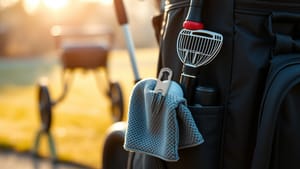
| Towel | Frogger Amphibian 2-in-1 | Keeping club-cleaning and hand-drying separate | Amazon |
The Rain.RDY uses a durable water-repellent (DWR) coating rather than a fully sealed membrane, which is worth stating plainly before anything else: it handles light-to-moderate rain well, beading water off the surface and staying dry to the touch, but a sustained heavy downpour can eventually get through at the zippers and high-contact points. What it does particularly well is the part spec sheets rarely mention: independent reviewers consistently describe the outer fabric as quiet, with no crinkle or swish during the swing, and it folds into its own side pocket for bag-carry convenience.
For golfers who need a fully sealed shell instead, the Callaway Swing Tech Stormguard is the backup pick: seam-sealed and waterproof rather than water-resistant, with a stretch back panel and underarm vents built specifically so a fully waterproof jacket doesn't restrict the swing or trap heat.
Full breakdown, including sizing and the hood-versus-no-hood decision: adidas Rain.RDY Golf Jacket Review.
adidas Rain.RDY on Amazon | Callaway Swing Tech Stormguard on Amazon
The Stormproof Cloudstrike carries a 10,000mm hydrostatic rating on a 2.5-layer bonded fabric, confirmed across four sources, including Under Armour's own spec, with calf zips and a snap cuff for pulling the pants on or off over cleats without removing your shoes. Golf.com named it "Best Value" among 10 rain pants it tested, cheaper than category names like Galvin Green, Sun Mountain, Nike, and Peter Millar in the same lineup.
The backup pick, adidas RAIN.RDY Pants, is also fully waterproof, a 3-layer construction in 100% recycled polyester interlock, and leans on a quieter fabric feel and a "Best sustainability" ranking from Golfmagic. Breathability is the real tradeoff between the two: independent coverage is split, with Stormproof reported as "extremely breathable" by Golf Monthly and warm-running by Today's Golfer. For golfers who play 20 or more wet rounds a year, Stormproof's wider independent confirmation on waterproofing makes it the stronger long-term pick between the two. Full side-by-side, including a spec table and Amazon rating comparison: adidas Rain.RDY vs. UA Stormproof: Golf Rain Pants Compared.
UA Stormproof Cloudstrike on Amazon | adidas RAIN.RDY Pants on Amazon
The WeatherSof isn't a dedicated rain glove; it's a synthetic all-weather glove that happens to hold up better than leather once conditions turn wet or humid, which is why it's the right default for most golfers most of the time rather than a specialist pick. It resists the stretch and sag a leather glove develops in sustained moisture, and it's available across a wide size run including cadet sizing.
Where the WeatherSof reaches its limit is sustained heavy rain, not drizzle or a damp morning. That's the gap the FootJoy RainGrip fills: an autosuede palm engineered to grip better when wet rather than merely resist water, paired with a DrySof lining that wicks moisture off the skin instead of trapping it against it. Rotating two gloves through a round, one in play and one drying, matters more than which single glove you own. Full review of the WeatherSof: FootJoy WeatherSof Golf Glove Review.
FootJoy WeatherSof on Amazon | FootJoy RainGrip on Amazon
A standard single-canopy umbrella catches wind like a sail, which is exactly the failure mode a golf round exposes you to on an open course with little shelter. The G4Free's vented double-canopy design lets gusts pass through the top layer instead of inverting the frame, and the 54-inch (137cm) canopy is sized deliberately larger than a standard umbrella to cover both a player and a golf bag rather than one person standing still.
There's no backup pick in this category for a simple reason: the vented double-canopy design is the feature that matters, not the brand behind it, and this listing covers the spec without a meaningful step up available at a comparable size.
G4Free 54" Vented Umbrella on Amazon
This is the category most golfers get wrong on the rack, buying a mid-layer for warmth and ending up sweating through the back nine. The Weather Series pullover is built around the opposite job: a 90% polyester, 10% spandex stretch blend with confirmed Opti-Dri moisture-wicking, not Callaway's separate Opti-Therm warmth technology. UPF50 sun protection is the genuine standout spec, uncommon at this price tier and worth having on any course with exposed fairways.
It isn't a substitute for a waterproof shell and isn't marketed as one. The honest way to think about it: this covers cool-but-dry rounds and sun exposure, the jacket above covers rain and wind, and the two work as a layering system rather than either one trying to do the other's job. Full review, including sizing and care: Callaway Weather Series 1/4-Zip Pullover Review.
Callaway Weather Series Pullover on Amazon
This is a new category for the site, and it's also the item on this list I'm most likely to talk myself out of buying, right up until I'm using the one dry towel I packed to wipe mud off a clubface and then wondering why my grip feels tacky ten minutes later. A single towel forces a choice between cleaning gear and drying hands, and in a wet round you need both, separately, more often than you'd think.
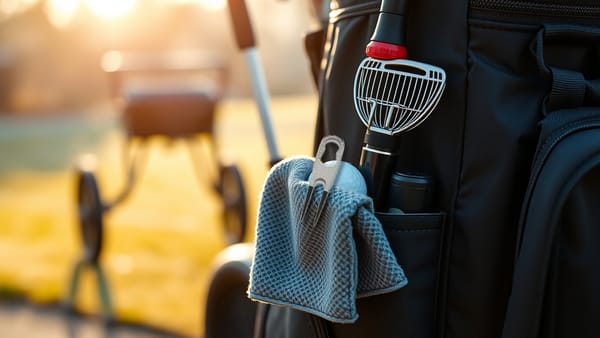
The Frogger Amphibian's maker-stated design splits the two jobs onto opposite sides of the same towel: a "wet" side built to scrub mud and grass off a clubface, and a "dry" side kept for hands and grips. A carabiner clip keeps it attached to the bag rather than getting left in the cart. No independent publication has run a dedicated test of this specific towel yet, so treat the two-sided design as a maker claim rather than a lab-verified one; the underlying idea, keeping your club-cleaning towel and your hand-drying towel physically separate, holds up regardless of which specific towel delivers it.
Frogger Amphibian 2-in-1 on Amazon
A golf-specific jacket earns its price on three points a general raincoat usually skips: stretch panels at the shoulders so a waterproof shell doesn't restrict your swing, a quiet outer fabric that doesn't crinkle or swish during the backswing, and a fit cut to layer over a golf shirt without bunching. A generic raincoat will keep you dry standing still. It's more likely to fight you at the top of the backswing and announce itself acoustically on every shot.
Water-resistant gear uses a durable water-repellent (DWR) coating on the outer fabric, which sheds light to moderate rain well but can let moisture through at seams and contact points in a sustained downpour. Waterproof gear uses a sealed, seam-taped membrane rated by hydrostatic head in millimeters, with 10,000mm generally considered the threshold for genuinely rainproof performance. Check which claim a product actually makes before buying for a specific climate; the two terms aren't interchangeable, and manufacturers are usually precise about which one applies.
Rotate two gloves through a round, drying whichever one isn't in play, and dry your grip with a towel before every swing rather than only when it feels obviously wet. For light-to-moderate rain, a water-resistant glove with treated leather or synthetic material holds up fine. For sustained heavy rain, a dedicated rain glove with an autosuede palm, designed to grip better when wet rather than just resist water, performs noticeably better than a standard glove pushed past its limit.
A standard umbrella can invert or fail in the wind speeds a round of golf actually exposes you to, since most courses offer little shelter. A vented double-canopy golf umbrella lets gusts pass through the top layer instead of catching it like a sail, and quality models are commonly rated to handle wind gusts well above what a single-canopy umbrella survives. The larger canopy size on golf umbrellas also matters, since it needs to cover both a player and a golf bag, not just one person.
Yes, for a different problem. A waterproof jacket handles rain and wind; it isn't built for temperature regulation. A wicking, stretch mid-layer worn underneath solves the cool-but-dry rounds a rain shell alone doesn't address well, and it also gives you a layering option once the jacket comes off later in the round. Buying them as a system, rather than expecting one item to cover both jobs, is the more honest way to plan a wet-season kit.
Some links in this article are affiliate links. If you buy through them, I earn a small commission at no extra cost to you. This never influences what I cover or recommend. I link to gear I'd buy myself.
Data-backed reviews and advice that works. No brand spin.