
 Buy now









how-to
How to Build a Consistent Putting Stroke
A consistent putting stroke isn't one specific technique. It's a setup, grip, path, and
Rain doesn't end a round, it changes the equation. This is the system: what to pack, how to keep your grips dry, what a wet ball actually does, and when the smart move is to call it.
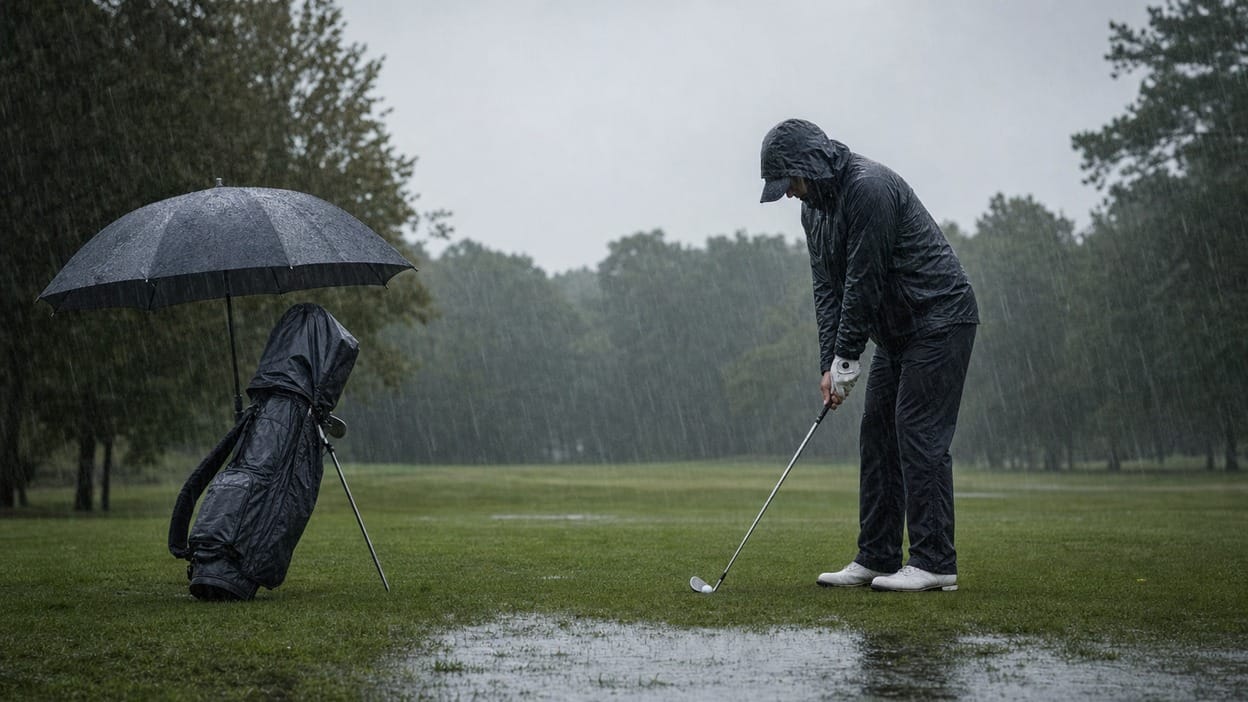
Rain doesn't end a round. It changes the equation, and most golfers never adjust for it; they just play their dry-day game slower and wetter. The ball flies differently, the greens run differently, your grip fails before your swing does, and the gear that helps isn't complicated or expensive. This is the system: what to pack, how to keep your hands working, what actually happens to a wet ball on wet turf, how to reset your scoring math, and when the smart move is to pick up and go home.
The round is decided in your car, or on your porch, before you tee off. Most bad wet-weather rounds trace back to one missing item in the bag, not a swing flaw.
The non-negotiables: two or three gloves (one wet glove is worse than no glove), a dry towel you can clip to your bag and keep out of the rain, a waterproof top layer, and a golf umbrella built to hold up in wind, not just shed water. Vented double-canopy umbrellas matter here because a single-canopy umbrella catches wind like a sail; the vent lets gusts pass through the top layer instead of inverting the frame. A quality double-canopy stick umbrella, like the G4Free 54-inch (137cm) vented model, is commonly rated to handle wind gusts in the 55 to 75 mph (89 to 121km/h) range without flipping, which covers the kind of squally weather that actually ruins a wet round, not just steady drizzle.
Buy nowBeyond the umbrella, think in terms of a dry system, not a single item. A rain hood for your bag keeps your grips dry between shots even before you touch them. A second glove lives in a sealed pocket, not loose in your bag, so it's still dry when glove one gives out. And pack more towels than feels necessary, one clipped outside for wiping the club and ball, one kept dry inside your bag for your hands.
Everything in this piece is downstream of one problem: wet grips mean mishits, and mishits compound every other issue rain creates. If your hands and grips stay dry, a wet round is just a slower, more deliberate version of a dry one. If they don't, nothing else on this list matters much.
The technique is simple and most golfers skip it: dry your hands and grip with a towel before every single swing, not just when they feel obviously wet. A grip that looks dry can still have a thin film of moisture that costs you control at impact. Keep a towel dry under an umbrella or inside your bag specifically for this, separate from the towel you use on the clubhead and ball.
Gloves matter more in the rain than any other piece of equipment, and not all rain gloves solve the same problem. FootJoy's WeatherSof, reviewed separately here, uses a water-resistant treated leather that genuinely outperforms untreated leather in light-to-moderate rain and holds up well through a damp round, but it isn't built for sustained heavy rain; water eventually gets through. For a properly wet day, a dedicated rain glove like the FootJoy RainGrip pair is the better call: its autosuede palm is designed to grip better when wet, the fibers stand up and bite into the club rather than sliding, and a DrySof lining wicks moisture off your skin instead of trapping it. Rotate two gloves through a round, drying whichever one isn't in play, and you'll rarely lose grip, though I'll admit my own instinct is still to reach for the second glove before I reach for the towel, even though the sequence that actually keeps you dry longest runs the other way around.
Buy nowYou don't need to replace your whole kit to play comfortably in the rain, but three items do most of the work: a jacket that's actually waterproof (not just water-resistant), an umbrella that survives wind, and shoes that keep your feet dry for a full 18.
On jackets, the spec that matters is the waterproof rating, measured in millimeters via a hydrostatic head test: 10,000mm is generally considered the minimum to call a garment genuinely rainproof, and golf-specific jackets often run higher. The Callaway Swing Tech Stormguard jacket is fully seam-sealed and waterproof rather than merely water-resistant, with a SwingTech back panel and stretch shoulder seams built specifically so a waterproof shell doesn't restrict your swing, plus underarm vents so you're not trading dry shoulders for a soaked base layer. If you want a second opinion on where it sits against competitors, the adidas Rain.RDY jacket review covers a DWR-coated alternative that performs well in light-to-moderate rain but can let water through at the seams in a genuine downpour, useful context if you're deciding how much jacket you actually need.
Buy nowFor your feet, waterproof golf shoes are worth the switch the moment you're playing in standing water or heavy morning dew. The Skechers Tempo Spikeless Waterproof shoe pairs a waterproof upper with a GOGA MAX insole and a spikeless GRIPFLEX outsole, so you're not sacrificing traction on wet cart paths and slick turf to get dry feet.
Buy nowThis is the part most golfers get wrong: they keep swinging like it's a dry day and wonder why the ball comes up short. It isn't your swing. It's physics.
A wet ball behaves differently at impact because water on the clubface and the ball's surface reduces friction, which lowers spin and raises launch angle at the same time, a combination that costs you carry distance. Golf.com's testing with Golf Top 100 Teacher Cameron McCormick (June 2024) used Trackman data to compare a wet and dry 110-yard (101m) sand wedge shot: the wet ball launched at 32 degrees with 7,162 rpm of spin and carried 103 yards (94m), against a dry launch of 26 degrees, 10,430 rpm, and the full 110 yards (101m). That's roughly a 7-yard (6m) gap on a single wedge shot, purely from moisture. Ping's vice president of fitting and performance told Golf.com's Jonathan Wall (September 2021) that some ball models can drop from 10,000 rpm to 5,000 rpm with just a light mist on the cover, while others lose far less, so the effect varies by ball, but it never goes to zero.
The ground changes too. Wet fairways kill roll almost entirely, so the carry number is close to the total distance. Plan your club selection around carry, not your usual total yardage. Wet greens run one to three feet (0.3 to 0.9m) slower on the Stimpmeter than dry ones, because the extra moisture adds friction between the ball and the grass, so putts you'd normally trust to run out will die short. And if your ball plugs in its own pitch mark in the general area, Rule 16.3 gives you free relief, drop within one club-length, no nearer the hole, no penalty. Don't play a half-buried ball out of stubbornness when the rules already solve the problem for you.
Once you accept that a wet ball flies shorter and spins less, the scoring math changes with it, and fighting that math is where most wet-round bad scores come from.
Club up. If a shot normally plays a 7-iron, take one more club in steady rain; the reduced spin and added launch mean you're not getting the same distance out of the same swing, and an extra club typically covers the 10 to 15 yards (9 to 14m) you're losing to moisture rather than asking for a harder swing that just adds more mishit risk on a slick grip. Aim for the fat part of the green rather than tucking a shot within 10 feet (3m) of a pin cut near a bunker or water hazard; reduced spin means less stopping power, so a shot that would normally check up near a tight pin can release further than expected. On and around the green, expect the ball to release more on chips and less on putts, so read greens for extra roll on chip shots and extra weight on putts.
Take relief when it's available rather than playing from mud. Rule 16.1 covers abnormal course conditions, including temporary water, so if your ball sits in a puddle or standing water deep enough to affect your stance or swing, you're entitled to a drop. Use it. Many committees also adopt a preferred-lies local rule in genuinely soggy conditions, letting you lift, clean, and place your ball in the general area; check the local rules sheet before you tee off on a wet day rather than assuming it applies. And mentally reset your target score. A wet course plays longer and putts slower than the card suggests, so chasing your usual number is how a manageable round turns into a frustrating one.
If wind is part of the equation too, not just rain, the adjustments stack: our how-to on playing golf in the wind covers the setup and ball-flight changes for that side of it specifically.
Most wet rounds are worth finishing. Some aren't, and knowing the difference matters more than any swing tip in this piece.
Lightning is the one non-negotiable. The 30-30 rule, the standard the USGA points to for outdoor safety, is simple: if you count 30 seconds or less between seeing lightning and hearing thunder, the storm is within 6 miles (10km); stop immediately and get to shelter. Stay there until 30 minutes have passed since the last lightning or thunder. No shot, no score, and no group's schedule is worth waiting that one out on an open fairway holding a metal club.
Short of lightning, it's a judgment call. Standing water deep enough to cover your shoe, roughly an inch (2.5cm) or more pooling on fairways and greens, usually means the course is calling a delay anyway, and greens that won't hold a pitch mark aren't fairly playable regardless of the rules. If your grips have gone through every dry towel and glove you packed and you're gripping a wet handle on every swing, that's a fair stopping point too; the safety and the score both go the same direction from there. There's no shame in picking up when the conditions have genuinely stopped being golf.
Yes. Golf.com's Trackman testing with instructor Cameron McCormick found a wet 110-yard (101m) wedge shot carried only 103 yards (94m), with spin dropping from 10,430 rpm dry to 7,162 rpm wet. Ping's VP of fitting and performance has reported some ball models losing half their spin, from around 10,000 rpm to 5,000 rpm, with just light moisture on the cover.
A dry glove and a dry towel beat every other item on this list. A waterproof jacket and a wind-rated umbrella matter, but they're solving comfort, not control. Grip is what actually falls apart first in the rain, so protect that before anything else.
Yes, specifically with lightning nearby. The 30-30 rule the USGA points to says if 30 seconds or less pass between a lightning flash and the thunder, the storm is within 6 miles (10km) and it's time to get off the course and stay off for 30 minutes after the last strike. Heavy standing water on greens and fairways is a playability issue rather than a safety one, but it's still a reasonable point to call the round.
No. A dedicated "wet weather" ball or club isn't necessary for most golfers. What actually helps is technique and gear that keeps your hands and grips dry, plus adjusting your club selection to account for reduced carry. Save any equipment upgrade budget for a genuinely waterproof glove and jacket before considering anything club-specific.
Some links in this article are affiliate links. If you buy through them, I earn a small commission at no extra cost to you. This never influences what I cover or recommend. I link to gear I'd buy myself.
Data-backed reviews and advice that works. No brand spin.