Every golfer eventually stands on a first tee with no idea what's coming: a friend's home course, a bucket-list stop on a trip, a member-guest invite to a club you've only seen in photos. The habits that work on your own course, where the blind spots and the trouble are already memorized, don't transfer. This guide starts once the tee time is already booked (for the booking and budget side, see how to plan a golf trip that's actually worth the money) and covers the scouting routine before the round and the playing plan that protects your score once you're on the course.
A weekend golfer playing a friend's club for one round needs the short version: scout for twenty minutes, pick a sensible tee, and play conservative. An improver wants an actual plan to carry onto the first tee. A serious amateur prepping for a member-guest or a bucket-list course has time to go deeper on the scouting, since one bad number on an unfamiliar hole can cost more than a whole round of steady bogeys. Each step below gives a default for all three.
- Scout before you play: the scorecard numbers, a free hole-by-hole flyover, and a tee pick based on your average drive, not your best one ever.
- Treat the first round at a new course as a data-gathering round, not a scoring opportunity: center of the green, one more club, and the safe side whenever you can't see where the trouble sits.
- No GPS watch or rangefinder is required. A course website's hole maps, a free GPS app's flyover, satellite view, and the pro shop's yardage book cover the same ground.
- A few minutes with the starter or pro shop before you tee off is worth more than a few minutes guessing on the course; spend your warm-up putting time on speed, not on reading lines.
- A short note after the round turns one blind visit into real local knowledge for the next one.
1. Scout the card and the course website
Start with the scorecard, either the physical one at the pro shop or the digital version most clubs post on their own website. You're looking for four things: total yardage from the tees you're likely to play, the course's Slope Rating and Course Rating, the par mix (how many par 3s, 4s, and 5s, and where they fall), and any local rules specific to that club.
Slope Rating and Course Rating aren't the same measurement. Course Rating measures how hard the course plays for a scratch golfer under normal conditions, and Slope Rating measures how much harder the same course plays for a higher-handicap golfer, built from the gap between the course's bogey rating and its scratch rating. The higher the Slope Rating, the bigger that gap, and the more a bad week gets punished relative to what the yardage alone suggests.
If the club sits on linksland rather than parkland turf, read its local rules with that in mind. Wind, firmness, and pot bunkers change the trouble spots in ways a parkland golfer won't expect; see links versus parkland golf for what actually changes underfoot. This is also where a genuine bias is worth admitting: I'd rather trust a course's reputation (a famous name, a glowing review) than its own scorecard, and the scorecard is almost always the more honest source. A course with a modest reputation and a Slope Rating of 138 will play harder than a famous one rated 122.
2. Do a hole-by-hole flyover with free tools
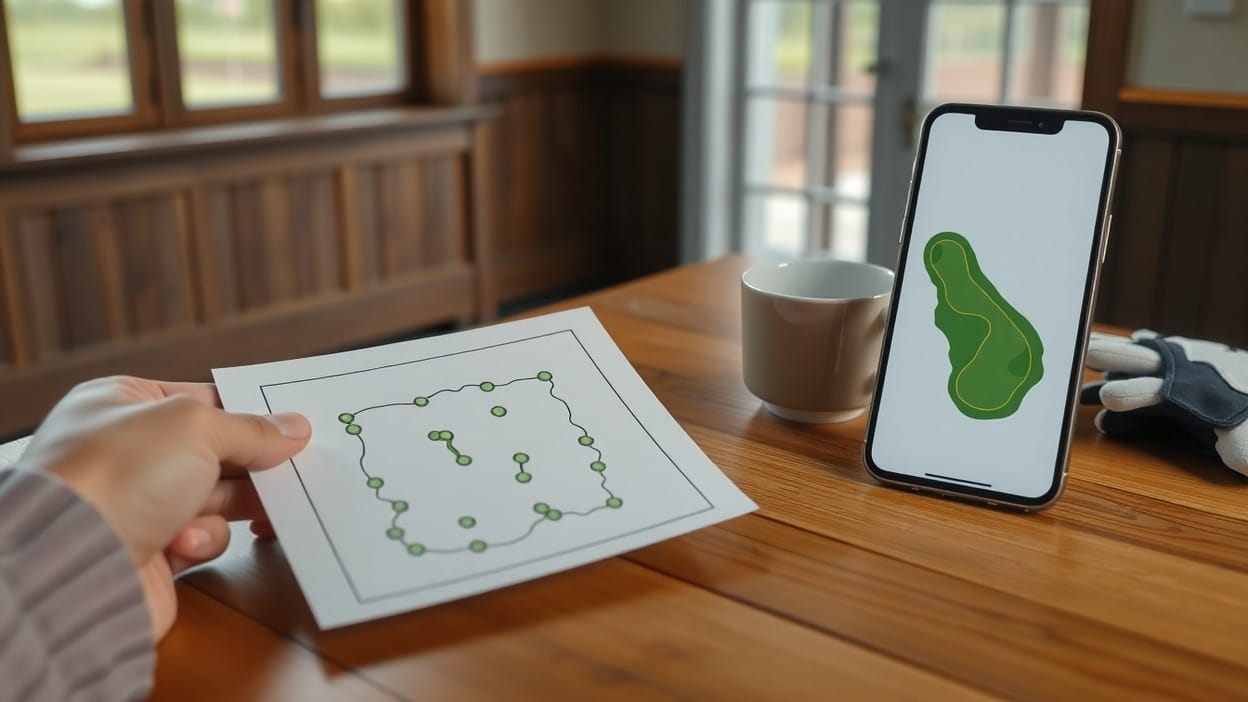
Once you know the numbers, look at the ground. Most clubs post hole-by-hole maps on their own website, often with yardages to greenside bunkers and hazards built in. A free GPS golf app will usually have a satellite or flyover view of the same course even if you've never played it, and a plain satellite-map view works as a last resort. A full GPS watch isn't required for this step; see best golf GPS watch 2026 if you're shopping for one anyway, since course maps and hazard distances come bundled in with most current watches.
Use the flyover to find three things on every hole: forced carries (water or a bunker you must clear, not just avoid), blind shots (where you can't see the landing area from the tee or the green from the fairway), and where the trouble actually sits relative to your real carry numbers, not the scorecard's. A bunker at 230 yards (210m) is irrelevant to a golfer who carries the ball 200 yards (183m) and means nothing to one who carries it 260 yards (238m). Note both on paper or in the app before you arrive.
3. Pick the right tee for a course you don't know
This is the step golfers get wrong most often on a new course, usually by playing the tees they played last time rather than the tees that match this course's actual yardage. The site's tee formula still applies: use your average driving distance over your last five to ten rounds, not your best drive of the year, and multiply it by 28 to get a recommended total course yardage. Full method at which tees should you actually play.
A golfer averaging 224 yards (205m) off the tee lands at a recommended total yardage of about 6,272 yards (5,735m); one averaging 181 yards (166m) lands closer to 5,068 yards (4,634m). On an unfamiliar course, match your number against the total yardage listed for each tee on the scorecard, not the tee's name or color, since "the member tees" or "the blue tees" means something different at every club.
The weekend golfer's default here is simple: when in doubt, play the shorter of two close options. The serious amateur heading into a member-guest should still run the math rather than defaulting to the back tees out of pride; a high-Slope unfamiliar course will expose that decision fast.
4. Use your arrival time well
Golfers who've never played a course often waste their warm-up time on the range and skip the two things that actually help: talking to someone who knows the course, and reading the practice green correctly. Ask the pro shop or the starter about green speed, pace of play that day, and any local quirks (a hole that plays longer than its yardage, a green that's notoriously quick, a shortcut the members use). Staff see every group come through and will usually tell you plainly if you ask.
Then spend your practice-green time on speed, not line. You can't learn a strange green's break in five minutes, but you can learn how fast it's rolling that day, which matters on nearly every putt you'll hit for the next four hours. Save the line-reading for step 6, once you're standing over an actual putt with real stakes.
5. Build a conservative first-round playing plan
Treat your first round at a new course as a data-gathering round rather than a scoring opportunity, and build the plan around three defaults. Aim at the center of the green and take one more club than your stock yardage suggests, because most amateurs miss short, not long; see course management: how to score lower for the full reasoning. Default to driver off the tee unless one of three triggers fires: a hard layup yardage, a forced carry beyond your reach, or a fairway that pinches at your full distance. A blind tee shot on an unfamiliar hole is a reason to check the flyover from step 2 first, not a fourth trigger on its own; see driver versus 3-wood off the tee. And whenever you can't see the landing area or the green, play to the safe side rather than the aggressive line, since you're guessing at trouble you haven't actually scouted.
These same defaults hold whether you're standing on a par 3, 4, or 5 tee; the specifics for each are covered at how to play a par 3, how to play a par 4, and how to play a par 5. The goal on an unfamiliar course is simply to avoid the round-wrecking hole, not to card a great score, so lean on how to avoid big numbers: if you find trouble, take the shot that gets you back into play in one swing rather than a risky recovery toward the green, and set your own par by adding one stroke on every hole where your handicap gives you a stroke.
For the improver, this step is the whole plan: three rules, applied on every hole, regardless of what the course throws at you. For the weekend golfer, it's permission to play safe without feeling like you're giving anything up, since you were never going to card your best score on a course you've never seen anyway.
6. Read unfamiliar greens from the big picture down
A green you've never putted on gives you no muscle memory to lean on, so start wider than usual. Before you even look at the line from your ball to the hole, step back and take in the whole green: where is its highest point, and where is its lowest. Picture where a marble would roll if you set it down in the center. That overall tilt matters more on a strange green than the line right around the cup, since misreading the macro slope is what actually costs strokes, not misreading a two-foot (0.6m) break. The full method, including the fall-line read that comes after the big picture, is at how to read greens like a tour pro.
7. Leave yourself a note for next time
Before you leave the course, or at the latest that evening, write down a handful of specifics while they're still fresh: which holes you'd attack differently next time, where your misses actually went relative to where you aimed, and any local quirk the starter mentioned that turned out to matter. Paper works, a notes app works, and a dedicated golf-trip log works if you're building a habit of playing new courses regularly; the planning framework in Plan a Golf Trip Worth the Money covers that habit in more depth for golfers who travel to play multiple unfamiliar courses a year. A single round of notes won't turn a new course into a home course, but it means your second visit starts from real information instead of the same blind scouting as your first.
Frequently Asked Questions
How long should I spend scouting a course I've never played?
Twenty to thirty minutes is usually enough: ten minutes with the scorecard and local rules, and the rest on a hole-by-hole flyover looking for forced carries, blind shots, and where trouble sits relative to your own carry numbers. A member-guest or bucket-list round is worth a longer look the night before.
What tee should I play on a course I've never seen?
Match your average driving distance over your last five to ten rounds, not your best drive ever, against the total yardage listed for each tee on the scorecard. Multiplying that average by 28 gives a recommended total yardage, which usually points to a shorter tee than pride suggests.
Do I need a rangefinder or GPS watch to play a new course well?
No. A course's own website usually has hole-by-hole maps, a free GPS golf app will show a flyover or satellite view of most courses, and the pro shop can supply a printed yardage book. A GPS watch or rangefinder adds convenience on the course itself, not information you can't get for free beforehand.
What's the single biggest mistake golfers make on an unfamiliar course?
Playing the tees they're used to instead of the tees that match this course's actual yardage and rating, and aiming at pins instead of the center of the green on a course where they don't yet know where the real trouble is hiding.
Some links in this article are affiliate links. If you buy through them, I earn a small commission at no extra cost to you. This never influences what I cover or recommend. I link to gear I'd buy myself.