Best Golf GPS Watch 2026: Ranked by What Matters
Three things separate a good golf GPS watch from an expensive wrist ornament: GPS accuracy to the yard, on-course features that justify the price, and whether the data feeds into something that helps you improve. That's the filter I applied to this roundup.
MyGolfSpy's 2025 GPS device test anchors these recommendations, backed by published accuracy research. Zanetti et al. (International Journal of Golf Science) measured leading GPS tracking devices and found a mean bias of 1 yard or less, with typical error in the 2 to 3 yard range across distance categories. For a 15-handicapper choosing between a 7-iron and an 8-iron, that margin is more than sufficient.
- 1.Best Overall: Garmin Approach S70 (47mm), top MyGolfSpy 2025 score, Virtual Caddie, 20-hour GPS battery, 43,000+ courses. $699.99.
- 2.Best Mid-Range: Garmin Approach S50, PlaysLike Distance, heart rate, AMOLED display. $399.99.
- 3.Best Value: Bushnell iON Elite, slope-compensated yardages, 38,000+ courses, color touchscreen. $219.99.
- 4.Best for Shot Tracking: Shot Scope V5, full strokes gained analysis, no subscription. $249.99.
- 5.Best Budget: Garmin Approach S12, 30-hour GPS battery, 42,000+ courses, simple and reliable. $199.99.
Best overall
Garmin Approach S70
Top score in MyGolfSpy 2025 testing, Virtual Caddie, 20-hour GPS battery
Best mid-range
Garmin Approach S50
PlaysLike Distance and heart rate monitoring at $399.99
Best value
Bushnell iON Elite
Slope-compensated distances for $219.99. No Garmin under $400 includes this
Best for shot data
Shot Scope V5
Full strokes gained tracking with 16 club tags, no subscription ever
Best budget
Garmin Approach S12
30-hour GPS battery, 42,000+ courses, nothing you don't need at $199.99
The Specs That Matter
GPS accuracy across these devices is close enough to be a non-factor in your buying decision. Zanetti et al. confirmed that leading wrist-worn units hold a mean bias at or below 1 yard (0.9m), with error staying inside 2 to 3 yards (1.8 to 2.7m). You won't find a meaningful accuracy gap between a $200 watch and a $700 one for center-green distances.
Battery life is quoted two ways: smartwatch mode and GPS mode. GPS mode is the number you care about. It tells you how many hours the watch can run while tracking your position on the course. A watch with "15 hours GPS battery" will handle 3 to 4 full rounds before needing a charge.
Course map count matters up to a point. Once a device covers 36,000+ courses, every layout you're going to play in the US, UK, Australia, or Canada is loaded. That gap between 36,000 and 43,000? Courses in countries most readers won't visit this year.
Garmin Approach S70: Best Overall
MyGolfSpy awarded the Approach S70 Best Overall in their 2025 GPS device test, giving it a 9.9/10 score. It's the benchmark.
Specs tell most of the story: AMOLED display (the brightest and sharpest in this category), 20-hour GPS battery on the 47mm model, 43,000+ preloaded courses, and Garmin's full suite of golf features including AutoShot distance logging and PlaysLike Distance.
Virtual Caddie is Garmin's AI club recommendation system. It uses the player's shot history and applies real-time adjustments for elevation, wind, and humidity to suggest which club to hit. After 3 to 4 rounds of data, the recommendations start reflecting your game rather than population averages. For a mid-handicapper with a 15 yard (13.7m) gap between clubs, that kind of targeted suggestion has practical value.
PlaysLike Distance accounts for uphill and downhill elevation changes. A 155 yard (141.7m) approach that plays 162 yards (148.1m) uphill is a different club, and this feature shows you the adjusted number without a rangefinder's slope toggle.
Honest weaknesses: $699.99 is a lot for a golf watch. Menu navigation takes a few rounds to learn. AutoShot records shot distances but doesn't give you strokes gained breakdowns, so if you want deep performance analysis, you'll need to export data to Garmin Connect and do the work yourself.
Verdict: Use this if you're a data-oriented golfer who wants the best display in the category and will use Virtual Caddie. Skip it if you want wrist distances and nothing more: the S50 or S44 do that for half the price.
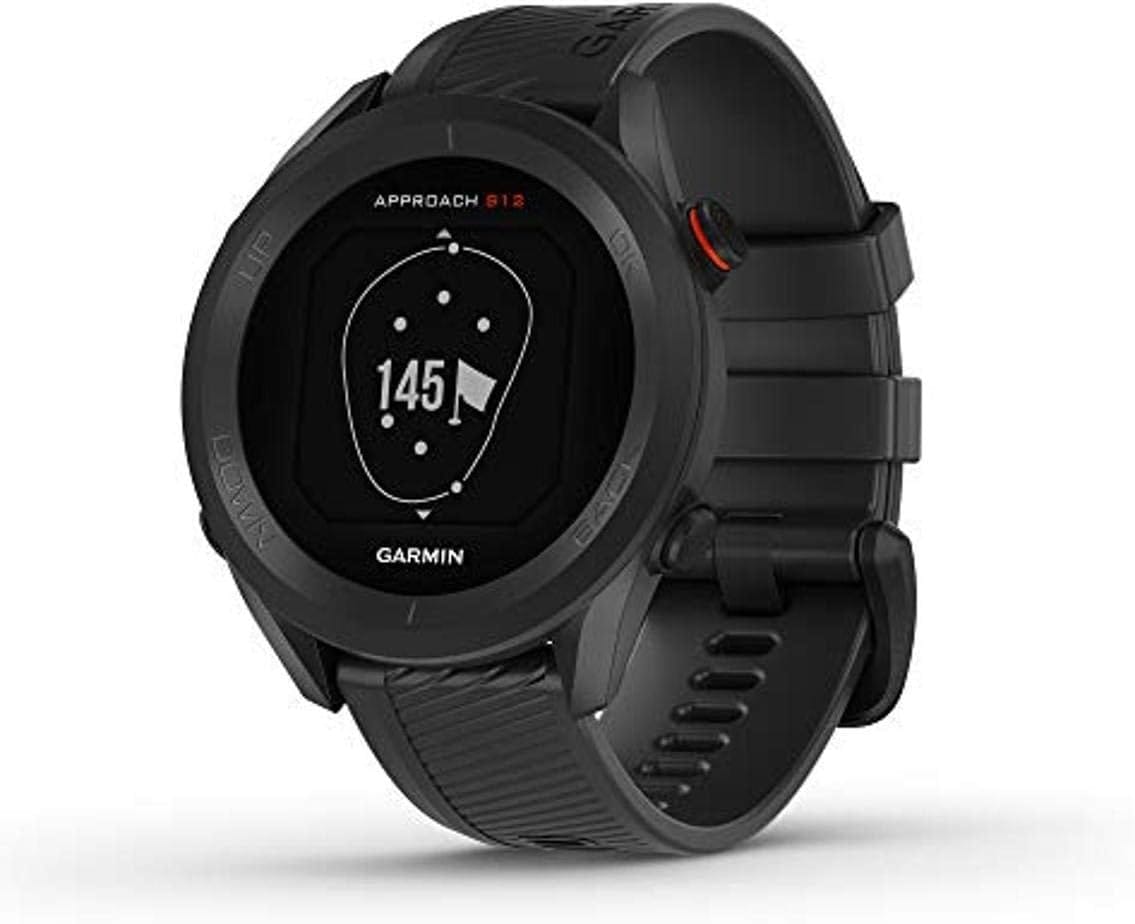
Garmin Approach S70 (47mm)
Best Overall. Top score in MyGolfSpy 2025 testing. 1.4-inch AMOLED, Virtual Caddie, 20-hour GPS battery, 43,000+ courses. No subscription needed.
Check Price on Amazon
Garmin Approach S50: Best Mid-Range
MyGolfSpy's 2025 Runner-Up, and the watch I'd point most mid-handicappers toward.
At $399.99, you get an AMOLED display, 15-hour GPS battery, 43,000+ courses, heart rate monitoring, PlaysLike Distance, and full health and activity tracking. Garmin's S44/S50 launch positioned the S50 as the fitness-meets-golf option, and that positioning is accurate.
What the S50 has over the S44: heart rate monitoring, PlaysLike Distance, and full health tracking. What it lacks compared to the S70: no Virtual Caddie, 5 fewer hours of GPS battery (15 vs 20), and a smaller display.
For a 15-handicapper who plays 50 rounds a year and wears the watch off-course for step tracking and heart rate, the S50 hits the price-to-feature sweet spot. You lose Virtual Caddie, which is the S70's signature feature, but you save $300.
Verdict: Use this if you want the S70 experience without the S70 price tag. PlaysLike Distance and heart rate monitoring at $399 is the sweet spot for most mid-handicappers.
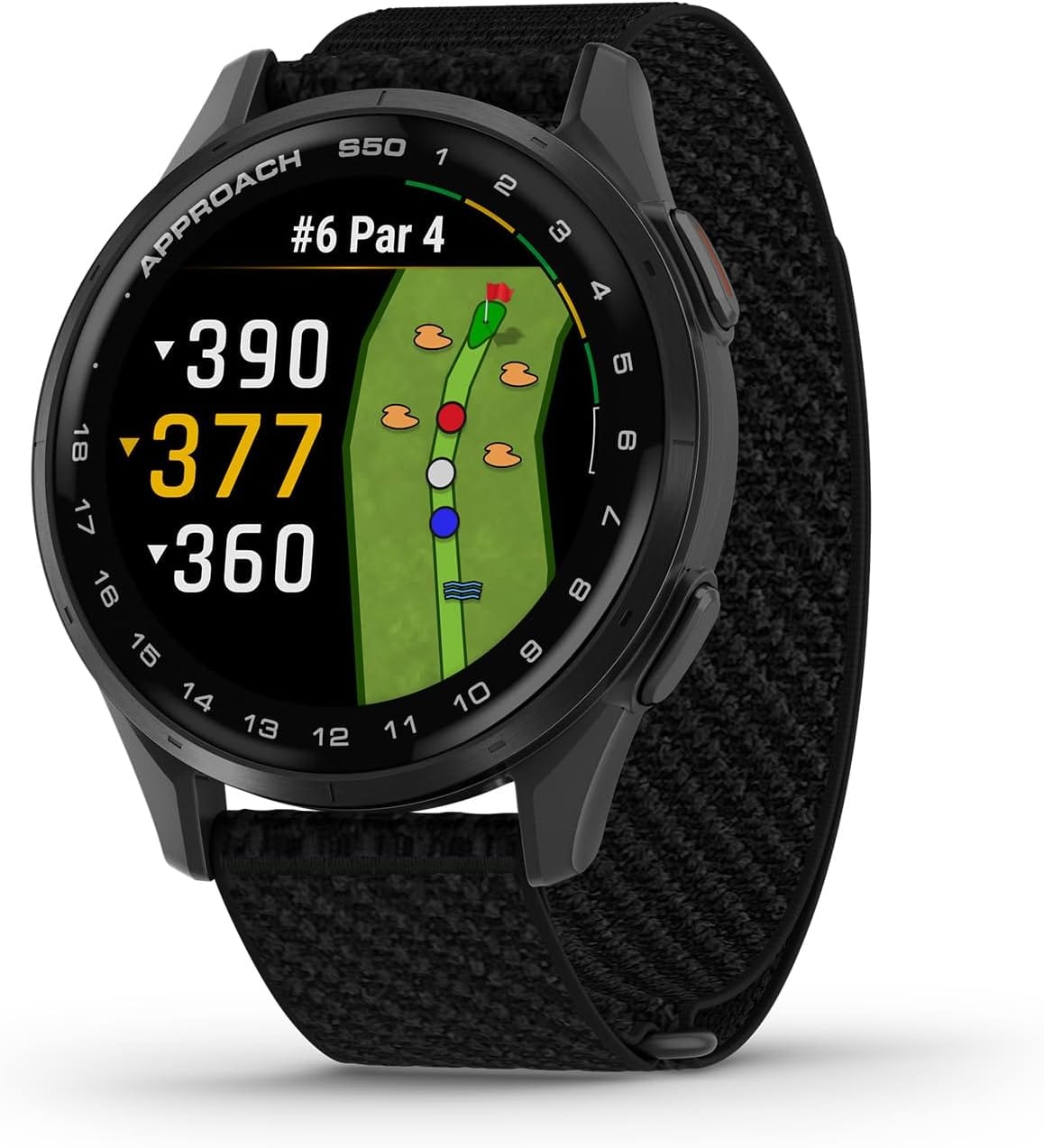
Garmin Approach S50
Best Mid-Range. PlaysLike Distance adjusts for elevation, wrist heart rate, 15-hour GPS battery, 43,000+ courses. $399.99.
Check Price on Amazon
Garmin Approach S44: Best AMOLED Under $300
Same GPS engine as the S50. Same 43,000+ courses. Same AMOLED display. $100 less.
Clean tradeoff: you lose heart rate monitoring and PlaysLike Distance. That's it. If you don't track fitness metrics and you trust your own ability to factor in slope, the S44 gives you the same GPS performance as its more expensive siblings.
At $299.99, it competes with the Bushnell iON Elite ($219.99) and Shot Scope V5 ($249.99). Its edge over both: the AMOLED screen and Garmin's course map database (43,000+ vs 36,000 to 38,000).
Verdict: Use this if you want accurate GPS on a bright display and have no interest in heart rate tracking or PlaysLike distances. The $100 saving over the S50 is real money for a feature most golfers don't use on every hole.
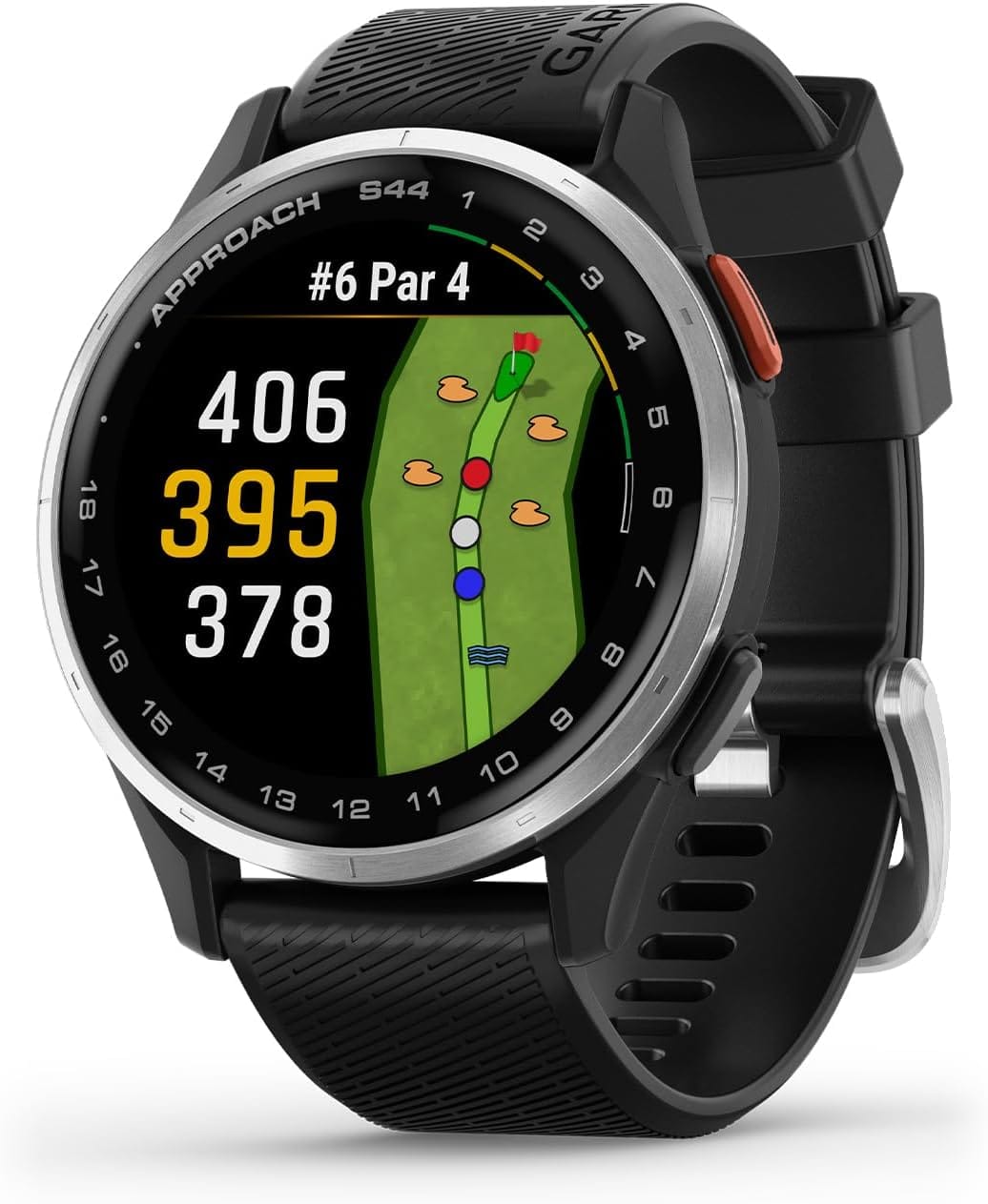
Garmin Approach S44
Best AMOLED Under $300. Same GPS engine as S50 but without heart rate or PlaysLike Distance. 15-hour GPS battery, 43,000+ courses. $299.99.
Check Price on Amazon
Bushnell iON Elite: Best Value
MyGolfSpy's Best Value award winner for 2025, and it earned that tag.
At $219.99, the iON Elite gives you 38,000+ courses, 12+ hours of GPS battery, a color touchscreen, and slope-compensated distances. That last feature is the standout: no Garmin watch under $400 includes slope adjustment. Bushnell does it for $219.99.
Slope-compensated distances show you how far a shot plays rather than how far it measures on a flat map. On a 165 yard (150.9m) par 3 with a 20 foot (6.1m) elevation drop, the iON Elite shows you it plays closer to 158 yards (144.5m). That's a club difference for most mid-handicappers.
Trade-offs: 38,000 courses is fewer than Garmin's 43,000+, though you'd struggle to find a gap in coverage across Tier 1 markets. No shot tracking. And the 12-hour GPS battery is the shortest here, enough for one round with margin, but you'll want to charge it between rounds during a golf trip.
Verdict: Use this if you want reliable GPS distances with slope compensation and don't need shot tracking or health monitoring. It's the best option under $230.
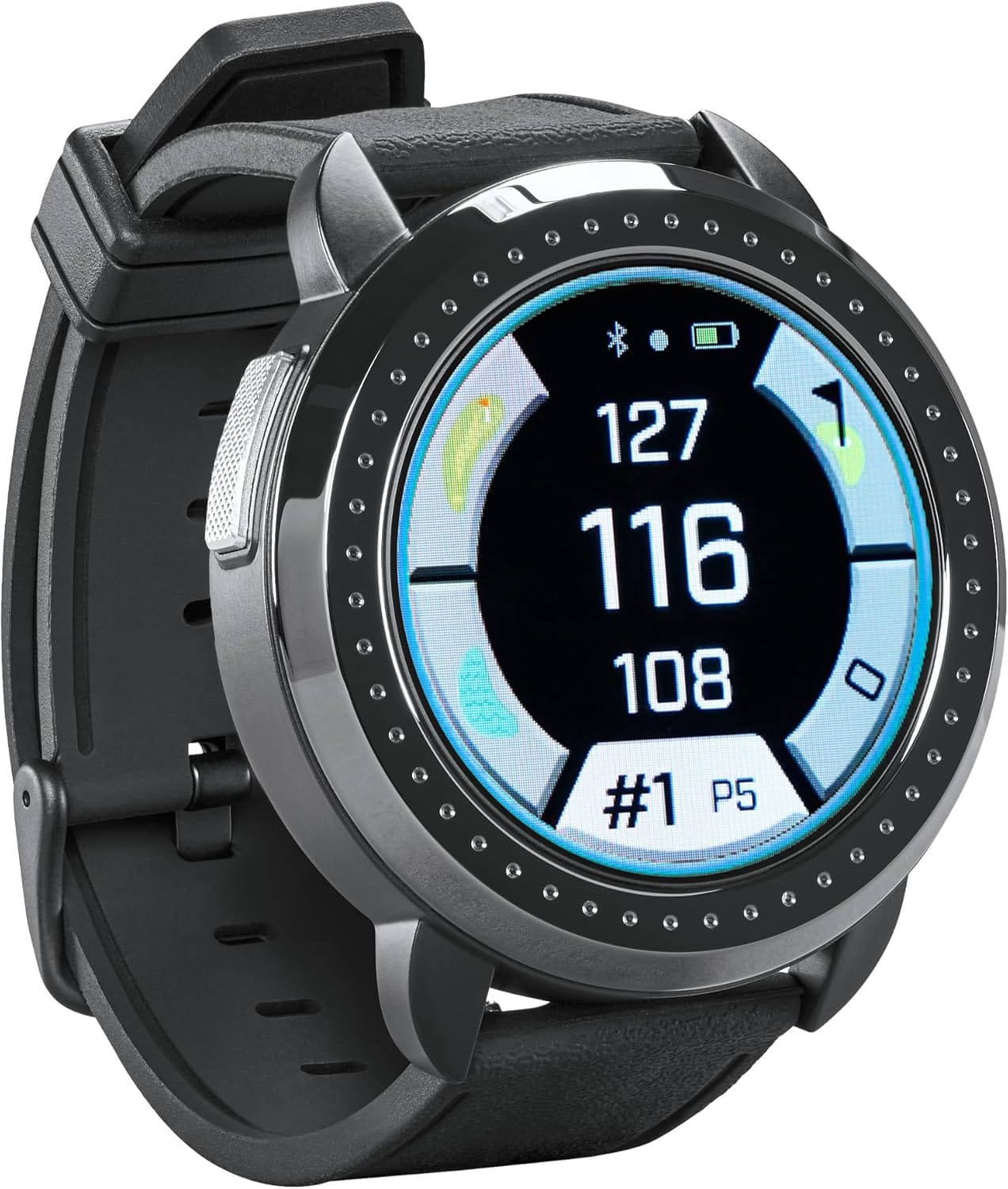
Bushnell iON Elite
Best Value. Patented Slope Technology, 38,000+ courses, 12+ hour battery, color touchscreen. $219.99.
Check Price on Amazon
Shot Scope V5: Best for Shot Tracking
Shot Scope took a different approach with the V5. It ships with 16 lightweight tags that screw into the butt end of each club grip. Each tag registers when you swing, and the watch logs the position. No manual input, no phone required during the round.
What you get in return is full strokes gained data. Strokes gained is the measurement system developed by Columbia professor Mark Broadie that compares every shot to the tour average from the same position and distance. It tells you whether your driving, approach play, short game, or putting is costing you strokes relative to your handicap. I've written a separate piece on how strokes gained works and why it matters if you want the detail.
All of this maps across your rounds with 36,000+ courses preloaded. And here's the part that matters most: no subscription. Your data is yours, free, permanent. Shot Scope's performance dashboard runs on a lifetime-free model. In a market full of $99/year subscriptions, that's a real differentiator.
Limitations worth knowing: physical buttons only (no touchscreen), the interface is functional rather than polished, and 36,000 courses is the smallest database in this roundup. None of those are dealbreakers for a golfer who prioritizes data over aesthetics.
Stock note: the V5 is out of stock at time of writing. It's available on Amazon and direct from Shot Scope.
Verdict: Use this if strokes gained tracking matters to you and you don't want a recurring subscription. Check availability before ordering.
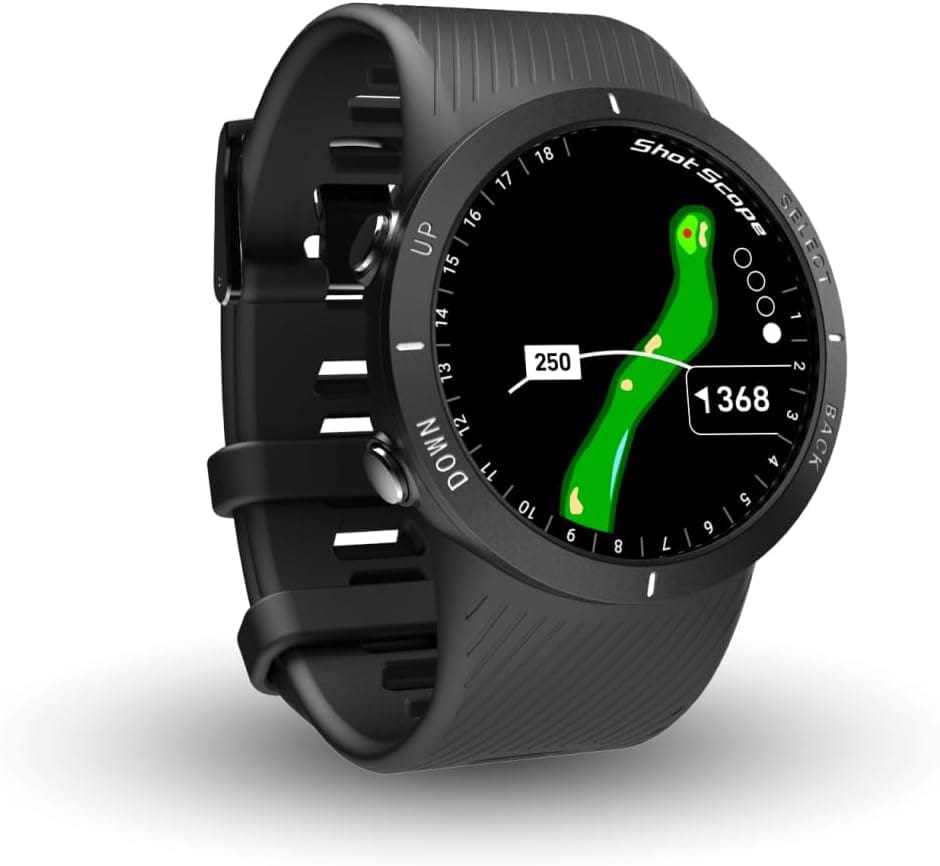
Shot Scope V5
Best for Shot Tracking. Full strokes gained analysis, 100+ statistics, no subscription, 36,000+ courses. Automatic shot tracking via 16 club tags.
Check Price on Amazon
Garmin Approach S12: Best Budget
$199.99. Black-and-white display. No color maps. No shot tracking. No heart rate. No smart features.
What it does have: a 30-hour GPS battery (the longest in this entire roundup by a wide margin), 42,000+ preloaded courses, and reliable front/middle/back yardages on every hole. That's everything a golfer needs from a GPS watch and nothing more.
That 30-hour battery is the practical selling point: 6 to 7 full rounds on a single charge. Play a long weekend trip and forget your charger. The S12 doesn't care.
Verdict: Use this if you want the simplest, cheapest GPS watch that works for multiple rounds without charging. Nothing more, nothing less.
For the full testing breakdown and long-term battery notes, see our Garmin Approach S12 review.
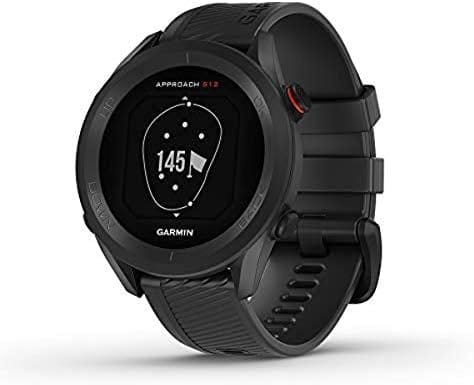
Garmin Approach S12
Best Budget. Simple button navigation, 30-hour GPS battery, 42,000+ courses. No touchscreen, no color display, just reliable yardages. $199.99.
Check Price on Amazon
What About the Apple Watch?
Apple Watch Ultra 2 has dual-frequency GPS (L1/L5) and runs golf apps like Arccos Caddie and Golfshot. With an active golf app running, battery life sits around 12 hours, enough for a single round.
Arccos Caddie combined with an Apple Watch is a legitimate shot-tracking setup. Arccos uses AI club detection (no physical tags) and delivers strokes gained data. Catch: it requires a $99.99/year subscription, and performance depends on the watch maintaining a Bluetooth connection to Arccos sensors in your grips.
Here's the honest answer: if you own an Apple Watch Ultra 2, use it with Arccos. It works. But if you're buying a device for golf, a dedicated GPS watch gives you longer battery life across multiple rounds, simpler on-course navigation, and keeps your daily watch free. Don't buy an Apple Watch for golf. Use one for golf if you already have it.
GPS Watch or Rangefinder: Do You Need Both?
If you're weighing this purchase alongside a rangefinder, here's how the tools divide. I've broken down the full GPS vs laser rangefinder question separately.
GPS watches deliver distances accurate to 2 to 5 yards (1.8 to 4.6m) for center-green, hazard, and layup numbers. For a 15-handicapper aiming at the middle of the green, that's plenty.
Laser rangefinders lock onto the flag at ±1 yard (0.9m). That precision matters when you need to know it's 164 yards (150m), not 169 yards (154.5m), to carry a front bunker. For a 5-handicapper shaping shots to specific pin positions, the laser fills a gap the watch can't.
Most mid-handicappers don't need both. A GPS watch handles everything except precise flag yardage. If your practice data from a sub-$1,000 launch monitor shows your dispersion is ±10 yards anyway, a 3 to 5 yard GPS variance disappears inside your own margin of error. If you do want both tools, let the watch handle the course and the rangefinder handle the flag.
Frequently Asked Questions
What is the difference between the Garmin Approach S44 and S50?
The S44 and S50 share the same GPS engine, AMOLED display, 15-hour GPS battery, and 43,000+ course database. The S50 adds heart rate monitoring, PlaysLike Distance (which adjusts yardage for elevation changes), and full health and activity tracking. The S44 drops those features and costs $100 less at $299.99 vs $399.99. If you wear your watch off-course and want fitness data, the S50 justifies the extra $100. If you want GPS distances on a great display and nothing else, the S44 saves you money without sacrificing GPS performance. The underlying mapping and distance data are identical between the two.
Can I use an Apple Watch as a golf GPS watch?
Yes, with limitations. The Apple Watch Ultra 2 supports dual-frequency GPS and runs golf apps including Arccos Caddie and Golfshot. Battery life with an active golf app sits around 12 hours, enough for one round. Arccos Caddie on the Apple Watch delivers strokes gained data through AI club detection, but requires a $99.99/year subscription and Arccos grip sensors. The setup works well for golfers who own the watch for other reasons. Buying an Apple Watch for golf alone doesn't make sense when dedicated devices offer better battery life, simpler interfaces, and no subscription requirement for core GPS features.
Do golf GPS watches need a subscription?
None of the six watches in this roundup require a subscription for core GPS features. Course maps, yardages, hazard distances, and green shapes come included with the purchase price and update for free. The Shot Scope V5 goes further by including lifetime free access to its strokes gained performance dashboard. Subscription fees enter the picture with third-party services: Arccos Caddie costs $99.99/year and some Garmin Connect premium features require a paid plan. For the watches themselves, your purchase price covers everything you need on the course.
How accurate are GPS watches compared to a laser rangefinder?
GPS watches deliver center-green distances accurate to 2 to 3 yards (1.8 to 2.7m) based on the Zanetti et al. study published in the International Journal of Golf Science. Laser rangefinders hit the flag at ±1 yard (0.9m). The practical difference matters most for approach shots to tight pins: a GPS watch tells you it's 157 yards (143.6m) to the center, while a rangefinder tells you it's 151 yards (138.1m) to the flag tucked front-left. For center-green strategy, which suits most mid-handicappers, GPS accuracy is more than sufficient. The laser earns its place when pin position and carry distance over a hazard demand yard-level precision.
Should I get a GPS watch if I have a rangefinder?
A GPS watch adds value even if you carry a rangefinder. The watch gives you distances without breaking stride: layup numbers, hazard carry distances, and front/middle/back of green are visible with a glance at your wrist. A rangefinder requires you to stop, aim, and shoot. On a busy course, having instant GPS yardages speeds up pre-shot planning. The rangefinder then confirms the exact number when you're standing over the ball. Most golfers who own both use the watch for course management between shots and the rangefinder for the final yardage before pulling a club.
Which Watch Should You Buy?
If money isn't the deciding factor, buy the Garmin Approach S70 and let Virtual Caddie learn your game. If you want the best balance of features and price, the S50 at $399.99 is where most mid-handicappers should land. If you care about strokes gained data more than screen quality, the Shot Scope V5 gives you deeper performance insight than any Garmin, with no ongoing fees. And if you want reliable distances for under $220, the Bushnell iON Elite punches above its weight with slope compensation included.
Don't overthink it. Pick the watch that matches your budget and the data you'll use. A GPS device you wear is more useful than a rangefinder sitting in your bag pocket.
Some links in this article are affiliate links. If you buy through them, I earn a small commission at no extra cost to you. This never influences what I cover or recommend. I link to gear I'd buy myself.