Best Golf Irons for Mid-Handicap Players in 2026
Six mid-handicap irons ranked by independent GCQuad data. Loft-adjusted distances, forgiveness ratings, and honest picks for 10-18 handicap golfers in 2026.
Best Golf Irons for Mid-Handicap Players in 2026
Forty per cent of the scoring gap between shooting 90 and shooting 80 comes from approach play. That figure is from Mark Broadie’s Every Shot Counts (Columbia Business School Press, 2014), and Shot Scope’s 2026 Annual Performance Report (870,000 rounds) backs it up: mid-handicappers hit the green in regulation less than 35% of the time, losing more strokes on approach than on any other part of the game.
Your irons won’t fix your swing. They can, however, give you a bigger landing zone on mishits and tighter dispersion when you do catch it flush. The difference between the most and least forgiving irons in independent testing is measurable: a 3 MPH swing on ball speed retention, 10 yards (9.1m) on carry, and double the left-right spread.
I’ve cut through the launch monitor data from two of the most thorough independent iron tests published in the last twelve months to find the six irons that perform for 10-18 handicappers. No personal testing. Published data, named sources, loft-adjusted comparisons.
- 1.Best overall pick for most mid-handicappers in 2026: Callaway Elyte HL, the best combination of forgiveness, distance, and feedback across the 10-22 handicap range.
- 2.Best forgiveness + distance: TaylorMade Qi, for higher handicappers who want maximum distance assistance.
- 3.Best consistency: Ping G440, with tighter shot dispersion across the face than any competing iron in this category (MyGolfSpy data).
- 4.Best players-distance look: Srixon ZXi4, for mid-handicappers who want a compact shape without sacrificing the distance game-improvement irons offer.
- 5.Best feel and shot control: TaylorMade P790 (2025), for improving mid-handicappers who want feedback on strike quality.
- 6.Best value: Mizuno JPX925 Hot Metal Pro, with players-distance performance at a price that makes the premium irons above it look overpriced.
How These Were Selected
Two independent test programmes form the backbone of this guide. Today’s Golfer’s GCQuad iron test used multiple testers averaging 90.8 MPH club speed, tracking ball speed, carry, spin, launch, and left-right dispersion on a Foresight GCQuad. MyGolfSpy’s 2025 Most Wanted Game Improvement Iron test measured 60+ iron sets across multiple testers on the same GCQuad platform.
Neither test is perfect. Both are far more reliable than manufacturer claims or YouTube range sessions with one tester and a Mevo+.
One thing you’ll notice in the comparison table below: 7-iron lofts range from 27 degrees to 30 degrees across these six sets. That’s a 3-degree spread, which translates to 8 to 12 yards (7.3 to 11.0m) of carry difference before you factor in face technology at all. A 28-degree “7-iron” will carry further than a 30-degree one. That’s physics, not performance. Every comparison in this guide includes the loft figure so you can see when distance is real and when it’s a loft trick.
Quick Comparison: Key Numbers
| Iron | Category | 7i Loft | Ball Speed | Carry | L-R Dispersion | Price (approx.) | Best for HCP |
|---|---|---|---|---|---|---|---|
| Callaway Elyte HL | GI | ~28° | N/A | N/A | N/A | ~$900 | 14-18 |
| TaylorMade Qi | GI | 28° | 129.1 MPH | 187 yds (171m) | 4.7 yds (4.3m) | ~$1,099 | 12-18 |
| Ping G440 | GI | ~27-28° | N/A | ~186-190 yds (170-174m) | N/A | ~$1,299 | 12-18 |
| Srixon ZXi4 | Players Distance | 28.5° | 124.0 MPH | 186.7 yds (171m) | 6.1 yds (5.6m) | ~$1,199 | 10-14 |
| TaylorMade P790 (2025) | Players Distance | 30° | 124.9 MPH | 179.5 yds (164m) | 2.7 yds (2.5m) | ~$1,399 | 8-14 |
| Mizuno JPX925 HM Pro | Players Distance | ~30° | N/A | N/A | N/A | ~$1,099-$1,199 | 10-16 |
Sources: Today’s Golfer GCQuad test (90.8 MPH avg. club speed); MyGolfSpy 2025 Most Wanted. Elyte HL, G440, and JPX925 HM Pro ball speed/carry figures not available from these tests. N/A = not reported in either test programme.
1. Callaway Elyte HL: Best Overall (14 to 18 HCP)
The Elyte HL earned MyGolfSpy’s 2025 Most Wanted Best Overall Game Improvement Iron award with an 8.8/10 accuracy score and a top-5 forgiveness rating across 60+ sets tested. For mid-handicappers who need maximum launch and a wide sweet spot, this is the iron to beat.
Callaway’s Ai10x Face technology uses machine learning to optimise face thickness across the hitting area. The Speed Frame internal structure stiffens the perimeter while keeping the centre flexible, which means off-centre strikes retain more ball speed. In practical terms: your thin shots still get up, and your toe strikes don’t bleed 15 yards (13.7m) right.
Stock shafts are KBS Max 85 MT in steel and Aldila Ascent in graphite. The graphite option keeps total club weight low, which matters if you’re over 50 or dealing with joint issues. Lofts run weaker than the Qi and G440, producing higher launch angles and better stopping power on approach shots. You won’t top the distance charts, but your 7-iron will hold a green from 165 yards (151m) instead of bouncing through.
At around $900, it’s the most affordable iron on this list. That’s rare for a test winner.
Who skips it: If you’re a 10 to 12 HCP with a consistent ball-striking pattern, the compact head of the ZXi4 or P790 will give you more control and feedback.
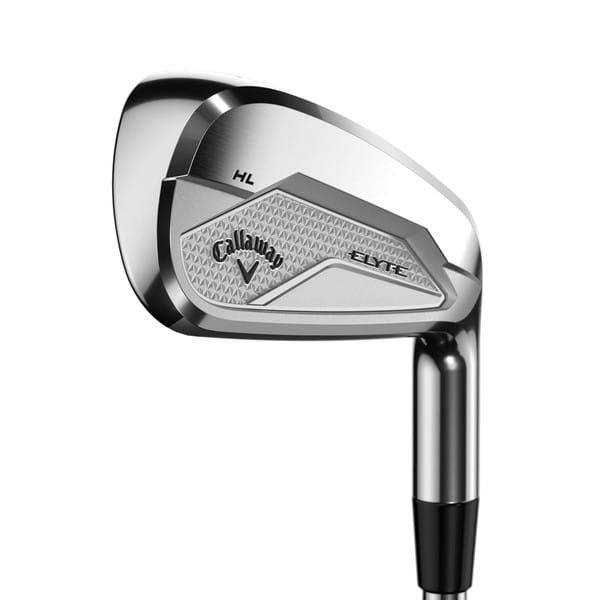
Callaway Elyte HL Irons
2. TaylorMade Qi: Best for Forgiveness + Distance
Today’s Golfer’s GCQuad test measured the Qi at 129.1 MPH ball speed and 187 yards (171m) carry with a 90.8 MPH club speed. Left-right dispersion: 4.7 yards (4.3m). Those are top-tier numbers in both categories, and the 28-degree 7-iron loft means this distance is legitimate, not a loft trick.
The speed-injected Cap Back Design maximises face flexibility, while the SpeedPocket in the sole absorbs vibration on low-face strikes. TaylorMade’s approach here is brute force engineering: make the face as fast as regulations allow, then build enough perimeter weighting to keep mishits in play.
Stock shafts: KBS MAX 85 MT (steel) or Fujikura Ventus TR Blue (graphite). Both are solid options, though the Ventus Blue runs a touch firmer than most graphite GI shafts.
At 28 degrees, the Qi’s 7-iron sits at the same loft as older Ping G425-era irons. Context matters: this iron is producing 187 yards (171m) of carry at a loft that would have been standard five years ago. The distance is coming from face technology, not loft manipulation.
The Qi is a 2024 model, and pricing has dropped to around $1,099 in steel. That’s competitive for what you’re getting.
Who skips it: If you value a thin topline at address, the Qi will look chunky. Golfers who prefer a compact head and more workability should look at picks 4 through 6.

TaylorMade Qi Irons
3. Ping G440: Best for Consistency
Plugged In Golf’s review measured ball speed loss of less than 3 MPH regardless of strike location on the face. No other iron on this list matched that level of mishit consistency. If you spray it across the face and want the same result every time, the G440 is the answer.
PurFlex Technology fills the cavity behind the face, damping vibration and keeping energy transfer high on off-centre hits. The Hyper 17-4 stainless steel face is thinner and more flexible than the prior G430, which means strikes low on the face (a common miss for mid-handicappers) still launch with enough speed to reach the target.
Stock shafts: AWT 2.0 (steel) or Recoil (graphite). Both are well suited to the 85 to 95 MPH swing speed range that most mid-handicappers occupy.
Fitting note: Ping’s colour-coded shaft system (12 lie angle options mapped by height and wrist-to-floor measurement) makes the G440 the easiest iron on this list to get into the right spec. If you’ve never been fitted and don’t know your lie angle, start here.
At around $1,299, it’s the most expensive GI iron on this list. You’re paying for Ping’s quality control and that consistency, which is a trade-off worth making if your game rewards predictable distances.
Who skips it: Pure ball-strikers who want feedback on mishits. The G440 is so forgiving that bad swings feel good, which isn’t ideal if you’re working on improving strike quality.

Ping G440 Irons
4. Srixon ZXi4: Best for Mid-Handicappers Who Want a Players Look
Today’s Golfer’s GCQuad test: 124.0 MPH ball speed, 186.7 yards (171m) carry, 6.1-yard (5.6m) left-right dispersion at a 28.5-degree 7-iron loft. MyGolfSpy’s 2025 results backed that up with an 8.8/10 accuracy score, making the ZXi4 the second-most accurate GI iron they tested.
Two things separate this from the Qi and Elyte HL. First, the head. Srixon’s MainFrame milled channels on the face are CNC-milled into a forged S20C steel body. It’s a compact, clean profile at address, closer to a players iron than a GI head. Second, the feel. That i-FORGED construction delivers impact feedback you won’t get from a cast face. You know where you hit it.
Stock shafts: Dynamic Gold Lite S300 (steel) or Recoil Dart (graphite). The DG Lite is a proven mid-weight steel shaft that suits swing speeds in the 85 to 100 MPH range.
The carry figure of 186.7 yards (171m) at 28.5 degrees is strong. Half a degree more loft than the Qi, 0.3 yards (0.3m) less carry. This iron converts swing speed into ball speed with impressive efficiency for a compact head.
At $1,199, it sits between the Qi and the P790. For 11 to 14 HCP players who’ve outgrown the chunky look of traditional GI irons but still need forgiveness, the ZXi4 threads that needle.
Who skips it: If you’re a 16+ HCP who mishits more than you’d like to admit, the wider sole and bigger face of the Qi or Elyte HL will save more shots per round.

Srixon ZXi4 Irons
5. TaylorMade P790 (2025): Best for Feel and Shot Control
Today’s Golfer’s GCQuad test: 124.9 MPH ball speed, 179.5 yards (164m) carry, 2.7-yard (2.5m) left-right dispersion. That’s the tightest dispersion on this entire list. When you flush a P790, it goes where you’re looking.
The carry number is lower than the Qi and ZXi4, but the loft tells the story. At 30 degrees, the P790’s 7-iron is 2 degrees stronger than the Qi’s 28-degree head. Adjust for that loft gap and the P790 is producing comparable ball speed per degree of loft. The “shorter” carry is a design choice: more loft means higher launch, steeper descent, and better stopping power.
Inside the head, SpeedFoam Air replaces the solid polymer fill of earlier P790 generations, freeing up mass for perimeter weighting without adding total weight. The 4340M forged steel face is 20% stronger than the prior generation, allowing a thinner face profile while maintaining durability.
Stock shaft: True Temper DG 105 (steel). It’s a mid-weight option that suits the 8 to 14 HCP sweet spot.
This is the iron for players who want to feel the shot. Impact feedback is crisp and immediate. You’ll know whether you caught it thin, heavy, or out of the toe before you look up.
At $1,399, it’s the most expensive iron on this list. That price reflects the forged construction and players-distance positioning. If feel and shot shaping matter more to you than raw forgiveness, it’s money well spent.
Who skips it: 16+ HCP golfers struggling with consistency. The Qi or Elyte HL forgive off-centre strikes more and produce more predictable distances across the face.

TaylorMade P790 (2025) Irons
6. Mizuno JPX925 Hot Metal Pro: Best Value, Best Feel in Players Distance
MyGolfSpy’s 2025 Most Wanted named the JPX925 Hot Metal Pro as a runner-up in the GI category, and Mizuno’s own testing data shows 7 yards (6.4m) more carry than the prior JPX923. For golfers chasing the Mizuno feel at a GI price, this is the entry point.
Mizuno’s Grain Flow Forged HD process produces the impact sound and feedback the brand is known for, at a price below the MP or Pro line. Reduced offset compared to the standard Hot Metal makes this better suited to 10 to 15 HCP golfers who want a cleaner look at address with some workability.
Stock shafts: True Temper Elevate 95 (steel) with a Nippon NS Pro graphite option. The Elevate 95 is a solid mid-weight shaft, though faster swingers (over 95 MPH) may prefer something in the 105 to 115g range.
At $1,099 to $1,199, the JPX925 HM Pro undercuts the G440 by $100 and the P790 by $200 while delivering a comparable feel profile. It’s the value pick on this list, not because it’s cheap, but because the performance-to-price ratio is the strongest here.
Who skips it: If you’re a 16+ HCP, the standard JPX925 Hot Metal offers more forgiveness with a wider sole and more offset. The “Pro” designation means less help on mishits, so be honest about your strike consistency before choosing this over the standard model.

Mizuno JPX925 Hot Metal Pro Irons
Which Iron Is Right for You?
Handicap range narrows the field. Here’s where each iron sits:
14 to 18 HCP: Maximum launch and forgiveness matter most. The Callaway Elyte HL gives you the widest sweet spot and highest launch at the lowest price. The TaylorMade Qi adds distance on top of that forgiveness but costs $200 more.
12 to 14 HCP: You’re striking it well enough to start prioritising consistency and feedback. The Ping G440 delivers the tightest mishit penalty, while the Srixon ZXi4 gives you a compact head with strong GI-level forgiveness.
10 to 12 HCP: Feel and control become the priority. The TaylorMade P790 (2025) has the tightest dispersion on this list at 2.7 yards (2.5m), and the feedback lets you diagnose your misses. The Mizuno JPX925 Hot Metal Pro offers comparable feel at a lower price, with a touch more forgiveness.
Slower swing speed or joint pain: The Elyte HL with the Aldila Ascent graphite shaft drops total club weight, and Ping’s G440 HL variant offers a lighter package with the same face technology.
One more thing. MyGolfSpy’s 2023 fitting study found that over 50% of fitted golfers were still playing the wrong shaft flex. The best iron head in the world won’t perform if it’s paired with a shaft that doesn’t match your tempo, transition, and swing speed. A 30-minute fitting session at a local club or retail fitter will tell you more than any article can. If you want to understand how the numbers behind a fitting work, read up on how strokes gained works and why approach play matters so much for your scores.
Frequently Asked Questions
What is the difference between game improvement and players distance irons?
Game improvement (GI) irons have wider soles, more offset, larger faces, and are designed to maximise forgiveness on off-centre strikes. Players distance irons use a more compact head shape with less offset, offering more feedback and workability while still incorporating face technologies that boost ball speed. In this guide, the Elyte HL, Qi, and G440 are GI irons. The ZXi4, P790, and JPX925 HM Pro fall into the players distance category. The practical difference: GI irons protect you from bad swings, players distance irons reward good ones.
Are game improvement irons worth it for a mid-handicapper?
For most mid-handicappers (12 to 18 HCP), yes. GI irons retain more ball speed on mishits, produce higher launch angles, and reduce left-right dispersion compared to players irons. Today’s Golfer’s GCQuad data shows the best GI irons on this list keep dispersion under 5 yards (4.6m), which is tighter than many players irons from two generations ago. The exception: if you’re a 10 to 12 HCP with consistent centre-face contact, a players distance iron gives you more control without sacrificing much forgiveness.
How do I choose between steel and graphite shafts?
Steel shafts offer more consistent weight and flex profiles, which most fitters recommend for swing speeds above 85 MPH (38 m/s). Graphite shafts weigh 15 to 30g less per club, reducing fatigue over 18 holes and increasing club speed for slower swingers. If you’re under 85 MPH, over 50, or dealing with elbow or shoulder issues, graphite is worth trying. If you’re between 85 and 100 MPH and have no physical limitations, steel is the default. The only way to know for certain is to hit both on a launch monitor during a fitting.
How much should a mid-handicapper spend on irons?
The six irons on this list range from $900 (Elyte HL) to $1,399 (P790). For a mid-handicapper who plays 20 to 40 rounds per year and keeps a set for 5 to 7 years, that works out to $25 to $55 per year of use. The Callaway Elyte HL and Mizuno JPX925 HM Pro offer the strongest performance per dollar. Spending more than $1,400 on irons makes sense if you’re working with a fitter and moving into a players cavity back, but most 12 to 18 HCP golfers won’t extract the extra performance from a $1,800+ set.
What 7-iron distance should a mid-handicapper expect?
Today’s Golfer’s GCQuad test across all categories produced a 7-iron carry average of 183.7 yards (168m) at 90.8 MPH club speed. That’s total category average, not just the longest irons. Your number will vary based on loft (a 28-degree 7-iron carries further than a 30-degree one), strike quality, and conditions. A mid-handicapper with 85 to 90 MPH club speed should expect 170 to 185 yards (155 to 169m) of carry with a modern GI iron. Measure your swing speed on a launch monitor before comparing yourself to these figures.
For most 14 to 18 HCP golfers reading this, the Callaway Elyte HL is the default recommendation. It won MyGolfSpy’s top spot for a reason: it’s forgiving, it launches high, and it costs less than everything else on this list. If you’re a 10 to 13 HCP who values feel and shot shaping, the P790 (2025) delivers the tightest dispersion here and the kind of impact feedback that helps you improve.
Whatever you pick, a proper fitting maximises the benefits. Even the best iron head underperforms in the wrong shaft. If you’re investing $900 or more in a new set, spend 30 minutes on a launch monitor with a fitter. Grab a launch monitor that gives you the four numbers that tell you whether a fitting is working, or book a session at your local pro shop.
Some links in this article are affiliate links. If you buy through them, I earn a small commission at no extra cost to you. This never influences what I recommend. I link to gear I’d buy myself.






The golf newsletter that cuts the hype
Data-backed reviews and advice that works. No brand spin.
Recommended products