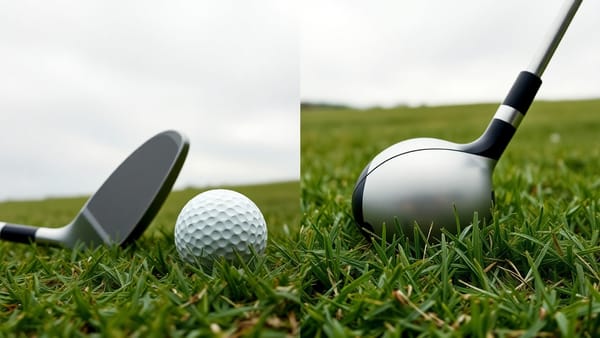
Driver vs 3-Wood Off the Tee: When to Use Each
Shot Scope data from 80M shots shows the fairway hit gap between driver and 3-wood is just 0.8%. Here's when each club wins off the tee, with proof.

Conventional wisdom on tight tee boxes is wrong. "When in doubt, hit 3-wood" is what you'll hear at every clubhouse in golf. Shot Scope's analysis of 80 million tracked swings (Feb 2026) shows fairways found by a longer stick versus its shorter alternative differ by just 0.8 percentage points. Tiny. Mid-handicappers also ship more wreckage into trouble, not less.
So safe play isn't safe. It only feels safer. Most weekend players score better pulling the big dog than reaching for caution.
TL;DR
- 1Bigger stick wins for most weekend players. Shot Scope (80M tracked swings, Feb 2026): fairway accuracy differs by 0.8 points, while average flight gives big dog 22 extra yards (20m), 225 versus 203 (206m vs 186m).
- 2MyGolfSpy reading those numbers (Nov 2025): a 15-handicap drops into trouble 5% of attempts with the layup option versus 2% pulling driver. More club, lower score.
- 3Default to big dog on every par 4 and par 5 unless one of three triggers fires: a hard layup yardage, a forced carry beyond reach, or a fairway that pinches at full distance.
- 4Reach for the shorter alternative when geometry forces it, not when nerves do. "Just to be safe" is the priciest swing in amateur golf.
- 5Losing 22 yards (20m) off every tee box with no accuracy benefit? That's a fitting issue, not a strategy one.
What the data says about driver vs 3-wood
That dataset of 80 million tracked swings gives us the cleanest read available. Fairway-found rates between both clubs sit almost identical.
A 22-yard (20m) distance gap. A 0.8 point accuracy gap. Effectively a free 22 yards (20m).
Myth says you trade carry for control. Reality says you trade carry for almost nothing. Measure quality by where your ball ends up rather than how impact feels off the face, and that safer-looking pick loses its case.
Then trouble-shot data lands its second blow. Penalty rate measures how often any swing ends in penalty stroke territory: lost-ball drop, water carry, or out-of-bounds reload. MyGolfSpy's read of those numbers (Nov 2025) splits results by handicap, and what comes out for 15-handicaps is uncomfortable reading: 2% with driver, 5% pulling 3-wood. Twice as many drops from this supposedly cautious choice.
So why does this shorter weapon produce more penalties? Three reasons. Less loft, so any small strike error sends balls further offline before they climb. Tee height sits awkwardly for amateurs, somewhere between fairway-strike position and full-tee position, which feeds inconsistency. And weekend players swing it like a fairway club from tight lies rather than off the peg. Shallower contact, lower launch, weaker result.
A driver is a single-purpose club. Tee it up, aim, swing. The geometry is forgiving in a way a 3-wood isn't.
That's the whole engineering case for defaulting to it.
For lower handicaps, this gap narrows. A scratch golfer with a tour-prepped 3-wood and known carry distance can use it on holes where pulling driver brings a hazard into play. Across the 10-22 handicap range LaunchPoint writes for, big stick wins more often than safe-play disciples admit.
When to use your driver off the tee
Default to driver. Exceptions are narrow.
Pull big dog when:
- The hole is a par 4 or par 5 with no hazard in driver range
- The fairway is the same width at driver distance as at 3-wood distance (most fairways are)
- You're playing into a green where being closer matters
- You've been hitting your driver well in warm-up and your stock shape is showing up
- You don't have a forced carry that exceeds your driver carry distance
That last point gets misread. A forced carry only forces a club-down when the carry is outside your driver's range. Carry the big stick 230 yards (210m) over a hazard that ends at 220 yards (201m), and the driver clears it. Pulling 3-wood there is the wrong call, because flying short of the hazard takes a perfect strike that the data says you don't make as often as you think.
The hidden value of driver isn't the average. It's the upside. Shot Scope's strokes-gained breakdown (via MyGolfSpy, Nov 2025) shows the closer your second shot, the better your scoring average. A par 4 from 130 yards (119m) plays half a stroke better than the same hole from 165 yards (151m). Across 18 holes that's eight or nine shots, without changing anything but club selection off the tee.
So the 22-yard (20m) distance edge matters more than the 0.8% accuracy gap. The math runs the other direction from how it feels.
When to use your 3-wood off the tee
The 3-wood earns its place when geometry forces it, not when nerves do. There's a short list of holes where the shorter club is the right call, and a longer list where amateurs reach for it anyway.
Pull 3-wood off the tee when:
- The hole has a forced layup yardage. Some par 4s have a creek, ditch, or fairway bunker complex at 240-260 yards (220-238m) that swallows a driver. If the layup gap is tighter than your driver landing zone, club down.
- A forced carry exceeds your driver carry. A 215-yard (197m) carry distance won't clear a 230-yard (210m) hazard, so the driver isn't safe even on a flush strike.
- The fairway narrows at driver distance and stays wide short of it. Rare. Most fairways are about the same width through the landing zone.
- You're into a strong wind where driver flight balloons. A lower-launching 3-wood holds its line better.
- A scratch or low-handicap player with launch-monitor evidence their 3-wood dispersion is tighter than their driver, not just felt tighter.
That's the list. Five situations. None of them are "I'm a bit nervous on this hole."
The "just to be safe" reflex is the most expensive shot in amateur golf. It costs you 22 yards (20m) of distance, doesn't buy any meaningful accuracy improvement, and increases your odds of a penalty drop. Naming it as a habit is half the work of fixing it.
A quick note on attack angle, which is the angle the clubhead approaches the ball at impact. A 3-wood off a tee gets played with a small negative attack angle by most amateurs, which creates lower launch, more spin, and a flight sensitive to face angle errors. A driver off a tee gets played with a positive attack angle (or should be), which produces higher launch, lower spin, and a flight more forgiving of strike. The 3-wood needs more precision to behave like a tee shot rather than a fairway shot.
Is a 3-wood safer off the tee than a driver?
For most amateur golfers, no. Shot Scope's 80 million shot dataset (Feb 2026) settles the accuracy question: 0.8% difference in fairway hit rate. The penalty numbers from MyGolfSpy's analysis (Nov 2025) say a 15-handicap is more than twice as likely to take a penalty stroke with the 3-wood than the driver, 5% versus 2%. The "safer" feeling comes from the swing, not from where the ball ends up. Judge a tee shot by where it finishes and the driver is the safer pick for the 10-22 handicap range. Most of the time the 3-wood is the wrong tool, even though it's the one amateurs reach for when nerves take over.
I'll flag my bias. I'm a 7-handicap who came to golf through the simulator rabbit hole, so numerical proof lands harder for me than feel-based reasoning. If feel matters more than data in your decision-making, weight my take down. The numbers still apply to your scorecard.
The club-fitting angle
A driver going 22 yards (20m) shorter than the 225-yard (206m) average with no accuracy benefit is a fitting problem, not a strategy problem.
Two common culprits: shaft flex that doesn't match your swing speed, and loft that doesn't match your attack angle. A stiff shaft with a slow tempo produces low launch and weak distance. A 9-degree head with a negative attack angle produces a low-launch flight that doesn't carry. Both feel fine because the strike is solid. Both leave 25-30 yards (23-27m) of carry on the table.
The driver swings itself when it's matched to the right shaft flex and the right loft. Without that match, no amount of strategy talk fixes the underlying issue. I covered the loft side in my guide to dialing in your driver loft, and the shaft side in my breakdown of getting matched to the right shaft flex. Never been on a launch monitor with your current driver? That's the highest-return move you can make to find the 22 yards (20m) you're losing, and it pairs well with the fastest way to lower your score if you're chasing a number.
Recommended 3-woods for the situations that call for one
Worked through the framework already and your course still demands a 3-wood off the tee on a few holes? Two heads are worth a serious look. Both sit in the same price bracket and target different player profiles.
Callaway Paradym AI Smoke Max 3-Wood
TaylorMade Qi10 3-Wood
The Paradym AI Smoke Max is the more forgiving of the two. Pull it if mishits are your main miss off the tee. The Qi10 is the better tee-shot launcher for players with cleaner contact who want the 3-wood to function as a long-range tee club rather than a layup. Either way, get it fitted. A 3-wood off the tee is sensitive to shaft and loft choices in a way the driver isn't.
Frequently Asked Questions
Should a high-handicapper hit driver or 3-wood off the tee?
Driver, in most cases. Shot Scope and MyGolfSpy's joint analysis (Nov 2025) found high-handicappers gain more strokes from being closer to the green than they lose from a small fairway hit rate decline. Pull driver as the default and switch only when geometry forces it.
How much further does a driver go than a 3-wood?
About 22 yards (20m), based on Shot Scope's 80 million shot dataset (Feb 2026). Driver averages 225 yards (206m) total; 3-wood averages 203 yards (186m). For a player swinging in the 90-100 mph driver range, expect a 20 to 25 yard (18 to 23m) edge with the driver.
Is a 3-wood easier to hit off the tee than a driver?
Not for most amateurs. The 3-wood's lower loft and shorter shaft feel more controllable on the takeaway, but the strike requirements are tougher. A 3-wood off a tee is sensitive to attack angle and tee height in ways a driver isn't. The penalty rate data (Nov 2025) confirms the strike difficulty: 5% with 3-wood versus 2% with driver for a 15-handicap.
When should I hit 3-wood off the tee?
Five situations qualify. A real layup yardage where driver runs through the fairway. A forced carry that exceeds your driver distance. A fairway that narrows at driver distance and stays wide short of it. A strong wind where lower flight holds its line. A low-handicap player with launch-monitor evidence their 3-wood dispersion is tighter than their driver's. Outside those, default to driver.
Does fairway-finder strategy save strokes?
Not on the average amateur scorecard. The "fairway-finder" idea (club down for accuracy, lose distance, gain control) doesn't show up in the data. Shot Scope's numbers show the accuracy gain is 0.8%, the distance loss is 22 yards (20m), and the penalty rate goes up with the shorter club for mid-handicappers. The strokes-gained math runs against the strategy.
The takeaway
Driver as default. 3-wood when geometry forces it. The strokes you save by being 22 yards (20m) closer to the green compound across 14 tee shots in a way no fairway hit percentage can offset.
Next time you're standing on a tee deciding what to pull, ask yourself which of the five 3-wood triggers is in play. If none of them are, the answer is in the headcover that says driver. Hit it.
Some links in this article are affiliate links. If you buy through them, I earn a small commission at no extra cost to you. This never influences what I cover or recommend. I link to gear I'd buy myself.





The golf newsletter that cuts the hype
Data-backed reviews and advice that works. No brand spin.
Recommended products