Attack Angle in Golf: Why It Changes Your Distance
Most amateurs hit down on their driver at -1.8 degrees and lose 20 to 25 yards. Here is what attack angle really means, and how to fix yours.

Attack angle describes which direction your clubhead travels vertically at strike, expressed in degrees against horizon. Negative means face descending into contact. Positive means it climbs.
Most weekenders hit down on their longer club without realizing. Trackman puts your typical 14.5-handicapper at -1.8 with big stick, when optimal window for those speeds lives closer to +2 through +4. One habit, twenty to twenty-five yards (18 to 23m) of lost carry per tee shot, no swing change required. Biggest, most fixable distance leak in amateur play, and almost nobody knows their number.
YouTube tips skip this part. AoA is measurable. You can read it off any monitor. Three setup tweaks change it. Once you do, an identical motion delivers different flight.
TL;DR
- 1Driver: hit up. Optimal AoA is +1 to +5 degrees. Average amateur sits at -1.8 (Trackman), losing 20 to 25 yards (18 to 23m) of carry.
- 2Irons: hit down. A 7-iron at -6 degrees carries 21.7 yards (19.8m) further than +2 (Foresight Sports), and holds the green.
- 3The mechanism is spin loft. Negative driver AoA inflates spin loft, which inflates spin, which kills smash factor and carry.
- 4Measure it for under $700. Garmin Approach R10 and Rapsodo MLM2PRO both report AoA on every shot.
- 5Fix it with setup, not swing. Forward ball position, higher tee, lead-hip bump toward the target.
What Attack Angle Means in Practice
Picture your clubhead tracing an arc through impact. Zero stays dead level. Positive readings mean climbing face as it meets the ball; negatives descend. With irons, an arc bottoms out past strike, so you compress first and take divot after. Off your longer stick, low point sits behind contact, so clubface on its way back up greets the tee shot. Same idea, opposite execution.
Here is how Tour and weekend players stack up, all pulled from that data.
| Player Type | Driver Attack Angle |
|---|---|
| PGA Tour average | -0.9 degrees |
| LPGA Tour average | +2.8 degrees |
| Scratch amateur | -0.9 degrees |
| 5 handicap | -1.1 degrees |
| 10 handicap | -1.2 degrees |
| 14.5 handicap (average amateur) | -1.8 degrees |
| Bogey golfer | -2.1 degrees |
Why does upward path matter if pros average -0.9 with their big stick? Speed. Tour pros swing 113 through 118 mph, and at those velocities launch-and-spin geometry forgives a small minus sign. At 90 mph, where weekenders live, no forgiveness remains. LPGA's +2.8 figure is what amateurs should chase. Math behind the gap sits below.
Why Attack Angle Wrecks Driver Distance
Cause-and-effect chain runs from impact path through carry distance. AoA sets spin loft. Loft figure sets rpm. Rpm sets smash factor. Smash factor sets outgoing velocity. Break it anywhere and yards vanish.
Spin loft measures difference between dynamic loft and AoA. Smash factor measures ratio of ball velocity to head pace. Negative reading on 10.5 degree clubface widens this gap, lifts rpm, drags smash below 1.50 ceiling. Climbing through impact does opposite. Same club, same swing, tighter geometry, cleaner transfer.
The research benchmarks make this visible.
| Player | Spin Loft (Driver) |
|---|---|
| PGA Tour | 14.7 degrees |
| Scratch | 14.8 degrees |
| 5 handicap | 15.8 degrees |
| 10 handicap | 17.3 degrees |
| 14.5 handicap | 18.3 degrees |
Mid-cap golfers carry 3.6 more degrees of spin loft than tour pros. That gap is not face-loft mismatch. It is AoA. Close one and you close the other.
How much carry sits on the table? A clean simulation comparing -5 against +5 across amateur swing speeds tells you.
| Club Head Speed | Carry Gain (+5 vs -5 AoA) | Total Distance Gain |
|---|---|---|
| 75 mph | +21 yards (19m) | +21 yards (19m) |
| 85 mph | +22 yards (20m) | +24 yards (22m) |
| 90 mph | +23 yards (21m) | +24 yards (22m) |
| 95 mph | +24 yards (22m) | +23 yards (21m) |
| 100 mph | +25 yards (23m) | +28 yards (26m) |
Twenty-plus extra across the whole amateur band, just from changing direction through contact. Fredrik Tuxen, Trackman's CTO, summed it up in a Keiser University College of Golf interview: "If your attack angle is +5 degrees at 90 mph club speed, your optimal launch angle is 16 degrees and spin rate 2,200 rpm, carrying the ball almost 30 yards farther than a -5 degree attack angle."
For our 14.5-handicapper sitting at -1.8, moving up to +3 means a 4.8 degree shift, worth 22 to 25 yards (20 to 23m). No new gear, fitness work, or shaft tinkering. Setup only.
Why Irons Are the Opposite
With irons, hitting down is not a flaw. It is the job. A negative attack angle puts the low point past the ball, so the face strikes the ball first and the turf second. Ball, then ground. That sequence creates compression, which creates spin, which creates the descent angle that holds a green.
Foresight Sports' iron testing ran a 7-iron at 100 mph and compared -6 against +2. The minus number carried 21.7 yards (19.8m) further, by compressing the cover and leaving the right rpm to climb to a holding apex.
Foresight also flagged the descent angle target. A 7-iron landing at 45 to 50 holds a green. Below 40, the shot releases through the back. Descent is set by spin, spin by spin loft, spin loft by AoA. Same chain, opposite direction.
The Trackman PGA Tour 6-iron AoA is -3.7. Pros hit down hard with irons, and the ball flies further for it. The window narrows as speed drops.
| Club | Optimal Attack Angle |
|---|---|
| Driver | +1 to +5 degrees |
| Fairway wood (off ground) | 0 to -3 degrees |
| Mid irons (6, 7, 8) | -3 to -6 degrees |
| Short irons (9, PW) | -4 to -7 degrees |
| Wedges | -5 to -8 degrees |
The common error in amateur iron play is the "sweep." It feels prettier. It loses compression, kills spin, lowers carry, refuses to hold greens. If your divots start at or behind the ball, your AoA is too shallow. The fix in reverse: ball central or a touch back, weight forward at impact, hands ahead of the head.
One caveat. Foresight's testing showed players below 70 mph with a 7-iron carry it further with a neutral or small minus number in the -2 to 0 range. Slow swings cannot afford to bleed speed into a steep angle. If you are not sure where you sit, my swing speed and ball chart breaks it down by club.
How Do You Measure Your Attack Angle?
Three options, ordered by accuracy.
Option 1: a personal launch monitor. The only way to get a real number. Two units under $700 report AoA on every shot.
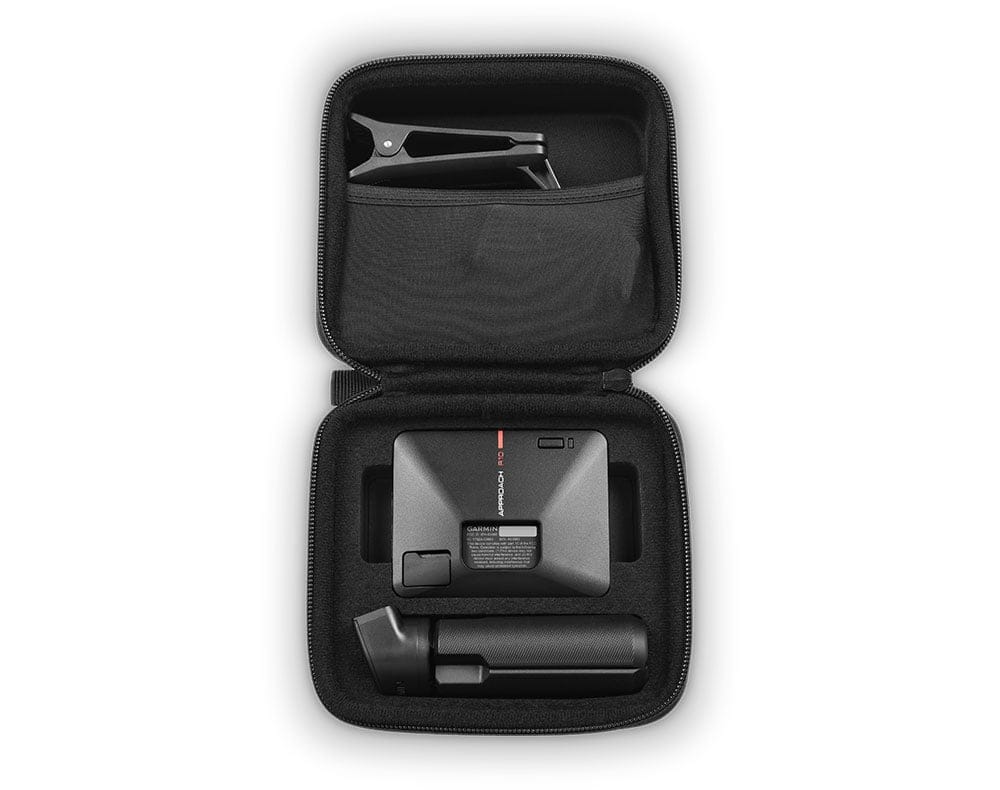
Garmin Approach R10
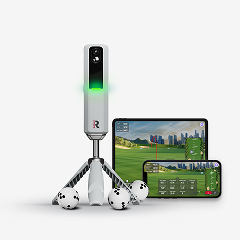
Rapsodo MLM2PRO
Option 2: low-tech proxies. No monitor, no problem, just less precision.
For driver: tee a ball at normal height. After your swing, pick the tee out of the ground. If it sits in front of where the ball was, the low point is past the strike, meaning negative AoA. If it is still standing or pushed back, the low point is behind, meaning positive.
For irons: take a normal pass on the practice mat. Look at the divot. If it starts at or behind the ball, your AoA is too shallow. If it starts a couple of inches in front, you are ball-first, turf-second, which is what you want.
Option 3: phone apps. Shot Vision, GolfTrak and similar give directional data at lower accuracy than dedicated units. Good for trend-spotting, not absolute numbers.
How to Fix a Negative Driver Attack Angle
Four setup adjustments. None require a swing change. All testable in 15 minutes on the range with a launch monitor or the tee-pick-up proxy.
1. Move the ball forward in your stance. It should sit off the inside of the lead heel, or about under the lead armpit. Forward position lets the head bottom out before it reaches the strike, so it is traveling upward through contact.
2. Tee the ball higher. Half should sit above the crown of the driver at address. A high tee is a physical cue: you cannot dig down to something that is sitting up, so your body adjusts the path on its own.
3. Tilt your spine away from the target. A small bump of the lead hip toward the target at address pushes the trail shoulder lower than the lead shoulder. That tilt is the position that produces a positive number at impact. The cue I use: imagine you are about to skim a stone with your trail hand.
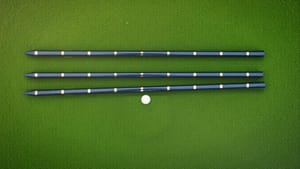
4. The alignment stick drill. Push a stick into the ground a foot behind the ball, angled so the top points toward your trail shoulder. Take normal passes without clipping it. If you do, your AoA is steep and your hands too high. The stick forces a shallower bottom-out point ahead of the strike.
One caveat. When you change AoA, your optimal driver loft moves with it. A player at -2 degrees needs more static loft than the same player at +3, because spin loft is what the club delivers, and a shallower angle thins it fast. If you raise your number, choosing the right driver loft depends on your attack angle and you may need to loft up. Same logic for shaft flex.
If the driver still feels short after fixing AoA, the issue might be club choice off the tee. On the right hole, the driver versus 3-wood tradeoffs come down to your spin and launch numbers.
Frequently Asked Questions
What should my attack angle be with a driver?
For most amateurs, the target window is +1 to +5 degrees. The LPGA Tour average is +2.8 degrees and the carry-distance benefit is largest at swing speeds under 100 mph. PGA Tour players average -0.9 degrees, but they swing at 113 to 118 mph where launch geometry is more forgiving. If you swing the driver below 100 mph, get the number positive, because that is where the carry gains live.
How much distance does attack angle affect?
A lot. Trackman's comparison of +5 against -5 degrees AoA shows 21 to 25 yards (19 to 23m) of carry difference across speeds from 75 to 100 mph. For a 14.5-handicapper at -1.8 degrees, moving to +3 is a 4.8 degree shift, worth about 22 to 25 yards (20 to 23m) of carry on the same swing. No speed gain required.
Is it OK to hit down with the driver?
It is OK if you swing at Tour speed. It is not OK if you don't. PGA Tour players average a small negative AoA at -0.9 degrees because they make enough ball speed to carry the geometry. At amateur swing speeds in the 80 to 95 mph range, a negative driver AoA inflates spin, kills smash factor, and steals 15 to 25 yards (14 to 23m) of carry compared to a positive number. For amateurs, the answer is no.
Does attack angle matter for irons?
Yes, in the opposite direction. With irons you want a negative AoA so the low point of the swing sits past the ball. That sequence compresses the ball, creates spin, and produces the descent angle that holds a green. Foresight Sports testing showed a 7-iron at -6 degrees carries 21.7 yards (19.8m) further than the same 7-iron at +2 degrees, with a better landing angle. The Tour average for a 6-iron is -3.7 degrees, so hitting down is the goal.
How do I check my attack angle at home without a launch monitor?
Use the tee proxy for driver. Tee a ball at normal height, hit a shot, then check where the tee landed. A tee in front of the original ball position means the club bottomed out past the ball, which is a negative AoA. A tee that stayed in place or got pushed back means a positive number. For irons, check your divot pattern on a range mat or on real turf. A divot that starts at or behind the ball means your AoA is too shallow. A divot that starts a couple of inches ahead of the ball is ball-first contact, which is what you want.
The fastest 25 yards (23m) most amateurs will ever find sits in their setup, not their swing. Get on a launch monitor, or use the tee-pick-up trick if you don't have one. Find your number. If it is negative with the driver, fix the ball position and the spine tilt before spending another dollar on shafts, balls, or speed sticks. Check it again in two weeks. The same motion should be putting up different numbers.
Some links in this article are affiliate links. If you buy through them, I earn a small commission at no extra cost to you. This never influences what I cover or recommend. I link to gear I'd buy myself.







The golf newsletter that cuts the hype
Data-backed reviews and advice that works. No brand spin.
Recommended products

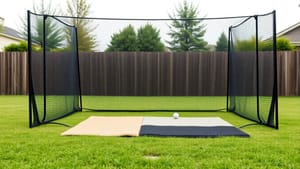
Rukket SPDR Golf Net Review: 10x7 Bundle for Home Practice.
The Rukket 10x7 SPDR golf net bundle reviewed: what's actually in the box, what MyGolfSpy and PluggedInGolf found, and who it fits best.
Read review