Putter Length Guide: How to Find the Right Fit
The right putter for most male golfers is 33.5 to 34.5 inches, not the 35-inch shop standard. Here's how to measure yours and cut three-putts in the process.
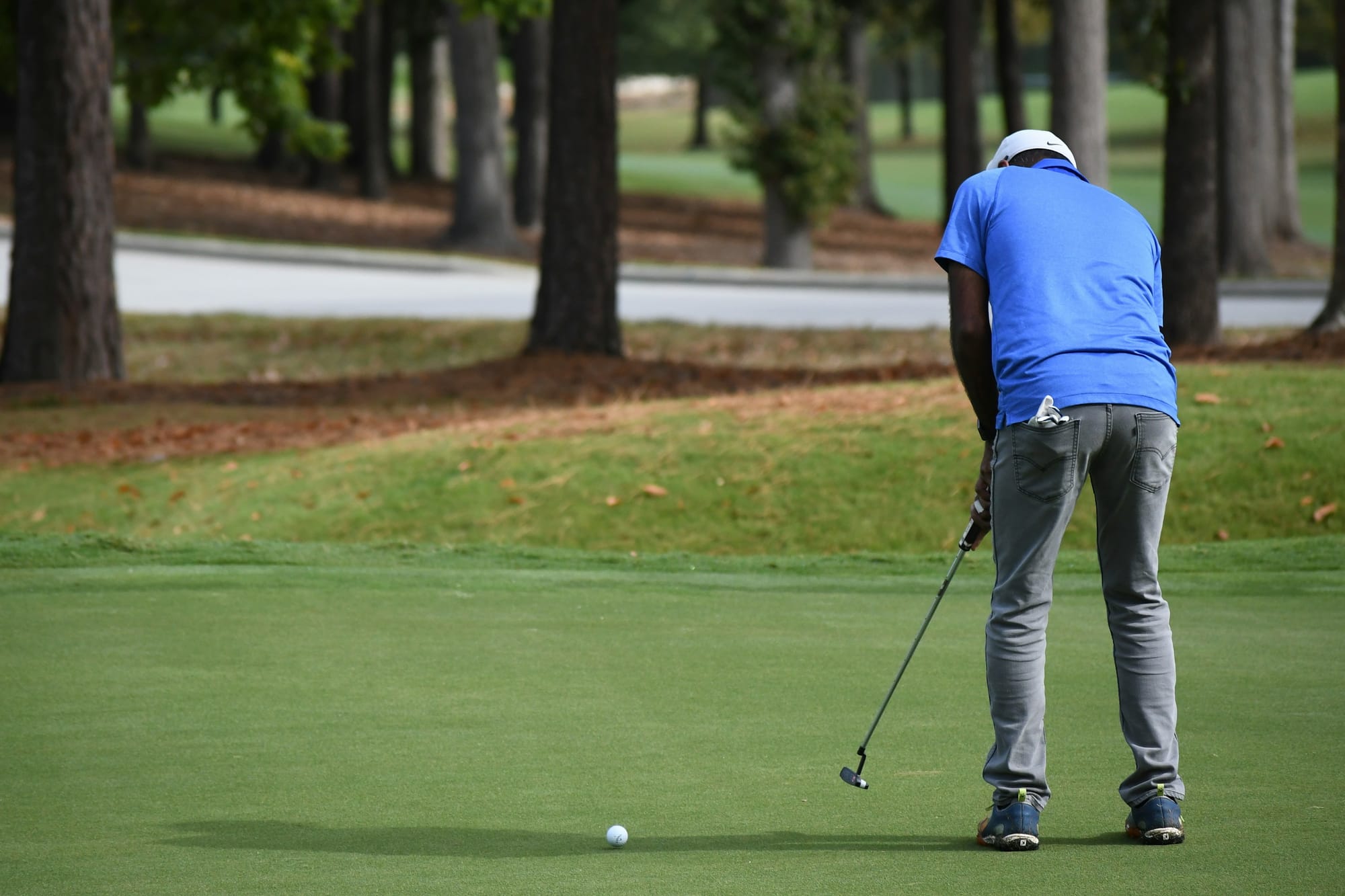
Photo by Gene Gallin on Unsplash
TL;DR
- The 35-inch (89cm) retail default fits very few golfers. GolfWorks states both men and women almost always need a smaller size.
- PGA Tour pros average 33 to 33.5 inches (84 to 85cm), well below shop spec.
- Use the wrist-to-floor method in your address posture as the starting point. Stance shape beats raw height.
- A wrong-fit club changes face rotation, lie angle, and eye position over the ball. Together those three faults produce the misses you're already making.
- Only 35% of full bag fittings include the flat stick (MyGolfSpy survey). It's the highest-ROI session amateurs skip.
What the Standard 35-Inch Putter Is Getting Wrong
The 35-inch (89cm) wand became the retail standard decades back, when the typical male customer was treated as a 6-foot (183cm) golfer. Few are. Adult males in the US clock 5'9" (175cm), and once you factor in normal stance over the ball, the math stops working.
GolfWorks, one of the most cited fitting authorities in the industry, puts it plainly: "both men and women golfers will almost always fit into shorter lengths than those offered as standard." That isn't a soft preference. It's a near-universal finding.
The PGA Tour average sits at 33 to 33.5 inches (84 to 85cm). Brad Faxon gamed a 33.25-inch wand for years. Jim Furyk has worked at 33. Even big guys like Adam Scott have gone below the rack figure, because size is set by posture, not height.
So why is it still 35? Shortening is a thirty-dollar shop job and lengthening is a hassle. Manufacturers ship long, retailers stock long, and the buyer never looks down to ask whether the shaft fits.
How to Measure for Your Correct Putter Length
You need a tape measure, golf shoes, and a hard, level floor. This reading is what every major fitter starts with, and it works because it captures your real setup, not a generic chart number.
Wrist-to-floor measurement is the method of measuring from your wrist crease to the floor while you stand in your normal putting address. It's the closest thing to a self-fit that exists.
The wrist-to-floor steps
- Put on the golf shoes you play in. Heel thickness changes the answer.
- Stand on a hard, level surface. Carpet skews the result.
- Take your regular putting position: slight knee bend, slight forward tilt from the hips, arms hanging.
- Let your arms hang under your shoulders with elbows soft.
- Measure from the crease at the base of your palm straight down to the floor.
- That number, in inches, is your starting club length.
- Cross-check it. At that mark, your eyes should sit over the ball, or just inside it. If they're well inside the line (more than 2 inches / 5cm), shorten. If they sit outside, lengthen.
Height-to-putter-length starting chart
Height is a useful starting point only. Posture shifts the answer by half an inch (1.3cm) to a full inch (2.5cm) in either direction.
| Height | Suggested Putter Length |
|---|---|
| Under 5'0" (152cm) | 32" (81cm) or shorter |
| 5'0" to 5'2" (152 to 157cm) | 32.5" (83cm) |
| 5'2" to 5'4" (157 to 163cm) | 33" (84cm) |
| 5'4" to 5'6" (163 to 168cm) | 33.5" (85cm) |
| 5'6" to 5'8" (168 to 173cm) | 34" (86cm) |
| 5'8" to 6'0" (173 to 183cm) | 34" to 34.5" (86 to 87cm) |
| 6'0" to 6'2" (183 to 188cm) | 35" (89cm) |
| 6'2" to 6'4" (188 to 193cm) | 35.5" (90cm) |
| Over 6'4" (193cm) | 36" (91cm) |
The caveat the chart can't capture: stance beats height. An upright golfer who stands tall over the ball might need an extra half inch (1.3cm). One who crouches deep, hands lower, will need to come down. That's why the wrist-to-floor reading matters more than the table.
How Does Putting Style Affect Putter Length?
Stroke style changes the ideal length because different motions ask the body to do different things at address. A straight-back-straight-through (SBST) stroke wants the eyes over the ball, which pulls posture upright and suits a slightly longer club. An arc stroke, where the path moves inside on the backswing and back inside on the follow-through, prefers the eyes just inside the ball and suits a shorter shaft.
The fit also feeds into head selection. Face-balanced mallets (the face points at the sky when you balance the shaft on a finger) suit minimal-arc strokes. Toe-hang blades, where the toe drops toward the floor, suit pronounced arc strokes. If you've been fighting your flat stick, the head shape might be wrong for your stroke, and the wrong length amplifies it.
The connection runs both ways. Too long pushes you upright, flattens the lie angle, and encourages SBST motion. Too short pushes you into a crouch, steepens the lie, encourages arc. If you've changed putters and your stroke shape changed with it, the club did that, not your hands.
Ever felt like a wand "pulled" you into a different posture? That's the spec doing its job, for better or worse.
What Happens When Your Putter Is the Wrong Length
Three things go wrong, and they compound.
First, face rotation changes. Face rotation is the amount the clubface opens and closes during the stroke. True Spec Golf ran high-speed camera tests in 2017 and found a too-long club rotated the face beyond the target range; a too-short one rotated below it. The conclusion, quoted in the GolfWorks guide: "length equally affects both distance control and directional control."
Second, lie angle goes off. A shaft that's too long forces the heel up, the toe drops, the path tilts, and the ball gets pushed or pulled depending on how you compensate. Too short raises the toe, again tilting the path. Most amateurs feel this as a chronic miss one direction and assume it's their stroke.
Third, eye position drifts. Stand too tall and your dominant eye sits inside the line, which makes putts look like they're breaking left when they're not. Crouch too low and your eyes sit outside the line, producing the opposite illusion. You aim where you see, so the read goes wrong before the stroke starts.
The compound effect is grim. A wrong-fit flat stick produces a path that fights itself, a face that rotates the wrong amount, and a read that doesn't match reality. Then the golfer goes home and works on alignment.
Why Putter Fitting Is the Most Overlooked Fitting
Shot Scope tracks millions of amateur rounds and publishes three-putt frequency by handicap bracket. The numbers are uncomfortable.
A 15-handicap averages 3.8 three-putts per round. A 20-handicap averages 4.6. A 25-handicap averages 5.8. That's four to six dropped strokes a round, and the gap between an 18-handicap and a 14-handicap often comes down to lag putting and the resulting three-putts.
Despite that, only 35% of club fittings include the flat stick, per a MyGolfSpy survey I dug into when I wrote about what a proper club fitting actually covers. The other 65% walk out with fresh irons and a 35-inch (89cm) club that doesn't fit.
Here's the ROI argument. A new driver runs $500 to $700 and might earn you a few extra yards. A new iron set is $1,200+ and might tighten dispersion. A putter fitting is $50 to $100, sometimes free with purchase, and saves the average amateur one to two strokes per round on day one. No other intervention in golf has that ratio. If you're playing off 15 or higher, it's the easiest stroke-saving change in the bag, and most golfers walk past it.
If you've worked on green reading and pace without much progress, the club is the next variable. What I wrote on cutting three-putts covers the technique side; this one covers the equipment side. Same problem.
A Note on Long Putters and the 2016 Anchoring Ban
The language gets misused, so worth clearing up. The USGA and R&A banned the anchored stroke under Rule 14-1b (now Rule 10.1b), effective January 1, 2016. The ban prohibits anchoring the club, or a forearm, against the body. It does not ban the equipment.
Long and belly putters remain legal kit. You can carry a 50-inch (127cm) broomstick as long as you don't anchor it against your sternum or your forearm against your chest. The hands have to swing the shaft free of the body.
The most common modern workaround is the arm-lock putter, where the grip rests against the lead forearm but the forearm itself isn't anchored. Bryson DeChambeau and Webb Simpson have used arm-lock since the ban. Legal, repeatable under pressure, and arm-lock builds run 38 to 42 inches (97 to 107cm) with stiffer shafts for the forward press.
If your old belly putter is in the garage, it's still tournament-legal. The stroke that worked with it isn't.
Putter Picks Worth Looking At
Two clubs that come in the right sizes and back it up with build quality. Both are available in 33-, 34-, and 35-inch (84, 86, and 89cm) options via Amazon's variant selector, which matters because most retail listings default to 35 without making the alternatives obvious.
Odyssey White Hot OG #7 Nano Flow (~$219)
The White Hot insert has a longer competitive record than any face in golf. The #7 head is a winged mallet with two parallel alignment lines, face-balanced, suited to a minimal-arc stroke. Nano Flow is the lighter shaft variant for golfers sensitive to head feel. Available on Amazon in 33, 34, and 35 inch (84, 86, and 89cm) options.
Odyssey White Hot OG #7 Nano Flow
TaylorMade Spider Tour X Small Slant (~$349.99)
The Spider Tour family has been the most-used mallet on the PGA Tour for years. The Small Slant hosel produces around 30 degrees of toe hang, suiting a slight-arc stroke (most amateurs, without knowing it). Stable, forgiving, and the right pick if your old blade kept pulling left. Available on Amazon in 33, 34, and 35 inch (84, 86, and 89cm) options.
TaylorMade Spider Tour X Small Slant
Both make the list because they come in the sizes the data says you need. If your shop only stocks 35-inch, walk out and order online. A shop can shorten a putter, but doing it on the wrong head is wasted money.
Frequently Asked Questions
What is the standard putter length?
The men's retail default is 35 inches (89cm). The women's default is 33 inches (84cm). Both numbers exist for inventory reasons more than fitting reasons. According to GolfWorks, most golfers, men and women, fit into something shorter than the off-the-shelf number once posture is taken into account.
How do I know if my putter is too long?
Three signals. Your hands sit higher than your belt buckle, with elbows pinned out instead of hanging soft. Your eyes are well inside the ball line when you look down (more than 2 inches / 5cm inside). You fight a chronic pull or push that alignment work doesn't fix. Any one is a flag. All three together means the club is the problem, not your stroke.
What length putter do PGA Tour pros use?
The PGA Tour average sits at 33 to 33.5 inches (84 to 85cm), well below the 35-inch (89cm) retail default. Brad Faxon played a 33.25-inch club. Jim Furyk has worked at 33. Tour pros set length by posture and stroke shape, not by height, and most stand over the ball lower than amateurs assume.
Should tall golfers use a longer putter?
No, not as a rule. Height is one input. Posture is the bigger one. A 6'2" (188cm) golfer who bends deep into the stroke might fit into a 34-inch (86cm) club. A 5'10" (178cm) golfer who stands tall might need 34.5 inches (87cm). The wrist-to-floor measurement in your address posture beats your height every time.
Can I still use a belly or long putter?
Yes. Rule 10.1b bans the anchored stroke, not the equipment. Long and belly putters remain legal as long as you don't anchor the club or your forearm against your body. Arm-lock putters, where the grip rests against the lead forearm without the forearm itself being anchored, are a popular and legal modern alternative.
The Two-Minute Test
Pull your putter out, put your golf shoes on, and run the wrist-to-floor measurement on a hard floor. If your number sits more than half an inch (1.3cm) below the length stamped on the shaft, you've been playing the wrong club. A local pro shop will shorten and re-grip for $30 to $50, often same-day. Cheapest stroke-saving change in golf, sitting in your bag right now waiting for someone to notice.
Some links in this article are affiliate links. If you buy through them, I earn a small commission at no extra cost to you. This never influences what I cover or recommend. I link to gear I'd buy myself.







The golf newsletter that cuts the hype
Data-backed reviews and advice that works. No brand spin.
Recommended products