 Buy now








how-to
How to Hit a Fairway Wood Off the Ground
You can smash a 3-wood off a tee. Put the same club on the turf and the
83% of three-putts start outside 30 feet. Fix distance control on the first putt and cut three-putts fast, backed by Shot Scope, Arccos, and SAM PuttLab data.
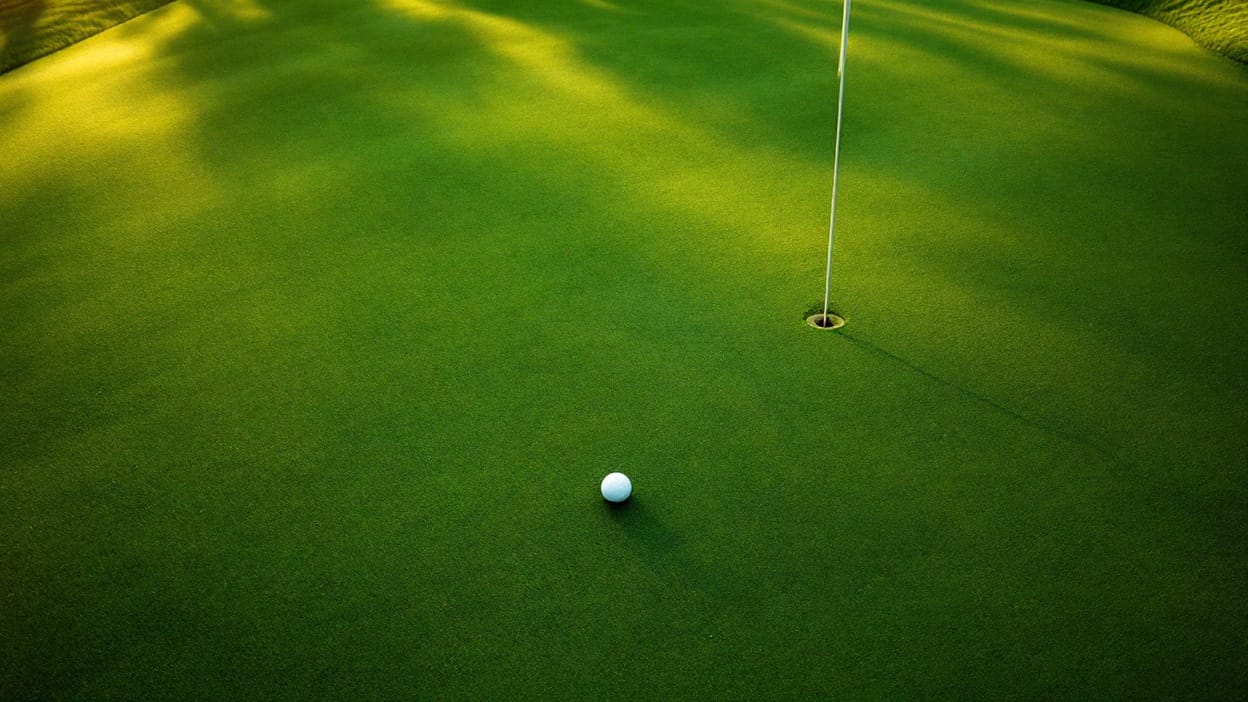
Three-putting is a distance control problem, not a green reading problem. Shot Scope data, reported by MyGolfSpy, shows that 83% of three-putts begin from outside 30 feet (9.1m). The first lag rolls too far past or pulls up too short, and the second putt becomes a 4 to 6 footer you weren't expecting to face. Fix the first-putt distance, and you cut the problem at its root.
That doesn't mean green reading and mechanics are irrelevant. They just rank lower in the cause hierarchy. What follows is ordered by impact, starting with the fix that covers 83% of the problem.
Arccos analyzed over 75 million shots across about one million rounds (November 2017) and found three-putt rates climb fast as handicap rises:
| Handicap Range | Three-Putt Rate | Per Round |
|---|---|---|
| 1 to 5 | 9.44% | ~1.6 |
| 6 to 10 | 11.71% | ~2.0 |
| 11 to 15 | 14.51% | ~2.5 |
| 15+ | 19.58% | ~3.2 |
A 15+ handicapper three-putts at double the rate of a scratch player. That's 1.6 extra strokes per round, from putting alone.
Here's the counterintuitive part. Mark Broadie's Every Shot Counts (Columbia University Press, 2014) showed that putting accounts for only 15% of the scoring difference between an 80 and a 90 shooter. Approach shots account for 40%. Mid-handicappers over-practice on the green and under-practice from 100 to 150 yards (91 to 137m). But within the 15% that putting does control, three-putt elimination is the single highest-leverage fix. If you want to see how strokes gained breaks down across your full game, I've got a strokes gained breakdown that maps the whole picture.
There's a threshold distance where three-putts become more probable than one-putts. Golf.com, citing Arccos data, puts it at 25 feet (7.6m) for a 20 handicapper, 28 feet (8.5m) for a 10, and 29 feet (8.8m) for scratch. Once you cross that line, the odds shift against you.
That 83% figure from Shot Scope deserves more context. It doesn't just mean "long putts are harder." It means the overwhelming cause of three-putting is a first putt that finishes too far from the hole to make the second one routine.
A 15-handicapper putting from 30 feet (9.1m) leaves their lag an average of 5.5 feet (1.7m) from the hole. PGA Tour players, from the same distance, leave it at 2 feet 4 inches (0.7m). That gap, about 3 feet (0.9m), is the entire problem. At 5.5 feet (1.7m), the make rate for a 15 handicapper drops to the 40% range (see the table below). At 2 feet 4 inches (0.7m), Tour players are above 90%.
The late short-game researcher Dave Pelz spent decades studying this relationship. His finding: fixing speed makes green reading more reliable, not the other way around. If you roll a putt 4 feet (1.2m) past the hole instead of 17 inches (43cm), even a perfect read will miss. Speed and line are not independent variables. Get speed right and your reads start working.
This table, from Shot Scope, shows how make rates collapse once you move beyond 6 feet (1.8m):
| Distance | 0 HCP | 5 HCP | 10 HCP | 15 HCP | 20 HCP | 25 HCP |
|---|---|---|---|---|---|---|
| 0 to 6ft (0 to 1.8m) | 92.8% | 90.2% | 89.3% | 84.4% | 84.0% | 82.5% |
| 6 to 12ft (1.8 to 3.7m) | 42.8% | 41.4% | 38.1% | 39.6% | 37.8% | 35.0% |
| 12 to 18ft (3.7 to 5.5m) | 25.1% | 23.9% | 20.2% | 20.2% | 18.8% | 16.0% |
| 18 to 24ft (5.5 to 7.3m) | 14.5% | 13.0% | 10.3% | 11.2% | 11.8% | 10.1% |
| 24 to 30ft (7.3 to 9.1m) | 8.3% | 10.1% | 5.4% | 7.8% | 6.8% | 6.3% |
| 30+ft (9.1m+) | 4.3% | 4.3% | 2.8% | 3.2% | 1.9% | 2.3% |
The drop-off from 0 to 6 feet (0 to 1.8m) to 6 to 12 feet (1.8 to 3.7m) is a cliff. A 15-handicapper goes from 84.4% to 39.6%. That's why the goal of every lag putt is simple: get the ball inside 6 feet (1.8m).
SAM PuttLab measured 99 PGA Tour players (2007) and found a consistent stroke timing pattern: 670 milliseconds on the backswing, 317 milliseconds on the through-swing. That's a 2.1:1 ratio, and it stayed consistent regardless of putt length. Amateurs show high variability in this ratio, which produces unpredictable distances. The backswing length changes for a 10-footer (3.0m) versus a 40-footer (12.2m), but the tempo ratio stays the same.
Phil Kenyon, putting coach to Rory McIlroy, Brooks Koepka, Justin Rose, and Tommy Fleetwood, teaches a speed control hierarchy: mechanics first, then rhythm and tempo, then touch and feel. He makes the point that speed control matters as much from 8 feet (2.4m) as from 30 feet (9.1m). It's not just a lag skill.
Tip
Count "one-two" on the backswing and "three" on the through-stroke. The through-stroke should be about half the duration of the backswing. Practice this rhythm on 10-foot (3.0m) putts first, then carry it to longer distances without changing the count, only the backswing length.
Pelz's research showed that the optimal putt speed carries the ball 17 inches (43cm) past the hole if it misses. Faster than that, and the ball breaks less, making your read wrong. Slower, and the ball is more affected by imperfections in the green surface. That 17-inch (43cm) window also keeps the comeback putt inside a comfortable range.
A 2017 study by Fazeli, Taheri, and Saberi Kakhki, published in Perceptual and Motor Skills (DOI: 10.1177/0031512517704106), tested 30 participants over six days with a one-week retention test. The group that practiced putting to random distances showed better long-term retention than the group that repeated the same distance in blocks. The random group also developed more structured mental representations of the task. This validates what good coaches have been prescribing for years: vary your distances.
The Clock Drill: Place four balls at 20 feet (6.1m), 25 feet (7.6m), 30 feet (9.1m), and 35 feet (10.7m) from the hole, arranged like clock positions. Putt one ball from each distance, rotating through them. Never putt the same distance twice in a row. The goal isn't to make the putt. The goal is to leave every ball within a 3-foot (0.9m) circle around the hole.
The Gate Drill (Lag Version): Set two tees 3 feet (0.9m) apart, centered behind the hole at various distances. Lag putts through the gate. Move the gate to a new distance after every three attempts.
Even with better lag skills, you'll face second putts from 3 to 6 feet (0.9 to 1.8m). Shot Scope data shows a 15-handicapper makes 84.4% of putts inside 6 feet (1.8m). That means about 1 in 6 miss. Over 18 holes with 30+ putts, those missed short ones accumulate.
Face angle at impact determines 83% of where the ball starts, according to SAM PuttLab / Science and Motion. Path contributes just 17%. For putts inside 6 feet (1.8m), which have minimal break on most greens, this means aim is the dominant variable. If your putter face is square at impact, the ball goes where you're looking.
Keeping the routine short prevents the "freeze and steer" pattern that causes deceleration on short putts.
Gate Drill (Short-Putt Version): Place two tees just wider than your putter head, 4 feet (1.2m) from the hole. Stroke putts through the gate. If the ball passes through the tees, your face angle is close to square. Set up 10 balls and track your percentage. A repeatable 8 out of 10 at 4 feet (1.2m) means your face control is solid.
PuttOUT Premium Pressure Putt Trainer
A built-out version of the gate drill above: a sloped mat with a raised gate that only lets a squarely struck putt of the right speed pass through and drop in a return channel. Off-line or mis-hit putts get kicked away, so every rep gives instant pass/fail feedback without needing tees or a hole.
This is the fix most golfers skip because it doesn't happen on the green. If your approach shot lands outside 30 feet (9.1m), you're in three-putt territory before you pull the putter out of the bag.
Broadie's data is clear: approach shots account for 40% of the scoring gap between an 80 and 90 shooter. Getting your approaches inside 30 feet (9.1m), from 25 feet (7.6m) instead of 40 feet (12.2m), cuts three-putt probability in half.
This doesn't require better ball-striking. It requires better decisions. Aim for the center of the green on approach shots over 150 yards (137m). Stop firing at pins tucked behind bunkers. Play the percentages. A 30-foot (9.1m) putt from the middle of the green is a two-putt. A 15-foot (4.6m) putt from the wrong tier after a pin-seeking approach might be a three-putt.
Note
If you're tracking your game with a rangefinder, knowing exact distances to the center of the green (not just the pin) changes your target selection. I've compared the best rangefinders for this kind of course management if you're in the market.
Most golfers warm up by rolling a few balls at a single hole from whatever distance they happen to stand. The Fazeli et al. (2017) research shows why this doesn't stick: blocked repetition at one distance builds short-term comfort but poor long-term retention.
PGA.com instructor Brendon Elliott recommends allocating 40% of practice time to putting. For a golfer who practises for an hour, that's 24 minutes. Here's how to spend a focused 20-minute session using randomised distances, based on the research:
Minutes 1 to 8: Lag Putting (Randomised) Clock drill. Four balls at 20, 25, 30, and 35 feet (6.1, 7.6, 9.1, and 10.7m). Rotate after each putt. Target: all four balls inside 3 feet (0.9m) of the hole. Run through the circuit three times. Count how many finish inside the target zone out of 12 total attempts.
Minutes 9 to 14: Short Putts (Gate Drill) Place the tee gate at 4 feet (1.2m), then 5 feet (1.5m), then 6 feet (1.8m). Five putts at each distance. Track your make rate. If you're below 70% at any distance, that's where you need the most reps.
Minutes 15 to 20: Pressure Finish One ball. Pick a random spot on the green, at least 25 feet (7.6m) from the hole. Lag it close, then make the second putt. If you miss either, start over. Complete three consecutive up-and-downs to finish the session.
Tip
Track your results across sessions. Write down your clock drill zone percentage and short-putt make rate. Progress over four weeks is more informative than any single session.
If you want a broader framework for turning solid practice reps into lower scores on the course, not just on the practice green, the Break 100 With the Swing You Already Have guide covers the course-management side of the equation, including how to build a hole strategy before you've hit your approach shot.
Arccos data (2017, 75 million+ shots) shows a 15+ handicapper averages about 3.2 three-putts per round, with a three-putt rate of 19.58%. If you're in the 11 to 15 range, expect about 2.5 per round at a 14.51% rate. Getting below 2 per round is a strong benchmark for a mid-handicapper working on this part of the game.
The clock drill with randomised distances. Research by Fazeli et al. (2017, Perceptual and Motor Skills) found that practicing at varying distances produces better long-term retention than repeating the same distance. Place four balls at 20, 25, 30, and 35 feet (6.1, 7.6, 9.1, and 10.7m) and rotate through them. The goal is to leave every ball within 3 feet (0.9m) of the hole.
Speed. Dave Pelz's research showed that correct speed makes your line reads more accurate, not the other way around. If you roll the ball 4 feet (1.2m) past the hole, even a perfect read misses. The target is 17 inches (43cm) past the hole. Get the speed right and your reads start working.
SAM PuttLab measured 99 PGA Tour players and found a 2.1:1 ratio of backswing to through-stroke duration: about 670 milliseconds back, 317 milliseconds through. This ratio holds across all putt lengths. The backswing gets longer for distance, but the tempo stays the same. Count "one-two" back and "three" through.
Less than you'd think. The dominant cause of three-putts is distance control failure, not misreads. Shot Scope data shows 83% of three-putts start from outside 30 feet (9.1m), where the challenge is rolling the ball close enough, not picking the right line. As Pelz documented, fixing speed control makes your reads more accurate as a secondary benefit. Green reading improvement has the biggest payoff on mid-range putts (8 to 15 feet / 2.4 to 4.6m), where the line matters more because you're aiming to make it.
The three-putt problem is a distance control problem, and fixing it doesn't require a new putter or a green-reading book. It requires structured practice at varied distances, a consistent tempo, and the discipline to aim for the middle of greens on approach shots. Start with the clock drill at your next practice session, track your zone percentage, and see where you are in four weeks.
Some links in this article are affiliate links. If you buy through them, I earn a small commission at no extra cost to you. This never influences what I recommend. I link to gear I'd buy myself.
Data-backed reviews and advice that works. No brand spin.