








how-to
How to Hit a Fairway Wood Off the Ground
You can smash a 3-wood off a tee. Put the same club on the turf and the
Interlocking, overlapping, and ten-finger: how to build each grip correctly, and what your hand size and strength say about which one fits.
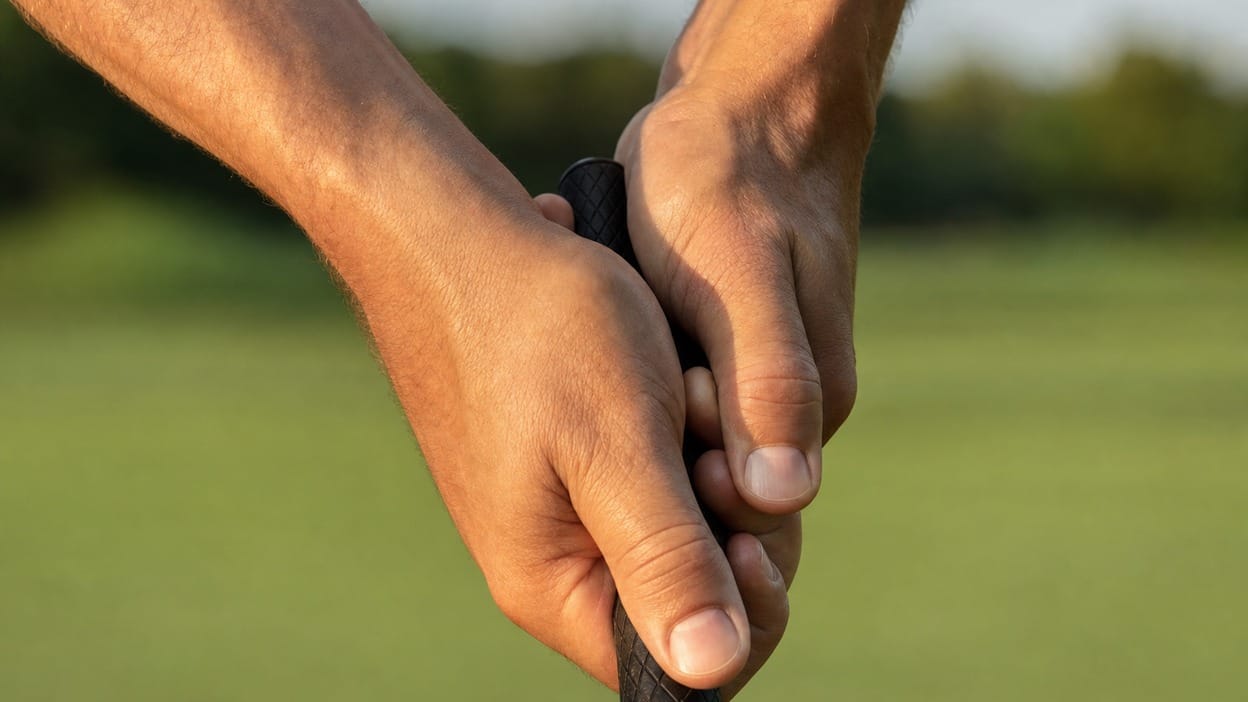
A golf grip that's a few degrees off can quietly produce a slice, a hook, or a shank, and it's usually the last thing anyone checks. A bad shot gets blamed on swing path or tempo, while the two hands actually holding the club get overlooked entirely. Fixing it doesn't require rebuilding your swing. It requires picking one of three established grip styles, building it correctly, and checking it often enough that an old habit doesn't creep back in. The instructions below are written for a right-handed golfer; if you play left-handed, mirror every step.
Interlocking grip. This links your hands into a single unit by hooking one finger together, which is why many players with smaller hands or shorter fingers gravitate toward it, though any golfer can use it. To build it:
Overlapping grip, also called the Vardon grip. This is the grip most widely taught to golfers with average-to-larger hands, since the fingers are long enough to overlap comfortably without forcing a hook. The first two steps are the same as above, then:
Ten-finger grip, also called the baseball grip. All ten fingers stay on the club, with none overlapping or interlocking, which gives players with limited hand or wrist strength, including many juniors and golfers managing arthritis, more independent leverage from each hand. To build it:
None of the three grips is objectively better; each one solves a different physical problem. Smaller hands or shorter fingers tend to struggle to interlock two fingers that don't quite reach each other comfortably in the overlapping grip, which is why interlocking is the more common recommendation there: it physically locks the hands together even when the fingers are short. Average-to-larger hands, and longer fingers in particular, usually find overlapping the more natural fit, since there's enough finger length to rest comfortably across the gap without straining. Limited hand or wrist strength changes the calculus entirely: the ten-finger grip trades some of the unified feel of the other two for more independent power from each hand, which is why it's the standard recommendation for junior golfers still building strength and for golfers managing arthritis or a hand injury. If you've never built any of the three deliberately, start with overlapping. It's the grip taught most often to new golfers with no strong reason to choose otherwise, and it's easy to switch away from later if your hands tell you something different.
Grip pressure gets treated like a mystery, but most instructors teach it on a simple one-to-10 scale, where 10 is a white-knuckle death grip and one is barely holding on. The target for a full swing sits around a four or five: firm enough that the club can't twist open or closed in your hands at impact, loose enough that your wrists can still hinge freely on the backswing and release naturally through the ball. A grip pressure that creeps toward eight or nine locks the wrists and turns the golf swing into an arm swing, which is one of the more common sources of lost distance that has nothing to do with strength or technique.
Where the club sits in your hands matters as much as how hard you hold it. The club should run diagonally through the fingers of both hands, not flat across the palm. A palm-heavy grip feels more secure at address, which is exactly why golfers drift into it, but it locks the wrist joint and turns what should be a hinge into a fixed connection. Fingers, by contrast, let the wrist cock on the way back and release through impact, which is where most of a golf swing's clubhead speed actually comes from.
A grip described as "too strong" or "too weak" isn't about how hard you're squeezing, it's about how far your hands are rotated on the handle relative to neutral. A strong grip has both hands rotated clockwise on the club, which tends to close the clubface through impact and produces a hook or a low, running shot. A weak grip has both hands rotated counterclockwise, opening the face and producing a slice or a high, weak fade. Neither fault shows up as a feeling; it shows up in ball flight, which is exactly why a quick visual check matters more than trusting how the grip feels in your hands.
Two checks catch almost every grip fault. First, look down at address and count the knuckles visible on your lead hand: two to three knuckles is roughly neutral, zero to one is weak, and four is strong. Second, check where the V formed by the thumb and forefinger of each hand points. On a neutral grip, both V's point toward your trail shoulder; a V pointing toward your chin or lead shoulder signals a weak grip, and a V pointing outside your trail shoulder signals a strong one. My own hands are on the smaller side, and I switched from overlapping to interlocking about a decade ago after struggling to keep the club connected through faster swings; it took a full season of deliberately checking my knuckle count before the new grip stopped feeling like a compromise.
A grip trainer can shorten that adjustment window. The SKLZ Golf Grip Trainer clips onto the handle and marks exactly where each hand should sit, which is useful specifically during the stretch where you're unlearning an old grip and can't yet trust your own hands to find the new position without a visual reference. It isn't required to build any of the three grips correctly; a mirror and the knuckle-and-V check above work just as well, the trainer just removes the guesswork while the new habit sets in.
Once a neutral grip is second nature, adjusting it slightly stronger or weaker on purpose, rather than by accident, is exactly how better players start shaping shots, a subject covered in How to Hit a Draw in Golf, on Command. And if you're still assembling your first set of clubs alongside sorting out your grip, Golf Equipment for Beginners: What to Buy First covers the rest of what actually matters early on.
The interlocking grip is the most common recommendation for smaller hands or shorter fingers, since hooking one finger between the other physically unifies the hands even when the fingers don't reach comfortably across each other the way the overlapping grip requires.
Aim for roughly a four or five on a one-to-10 scale, where 10 is a white-knuckle squeeze. That's firm enough to control the club through impact without locking your wrists, which is what happens when pressure creeps toward eight or nine.
Look down at address and count the knuckles visible on your lead hand: two to three is neutral, zero to one is weak, and four is strong. Then check where the V formed by each hand's thumb and forefinger points; both should point toward your trail shoulder on a neutral grip.
Some links in this article are affiliate links. If you buy through them, I earn a small commission at no extra cost to you. This never influences what I cover or recommend. I link to gear I'd buy myself.
Data-backed reviews and advice that works. No brand spin.