A category-leading distance number, and the tradeoff that comes with it
The Callaway Elyte X is built for one job: more distance than your current irons, with enough forgiveness that a mishit still gets you most of the way there. Independent testing backs up the distance claim more clearly than almost anything else in the super game-improvement (SGI) category. What that testing also shows is a real tradeoff, and whether that tradeoff works for you depends entirely on the kind of miss you're used to living with. Callaway has since moved on from the Elyte line: the Quantum Max, which replaces the Elyte X specifically, launched January 16, 2026, so the set covered here is now a generation behind Callaway's current game-improvement iron.
The verdict: category-leading distance with a wider dispersion spread than most SGI irons, best suited to higher-handicap golfers who mishit often and want those misses to still travel.
MyGolfSpy's 2025 SGI test scored the Elyte X 8.5/10 overall and 9.2/10 on distance, the top distance number in the category.
The cost of that distance is accuracy: dispersion runs wider than category average, and MyGolfSpy specifically flags fitting as worth doing given the spread.
Who it's for: higher-handicap and improving golfers prioritizing distance and forgiveness over shot-shaping control.
Who should skip it: low-handicap golfers who already shape shots and would rather trade some distance for tighter dispersion.
Where it sits now: Callaway's Quantum Max succeeded the Elyte X in January 2026. This review covers the Elyte X on its own terms, one generation back.
What the Elyte X actually is
Spec
Detail
Set makeup
5-iron through PW + AW (7 clubs)
Construction
Hollow-body Speed Frame, Ai10x face
Sole
Wide sole
Loft range
21° (5-iron) to 41° (PW)
Shaft options
Steel, graphite
This review
Steel, regular flex, standard length/lie
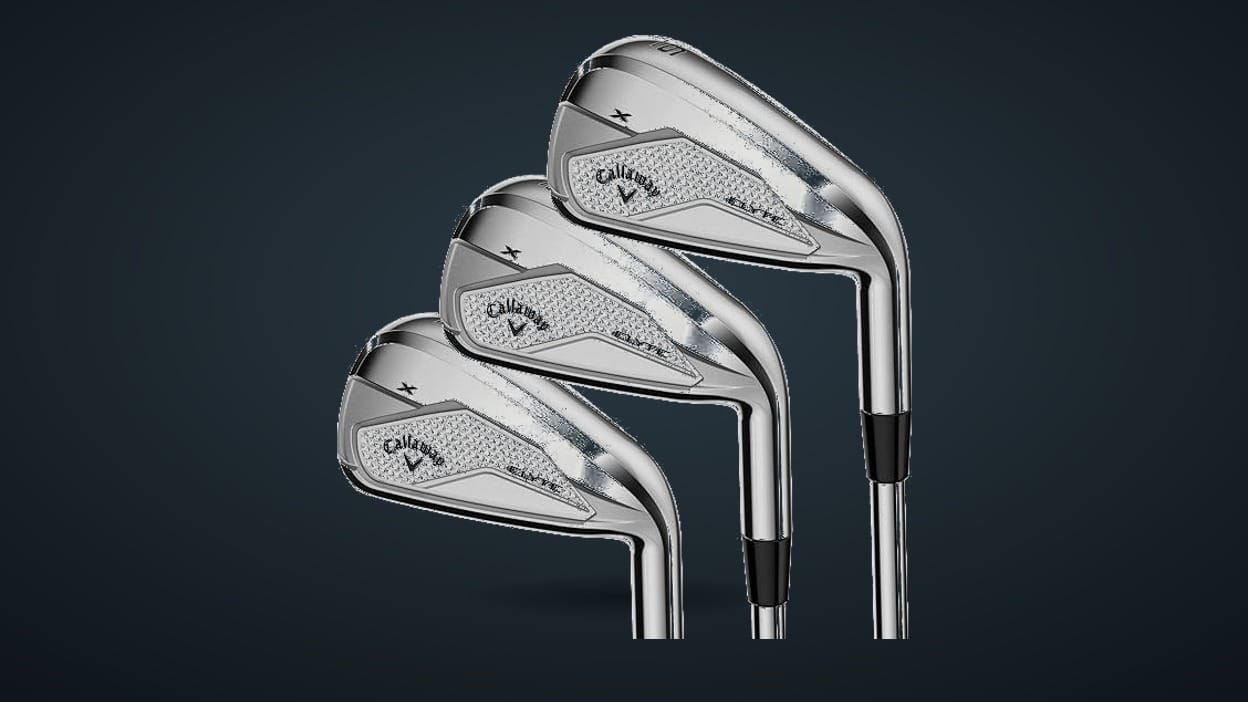
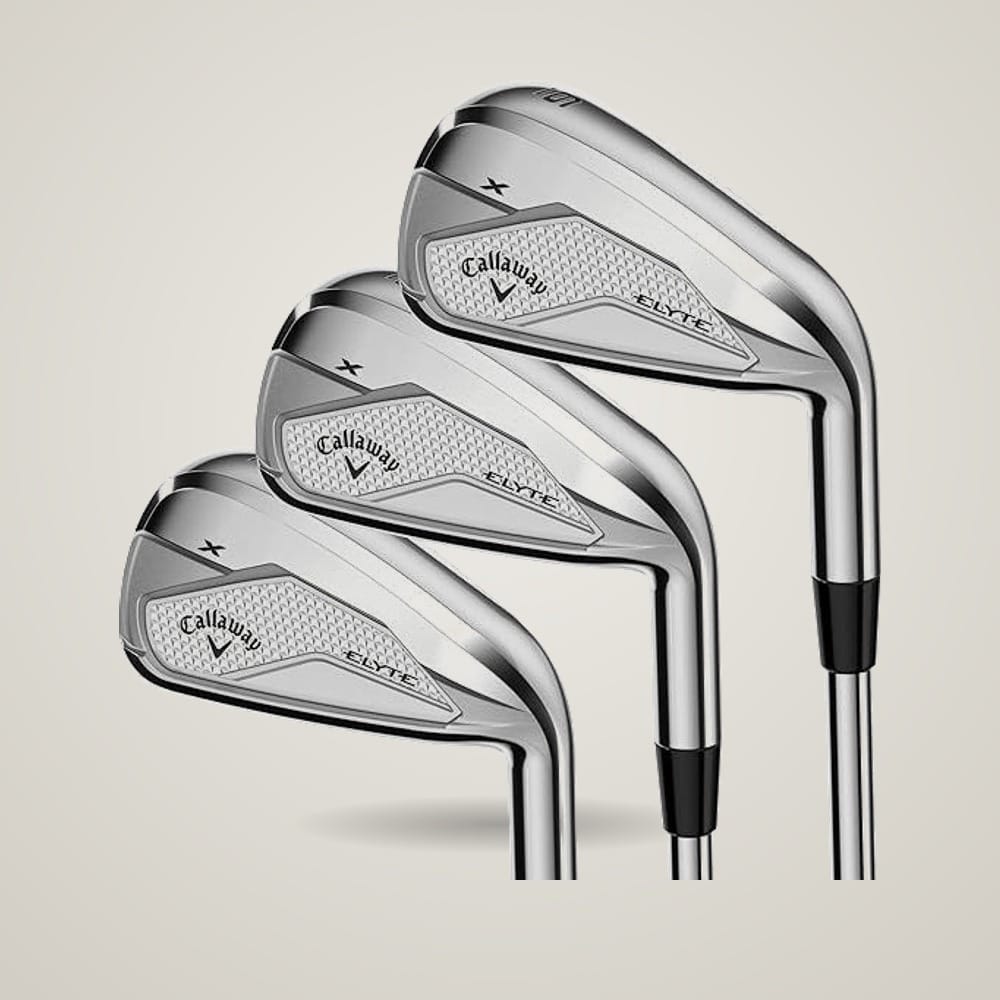
The Elyte X set (5-iron through pitching wedge, plus an approach wedge) is built around Callaway's Ai10x face and a Speed Frame hollow-body construction, the combination the brand uses to push ball speed up without asking the golfer to swing any faster. A wide sole lowers the center of gravity and adds forgiveness on shots struck low on the face, the miss that costs distance and height on a traditional iron. Lofts are strong by traditional standards, running from 21 degrees on the 5-iron to 41 degrees on the pitching wedge, part of how the set generates its distance numbers. The set ships in steel or graphite shafts; the ASIN referenced in this review is the steel, regular flex, standard length and lie configuration (B0DHWFZV37).
What the independent data shows
Manufacturer specs describe what a club is built to do. Independent testing is what confirms whether it does it. MyGolfSpy's 2025 SGI category test scored the Elyte X 8.5/10 overall, with a 9.2/10 distance score that led the category, backing up Callaway's distance claims with a third-party number rather than a marketing one. The same test names feel and looks as strengths alongside distance, which matters in a category where max-distance irons often feel harsh or look clunky at address.
The same data also names the tradeoff directly: dispersion accuracy came in below the distance and feel scores, a pattern MyGolfSpy attributes to the max-distance SGI category generally rather than to this set specifically. The practical read is that the Elyte X will produce longer average shots and a wider spread of where those shots land, and the testers recommend a fitting given how wide that spread ran in testing. That's not a knock on the set so much as an honest description of what a distance-first design trades away, and it's the single most important number in this review for deciding whether the set is right for you.
Who it suits
Distance is the headline, and it delivers. For a higher-handicap golfer whose biggest scoring problem is coming up short of the green with a mid-iron, a category-leading distance number solves a real problem, not a marginal one.
Forgiveness on mishits is where the wide sole and hollow-body construction earn their keep. A shot struck low on the face still gets airborne and still carries respectable distance, which matters more to an inconsistent ball-striker than a shot struck flush.
Feel and looks score well for a max-distance iron, a category that has historically traded feel for ball speed more aggressively than this set appears to.
Dispersion is the real cost, and it's worth taking seriously. A wider spread means more approach shots missing the green left or right, not just short or long, and for a golfer who already fights a two-way miss, that spread can cancel out some of the distance gain. I'll admit that even knowing the data, my own instinct still leans toward a smaller, more workable head, a bias that shows up whenever a set trades dispersion for distance this openly.
Shot-shaping isn't the strength here. A low-handicap golfer who deliberately draws or fades approach shots into pins will find less to work with than a traditional cavity-back or blend-style iron offers.
How it compares to the guides
The Elyte X is already the featured pick in Best Game-Improvement Irons for High Handicappers, which covers it alongside its main competitors in a comparison format. For a mid-handicap golfer weighing this set against options built more toward the workability end of the spectrum, the mid-handicap irons guide lays out that tradeoff across a wider field. This review exists to answer a narrower question than either guide does: is this specific set worth buying, on its own, for the golfer it's built for.
The verdict
The Elyte X earns its place at the top of the SGI distance conversation, and the independent data backs that up rather than just repeating Callaway's marketing. The honest caveat is dispersion, and any golfer considering this set should read that as a genuine decision point, not fine print. For a higher-handicap or improving golfer who mishits often and wants those misses to still cover ground, this is a well-supported buy. For a golfer who already controls shot shape and values tight dispersion over raw distance, the tradeoff this set makes probably isn't the one you want to make. One note on timing: Callaway's Quantum Max has since replaced the Elyte X at the top of the lineup, launching January 16, 2026. A buyer weighing this purely on what's newest should compare the two directly; the distance and dispersion tradeoff described above is specific to the Elyte X.
For higher-handicap and improving golfers who want a distance-first iron set backed by independent test data, the Elyte X is a well-supported buy.
Is the Callaway Elyte X good for high-handicap golfers?
Yes, it's built specifically for that golfer. The wide sole and hollow-body construction add forgiveness on mishits, and independent testing scored it category-leading on distance, both of which matter more to a higher-handicap game than shot-shaping precision does.
What's the real downside of the Callaway Elyte X?
Dispersion. Independent testing found the accuracy spread wider than category average, which MyGolfSpy attributes to the max-distance SGI category broadly rather than to this set alone. A fitting is worth doing before committing to this set given how wide that spread ran in testing.
Does the Callaway Elyte X come in graphite shafts?
Yes. The set is available in steel or graphite shafts. This review references the steel, regular flex, standard length and lie configuration.
How does the Elyte X compare to other game-improvement irons?
It led the super game-improvement category on distance in independent testing, with feel and looks also scoring well. The main tradeoff versus competitors in the same category is a wider dispersion spread, which is the main variable to weigh against the distance gain. Callaway's Quantum Max succeeded the Elyte X in January 2026 as the brand's current SGI iron. A shopper weighing this purely on what's newest should compare the two directly rather than assume the Elyte X is still Callaway's latest.
Some links in this article are affiliate links. If you buy through them, I earn a small commission at no extra cost to you. This never influences what I cover or recommend. I link to gear I'd buy myself.
The golf newsletter that cuts the hype
Data-backed reviews and advice that works. No brand spin.
Recommended products
James WhitfieldGolf writer
James Whitfield plays off a 7 handicap in the Pacific Northwest. A former tech pro, he reads what independent tests show, cross-references owner reports, and turns the evidence into buying advice. He's happier with a spec sheet than a putt.
A $60-80 laser that nails straight-line distance in independent testing, but skips the physical slope switch and tournament-grade weatherproofing of pricier units.
Chandler Blanchet, a PGA Tour rookie, leads the Bermuda Championship solo at 9 under (62) after the first round, one shot clear of a group of four at Port Royal.


 Buy now