








how-to
How to Hit a Fairway Wood Off the Ground
You can smash a 3-wood off a tee. Put the same club on the turf and the
And Stop Leaving the Ball Short

The golfer who leaves pitch shots short isn't guessing wrong about tempo or feel. They're guessing. The fix isn't to feel more; it's to stop guessing and start using calibrated reference swings: a three-position system, built in practice, that turns pitch distance from an estimate into a decision.
A pitch shot is a wedge shot that flies higher than a chip and requires a partial swing rather than a full one. Chips run along the ground shortly after landing; pitches carry most of the distance in the air and land with enough spin to stop. For a longer discussion on the distinction: Chipping vs. Pitching If a chip is the right call, our chip shot distance system covers the carry-to-roll ratios for the ground-game side of that decision.
The distance control problem is structural: full swings have a natural ceiling (you either make a full swing or you don't), but partial swings have no inherent reference points. Without a system, the golfer improvises a swing length for each distance, making the outcome dependent on how well they calibrated that improvisation under pressure. Published teaching data consistently identifies the 30-to-100-yard (27-to-91m) range as the area of the course where recreational golfers lose the most strokes to poor distance control, not poor mechanics.
The clock system solves this by replacing improvisation with reference.
The system uses three backswing positions, described using clock positions as reference points. Stand in a normal address position and imagine a clock face on your swing plane. Your club at address points to 6 o'clock; the positions above define your backswing length.
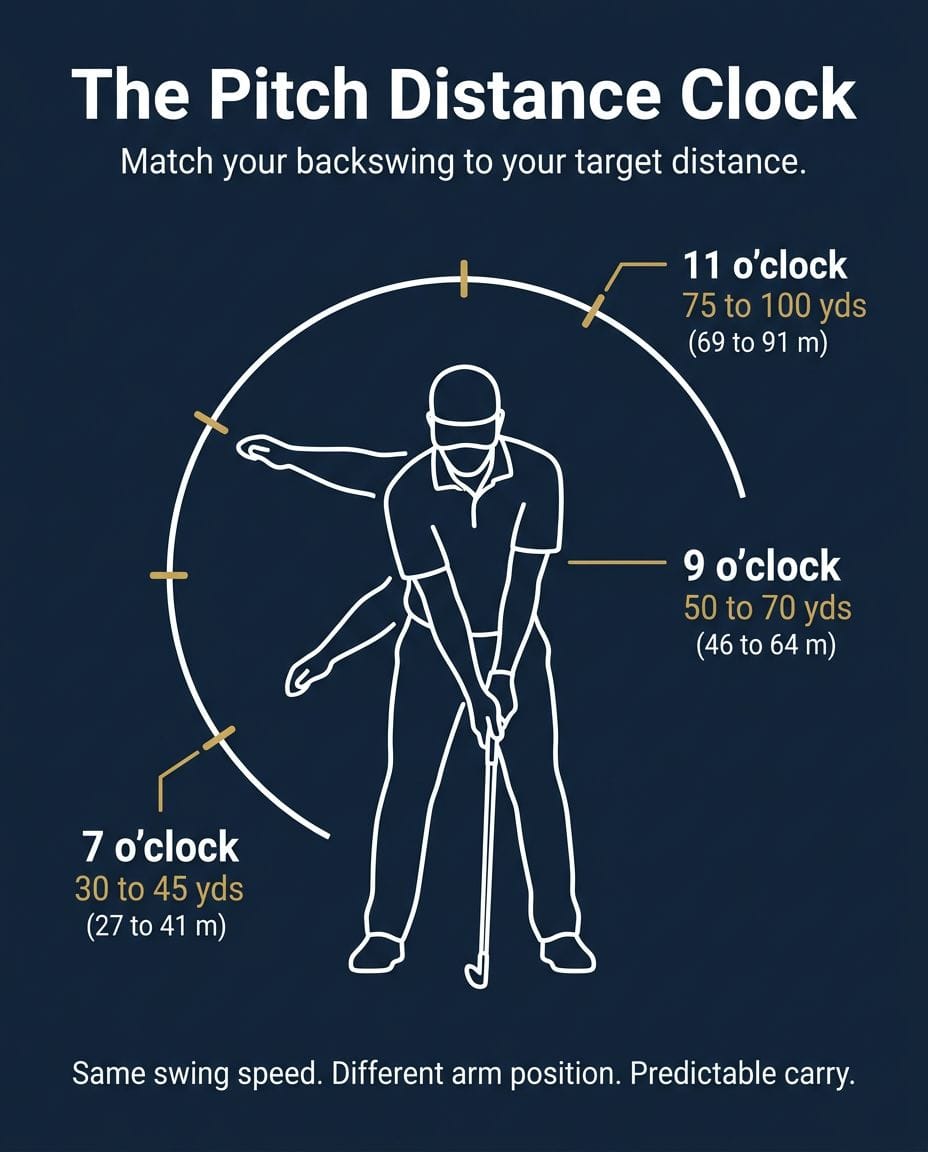
The lead arm reaches roughly hip height on the trail side of the body. This is a compact, controlled motion, more of a controlled acceleration than a swing. The wrists hinge minimally. Published short-game teaching material from multiple sources identifies this as the primary shot window for pitches inside 45 yards (41m), where height and soft landing are the priority rather than carry distance.
Approximate carry window: 30 to 45 yards (27 to 41m). Your calibrated distance will vary.
The lead arm reaches parallel to the ground at the top of the backswing. This is the most commonly referenced position in published wedge instruction because it's repeatable: parallel is easier to feel and identify than positions above or below it. The wrists hinge naturally into this position without forcing length.
Published fitting methodology identifies the 9 o'clock position as the most reliable single reference for golfers building a pitch distance system for the first time, because it sits between the two extremes and is the easiest to locate consistently.
Approximate carry window: 50 to 70 yards (46 to 64m). Your calibrated distance will vary.
The lead arm reaches approximately shoulder height. This is the longest reference position in the system and the one most prone to tempo inconsistency, because a longer backswing creates more time for the golfer to either add speed or lose rhythm. The swing to 11 o'clock should feel like an extension of the 9 o'clock rhythm, not a separate, bigger effort.
Approximate carry window: 75 to 100 yards (69 to 91m). Your calibrated distance will vary.
The 9 o'clock position is, in my reading of the published teaching consensus, the most contested data point in this system: the carry estimates vary considerably by source because individual swing speed and tempo affect it more than the shorter positions do. This is why the calibration step isn't optional. You are building your reference distances, not adopting a textbook average.
This session establishes the carry numbers for your clock positions with your actual wedges. Run it once, record the results, and refine in a follow-up session two to three weeks later.
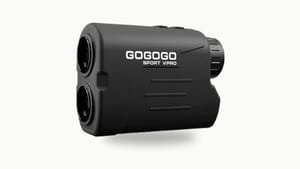
What you need: a rangefinder or a range with marked yardage targets, your sand wedge (and lob wedge if you carry one), 30 to 45 minutes, and something to record numbers with.
Before calibrating partial swings, hit 10 to 15 full wedge shots to establish your baseline tempo and contact. The partial swings in the calibration session should feel like reductions from the full swing, not a separate motion.
Start in the middle. Hit 15 shots with your sand wedge using a consistent 9 o'clock backswing and the same tempo on each. Discard the two longest and two shortest. Average the remaining 11. That number is your 9 o'clock carry with that wedge.
Record it. Don't adjust it during the session.
Repeat the process for the short and long positions. Hit 15 shots, discard the outliers at both ends, average the middle cluster.
If your 7 o'clock and 11 o'clock distances don't scale proportionally from the 9 o'clock figure, don't adjust your swing; adjust your expectations. The carry windows are real; they just reflect your tempo, not an idealized average.
The reference swings depend on consistent tempo as much as consistent length. The Orange Whip Wedge is designed for this: the weighted, flexible shaft forces a smooth, connected arc and penalizes tempo breaks with the same feedback a well-struck pitch gives you. Five minutes with it before a calibration session shortens the warm-up and stabilizes the rhythm that makes the distance numbers repeatable.
Write your three numbers down. Sand wedge: 7/9/11 o'clock = X / Y / Z yards (m). Keep it in your bag. The point of the system is that you reach for the reference, not for a feel.
If you carry a lob wedge, run a separate calibration for it. Published fitting guidance recommends calibrating no more than two wedges using this system to keep the on-course decision process simple; adding a third club's reference numbers tends to create decision paralysis rather than precision.
The reference distances you built in practice are practice distances. They were hit from a flat mat, with no pressure, toward a known yardage target. On the course, the same 9 o'clock swing faces a downhill lie, a firm fairway, a pin tucked behind a bunker, and the knowledge that the shot determines whether you're making par or bogey.
Published motor learning research identifies this gap as the point where most practice-built skills fail: the skill exists, but it hasn't been validated under variable, consequence-bearing conditions. The 10-Shot Validation System addresses this directly, including a pitch distance protocol that confirms whether your reference swings hold under on-course conditions before you rely on them in a scored round. If you've built the system, that's the next step.
For the data-based complement to this feel-based system: How to Build Your Wedge System with a Launch Monitor
For wedge selection: Titleist Vokey SM10 Review
And for the loft-gap framework that determines which wedge you're calibrating at which distance: Wedge Loft Gaps Explained
The clock system uses three backswing positions as distance references. At 7 o'clock, the lead arm reaches roughly hip height on the trail side, producing short pitch carries of approximately 30 to 45 yards (27 to 41m). At 9 o'clock, the lead arm reaches parallel, producing mid-range carries of roughly 50 to 70 yards (46 to 64m). At 11 o'clock, the club reaches shoulder height, producing carries of 75 to 100 yards (69 to 91m). Exact distances depend on individual swing speed and club selection; the system is calibrated in practice.
Most short pitches come from either choosing the wrong swing reference (a 7 o'clock swing for a 60-yard (55m) carry) or decelerating through impact. Deceleration typically happens when the golfer doesn't trust a specific swing length and slows down mid-swing to "control" the distance. The fix is building calibrated reference swings in practice so you know what your 9 o'clock swing produces, then committing to it on the course. Golfers who trust a defined reference rarely decelerate; golfers who improvise distance do.
Most recreational golfers use a sand wedge (typically 54 to 56 degrees) for pitches in the 50-to-90-yard (46-to-82m) range and a lob wedge (58 to 60 degrees) for shots inside 50 yards (46m). The specific wedge determines how far each clock-position swing carries, so calibrate with the wedge you actually play on the course. See Wedge Loft Gaps Explained for the gap framework behind this choice.
A single focused session of 30 to 45 minutes is enough to build a reliable first set of reference distances. Hit 10 to 15 shots per clock position, average the middle cluster (discarding outliers at both ends), and record the results. The numbers from session one will shift slightly as tempo becomes more consistent. A second calibration session two to three weeks later typically produces figures that hold across on-course conditions.
Yes, but each wedge produces different carries at the same clock position. A 56-degree sand wedge carries further than a 60-degree lob wedge from the same 9 o'clock backswing. Calibrate each wedge separately. Published fitting guidance recommends building reference numbers for no more than two wedges to keep the on-course decision process simple.
Some links in this article are affiliate links. If you buy through them, I earn a small commission at no extra cost to you. This never influences what I cover or recommend. I link to gear I'd buy myself.
Data-backed reviews and advice that works. No brand spin.