









how-to
How to Hit a Fairway Wood Off the Ground
You can smash a 3-wood off a tee. Put the same club on the turf and the

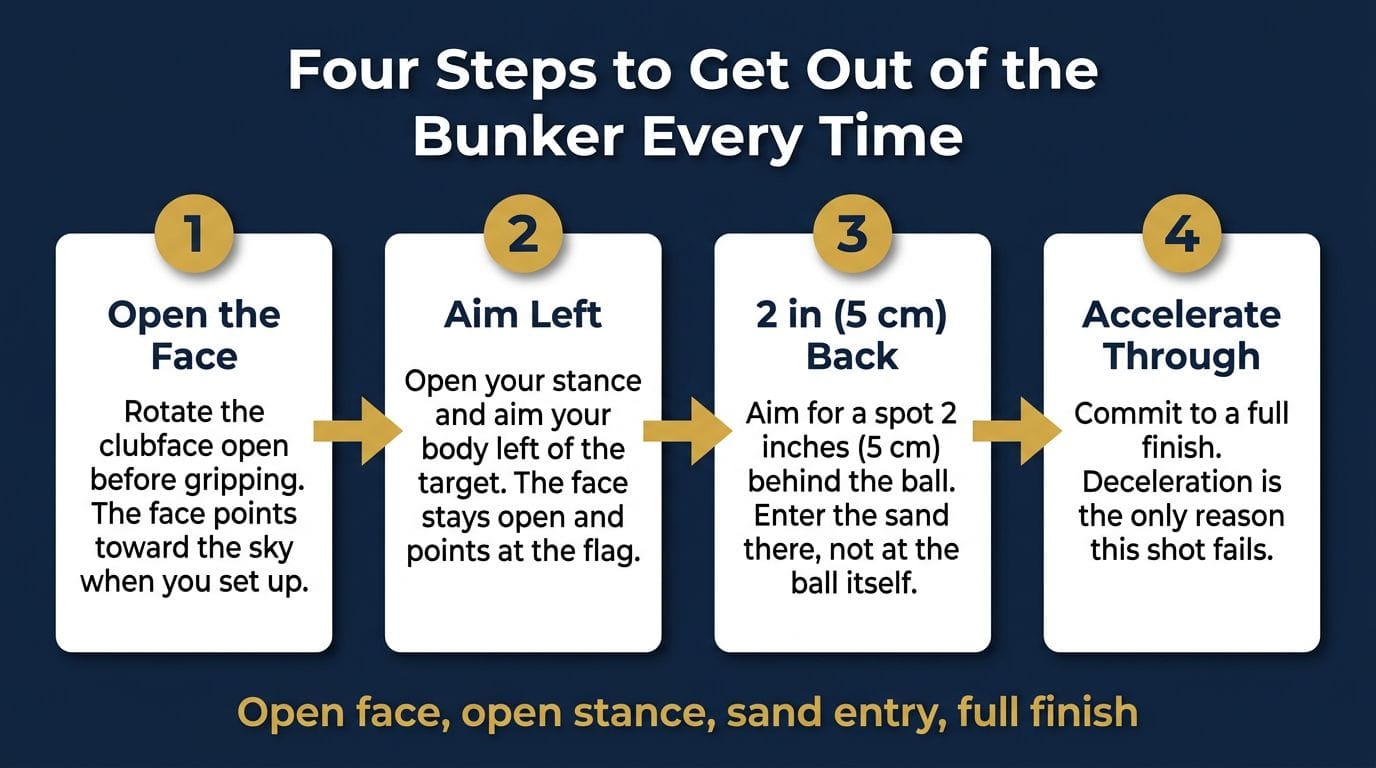
Most bunker shots fail because the swing decelerates before impact. Open the clubface before you grip the club, aim your stance left of the target, enter the sand 2 inches (5cm) behind the ball, and swing through to a full finish. Commit to that sequence and the ball comes out.
Open the clubface before you take your grip, not after. Rotating the handle in your hands once you have gripped the club closes the face back toward neutral and removes the loft you added. At address, the face of a properly opened sand wedge sits at a significant angle from vertical: for a standard greenside bunker shot, the face should look nearly skyward. The exact rotation varies with lie and required trajectory; the principle of opening before gripping is constant.
With the face open, align your feet, hips, and shoulders left of the target line (for right-handed golfers). The open stance pre-sets a swing path that works with the open face to produce a high, soft shot that lands without forward roll. Your stance line runs parallel to but left of the ball-to-flag line. The more open the face, the more open the stance typically needs to be to match.
The club contacts the sand first, not the ball. The published standard for a greenside bunker shot is a sand entry point approximately 2 inches (5cm) behind the ball. The displaced sand carries the ball out. Entry too close to the ball risks thin contact and a shot that shoots low and hot across the green; entry too far back means the club decelerates in the sand before reaching the ball. The 2-inch (5cm) number appears consistently across major instruction sources and is the correct starting point.
Sand offers resistance. The club needs to push through it rather than stop in it. A deceleration at impact leaves the ball short or in the bunker. The mental picture that produces the right motion: swing through to a full, high finish, as though hitting a full pitch shot to a target beyond the flag. That thought generates the acceleration the shot requires. The ball is a secondary consideration; the sand entry and the follow-through are primary.
A sand wedge built with adequate bounce (10 degrees or more) is designed for this shot. The bounce angle prevents the leading edge from digging into the sand. A pitching wedge or a low-bounce wedge lacks this property and makes the sand entry point significantly harder to control. High handicappers who struggle with bunker play should check the bounce angle on their current wedge before adjusting technique.
The Cleveland CBX Full-Face 2 is a strong option in this category. The Full-Face groove design extends grooves to the face edge for maximum spin versatility from tight lies, bunkers, and rough. Published reviews consistently place it near the top of the maximum-forgiveness wedge category for golfers who want reliable bunker and short-game performance without tour-level feel requirements.
Cleveland CBX Full-Face 2 on Amazon (58°, RH)
The standard open-stance technique produces high, soft bunker shots that land and stop. That's the right tool for most greenside situations. Tour players add a second setup to their bunker repertoire for situations where distance control and a lower trajectory matter more than a soft landing: the closed-stance bunker shot.
The adjustment is in the feet. Instead of aligning the stance left of the target line, the trail foot (right foot for right-handed golfers) drops significantly back from the target line. The clubface remains open. The resulting swing path is different: shallower, producing a lower ball flight with more forward roll after landing. The technique is useful for longer greenside bunker shots where a high, stopping trajectory would require too much swing speed to control.
There's one lie I don't think the fundamentals solve cleanly regardless of technique: the plugged downhill lie with a short-sided pin. Published exit-rate data from that combination drops sharply even at the professional level. My read on those numbers: if a chip from the fringe is available, take it. The bunker technique is technically correct; the expected outcome from that lie isn't favorable enough to justify the full commitment.
The closed-stance method is an advanced addition. A golfer who can't exit a bunker reliably with the standard open-stance technique won't improve that outcome by changing the stance. Get the fundamentals solid first.
Consistent bunker play is a repetition problem: the correct motion needs to be grooved before the feel becomes automatic. Most golfers don't have regular access to a practice bunker. The WHYGOLF Bunker Mate replicates the resistance and ball-flight feedback of sand contact without requiring a bunker, making it a practical option for golfers who want to build the swing path at home or on the mat.
For a broader look at practice tools across swing categories: Golf Training Aids That Work.
For broader short-game improvement: How to Improve Your Short Game Without Taking Lessons.
The club hits the sand, not the ball. In a standard greenside bunker shot, the clubface enters the sand approximately 2 inches (5cm) behind the ball. The displaced sand acts as an intermediary and carries the ball out. Direct contact with the ball from a bunker typically produces a thin shot that travels low and hot, often well past the target.
A sand entry point 2 inches (5cm) behind the ball produces a divot roughly 6 to 7 inches (15 to 18cm) long through impact. Taking significantly more sand than that risks the club decelerating before it reaches the ball; taking less risks thin contact. The 2-inch (5cm) entry is the published standard. Focus on where the club enters the sand, not on how much to take: the correct entry point produces the correct amount automatically.
A sand wedge of 56 to 58 degrees is the standard tool. The loft produces a high-angle trajectory over short distances, and the bounce angle (typically 10 to 14 degrees on a sand wedge) prevents the leading edge from digging into the sand. High handicappers who struggle with bunkers should prioritize adequate bounce over loft. A pitching wedge or low-bounce wedge makes this shot harder to control because the leading edge tends to dig rather than glide.
Deceleration is the most common cause. When the swing slows down through impact, the club stops in the sand before it displaces enough material to carry the ball out. The fix is committing to a full swing that continues past the ball to a high finish, not a softer, slower swing. Many golfers instinctively shorten the swing when in a bunker; this makes the problem worse. The bunker shot requires at least as much swing commitment as a pitch from the same distance on grass.
Open the face before gripping, aim the stance left of the target, enter the sand 2 inches (5cm) behind the ball, and commit to a full accelerating swing through to a finish. That sequence, executed consistently, produces reliable bunker exits from standard greenside lies. The variation between shots is swing speed for distance control; the four fundamentals stay constant. Practice the entry point first: put a line or coin 2 inches (5cm) behind a ball and practice striking the sand at that mark until the feeling is automatic.
Bunker exits are a scoring problem as much as a technique problem.
Published data on what drives scores for 90-to-110 handicappers points to a consistent pattern: the strokes aren't lost to ball-striking. They come from compounding avoidable errors: shots that stay in trouble, unforced penalties, lag putts that leave difficult thirds. A reliable bunker exit removes one of the most common sources of compounding at this level.
How to Break 100 With the Swing You Already Have works through the complete scoring framework for players in that range.
Some links in this article are affiliate links. If you buy through them, I earn a small commission at no extra cost to you. This never influences what I cover or recommend. I link to gear I'd buy myself.
Data-backed reviews and advice that works. No brand spin.