










how-to
How to Warm Up for Golf With No Range Access
You pull into the lot ten minutes before your tee time. There's no range, or the
Your irons fade but your driver slices, and it's the same swing. Here's the geometry that explains it, and five driver-specific fixes.

Your irons don't slice because you're hitting down on them. Your driver slices because you're meant to hit up, and the same out-to-in swing path that produces a manageable iron fade becomes a full driver slice when the ball is caught on the ascending arc. The fix is driver-specific.
The same swing can produce a 5-yard iron fade and a 50-yard driver slice. The swing isn't different. The ball is being caught at a different point in the arc.
Irons are struck on a descending blow. A slightly out-to-in path moves the face left of the swing direction, but higher loft (around 30 degrees on a 7-iron) creates enough backspin to overpower the sidespin. You get a fade, not a slice.
With a driver, the goal is a positive attack angle. TrackMan data shows elite players average between +3 and +5 degrees on the upswing with the driver. At that point in the arc, an out-to-in path moves further left than it did during the iron's descending strike. And a 9 to 10 degree driver loft generates far less backspin, so the sidespin from the face-to-path gap isn't suppressed. The ball curves hard right.
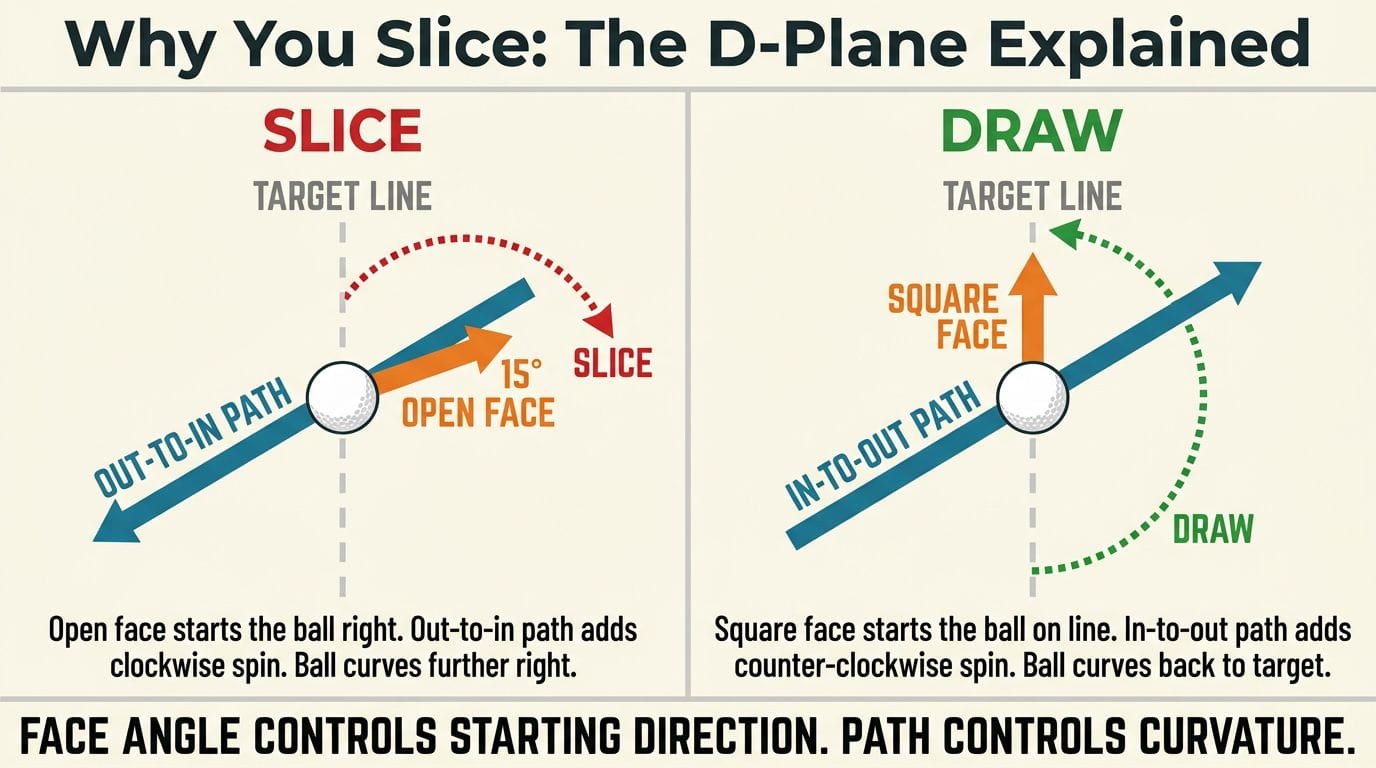
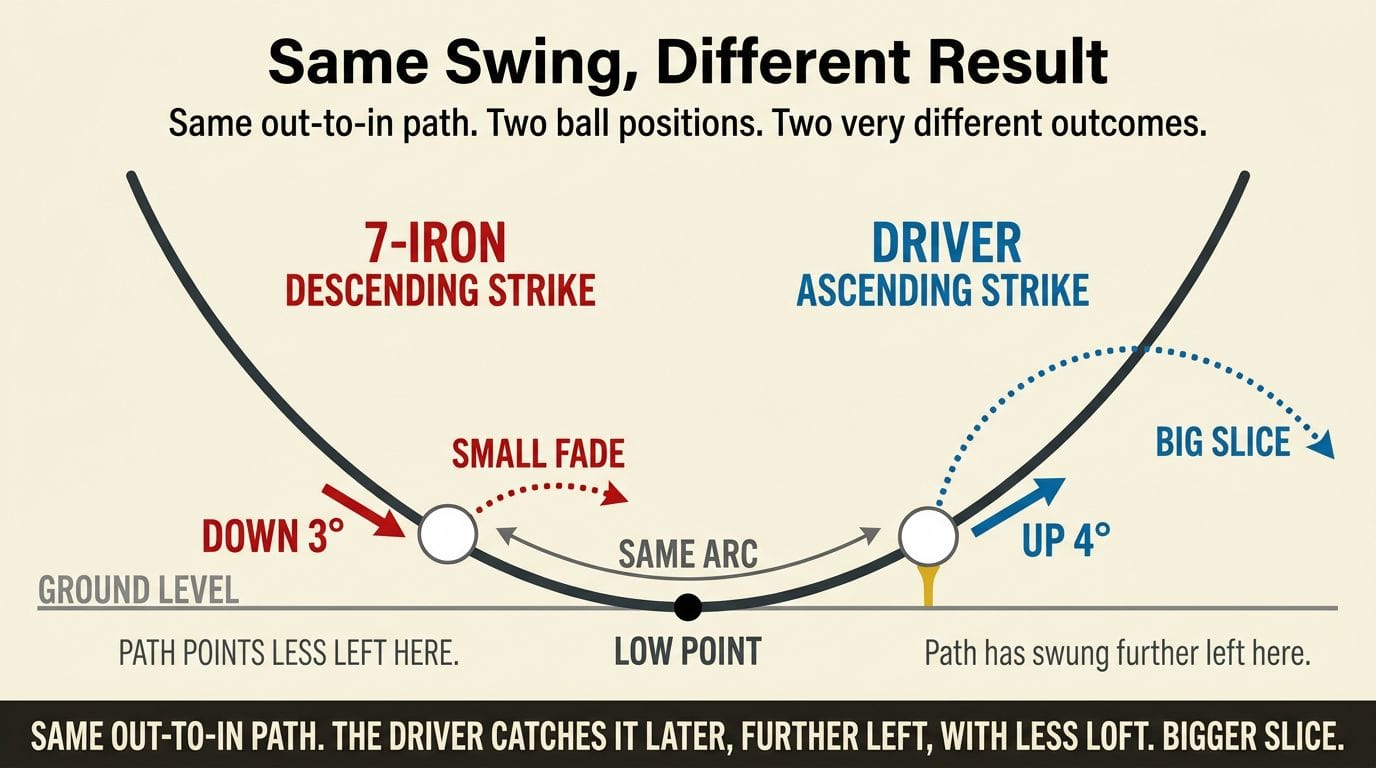
Most instruction treats the driver slice and the iron fade as the same problem in different packaging. They aren't, which is why path fixes alone so rarely kill the driver slice, and the consistency of that finding across the coaching data surprised me.
For a full breakdown of the face-to-path relationship across all clubs, see our guide to fixing a golf slice.
Driver shafts run 44 to 47 in (112 to 119cm), longer than any other club in the bag. More length means the head is moving faster through impact with less time to square the face.
HackMotion's analysis of over one million amateur swings found that high-handicap golfers average 24.2 degrees of wrist extension at impact with the driver, compared to 14.5 degrees for elite players. That 10-degree gap maps directly to an open face at contact. An open face combined with an out-to-in path is the two-condition recipe for a driver slice.
The face controls 75 to 85% of where the ball starts, per TrackMan. Path shapes the curve. A 5-degree open face with a 2-degree out-to-in path sends the ball right and curves it further right. Fixing path without fixing face still produces a slice.
Place the ball inside the lead heel. Teeing it back toward center forces a descending blow and amplifies any out-to-in path. Inside the lead heel is the starting point.
Tee height: half the ball should sit above the driver crown at address. A low tee produces a descending strike. The ascending contact that neutralizes the path problem requires the ball to be up.
These two changes alone will shift ball flight. Do them before touching anything else.
Before shaping the swing, build a repeatable sense of what a square face feels like at contact. The SKLZ Smash Bag is the standard tool for this: hit it at reduced speed and hold the finish position. Check whether the face points at the target, is closed (rotated left), or open (rotated right). Most slicers find the face open well past the point they expected to have squared it. Repeat until the square-face feeling is consistent without deliberate effort.
This is feel-building, not power work. Full-speed swings come later.
Set two SKLZ Pro Rods (SKLZ Pro Rods) on the ground: one pointing at the target, one roughly 10 degrees to its right, forming a corridor through the impact zone. Make half-speed driver swings through the gate without catching either rod.
This builds a more neutral path pattern. Work on it only after Steps 1 and 2 confirm tee setup and face position are sorted. A path gate on top of an open face doesn't fix a slice.
The Eyeline Speed Trap (Eyeline Speed Trap) sits just inside the ball at address, with raised rails that give immediate tactile feedback on path. Clipping the outside rail means the club is still coming over the top. Clean through the corridor means the path has improved. Clipping the inside rail means the path has gone too far in-to-out, which can happen as an overcorrection.
Work at 60 to 70% swing speed until contact through the corridor is consistent before building back to full speed.
Slicers often race the downswing, which pulls the handle past the face and leaves it open at contact. The Orange Whip 47" (Orange Whip Trainer) has a counterweighted tip that forces a tempo-first transition: the ball at the end of the flexible shaft can't follow the body if the downswing is rushed. Eight to ten smooth swings before a driver session resets sequencing more reliably than any swing thought at full speed.
The Orange Whip doesn't square the face on its own. It reinforces the body-before-arms timing that gives the face time to catch up.
Two numbers confirm the fix is working: attack angle and face-to-path gap.
Target attack angle is +2 to +5 degrees (positive = ascending). Target face-to-path gap is under +3 degrees. A residual slice almost always means the gap is still too wide, even if the path has improved.
TrackMan and Foresight GCQuad report both reliably. The Garmin Approach R50 and SkyTrak Plus report attack angle; check your device's spec sheet before relying on it for this measurement.
Without a launch monitor, read the ball flight. A slice that starts left of the target and curves right means the face was left of the path (open face relative to path). A push-slice that starts right and curves further right usually points to a setup problem: ball too far back, too much tilt away from the target, or an open stance. The first needs face work; the second needs a setup check.
Draw-bias drivers shift internal weighting to encourage a more closed face at impact. The Callaway Paradym Ai Smoke Max D and TaylorMade Qi10 Max both work this way. For full specs on the Qi10, see our TaylorMade Qi10 review.
A draw-bias head is worth using while working through the steps above. It keeps the ball in play on the course while the pattern changes on the range. It doesn't change the underlying face-to-path gap, so the slice returns with a neutral driver if the swing isn't addressed.
On shaft flex: below 85 mph (137km/h) driver swing speed, Stiff flex delays face rotation and compounds the open-face problem. Regular flex is correct below 85 mph; Senior or Lite flex below 75 mph (121km/h).
A slice off the tee is one of the most reliable ways to blow up a hole and stay stuck above 100. The Break 100 book covers the full tee-to-green strategy for eliminating those high-number holes.
The driver and irons are caught at different points in the swing arc. Irons strike on a descending blow, where higher loft (around 30 degrees on a 7-iron) generates enough backspin to suppress sidespin. The driver is designed to strike on the upswing, positive 3 to 5 degrees attack angle per TrackMan data, and a 9 to 10 degree loft can't produce enough backspin to cancel the resulting sidespin. The same path fault that shows up as a small iron fade becomes a full driver slice.
Ball position and tee height corrections produce measurable changes within one session. The full drill sequence (smash bag, alignment sticks, Speed Trap, Orange Whip) typically shows meaningful improvement over 4 to 6 weeks at 2 to 3 sessions per week. Sequencing matters: setup first, face angle second, path third. Jumping to path drills before sorting tee height and face position extends the timeline.
Yes. A low tee forces a descending blow that amplifies an out-to-in path the same way an iron does. A higher tee promotes the ascending contact that reduces the path problem. Target: half the ball above the driver crown at address.
Match flex to driver swing speed. Below 85 mph (137km/h): Regular flex. Below 75 mph (121km/h): Senior or Lite. A shaft too stiff for your swing speed delays face rotation and keeps the face open at contact. Most slicers who game Stiff shafts without the swing speed to load them are compounding a swing problem with an equipment mismatch.
They reduce it, but they don't fix it. Draw-bias heads like the Callaway Paradym Ai Smoke Max D and TaylorMade Qi10 Max shift internal weighting to encourage a more closed face at impact. For a golfer actively working on the swing, they're a useful game-management tool on the course. Switch to a neutral driver without fixing the underlying face-to-path gap and the slice returns.
Some links in this article are affiliate links. If you buy through them, I earn a small commission at no extra cost to you. This never influences what I recommend. I link to gear I'd buy myself.
Data-backed reviews and advice that works. No brand spin.