








how-to
How to Warm Up for Golf With No Range Access
You pull into the lot ten minutes before your tee time. There's no range, or the
Learn how to aim your clubface and body correctly at address, with the parallel-lines setup method and fixes for the most common alignment faults.

Most misaligned golfers aren't misaligned because of a bad swing. They're misaligned because they aimed the body at the target instead of parallel to it, and a swing built on a crooked foundation compensates for a fault it never actually diagnoses. Correct alignment starts with the clubface, then squares the body to it using a simple parallel-lines setup, and takes about five minutes to learn.
Set the clubface before you set your stance. Stand behind the ball, sight a line from the ball to the target, and pick out a spot 1 to 2 feet (0.3 to 0.6m) in front of the ball that sits directly on that line, a mark in the grass, an old divot, a discolored blade, anything specific enough to aim at. Walk in and set the clubface square to that intermediate spot rather than trying to aim at a target 150 yards (137m) away, which the eye reads far less accurately from ground level.
This single change fixes more misalignment than any body-position drill, because the clubface decides where the ball starts and the body's job is only to get out of its way. Golfers who set their feet first and then adjust the clubface to match are aiming twice, once with the body and once with the hands, and the two rarely agree.
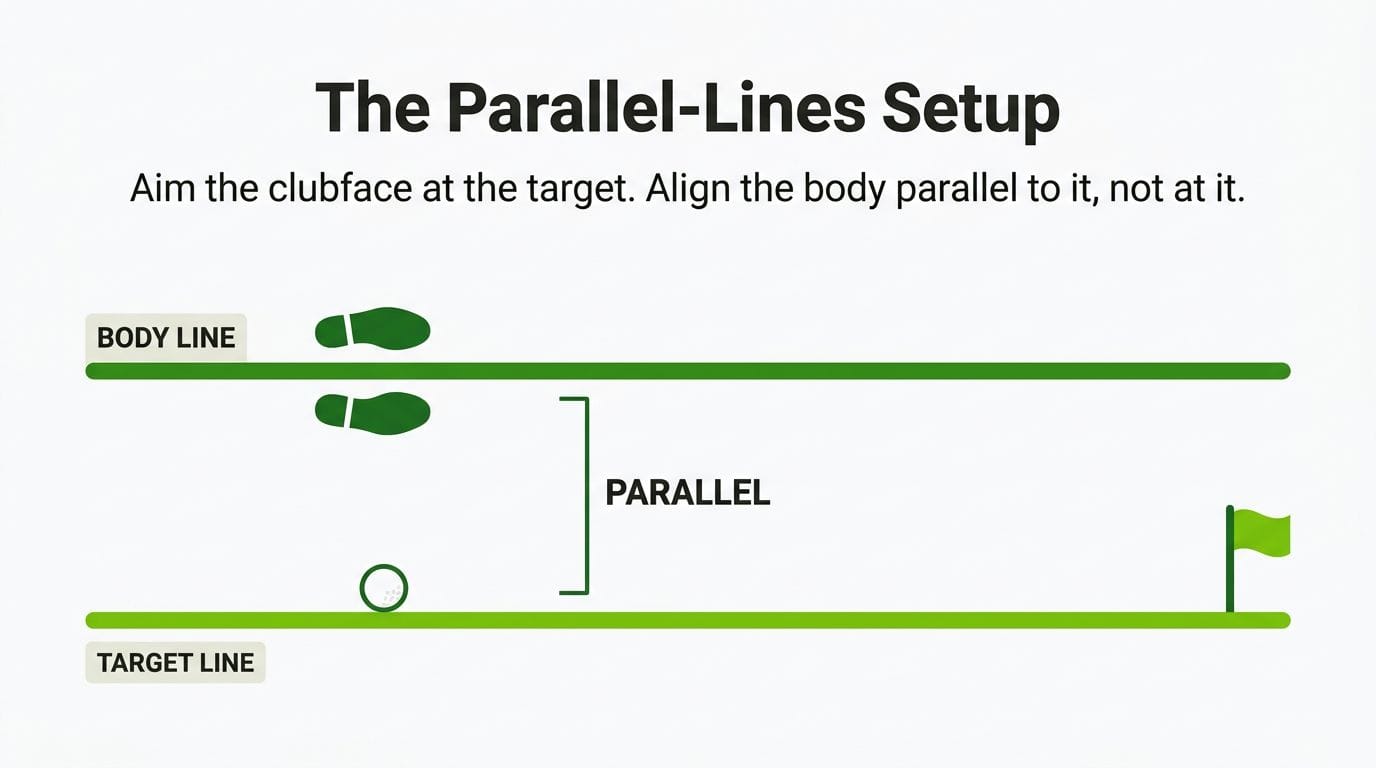
Once the clubface is square, align your body to it using the parallel-lines concept: picture two rails on a railroad track. The ball sits on the near rail, on the target line. Your feet, hips, and shoulders sit on the far rail, running parallel to that line, not pointing at the target themselves.
Work through the checkpoints in this order:
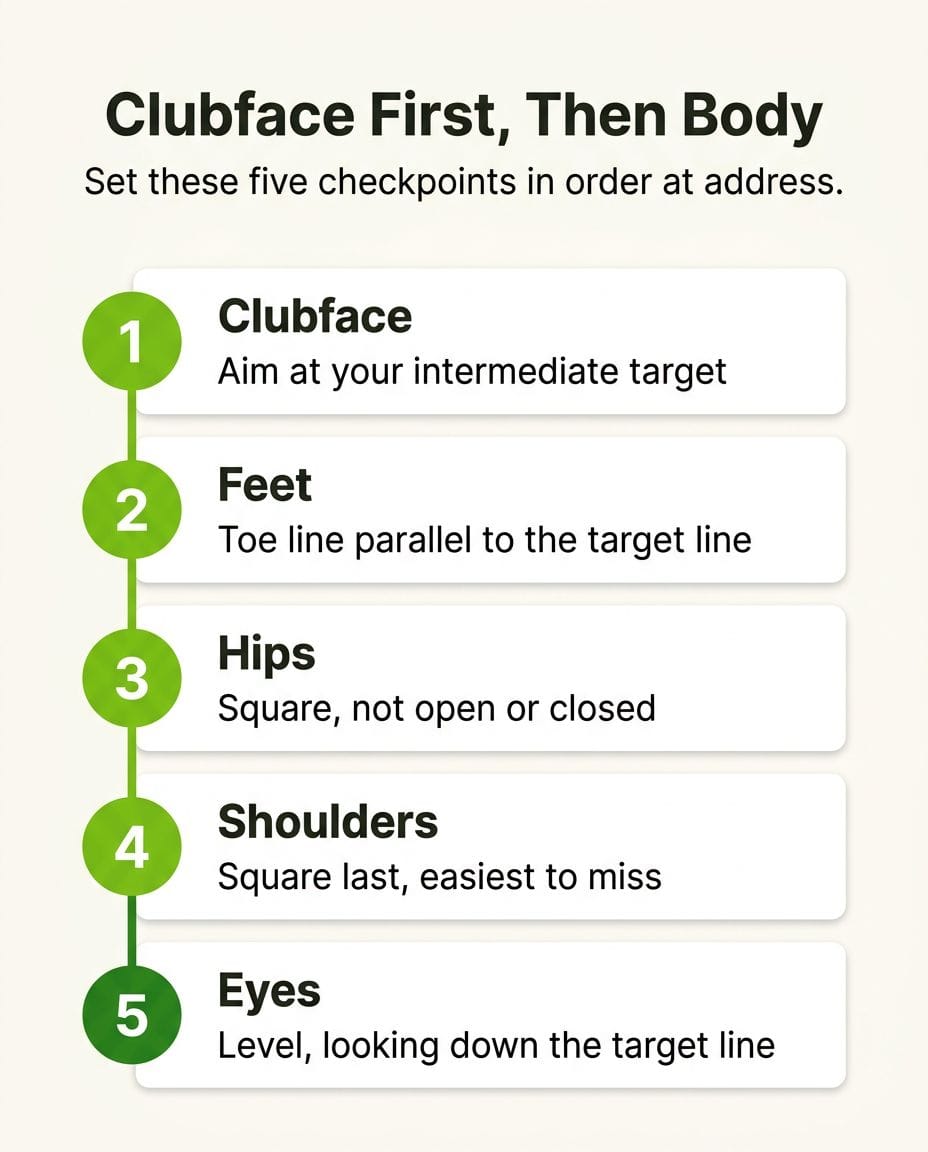
Each checkpoint takes a couple of seconds once it's a habit. The order matters because a fault in an earlier checkpoint tends to drag the later ones out of position with it, an open front foot pulls the hips open, open hips pull the shoulders open, and by the time a golfer notices something feels off, three checkpoints have drifted, not one.
Aiming the body at the target instead of parallel to it. This is the single most common alignment fault, and it happens because aiming at the target feels intuitive even though it's mechanically wrong. The fix is the two-club check below: if the body-line club points at the flag instead of running parallel beside the target-line club, the stance is aimed, not aligned.
Shoulders open at address (for a right-handed golfer, aimed left of parallel). Usually caused by looking at the target with the head instead of just the eyes, which rotates the lead shoulder open without the golfer feeling it happen. Fix: pick the intermediate target from Step 1 and keep the chin level when checking it, rather than turning the whole head toward the distant target.
Closed stance from ball position drift. Playing the ball too far back in the stance tends to close the shoulders as a compensation, and playing it too far forward opens them. If alignment checks fine but shots still start offline consistently in one direction, check ball position before assuming it's an aim problem at all.
Checking alignment with an iron and trusting it with the driver. A teed-up driver shot moves the ball forward in the stance and widens it, and both changes shift where the shoulders naturally sit at address. A golfer who only ever runs the two-club check with a 7-iron can be aligned correctly with that club and still be several degrees open with the driver, since the wider, more forward setup was never checked on its own. Run the drills below with at least one iron and the driver, not just whichever club is easiest to grab on the range. I'll admit my own default miss, even after years of using the checkpoints above, is aiming my body a touch right of parallel rather than truly square; the target-at-the-body habit is a hard one to fully unlearn, which is exactly why the two-club check earns a permanent spot in a pre-round routine instead of being something to outgrow.
Alignment faults rarely feel like an aim problem while they're happening, they feel like a swing problem, because the compensation happens unconsciously and the miss shows up in the ball flight instead of at address. Reading the shot pattern backward is often faster than re-diagnosing the setup after the fact.
A consistent push or fade that wasn't there before usually points to an open stance, shoulders and hips aimed left of parallel for a right-handed golfer, which sends the swing path across the ball from outside to in relative to where the body thinks the target is. The clubface can be perfectly square and the ball will still start right of the intended line, because the path, not the face, is doing the damage.
A consistent pull or draw that turns into a hook under pressure often points the other way, a closed stance with the shoulders and hips aimed right of parallel, which produces an inside-to-out path and sends the ball left of target even with solid contact. This one is easy to misdiagnose as a hand or release problem when it's actually a setup problem showing up at impact.
Inconsistent direction, some shots left and some right with no pattern, is less often an alignment fault specifically and more often a sign the pre-shot routine isn't checking alignment the same way every time, a rushed setup on some shots and a careful one on others. The two-club drill below fixes this by making the check identical and repeatable rather than a feel-based guess at the top of the swing, and it's worth running that check on a handful of shots in a row rather than once and trusting the routine to hold up on its own.
The two-club check. Lay one club on the ground along your target line, a few inches (5 to 10cm) outside the ball. Lay a second club parallel to it, along your toe line, close enough to touch your shoes at address. Take your normal setup between them and look down: if the toe-line club isn't running parallel to the target-line club, the stance is off, no matter how the shot felt. This costs nothing and takes about a minute to set up.
The mirror check. From directly behind the target line, use a full-length mirror or a phone propped against a bag to check that shoulders and hips read as a single flat line, not staggered. This catches shoulder faults the two-club drill can miss, since it's checking rotation rather than stance width.
For golfers who want the same feedback without laying anything out by hand each time, the SKLZ Pro Alignment Rods are a set of three fiberglass rods built for exactly this drill, planted in the turf rather than balanced on top of it, which holds the lines still through a full practice session. They're a convenience upgrade on the free version above, not a requirement for fixing the fault. Our guide to the best golf training aids of 2026 covers where they rank against other setup and swing-speed tools, and our roundup of training aids that actually work covers drill variations with a similar alignment-stick setup.
Aiming refers to the clubface, where it's pointed at address. Aligning refers to the body, whether the feet, hips, and shoulders are square to the same target line the clubface is aimed along. A golfer can aim the clubface correctly and still align the body incorrectly, which is why the two are checked separately.
Lay two clubs on the ground, one along the target line and one along the toe line, and take your normal setup between them. If the toe-line club doesn't run parallel to the target-line club, the stance is misaligned. This free version works as well as a dedicated set of alignment rods for spotting the fault.
Aiming directly at the target feels intuitive, since that's how aiming works with a thrown object. But a golf stance sits beside the ball, not behind it, so a body aimed at the target is actually aimed well right of where it needs to be for a right-handed golfer, which opens the shoulders and pulls the swing path across the ball.
Some links in this article are affiliate links. If you buy through them, I earn a small commission at no extra cost to you. This never influences what I cover or recommend. I link to gear I'd buy myself.
Data-backed reviews and advice that works. No brand spin.