Golf posture breaks down in one of two directions. Some golfers fold forward at the waist like they're picking something up off the floor. Others drop straight down into a squat, like they're about to sit in a low chair. Both positions fight the swing before the club ever moves, and neither one is fixed by "bending your knees more" or "standing up straighter," the two cues that get repeated most and help the least. The actual fix lives in three joints: the hips, the knees, and the way the arms hang off the shoulders. None of it needs equipment, just a club and a flat surface to check yourself against.
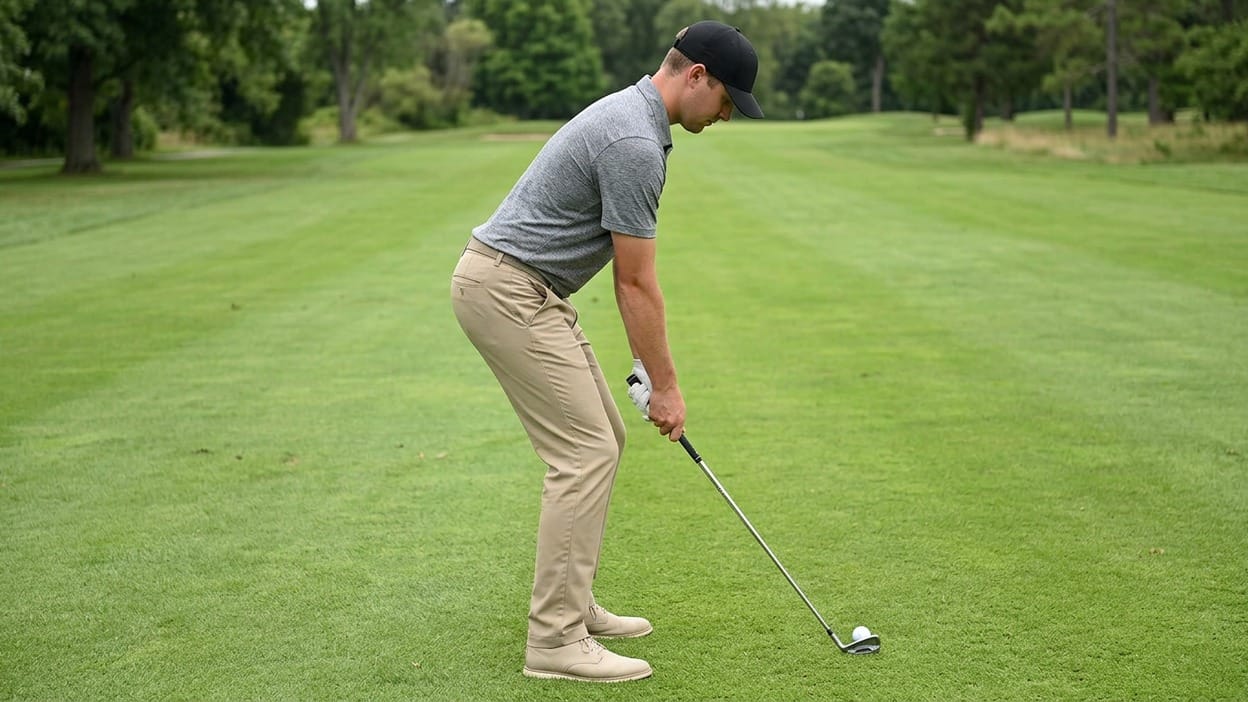
Hinge, don't bend: Push the hips back until the chest tilts over the ball; the waist should never be the hinge point.
Soft knees, not a squat: A small amount of knee flex is athletic. A lot of knee flex is a squat, and a locked leg is just as much of a fault.
Arms hang, they don't reach: Let gravity set the arms straight down from the shoulders instead of pushing them out toward the ball.
Weight sits forward of the heels: The balance point is the balls of the feet, not the heels and not the toes.
Posture changes with the club: Expect a more upright setup with the driver and more forward bend with a short iron.
Set your aim and your grip first
Posture is the last fundamental to set, not the first. Set the clubface to the target, then build the body around it: feet, hips, and shoulders parallel to the target line, as covered in how to aim and align correctly. Posture is what holds that alignment together once it's built, so doing it in the other order means re-aiming after the fact. Grip comes first too; if the grip still needs work, how to grip a golf club covers the three main grip styles and how to pick one, and nothing below changes based on which grip a golfer uses.
Step 1: Stand tall, then set your feet
Start upright, club held out in front with both hands, before anything bends. This gives a stable, tall starting point rather than trying to build posture from an already-hunched position. Feet come next, and stance width is its own topic covered in how to set ball position for every club, which also walks through where the ball sits for each club in the bag. Posture doesn't change those numbers; it changes what happens once the feet are already set.
Step 2: Hinge from the hips, not the waist
This is the step most amateurs get wrong, and it's also the one most often confused with "bending over." Golf Monthly's posture guide calls for "a really flat back, as well as a nice hip hinge," and gives a simple drill to feel it: hold a club at the belt line, then "push the club back into your hips, which should push your bum out while keeping the back straight." That's the hinge. The backside moves back, the chest tilts forward over the ball as a result, and the spine stays in one long line instead of rounding at the shoulders.
PGA of America instructor Brendon Elliott frames the same position around the spine's job during the swing itself: "imagine your spine as the axis around which your upper body rotates," and the goal at setup is to "try to keep that axis stable as you swing back and through." A rounded, waist-bent posture gives that axis nowhere stable to rotate around, which is a big part of why "bend at the waist" setups fall apart the moment the club starts moving.
Step 3: Add just enough knee flex
Knee flex exists to support the tilt created by the hip hinge, not to replace it. Golf Monthly describes good posture as "the optimum back angle supported by enough knee flex to counter the tilt," adding that the right amount is "good for balance and stability" and lets a golfer "make the best use of the ground through your legs."
Too much knee flex turns into the squat that so many weekend golfers default to when they're told to "get athletic" or "sit down" at address; it drops the whole body low without doing anything for the spine angle, and it's uncomfortable to hold for an entire swing. Locked, straight legs cause the opposite problem: no shock absorption, no ground connection, and a setup that looks stiff because it is stiff. The right amount sits between those two, closer to "soft" than either one.
Step 4: Let your arms hang, don't reach
Once the hip hinge and knee flex are in place, the arms should drop on their own. Golf Monthly's posture breakdown is direct about this: "A good tilt also produces good arm hang, directly under the shoulders." If the arms are hanging correctly, a golfer shouldn't feel like they're stretching toward the ball, and they shouldn't feel like the hands are crowded in against the thighs either. Reaching for the ball is usually a sign that the hip hinge was too shallow; standing too close, covered below, is usually the opposite problem.
Step 5: Get your weight into the right part of your feet
Balance at address sits in the balls of the feet. Golf Monthly's guide is specific on this point: "This balancing point should be under the balls of your feet (not in the heels or toes)." That's a narrower target than "balanced evenly," and it matters because weight that drifts toward the heels tends to pull the upper body back and out of its hinge, while weight that creeps onto the toes makes it hard to hold the position through the swing at all. The same source ties weight-in-the-heels directly to one of the most common faults, covered in the next section.
Step 6: Short iron vs. driver: how posture changes
Posture isn't one fixed position across the bag. GOLFTEC's breakdown of setup distance notes that "tour players average about 40 degrees of forward bend with their shoulders at setup," which works as a baseline for most irons, but "for the driver, bend less: more like 30-35 degrees instead of 40." Exactly how far the ball sits from your feet with a driver is covered in how to set ball position for every club; standing more upright keeps the swing shallow enough to catch the ball on the way up rather than digging down into it.
That 40-degree-versus-30-to-35-degree split is a tour average, not a universal setting. I'll admit I'm skeptical that any single degree figure fits every body as well as a published range suggests, since torso length and hip mobility vary enough from one golfer to the next. Treating a posture number as a rule to hit exactly, rather than a range to land inside, tends to cause more stiffness than it solves. The practical takeaway holds regardless: stand a little taller with the driver, and bend a little more with the shorter clubs.
Common posture faults and the miss each one causes
Hunched or rounded back. Golf Monthly names this "C-posture," where "the shoulders drop down, the head tucks in and the top of the back rounds out." A related fault, "S-posture," is when "the shoulders look like they are being squeezed together to form an inward arc in the back." Both remove the stable spine axis described in Step 2, which tends to show up as inconsistent contact rather than one specific miss.
"Sitting" too much. This is the squat fault from Step 3, and Golf Monthly ties it directly to where the weight sits: "my weight has shifted into my heels, creating a sitting position." The fix isn't more knee flex; it's moving the weight back toward the balls of the feet.
Standing too close or too far from the ball. GOLFTEC's setup-distance video is blunt about the cause: "If you're too upright or too bent over, it will affect how far you stand from the ball." Posture sets the distance, not the other way around, so adjusting stance distance without first checking posture usually just trades one problem for another.
Reaching for the ball. Covered in Step 4: a shallow hip hinge leaves the arms stretching to reach the ball instead of hanging under the shoulders.
Early extension and standing up through impact. This one lives mostly in the swing rather than the setup, and it's covered in depth in how to stop topping the golf ball, including why "keep your head down" is the wrong fix for it. Good posture at address doesn't prevent early extension by itself, but a hunched or overly upright starting position makes it easier to lose those angles on the way down. Golfers who can't hold a hip hinge without rounding their back, rather than losing it mid-swing, may be dealing with a mobility limit rather than a technique one; how to find your tightest link walks through how to screen for that without diagnosing anything.
Check your posture without buying anything
Every check below works with a club and a mirror or a phone propped against something. Nothing in this section requires a training aid.
Set up normally in front of a mirror or a phone camera, first from down the target line and then face-on. From down the line, the back should read as one continuous tilt from the hips, with no rounding at the shoulders or dip at the lower back. From face-on, both shoulders and both knees should sit level, with no visible lean toward either foot.
For a more precise check on the spine angle itself, Golf Monthly's coaching video describes laying a club or alignment stick along the back at address: "the alignment stick runs through the seat of my trousers at address, at the top of my backswing and at impact," and notes that "maintaining your spine angle is crucial" enough to be worth checking this way. A straight club works for this exactly as well as a dedicated stick; the stick is only easier to hold in place, which is the entire case for owning one. For golfers who want one, our review of the SKLZ Pro Alignment Rods covers what they're useful for, and the same pair is available on Amazon.
None of this replaces a lesson for a golfer who's genuinely stuck, but a 5-minute mirror check catches most of the faults above before they turn into a swing habit. For golfers working specifically on cutting strokes rather than chasing distance, this kind of fundamental is the subject of a dedicated breaking-100 guide, which builds a practice plan around getting the basics repeatable instead of occasional.
Frequently Asked Questions
Does my posture need to change for every club in the bag?
Not for every club individually, but it does change gradually from wedge to driver. GOLFTEC's research puts the shift at roughly 40 degrees of forward bend for a typical iron versus 30 to 35 degrees for the driver, with shorter clubs calling for more bend and the driver calling for a more upright stance.
Why does a golfer stand up out of posture during the swing?
Standing up through the swing, known as early extension, is usually a swing-sequence issue rather than a setup one, though a hunched or overly upright starting posture can make it worse.
How to stop topping the golf ball covers the causes and fixes in detail.
Where should my weight sit in my feet at address?
In the balls of the feet, not the heels and not the toes. Golf Monthly's posture guide is specific that the balance point sits there, and notes that weight drifting into the heels is what creates the "sitting" fault covered above.
How can a golfer check posture without a coach?
Set up in front of a mirror or phone camera from both down the target line and face-on, and look for one continuous tilt from the hips with no rounding at the shoulders. A straight club or alignment stick laid along the back at address, as shown in Golf Monthly's spine-angle drill, gives a more precise check of whether that tilt is holding.
Some links in this article are affiliate links. If you buy through them, I earn a small commission at no extra cost to you. This never influences what I cover or recommend. I link to gear I'd buy myself.