Best Golf Push Carts 2026: 5 Walking Trolleys Ranked
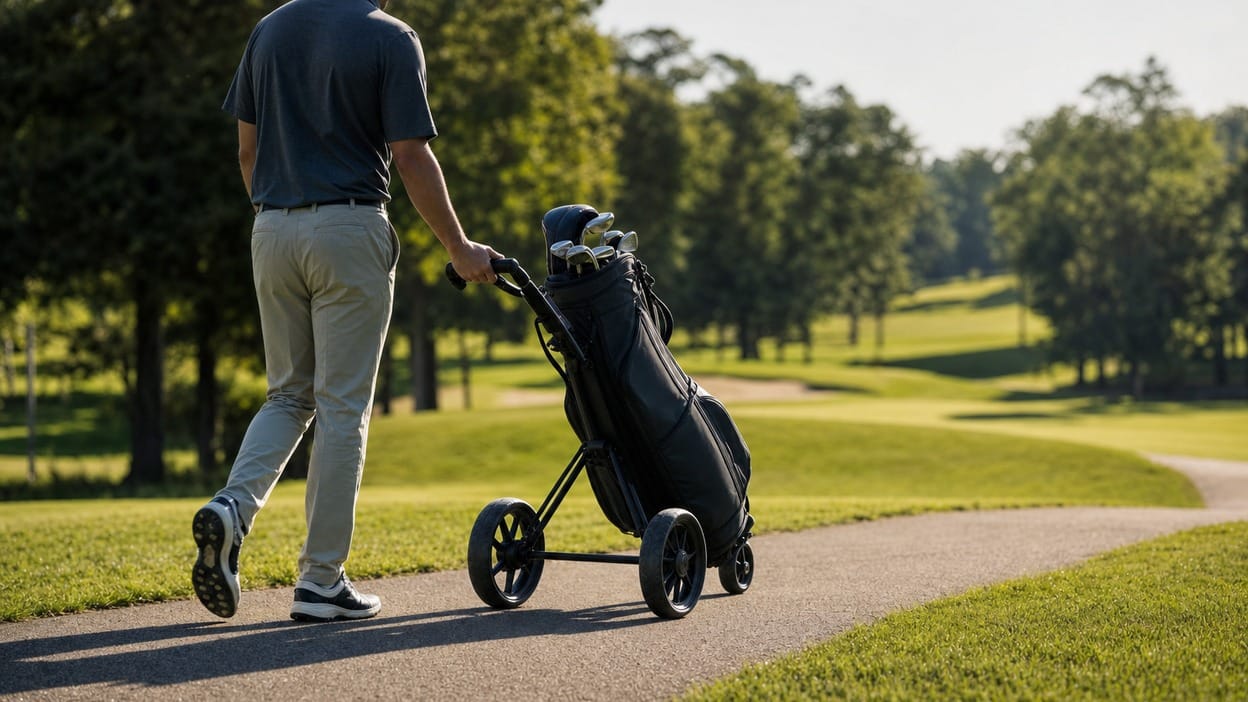
Walking 18 holes with a strapped bag is a different sport from walking it behind a cart, and the gap between a good push cart and a bad one shows up in the back nine, not the first. This roundup ranks five trolleys across the price range, from an entry-level folding two-wheeler to a full remote-controlled electric caddy, and matches each to the golfer who should actually buy it.
- Top overall pick: the Clicgear 4.0 is the category benchmark for a serious walker who wants one cart for years.
- Best value: the Bag Boy Compact 3 is the pick for a regular weekend player who doesn't need a purist's spec sheet.
- Budget pick: the Precise X-Lite 2-Wheel is the pick if you play occasionally and just need something that folds small and rolls.
- Full electric: the Motocaddy M7 GPS Remote trades a push cart's simplicity for full remote and GPS convenience.
| Cart | Wheels | Weight | Folded size | Best for |
|---|---|---|---|---|
| Precise X-Lite 2-Wheel | 2-wheel, fixed | Manufacturer markets it as its lightest model; no published figure | Folds compact for trunk storage | Occasional walker on a tight budget |
| Bag Boy Compact 3 | 3-wheel, folding front | 13.5 lbs (6.1kg) | 21.5 x 13 x 18 in (55 x 33 x 46cm) | Regular weekend walker |
| Bag Boy Nitron Swivel | 3-wheel, 360-degree swivel front | 18.5 lbs (8.4kg) | 19 x 13 x 22 in (48 x 33 x 56cm) | Upgrading from a basic 3-wheel, tighter paths |
| Clicgear 4.0 | 3-wheel, airless tires | 21 lbs (9.5kg) | 13 x 15 x 24 in (33 x 38 x 61cm) | Serious walker or purist |
| Motocaddy M7 GPS Remote | Dual 230W motor, remote-controlled | 32 lbs (14.5kg) | Not applicable, electric caddy | Full remote and GPS convenience |
Precise X-Lite 2-Wheel: the budget pick for occasional rounds
The X-Lite is built around one job: fold down small, roll smoothly, and get out of the way of a golfer who plays a handful of times a month rather than every weekend. It's a fixed two-wheel design rather than the three-wheel, folding-front layout most of this list uses, which keeps the mechanism simple and the price down. Precise markets it as its lightest cart, and while the brand hasn't published an exact figure, the compact folded footprint and simple two-wheel frame back up that positioning. It carries a scorecard holder, ball and tee slots, and a beverage holder, the same basic amenities as the pricier carts here, just without the swivel wheel or storage console upgrades. For a golfer deciding whether a push cart is even worth owning, this is the lowest-friction way to find out.
Precise X-Lite 2-Wheel: View on Amazon
Bag Boy Compact 3: the pick most weekend golfers should buy
This is the cart that earns its place in the middle of the lineup rather than just filling a price gap. At 13.5 lbs (6.1kg) folded to 21.5 x 13 x 18 in (55 x 33 x 46cm), the Compact 3 is genuinely light and small enough to live in a trunk without a second thought, and its three-step open-and-close mechanism is fast enough that it doesn't become a pre-round chore. A folding front wheel, deep scorecard console, and handle-mounted parking brake round out a spec sheet that covers what a regular walker actually uses round to round. This is the cart to buy if you play most weekends and want something that just works, not a cart bought only because it's cheap.
Bag Boy Compact 3: View on Amazon
Bag Boy Nitron Swivel: the step up for tighter courses
The Nitron Swivel's defining feature is its 360-degree front wheel, which makes a real difference on courses with tight cart paths, narrow bridges, or crowded staging areas near the tee. At 18.5 lbs (8.4kg) and folding to roughly 19 x 13 x 22 in (48 x 33 x 56cm), it's a step heavier than the Compact 3, a tradeoff for the added maneuverability and a more spacious storage console with magnetic accessory plates. It's the right upgrade for a golfer who already owns a basic 3-wheel cart and has felt it fight back on tight turns, not a first-cart recommendation.
Bag Boy Nitron Swivel: View on Amazon
Clicgear 4.0: the category benchmark
The Clicgear 4.0 has been the reference point other push carts get measured against for a reason. Aircraft-grade aluminum tubing, maintenance-free airless tires, and an infinitely adjustable silicone strap system add up to a cart built to be owned for a decade, not replaced in three years. At 21 lbs (9.5kg) and folding to 13 x 15 x 24 in (33 x 38 x 61cm), it's not the lightest cart here, but the extra weight comes from genuinely sturdier construction rather than unnecessary bulk. A handbrake that engages the front wheel, a full storage console, and an umbrella mount round out the spec sheet. This is the cart for a walker who plays year-round and wants one purchase to last, and it's why it's the top overall pick in this lineup even though it isn't the cheapest.
Clicgear 4.0: View on Amazon
Motocaddy M7 GPS Remote: full electric convenience
The M7 is a different category of product entirely: a remote-controlled electric caddy rather than a push cart, and the only fully electric option in this lineup. Dual 230W motors with all-terrain tires handle hills without a hand on the frame, a 3.5-inch touchscreen carries GPS mapping for more than 40,000 preloaded courses, and the remote handset gives full directional control from over 328 feet (100m) away, useful for sending the caddy ahead on a blind approach or parking it out of the way near the green. At roughly 32 lbs (14.5kg), it's meaningfully heavier than any push cart here, which is the nature of carrying a motor and a lithium battery rather than just a frame. If your budget stretches to a fully electric caddy, entry-level models in this category start meaningfully below the M7's price, stepping up from a simpler electric push (no GPS, no remote) toward the M7's full remote-plus-GPS package, so it's worth deciding how much automation you actually want before landing on the top of that range.
Motocaddy M7 GPS Remote: View on Amazon
Buying advice: what actually matters before you buy
2-wheel vs. 3-wheel. A 2-wheel cart like the X-Lite is simpler and usually cheaper, but a 3-wheel design with a folding or swiveling front wheel tracks straighter on uneven fairways and turns tighter around obstacles. If you're buying your first cart and don't yet know your course's terrain quirks, a 3-wheel design is the safer default.
Is electric worth it? This is the one place a spec sheet won't give a straight answer, and it's worth being honest about it: an electric caddy like the M7 is worth the extra cost and weight for a golfer managing a physical limitation, walking hilly courses regularly, or simply valuing the convenience enough to pay for it, but I'd steer a healthy mid-handicap golfer who walks flat-to-moderate courses toward a good push cart first, since the difference in actual fatigue saved rarely matches the price jump until the terrain or the golfer's own limits make it necessary.
Will it fit your bag? Every cart on this list uses an adjustable strap or bracket system built for standard stand and cart bags, but oversized tour bags can be a tight fit on the more compact frames like the X-Lite. Check your bag's base width against the cart's bracket spacing if you're carrying a larger bag, and see our Sun Mountain 4.5 LS stand bag review for a bag built with cart compatibility in mind.
How much to spend, by golfer type. An occasional player gets full value from the budget tier; a regular weekend walker sees the clearest return stepping up to a mid-tier 3-wheel cart; a serious or year-round walker is the one buyer who reliably gets their money's worth out of the Clicgear-tier build quality or the electric convenience of something like the M7.
Whatever cart you land on, it's only doing half the job without the rest of your walking setup dialed in. Pair it with shoes built for miles on your feet, not just a few holes, like our Skechers GO GOLF Elite 5 review, and a properly fitted glove from our Best Golf Gloves 2026 guide. If you're walking through summer heat, our guide to playing through firm, fast, hot-weather conditions is worth reading before you head out with any of these carts in tow.
Frequently Asked Questions
2-wheel vs 3-wheel push cart: which should I buy?
A 3-wheel cart with a folding or swiveling front wheel generally tracks straighter and turns tighter than a fixed 2-wheel design, which makes it the safer default if you don't already know how your usual course's terrain behaves. A 2-wheel cart like the Precise X-Lite is simpler, lighter, and usually cheaper, and it's a fine choice if you're playing occasionally and want the lowest-friction option.
Are electric golf carts worth it?
For a golfer managing a physical limitation, walking hilly courses often, or simply valuing full remote and GPS convenience, yes. For a healthy mid-handicap golfer walking mostly flat-to-moderate courses, a good push cart like the Clicgear 4.0 or Bag Boy Compact 3 usually delivers most of the practical benefit at a fraction of the cost and weight.
How much should I spend on a push cart?
An occasional player gets full value from a budget model like the Precise X-Lite. A regular weekend golfer sees the clearest return stepping up to a mid-tier 3-wheel cart like the Bag Boy Compact 3 or Nitron Swivel. A serious or year-round walker is the buyer most likely to get their money's worth from a benchmark build like the Clicgear 4.0 or a fully electric option like the Motocaddy M7.
Do push carts fit all golf bags?
Most modern push carts use an adjustable strap or bracket system designed for standard stand and cart bags, but oversized tour-style bags can be a tighter fit on more compact frames. Check your bag's base width against the cart's bracket spacing before buying, especially with a larger bag.
Push cart vs pull cart: what's the difference?
A push cart is walked from behind or beside with a handle you push, which tends to track straighter and put less strain on the wrist over 18 holes. A pull cart is towed from in front, which some golfers find more awkward on hills or turns. Every cart in this roundup is a push design, which is now the more common style on the market.
Some links in this article are affiliate links. If you buy through them, I earn a small commission at no extra cost to you. This never influences what I cover or recommend. I link to gear I'd buy myself.









The golf newsletter that cuts the hype
Data-backed reviews and advice that works. No brand spin.
Recommended products