








articles
Range Balls vs. Your Own Ball: Why the Numbers Lie
A range ball isn't the ball you play. It's built to survive thousands of

Every slow round has a villain, and it's almost never the group you can see. By the time a twosome ahead is visibly backed up, the real damage is already done upstream: a dozen small decisions, made by players who have no idea they're the problem, stacking into the gap everyone blames on someone else.
The average recreational round has stretched to 4 hours and 30 minutes, a new high, according to USGA research reported by Golf.com. That number is a symptom, not a cause. A round doesn't get slow because one group stands around; it gets slow because dozens of small gaps, most of them 10 or 20 seconds each, pile up between every shot, every group, for 18 holes. Blaming the group ahead feels satisfying because it puts the problem somewhere else. The honest version of that instinct, and I'll admit it's one I catch myself making every time a pace complaint crosses my desk, is that the data almost always points back at habits nearly every golfer shares rather than one bad group.
A handful of repeatable habits account for most of the lost time in a weekend round. None of them require buying anything.
Pace of play isn't just a recreational complaint this year; both major tours have made real rule changes. The PGA Tour's own policy pages describe a Speed of Play Working Group testing a revised Pace of Play Policy on the Korn Ferry Tour and PGA Tour Americas that assesses a one-stroke penalty on a player's first bad time, rather than waiting for a second offense, along with a rangefinder trial at PGA Tour events, according to PGATour.com. The tour says data from that testing could lead to a new Pace of Play Policy on the PGA Tour itself as early as 2026.
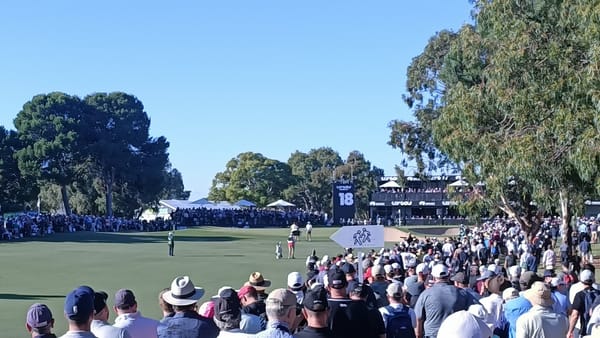
The DP World Tour already enforces something similar, and it isn't theoretical. At the Turkish Airlines Open in May 2026, Gregorio de Leo was handed a one-stroke penalty on the 11th hole after running more than 30 seconds past his 50-second allowance, the tour confirmed, a call that cost him a shot in a tightly packed leaderboard. These aren't exhibition rules. They're strokes, applied to players who are good enough to feel every one of them.
A rangefinder or GPS watch removes the guesswork from a yardage, which removes the minute or two some golfers spend pacing off sprinkler heads or guessing at a tree in the distance. If a device is already in the bag, this is one of the lowest-friction speed gains available, and our rangefinder and GPS watch guides cover what's worth buying.
Nobody needs to buy one to play faster, though. Sprinkler heads, cart-path markers, and the yardage plates on tee boxes carry the same numbers a rangefinder would give, for free, on nearly every course built in the last few decades. The habit that actually saves time is trusting a number once it's found, not finding a more precise one.
Beginners worry, reasonably, that they're the problem. Mostly they aren't. A new golfer who picks up after a bad hole, or plays a max-score format, loses less time than a single slow pre-shot habit repeated 70 times a round. Our guide to avoiding big numbers covers exactly that kind of speed-friendly scoring, and it's a legitimate tool, not a consolation prize.
Improvers tend to lose time in the gaps between shots: deciding on a club, reading a green, second-guessing a read. The fix is usually the same ready-golf and fixed-routine habits above, applied consistently rather than only when someone's watching.
Serious, low-handicap players are often the slowest group on the course, not the fastest, because a longer deliberate process feels like it's earning them better outcomes. The data on pace doesn't support that trade. Playing the right tees and committing to decisions instead of auditing them does more for both score and pace than another minute spent deliberating over a yardage. The same logic extends to course management generally: a decisive wrong decision costs less time, and often less score, than a correct one made slowly.
Some links in this article are affiliate links. If you buy through them, I earn a small commission at no extra cost to you. This never influences what I cover or recommend. I link to gear I'd buy myself.
Data-backed reviews and advice that works. No brand spin.