









articles
Golf Formats Explained
Stroke play, match play, Stableford, and scrambles: the scoring, handicap allowance, and strategy for each.
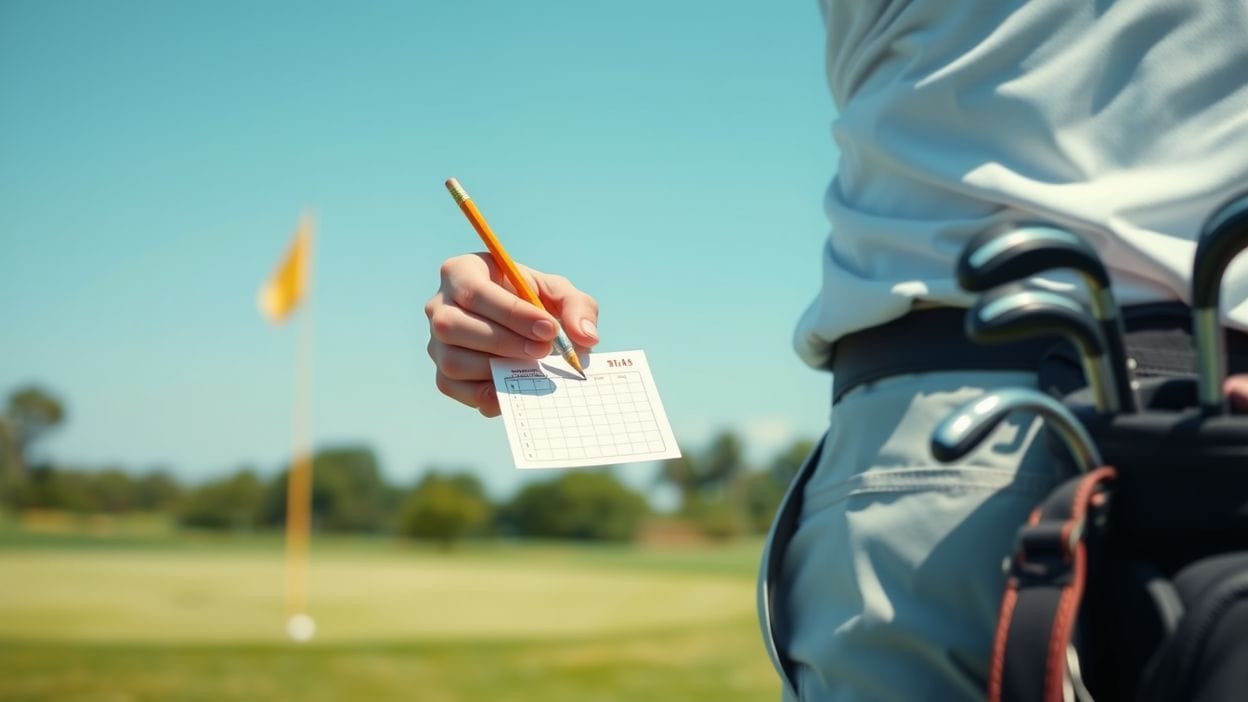
Most golfers can tell you their score. Far fewer can tell you where the strokes actually went. A scorecard already has room for five or six extra tick-marks a hole, and those marks turn a round into data instead of just a number.
None of this needs an app, a sensor, or a subscription. Every stat below can be marked with a pencil during the round and reviewed over a coffee afterward. How to Lower Your Golf Handicap Fast makes the same case for tracking every shot; this piece is the pencil-and-scorecard version of that advice, stat by stat.
Penalty strokes are often the cheapest strokes on the course to save, because the fix is usually a decision, not a swing change: laying up short of water, playing away from a tree line, taking an extra club off a tight tee.
How to mark it: one tick in the margin for every penalty stroke, whether it's a lost ball, a hazard, or an out-of-bounds. A single column, no categories needed.
Benchmark, per round (Arccos via MyGolfSpy):
| Handicap band | Penalty strokes per round |
|---|---|
| Scratch to 5 | 1.03 |
| 6 to 10 | 1.39 |
| 11 to 15 | 1.66 |
Shot Scope's broader all-golfer average sits higher, at 1.98 penalty strokes per round, per GolfWRX. The two figures come from different samples, so don't read them as the same number measured twice; they're two separate looks at the same habit.
What it tells you to practice: if your tally is running above your band, the fix is rarely a swing fix. It's usually a target-selection problem on specific holes, and the penalty-stroke column is the one I wince at most when I review it afterward, since it's nearly always the same two or three holes repeating the same decision.
"Fairways hit" is the traditional stat, but it's a worse one than it looks for a weekend golfer. A tee shot that leaks into the first cut still leaves a normal approach; a tee shot that finds a fairway bunker under the lip doesn't. Tracking strict fairway accuracy lumps both outcomes in with "miss," which hides the shots that actually cost strokes.
How to mark it: a dot for "in play" (fairway or first cut, a clean look at the green) and a slash for "trouble" (bunker, trees, a lost tee shot). Two categories instead of fairway's one.
Sourced figures, kept separate by provider: Shot Scope's all-golfer fairway average is 48%, per GolfWRX. Arccos puts scratch golfers at 51% fairways hit, per Golf Monthly. Different samples, different methods, so they sit side by side rather than as one trend line.
For the club-by-club picture behind any of this, Lower Your Score Through Course Management recommends tracking 10 to 15 shots per club to see real dispersion; this scorecard tally is the round-by-round version of that same idea.
GIR is the single best predictor of score on this list, because it's the stat that ties the rest of the round together: miss enough greens and the putting and short-game numbers below start moving for reasons that have nothing to do with putting.
How to mark it: a check mark if you reach the green in regulation (two strokes under par for the hole), nothing if you don't. No partial credit.
Benchmark, by handicap (Shot Scope 2026 data via Golf Monthly):
| Handicap | GIR |
|---|---|
| 5 | 41% |
| 10 | 32% |
| 15 | 21% |
Arccos's own community data puts the 10-handicap figure a little higher, close to a third of greens, which matches the 34% already live on this site. That's a different sample measured a different way, not the same golfers counted twice.
What it tells you to practice: a low GIR number with decent fairway numbers usually means the miss is happening with the approach club, not the tee shot, which is a different practice session than the one most golfers default to.
Total putts is the stat every golfer already tracks, and it's also the one most likely to send you to the wrong practice session. The number barely moves across handicap bands on its own.
How to mark it: a tally mark per putt, plus a circle around any hole where you three-putt.
Benchmark, per round (Shot Scope via MyGolfSpy):
| Handicap | Putts per round | Three-putts per round |
|---|---|---|
| Scratch | 29.9 | 0.8 |
| 10 | 31.2 | 2.4 |
| 15 | 32.1 | 3.8 |
| 20 | 33.4 | 4.6 |
Notice how little the putts-per-round column moves, from 29.9 to 33.4, while three-putts climb much faster. That's because total putts is really two different stories layered on top of each other. A weaker ball-striker misses more greens, chips it close, and one-putts from a few feet; a better ball-striker hits more greens and faces more genuine long first putts, which is where three-putts come from. The putt count ends up tracking how many greens you hit almost as much as it tracks your putting. That's the strokes-gained argument in plain words, and What Is Strokes Gained covers the full mechanics if you want them.
Three-putts are the cleaner signal on their own. How to Stop Three-Putting is the practical fix once the circles on your scorecard start piling up on one side of the green.
Scrambling, getting the ball up and down after missing the green, drops sharply as handicap rises, and it's the stat most likely to reveal whether a short-game problem is really a short-game problem or a GIR problem wearing a different hat.
How to mark it: a plus sign next to any missed green where you still make par or better.
Arccos's scratch-golfer data puts up-and-down success at 57% from inside 25 yards (22.9m), per Golf Monthly. There's no full banded table across handicaps in the current data, so treat this as a single reference point rather than a ladder: the direction (sharp decline as handicap rises) is well established even without every rung filled in.
A standard scorecard has enough white space for every mark above without needing a separate notebook. A simple key works for all five stats at once:
Five symbols, one pencil, no app required. A scorecard holder with a built-in pencil loop keeps the card flat and the pencil attached instead of rattling around the bottom of a bag, which is the only piece of gear this method actually needs.
Penalty strokes. It's the easiest mark to make consistently (one column, no judgment calls about what counts as "in play" or "regulation"), and it's usually the fastest stat to turn into fewer strokes, since the fix is a decision on the tee or in the fairway rather than a swing change on the range. If the five-column scorecard feels like too much on a first attempt, start with this one column for a few rounds, then add GIR, then the rest.
How to Break 100 With the Swing You Already Have makes a related case for golfers in exactly this spot: the strokes are usually a strategy problem before they're a swing problem, and penalty strokes are the clearest example of that on a scorecard.
A pencil and a scorecard cover every stat above. Where a device earns its cost is distance-band detail a hand tally can't capture on its own, like which specific yardages produce the most misses, which is the detail How to Lower Your Golf Handicap Fast points to Arccos and Shot Scope for.
A GPS handheld like the Shot Scope H4 adds GPS distances, shot tracking, and strokes-gained stats with no subscription required, per the listing. That's the upgrade path, not the starting point: get a few rounds of pencil data first, so there's a baseline to compare against once a device starts generating its own numbers.
Per Shot Scope data via MyGolfSpy, scratch golfers average 29.9 putts per round, 10-handicappers 31.2, 15-handicappers 32.1, and 20-handicappers 33.4. The gap is smaller than most golfers expect, because total putts is tied to how many greens you hit, not just how well you putt.
Shot Scope's 2026 data, via Golf Monthly, puts 15-handicap golfers at 21% greens in regulation, compared with 32% for 10-handicappers and 41% for 5-handicappers.
No. GIR is strictly the putting surface, reached in two strokes under par for the hole. A ball on the fringe still counts as a miss, even if it's inches from the green, because the point of the stat is to isolate approach-shot quality from short-game skill.
Not at first. A pencil and scorecard capture every stat on this list for free. A GPS or sensor system like the Shot Scope H4 earns its cost once you want distance-band detail, like which specific yardages produce the most misses, that a hand tally can't show on its own.
Fairways hit treats every miss the same, whether it's a tee shot in the first cut with a clean look at the green or one buried under a tree. Tracking "in play" versus "trouble" instead separates misses that actually cost strokes from misses that don't, which is the more useful split for a weekend golfer's practice time.
Some links in this article are affiliate links. If you buy through them, I earn a small commission at no extra cost to you. This never influences what I cover or recommend. I link to gear I'd buy myself.
Data-backed reviews and advice that works. No brand spin.