How to Lower Your Golf Handicap Fast: What the Data Says
How to lower your golf handicap fast using strokes gained data, approach play improvement, and club fitting. Backed by Arccos and Broadie research.

If you're carrying a handicap between 10 and 22, you've almost spent time working on the wrong things. Not because you're not trying hard enough. Because the data on where you're losing shots points somewhere different from where most golfers instinctively practice.
The strokes gained framework, built on Columbia Business School professor Mark Broadie's research in Every Shot Counts (2014) and validated by tracking systems like Arccos and Shot Scope, gives us a clear picture of what separates a 15-handicapper from a 10-handicapper. The answer isn't what you'd expect.
- 1.Approach play (shots from 100+ yards) accounts for about two-thirds of the scoring gap between handicap levels, according to Broadie's research. That's where to focus first.
- 2.Arccos data from 400,000+ players shows 10-handicappers hit 34% of greens in regulation vs 58% for scratch. Closing that gap moves your index faster than any other single change.
- 3.Under the World Handicap System, your index is the average of your best 8 differentials from your last 20 rounds. Three strong rounds in a row won't move it. Sustained improvement does.
- 4.Club fitting can produce immediate distance and accuracy gains: a Golfweek/Club Champion case study found a 21-handicapper gained 47 yards (43m) of driver carry after a proper fit.
- 5.A launch monitor removes guesswork from your practice. Knowing your ball speed and attack angle tells you where your efficiency ceiling is before you touch a swing thought.
- 6.Course management decisions (tee selection, when to take your medicine, playing away from short-side misses) are free. Most mid-handicappers leave 2-3 shots per round on the table here.
Where Are You Losing the Most Shots?
The most persistent myth in improvement is that putting is where to start. Walk into any pro shop and you'll find more putting aids than everything else combined. Yet Broadie's analysis, built on ShotLink data from the PGA Tour and amateur tracking systems, found something that most golfers have backwards.
Approach play is the dominant factor in scoring differences between players at every skill level. About two-thirds of the scoring gap between an 80-golfer and a 90-golfer comes from shots outside 100 yards (91m). Putting accounts for about 15% of that difference. Broadie's direct quote from Every Shot Counts: "Two-thirds of a 10-stroke difference comes from shots outside of 100 yards and about one-third comes from shots inside 100 yards."
A strokes gained score is a measure of how many shots you gain or lose compared to a baseline player from any given position on the course. Arccos, whose platform has tracked over 300 million shots from more than 400,000 players, uses this framework to put hard numbers on where club golfers bleed strokes. A scratch player hits 58% of greens in regulation. A 10-index player hits 34%. That 24-point GIR gap is where the scoring difference lives. From 50-100 yards (46-91m), scratch players hit 78% of GIR. Getting more approach shots on the green (not closer to the pin, just on the green) is the highest-leverage change most mid-index players can make.
The three-putt rate matters too, but in proportion. Arccos data shows 16-20 index players three-putt 19% of greens, compared to 8% for scratch. That sounds bad. Yet the gap closes faster by getting on the green in fewer shots than by eliminating three-putts once you're there. Two-putting from 40 feet (12.2m) while your playing partner is chipping from off the green means they've already lost before either of you picks up a putter.
This is how strokes gained actually works: a ranked list of your actual weaknesses rather than your assumed ones.
The Handicap Mechanics You Need to Understand
Before building a plan, understand how the index moves.
Under the World Handicap System (WHS), your index is the average of your eight lowest score differentials from your most recent 20 rounds. A score differential is a number that measures how well you played relative to the course difficulty, calculated as: (113 / Slope Rating) × (Adjusted Gross Score − Course Rating − Playing Conditions Calculation). A lower differential means a better round.
The formula means the system tracks demonstrated ability, not average performance. Three bad rounds in a row won't push your index up more than 5 strokes above your Low Handicap Index (the hard cap). Posting rounds that produce lower differentials will pull it down over time.
Here's what that means for a player at 16: to move to 12, you need your eight best differentials from the last 20 rounds to average about 12. If your best rounds are averaging 16 differentials, you need to improve them by 4 strokes. That's not one good week. That's a structural change in how you play.
The WHS also applies an exceptional score reduction if you post a round with a differential 7 or more strokes below your current index. That adjustment is applied across your last 20 recorded differentials, so one standout round accelerates the movement substantially. Post a differential 10 or more strokes below your index and the reduction doubles. It's a built-in reward for genuine breakthrough rounds.
Action Hierarchy: Ranked by Impact
The data supports this ordering. Work through it in sequence.
1. Get Your Approach Game Tracked
Before changing anything, you need your actual numbers. Apps like Arccos, Shot Scope, or a phone-based tracker will tell you your GIR percentage by distance band, your proximity to the hole from each range, and where the miss patterns are.
A 15-handicapper's median 7-iron shot from 150 yards (137m) finishes about 42 feet (12.8m) from the hole, based on Shot Scope's published benchmark data. Knowing whether you're at that benchmark or 60 feet (18.3m) away tells you whether you have a technique problem, a distance-control problem, or a club selection problem. They have different fixes.
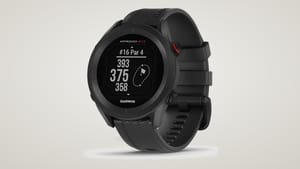
The Garmin Approach R50 is a portable option for golfers who want that kind of tracking without a permanent home setup, recording club data and shot dispersion on the range or in the back yard.
Buy now Buy now
2. Understand Your Equipment Data
This is where a launch monitor earns its place. Ball speed is the master metric: it tells you how well you're transferring energy at impact. At a standard 14.5-handicapper's swing speed, TrackMan Combine data shows an average attack angle of -1.8 degrees with the driver. Hitting down on the ball with the driver kills distance.
For irons, the optimal attack angle sits around -3 to -4 degrees for mid-irons, a descending blow that traps the ball. Many mid-handicappers are closer to 0 degrees, which produces the thin, low, inconsistent contact that sends approach shots short and offline.
You don't need a TrackMan to access this data. The Garmin Approach R10 gives you attack angle, ball speed, and spin rate at a fraction of the cost of a full fitting session. Knowing these numbers before you work with a coach or fitter means you walk in with a diagnosis rather than a vague complaint.
Knowing your own data (and how to stop three-putting when you do miss greens) means your practice time targets what's broken, not what looks wrong on video.
3. Get Fitted, Specifically for Your Irons
Club fitting has a reputation as a premium luxury. For mid-handicappers, it's often the fastest path to structural improvement.
A Golfweek series with Club Champion (published March 2020) tracked three players through full fittings. Nathan DeBerry, a 21-handicapper with a clubhead speed of about 110 mph (177km/h), gained 47 yards (43m) of driver carry after the fitting. The changes: shaft corrections that reduced his spin rate by 1,500 rpm and brought down an excessively high launch angle. His slice turned into a fade.
This specific result won't repeat for every player. But for anyone who's never been fitted, getting shaft flex and length right (two variables that affect attack angle and club path) produces real and measurable changes. Most golf retailers stock Regular and Stiff shafts. Most mid-handicappers need something in between, or a specific tip/butt section combination matched to their tempo. Playing off-the-rack clubs with the wrong flex is a dispersion and distance problem disguised as a swing problem.
See why club fitting moves the needle faster than most golfers expect for the full breakdown.
4. Structure Practice Around Your Weaknesses
The most common practice mistake: warming up on the range with driver and finishing with driver. It's comfortable. But strokes gained data from Arccos shows the biggest disparity between handicap levels isn't in driving distance. It's in GIR from inside 150 yards (137m).
Arccos data puts a scratch golfer at 78% GIR from 50-100 yards (46-91m). A 10-handicapper sits around 62% from that same range. That 16-point gap, spread over 100 holes, means about 160 approach shots missed that a 10-handicapper would have held.
The practice structure that addresses this isn't hitting wedges to the same target for 45 minutes. It's random-target practice: pick a different yardage and target on every shot, go through a full pre-shot routine, and track the outcome. Arccos advisory board chair and PGA Hall of Famer Bob Ford put it plainly: "I wouldn't even look at the range data if I was coaching that player. It is night and day. You see a different person on the course than on the practice range." On-course data tells you whether range work is translating.
5. Play the Right Tees
This one is worth confronting. Arccos reports that golfers in the 16-20 handicap range average 209 yards (191m) off the tee, while 0-5 handicappers average 243 yards (222m). That 34-yard (31m) gap means the mid-handicapper is hitting approach shots from further out on every par-4 and par-5.
Playing the same tees as a single-digit handicapper when you're at 16 doesn't build improvement. It puts you in positions the data says you can't convert at your current level, which adds penalty strokes and compounds into inflated scores that have little to do with technique.
The course management decisions most mid-handicappers get wrong include this one, and the fix is free.
The Three-Putt Problem in Context
Putting matters less than approach play in moving your index, but the numbers are real. The Arccos three-putt data (19% for 16-20 handicappers vs 8% for scratch) translates to 1-2 extra putts per round on average.
The biggest cause of three-putts isn't short putts. It's poor distance control from outside 30 feet (9.1m). Practicing putts of 30, 40, and 50 feet (9.1m, 12.2m, 15.2m) until you finish inside 3 feet (0.9m) moves the index faster than drilling 6-footers. Shot Scope's data shows 6-foot (1.8m) putts fall at about the same rate across the 10-20 handicap range. The lag putting gap is where the real difference shows up.
A Realistic Timeline
With focus on approach tracking, one fitting session, and 3-4 months of structured practice, a 15-handicapper who plays twice a week can move their index to 11-12 by the end of a season. That's not slow progress. Moving from 15 to 11 means your eight best differentials from the last 20 rounds need to average 4 strokes lower than they do now.
The players who move fastest are the ones who track every shot. The ones who know their GIR from 100-150 yards (91-137m) is 28% and set a specific target of 38%. The ones who find out their 7-iron plays 8 yards (7.3m) short of their assumed carry distance and stop choosing the wrong club into greens. The data doesn't make you better on its own. But it removes the guesswork from what to work on next, and that's where most of the time gets lost.
Frequently Asked Questions
How many rounds does it take to lower my handicap by 3 strokes?
Under the WHS, your handicap index is calculated from your best 8 score differentials out of your last 20 rounds. To lower your index by 3 strokes, those 8 differentials need to average 3 strokes lower than they do now. The fastest path is playing 20 rounds where your best 8 produce lower differentials across the board. That can happen inside a single season if the improvement is genuine. There's no minimum number of rounds, but the index responds to sustained performance, not one-off results.
Should I focus on my driver or short game to lower my handicap faster?
For golfers between 10 and 22 handicap, approach play is the higher-impact area based on strokes gained data. Mark Broadie's research found about two-thirds of the scoring difference between handicap levels comes from shots outside 100 yards (91m), with approach play as the dominant factor. Short game matters, but addressing approach consistency first moves the index faster for most players in this range.
Does club fitting really help mid-handicappers?
Yes, and more than most players realize. Mid-handicappers tend to gain more from fitting than low single-digit players because there's more inefficiency to correct: wrong shaft flex, incorrect lie angle, or mismatched loft for their swing speed. A Golfweek case study with Club Champion found a 21-handicapper gained 47 yards (43m) of driver carry after a single fitting session. Results vary by player, but if you've never been fitted, the shaft flex alone is likely costing you yards and accuracy.
How do tracking apps like Arccos or Shot Scope help my handicap?
They replace guesswork with ranked data. Instead of feeling like "my wedges are off," you see that your GIR from 75-100 yards (69-91m) is 41% compared to a 55% benchmark for your handicap level. That tells you the size of the gap and where it lives. Arccos data from 400,000+ players provides benchmarks by handicap level, so you can compare to players at your target handicap rather than PGA Tour averages. A device like the Garmin Approach R50 captures similar shot data automatically, without needing a phone running during the round.
What's the fastest way to lower my golf handicap?
The data points to three compounding levers: track your approach game so you know where you're losing shots, get fitted so your equipment matches your swing, and structure practice around your actual weaknesses. Course management (playing the right tees, taking your medicine on bad positions) adds strokes back without any swing change. None of these are instant fixes, but they're the variables with the highest return on effort based on what the numbers show.
Some links in this article are affiliate links. If you buy through them, I earn a small commission at no extra cost to you. This never influences what I recommend. I link to gear I'd buy myself.









The golf newsletter that cuts the hype
Data-backed reviews and advice that works. No brand spin.
Recommended products