What Is Strokes Gained? A Golfer's Plain-English Guide
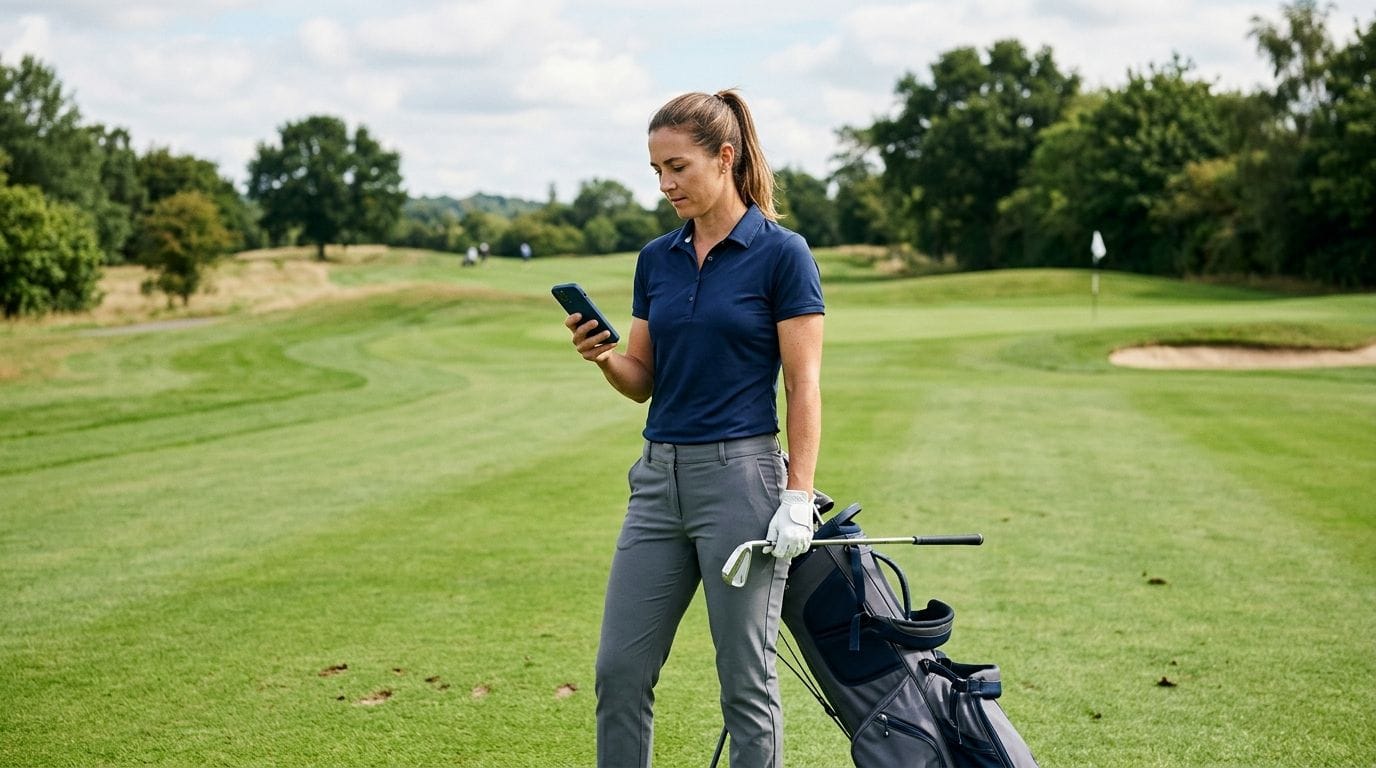
Strokes gained appears on Arccos dashboards, Shot Scope summaries, and Garmin Golf reports. Most golfers glance at it, don't fully understand what it's measuring, and move on. That's a mistake, because strokes gained is probably the single most useful piece of data an amateur golfer can look at to understand where they're actually losing shots.
The concept isn't complicated once you strip away the stats terminology. This guide covers what strokes gained actually measures, which categories matter most for golfers above 90, and how to turn the number into a concrete practice decision.
- 1Strokes gained measures each shot against a benchmark average, not against par. A shot that outperforms the benchmark gains strokes; one that underperforms it loses strokes. The number tells you how much better or worse than average you are, by category.
- 2The four individual categories are: Off the Tee, Approach the Green, Around the Green, and Putting. Tee-to-Green and Total are composites of these.
- 3For golfers above 90, SG: Putting and SG: Around the Green are the highest-return categories to address first. Both are high-frequency and more tractable than approach play without a fundamental swing change.
- 4The benchmark isn't scratch golf. In consumer platforms like Arccos and Shot Scope, it's the average of golfers at a similar handicap level. A negative SG: Putting means you're losing strokes to your peers, not to tour professionals.
- 5Arccos, Shot Scope, and Garmin Golf all generate strokes gained data from GPS-tracked amateur rounds. No launch monitor required.
- 6Strokes gained tells you what to practice, not how. A deficit in SG: Approach identifies the category; a teaching professional or practice plan addresses the cause within it.
What strokes gained actually measures
The foundational idea: every position on the golf course has an expected number of strokes it takes an average golfer to hole out from there. An approach from 150 yards (137m) in the fairway has one expected score. A putt from 30 feet (9.1m) has another. Every shot you play starts at one expected score and ends at another.
Strokes gained is the difference: the expected score before the shot, minus the expected score after, minus one for the shot itself. If you hit an approach from 150 yards (137m) and the ball finishes 5 feet (1.5m) from the hole, you've moved from a position where average golfers need roughly 3.0 more strokes to hole out to one where they need roughly 1.2. You used one shot. The calculation: 3.0 minus 1.2 minus 1 = approximately 0.8 strokes gained on the benchmark.
The framework was developed by Mark Broadie, a Columbia Business School professor, and outlined in his book "Every Shot Counts" (2014), and detailed in his book Every Shot Counts. The PGA Tour adopted strokes gained statistics around the same time. Arccos, Shot Scope, and Garmin have since applied the methodology to amateur round data, benchmarking against large pools of tracked rounds rather than against the tour average.
The key distinction: strokes gained measures relative to a benchmark, not relative to par. A golfer who makes par on every hole gains zero strokes against par, but whether that's good or bad depends entirely on their skill level. Strokes gained adjusts for that: a 20-handicapper with a positive SG: Putting number is genuinely outperforming their peers on the greens, regardless of what their score says.
The six strokes gained categories
The four individual categories, and the two composites:
SG: Off the Tee. Tee shots on par 4s and par 5s. Measures how much your driving contributes to or costs your score relative to the benchmark. Distance and accuracy both factor in: a long drive in the rough may or may not outperform a shorter drive in the fairway, depending on the lie and approach distance produced.
SG: Approach the Green. Shots played from outside a set distance threshold, typically 100 yards (91m), toward the green. Covers most of what golfers think of as iron play. Heavily influenced by proximity to hole; indirectly influenced by ball-striking consistency.
SG: Around the Green. Shots played from within 100 yards (91m) of the green, excluding putting. Chip shots, pitch shots, and short wedge play. For most high handicappers, this is where large, correctable losses accumulate.
SG: Putting. Every stroke taken on the putting surface. The most widely tracked category, and the one where GPS-based systems generate the most reliable data, since the putting surface is a known, fixed environment.
SG: Tee-to-Green. The sum of Off the Tee, Approach the Green, and Around the Green. Shows your overall ball-striking and short-game contribution, separated from putting.
SG: Total. The sum of all four individual categories. The single number summarizing how your overall performance compares to the benchmark across a round or a season of rounds.
Why high handicappers should start with SG: Putting and SG: Around the Green
A golfer playing to a 20 handicap is losing strokes in every category. The question isn't which category shows a negative number; it's which one is the most tractable starting point.
Two things make SG: Putting and SG: Around the Green the right first focus for golfers above 90:
Frequency. A typical round for a 20-handicapper involves 36 to 40 putts and 12 to 18 short-game shots. These are the two highest-frequency shot categories. Each stroke in either category represents a repeatable improvement opportunity.
Tractability. Improving SG: Off the Tee and SG: Approach typically requires a meaningful change in ball-striking ability, which takes time and usually instruction. Improving SG: Putting and SG: Around the Green can often be achieved through better decision-making and distance control. Getting a 30-foot (9.1m) putt to finish within 3 feet (0.9m) is a distance control problem for most golfers, not a fundamental technique problem.
The data tends to confirm this for most players (and for James personally: his first full-season Arccos report showed SG: Around the Green as his biggest category deficit, by a margin he hadn't expected given how adequate his chipping felt in the moment). A session with a wedge on a short-game area fixed something he'd been ignoring because the raw score didn't make the cost visible.
How to access your own strokes gained data
Three consumer platforms generate strokes gained data from amateur rounds without requiring a launch monitor:
Arccos Caddie. Grip sensors clip into the end of each club and communicate with the Arccos app via Bluetooth. The system uses GPS to detect shots automatically, with the golfer confirming or adjusting locations in the app. Arccos generates full strokes gained reports benchmarked against a large pool of tracked amateur rounds. Arccos Caddie Smart Sensors are available through Amazon; an annual subscription runs approximately $100 (approximately £78 / AU$155) per year after the first year; check current pricing before purchase as this changes periodically.
Shot Scope. GPS watches and earbuds with built-in automatic shot tracking. No grip sensors. Shot Scope is particularly strong in the UK and European market and generates full strokes gained reports. The hardware is a one-time purchase; the tracking software is included. Worth considering if you're in a market where Arccos GPS coverage is less complete.
Garmin Golf app. Certain Garmin GPS watches running the Garmin Golf app track shots and generate strokes gained summaries. If you already own a qualifying Garmin watch, the tracking can be activated within the existing ecosystem without additional hardware. The Garmin Golf subscription runs $9.99 (approximately £7.80 / AU$15.50) per month or $99.99 (approximately £78 / AU$155) per year.
For golfers who already own a launch monitor and want to understand how device tiers connect to the underlying data types that feed strokes gained analysis, the launch monitor total cost guide has the breakdown by tier.
What to do with the number
A strokes gained report by category tells you what to practice. It doesn't tell you how.
A large deficit in SG: Putting points toward lag putting distance control, pace consistency, and green reading as practice priorities. A deficit in SG: Around the Green points toward short-game decisions: club selection, target selection, and committed contact. Both categories can be addressed directly through practice without necessarily booking an instruction block.
A large deficit in SG: Approach or SG: Off the Tee typically requires a teaching professional, because the causes are usually technical. The strokes gained number identifies the category; the instructor finds the cause within it.
One useful frame: treat strokes gained as a diagnostic that accumulates over a season of tracked rounds. A single round's numbers are noisy (one bad putting day, one fortunate chip-in), but after 15 to 20 tracked rounds, the pattern stabilizes. The categories with the largest consistent deficits are where practice time should concentrate.
For golfers whose biggest deficit is SG: Off the Tee and who suspect ball speed or contact quality is a contributing factor, the smash factor guide connects that category to a specific launch monitor diagnostic.
Frequently Asked Questions
What is a good strokes gained putting number for an amateur?
Relative to the Arccos amateur benchmark (not the PGA Tour average), a 15 to 20-handicapper should expect SG: Putting numbers ranging from around -1.0 to +0.5 per round across a season. Consistently above 0 means your putting is outperforming similar-handicap golfers in the system, which is a genuine strength. Consistently below -1.0 suggests putting is a meaningful drag relative to peers. These benchmarks vary slightly between platforms: Arccos and Shot Scope each use their own amateur databases, so the reference pool differs.
Does strokes gained work with a GPS watch?
Yes, with some caveats. GPS-based systems (Garmin Golf, Shot Scope) generate strokes gained data by tracking shot positions and comparing them to expected score tables for those positions. GPS accuracy in open conditions is typically 10 to 16 feet (3 to 5m), which is sufficient for most categories. SG: Putting data is the most reliable since the system knows you're on the green; SG: Approach data quality depends on how accurately shot position and club selection are recorded. The systems have improved considerably, but the occasional missed or misattributed shot still occurs.
How is strokes gained different from handicap?
Handicap measures your scoring performance relative to par over a set of recent rounds, adjusted for course difficulty. Strokes gained measures your performance in specific shot categories relative to the average of similar-skilled golfers across a given round. Handicap tells you how good you are overall; strokes gained tells you where the strokes go. Two golfers with the same handicap can have completely different strokes gained profiles: one losing shots on approach, the other losing them on the greens. The handicap is identical; the practice priorities are completely different.
What to do next
Run 15 to 20 tracked rounds before treating a strokes gained report as a practice guide. The categories stabilize after enough rounds to smooth out variance. The category with the largest consistent deficit is where to start.
If putting or around the green is the gap, the guide on breaking 100 on this site covers the decision-making changes that move the score fastest without a swing overhaul. If ball speed or contact is contributing to an approach play deficit, the smash factor guide connects that to a specific launch monitor diagnostic.
Some links in this article are affiliate links. If you buy through them, I earn a small commission at no extra cost to you. This never influences what I cover or recommend. I link to gear I'd buy myself.








The golf newsletter that cuts the hype
Data-backed reviews and advice that works. No brand spin.
Recommended products

Rukket SPDR Golf Net Review: 10x7 Bundle for Home Practice.
The Rukket 10x7 SPDR golf net bundle reviewed: what's actually in the box, what MyGolfSpy and PluggedInGolf found, and who it fits best.
Read review