What Is Smash Factor? (And How to Improve Yours)
If you've spent any time with a launch monitor, you've seen the number. Smash factor sits there alongside ball speed and club head speed, gets glanced at, and then gets ignored in favor of carry distance. That's a mistake, and a correctable one: smash factor is probably the single most efficient signal for whether your driver is actually working.
Here's what it is, what the numbers mean by club, and how to move the needle if yours is low.
- 1Smash factor is ball speed divided by club head speed. The USGA caps drivers at 1.50 (the COR limit). Tour pros average around 1.49 per Trackman's published tour data; most amateurs sit between 1.40 and 1.46.
- 2The number tells you how efficiently you're transferring energy at impact. Low smash factor means energy is leaking somewhere, usually a center miss.
- 3Irons produce lower smash factor than drivers by design (1.38 to 1.44 for mid-irons); wedges lower still.
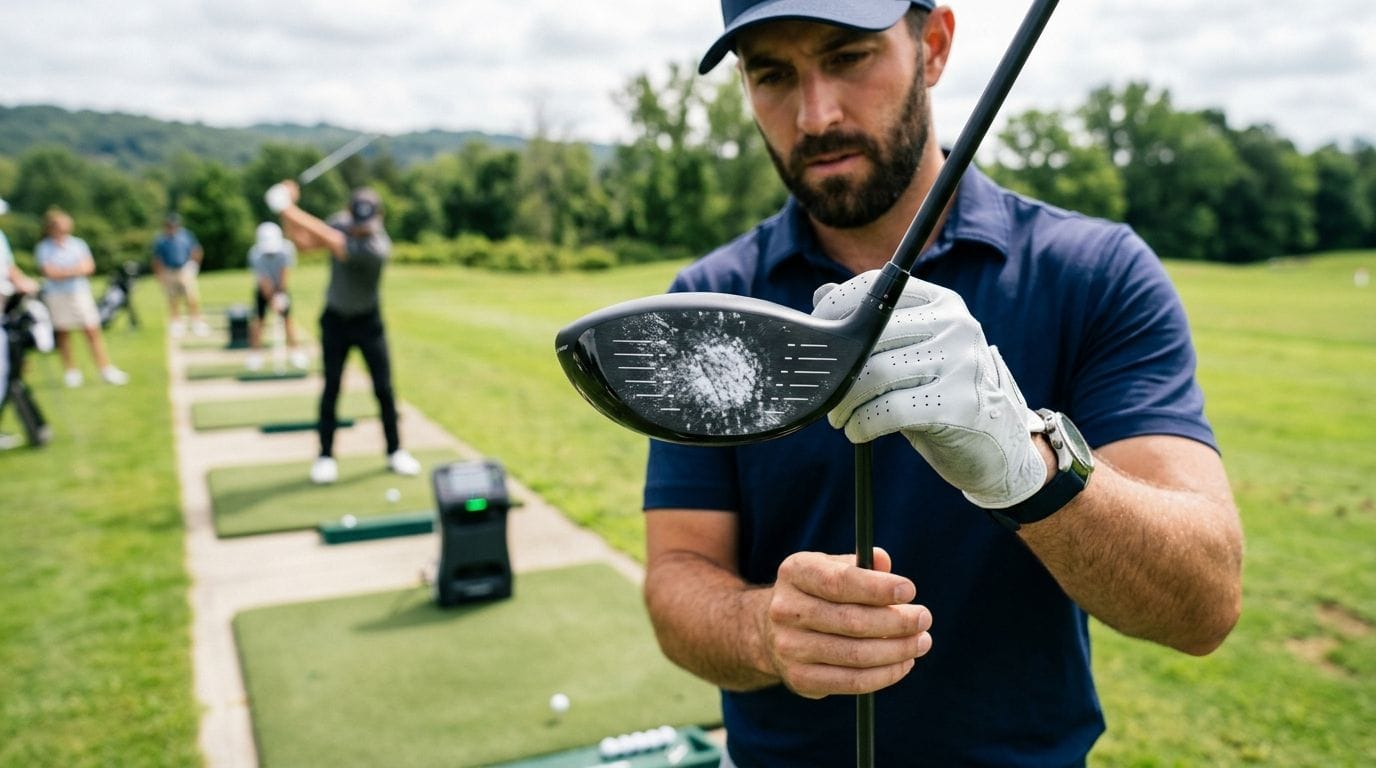
- 4The fastest diagnostic is a sheet of impact tape. Where the mark lands tells you more than almost any other data point.
- 5You don't have to swing harder to add distance. Improving your smash factor from 1.42 to 1.47 at the same club head speed adds roughly 5 mph (8km/h) of ball speed, which translates to 12 to 15 yards (11 to 14m) of carry.
What smash factor actually measures
Smash factor is ball speed divided by club head speed. A golfer who delivers 100 mph (161km/h) of club head speed and produces 148 mph (238km/h) of ball speed has a smash factor of 1.48. It's a measure of energy transfer efficiency at impact. Nothing more, nothing less.
The ceiling for driver smash factor is 1.50, which reflects the USGA's limit on the coefficient of restitution (COR) for golf club faces. A higher COR means a springier face; at 1.50, the face is at maximum allowable spring effect. Most modern conforming drivers are engineered to reach 1.50 across a reasonable strike zone. The challenge isn't the club; it's the golfer.
Physics sets the limits for everything else. An iron face doesn't spring the way a thin titanium driver face does, which is why iron smash factors are structurally lower. A wedge delivered with 16 degrees of dynamic loft is going to lose more energy to loft than a driver delivered at 12 degrees. Smash factor varies by club; the question is whether yours is where it should be for each club in your bag.
What makes smash factor useful as a diagnostic tool is that it integrates several sources of impact quality into a single number. You can hit 105 mph (169km/h) of club head speed and produce a 1.38 smash factor if you're off-center, or a 1.48 if you're flushing it. The number doesn't care about your swing. It just reports what happened at the moment of contact.
What good looks like by club
Not all smash factors are equal, and comparing your driver smash factor to your 9-iron smash factor tells you nothing useful. Each club has its own realistic range.
| Club | Tour benchmark | Solid amateur range | Notes |
|---|---|---|---|
| Driver | ~1.49 | 1.44 to 1.48 | USGA ceiling 1.50; source: Trackman tour data |
| 3-wood | ~1.47 | 1.42 to 1.46 | Smaller face than driver |
| 4-7 iron | ~1.40 to 1.44 | 1.36 to 1.42 | Face doesn't spring; loft reduces efficiency |
| 8-9 iron | ~1.35 to 1.40 | 1.30 to 1.38 | Increasing loft, shorter swing |
| Wedges | ~1.20 to 1.30 | 1.15 to 1.28 | High loft, often open face at impact |
If you're consistently hitting 1.44 or above with your driver, your contact is in the range where the club is doing what it's supposed to do. Below 1.40, something structural is going on (contact, delivery, or both), and it's worth diagnosing rather than ignoring.
Why smash factor drops
Three things drain smash factor, and they tend to compound each other.
Off-center contact. This is the most common culprit and the one most golfers underestimate. A strike 1 inch (2.5cm) toward the toe of a driver produces significant ball speed loss. Trackman data consistently shows off-center contact as one of the fastest ways to drop smash factor. Modern driver faces compensate for this more than blades do, but there's no compensation that eliminates the loss entirely.
Gear effect. An off-center strike doesn't just reduce ball speed; it also creates unintended spin. A toe strike on a driver creates hook spin; a heel strike creates slice spin. That spin is energy redirected away from forward motion, which compounds the ball speed loss. If your smash factor is low and your spin numbers are unusually high or inconsistent, gear effect is likely in the mix.
Delivery angle and dynamic loft. How you arrive at the ball changes how efficiently the face can transfer energy. A driver delivered with 20 degrees of dynamic loft when you're hitting down at 8 degrees is transferring more energy into spin than it needs to. This matters most for golfers with steep swings who haven't fit their driver loft and shaft to their actual attack angle. It's why fitting and smash factor tend to move together: a properly fitted driver lets you maximize the COR across your actual delivery pattern, not just on the manufacturer's robot-tested ideal.
Reading your launch monitor data
Most launch monitors above the entry-level tier report smash factor directly as a field. If yours doesn't display it, divide ball speed by club head speed. Any session where you're capturing both gives you the calculation.
The number on its own tells you something is wrong; it doesn't tell you what. The diagnostic loop works like this:
- If smash factor is low, check face impact location first. Impact tape (a sheet placed on the face before a shot) shows exactly where the ball made contact. Before assuming a technique problem, confirm where contact is actually happening. Sometimes what feels like a center strike is consistently toward the toe.
- If contact is centered but smash factor is still low, look at dynamic loft. Most mid-range and premium launch monitors, including the Bushnell Launch Pro, report dynamic loft. If your driver is delivering 18 to 22 degrees of dynamic loft, you're losing ball speed to spin even on center strikes. That's typically a fitting problem or an attack angle problem; the fix isn't a swing drill.
- If contact is centered and dynamic loft is in range but smash factor is still low, the issue may be shaft timing or tempo. The face needs to be returning square at maximum speed; if the shaft is still loading when the face arrives, you're not hitting the ball at peak club head speed. This is where a launch monitor session with a knowledgeable fitter is worth the time (and, if James is being honest about it, the one step in this loop he wouldn't trust himself to diagnose).
The draw and fade guide on this site covers how face angle at impact drives shot shape, and that same dynamic applies to smash factor. A closed or open face at impact costs ball speed the same way a center miss does. If your smash factor drops when you're actively working on a specific ball flight, track that through the diagnostic loop too.
For golfers tracking which launch monitor metrics are worth the subscription cost, the launch monitor total cost guide breaks down which tiers give you access to dynamic loft and face impact data, and what that's worth over five years.
Three practice approaches that move the number
- Impact tape, used consistently. A sheet of impact tape on the face before every ball in a range session gives you immediate, objective contact feedback before you've convinced yourself the shot felt centered. Peel off a sheet, hit a ball, look at the mark before you reach for the next ball. After 20 shots you'll know exactly where your misses are landing on the face. Callaway impact tape on Amazon runs around $15 for a pack that covers dozens of sessions.
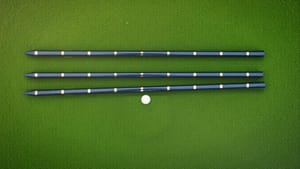
- Gate drills for delivery consistency. Two alignment sticks placed on the ground, one outside the ball and one inside, constrain your approach angle and force the club to arrive on the same path repeatedly. Path consistency and face arrival consistency are related: a swing that produces a different path each time also varies its delivery angle, which varies smash factor. The gate doesn't fix face control, but it eliminates one delivery variable while you're working on face control.
- Slow-motion contact rehearsal. Make a half-speed practice swing, stop the club at the impact position, and look at where the face is pointing. Do this 10 times before a range session. The goal is to build an accurate sense of what center-face contact actually feels like, because many golfers with consistently low smash factor have an inaccurate model of what they're doing at impact. The impact tape confirms the diagnosis; the slow-motion rehearsal builds the proprioceptive fix.
None of these requires more club speed. Moving your smash factor from 1.42 to 1.47 at the same 95 mph (153km/h) of club head speed adds roughly 5 mph (8km/h) of ball speed, which is about 12 to 15 yards (11 to 14m) of carry. That's the upgrade that doesn't cost anything beyond a few packs of impact tape.
Frequently Asked Questions
What's a good smash factor with a driver?
For most serious amateur golfers (handicap 10 to 22), a smash factor of 1.44 to 1.48 with a driver is a solid, realistic target. Tour professionals average around 1.49 per Trackman's published tour data, close to the USGA's legal maximum of 1.50. If you're consistently hitting 1.44 or above, your contact is in the range where the club is performing as designed. Below 1.40, there's a meaningful contact or delivery problem worth diagnosing before you change equipment.
Does smash factor matter for irons and wedges?
It matters, but the benchmarks are different. Mid-irons (5 through 7) typically produce smash factors between 1.36 and 1.42; short irons and wedges run lower because the lofted face transfers more energy into spin by design. The diagnostic value is the same: a low smash factor relative to the expected range for a given club points to off-center contact or a delivery issue. The most useful comparison is your own data across sessions, not the tour average. If your 7-iron smash factor drops from 1.40 to 1.33 in a given session, something about your contact has changed and it's worth investigating before you put it down to a bad range day.
Can improving smash factor add distance without swinging harder?
Yes, and it's one of the better-returning investments for most amateurs. Moving from a 1.40 to a 1.47 smash factor at 90 mph (145km/h) of club head speed adds about 6 mph (10km/h) of ball speed, which translates to roughly 15 to 18 yards (14 to 16m) of carry depending on launch conditions. That's the same gain you'd get from adding 6 mph of club head speed, and improving contact quality is generally more repeatable than increasing swing speed. If your launch monitor data shows a low smash factor, that's the place to start before thinking about equipment changes or speed training.
What to do next
If you've got a launch monitor, pull up your last few sessions and average your driver smash factor. If it's below 1.42, a pack of impact tape and a focused range session will tell you more about what's happening at impact than almost any other diagnostic tool at this price point.
Some links in this article are affiliate links. If you buy through them, I earn a small commission at no extra cost to you. This never influences what I cover or recommend. I link to gear I'd buy myself.









The golf newsletter that cuts the hype
Data-backed reviews and advice that works. No brand spin.
Recommended products

Rukket SPDR Golf Net Review: 10x7 Bundle for Home Practice.
The Rukket 10x7 SPDR golf net bundle reviewed: what's actually in the box, what MyGolfSpy and PluggedInGolf found, and who it fits best.
Read review