How to Break 100 With the Swing You Already Have
Breaking 100 is a strategy problem, not a swing problem. The data on where 100+ golfers lose strokes points to big-number holes, three-putts, and short-game decisions inside 100 yards, not driving distance.

Breaking 100 isn't a swing problem. It's a strategy problem. Published data on amateur scoring shows the gap between a 105 and a 95 usually comes down to two or three blow-up holes per round, not swing mechanics. The course management system that closes that gap is learnable without touching your swing.
TL;DR
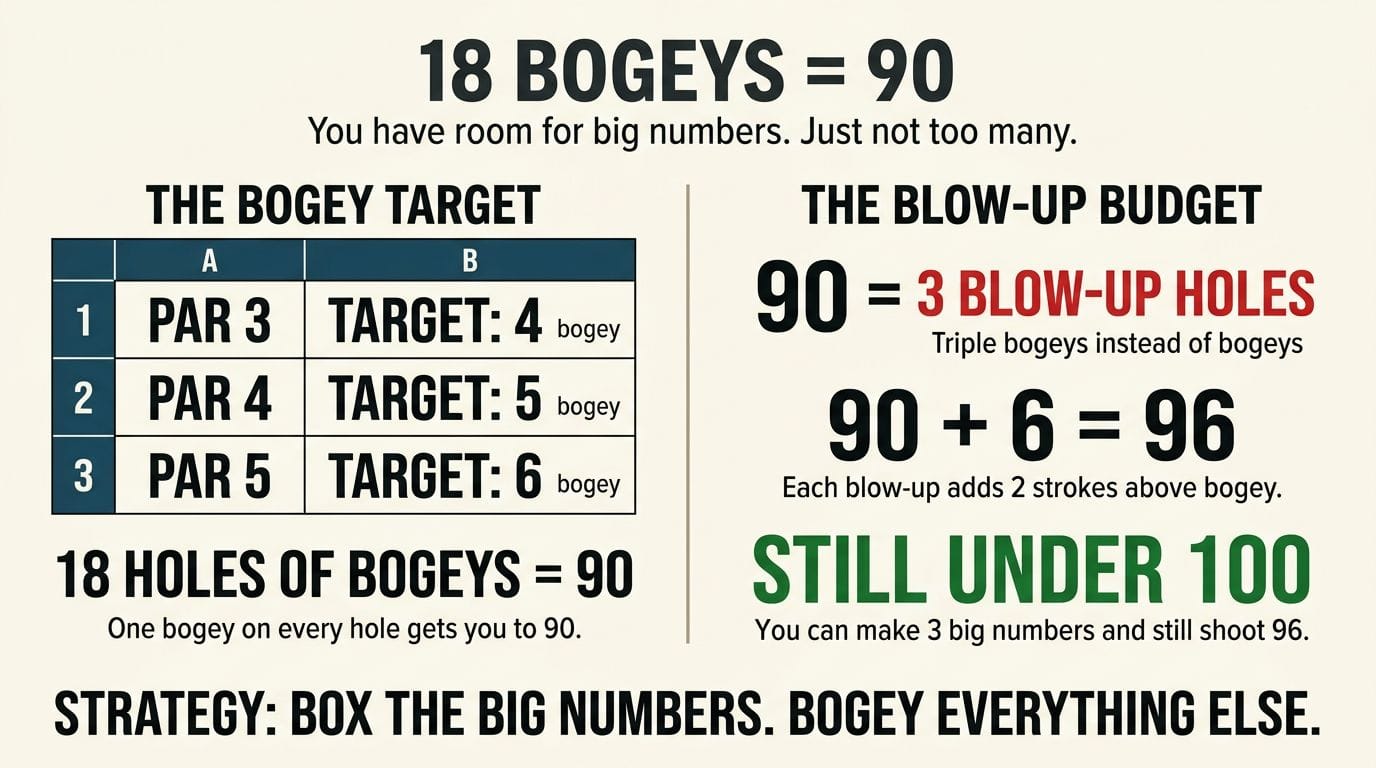
- 1On a par-72, 18 bogeys equals 90. Most 100+ golfers can already make bogeys. The problem is the holes where they make 7s and 8s instead.
- 2Dave Pelz's research puts roughly 60 percent of amateur strokes inside 100 yards. The fastest route to lower scores runs through that zone, not the driving range.
- 3Big-number holes are the single highest-return fix. Eliminating two triple-bogeys per round saves the same strokes as cutting a five-stroke slice of driver.
- 4Three-putt elimination is the second lever. Most 100+ golfers three-putt from distances where a lag to within 3 feet (90cm) eliminates the problem entirely.
- 5The Break 100 book covers the complete system: tee to green, short game, putting, and on-course decision-making, all built around the swing you already have.
The math of breaking 100
Par-72 arithmetic sets the frame for everything else.
To shoot 99, you need to average 1.5 over par per hole. A round with nine bogeys and nine double-bogeys gets you exactly there. A round where you bogey every single hole gets you to 90, well clear of the target.
That's the first thing worth sitting with. Most 100+ golfers can make bogeys. They do it regularly. The issue isn't a shortage of bogeys in the bag. It's the handful of holes per round where the score runs to 7 or 8 instead of 5 or 6, and those holes absorb all the progress made elsewhere.
A player shooting 105 is 33 over par on a par-72. A player shooting 97 is 25 over par. That's an 8-stroke gap, but it doesn't take 8 better shots. It takes eliminating the three holes in a round where a decision led to a 7 instead of a 5. The same golf swing. A different set of choices.
Where the strokes actually go
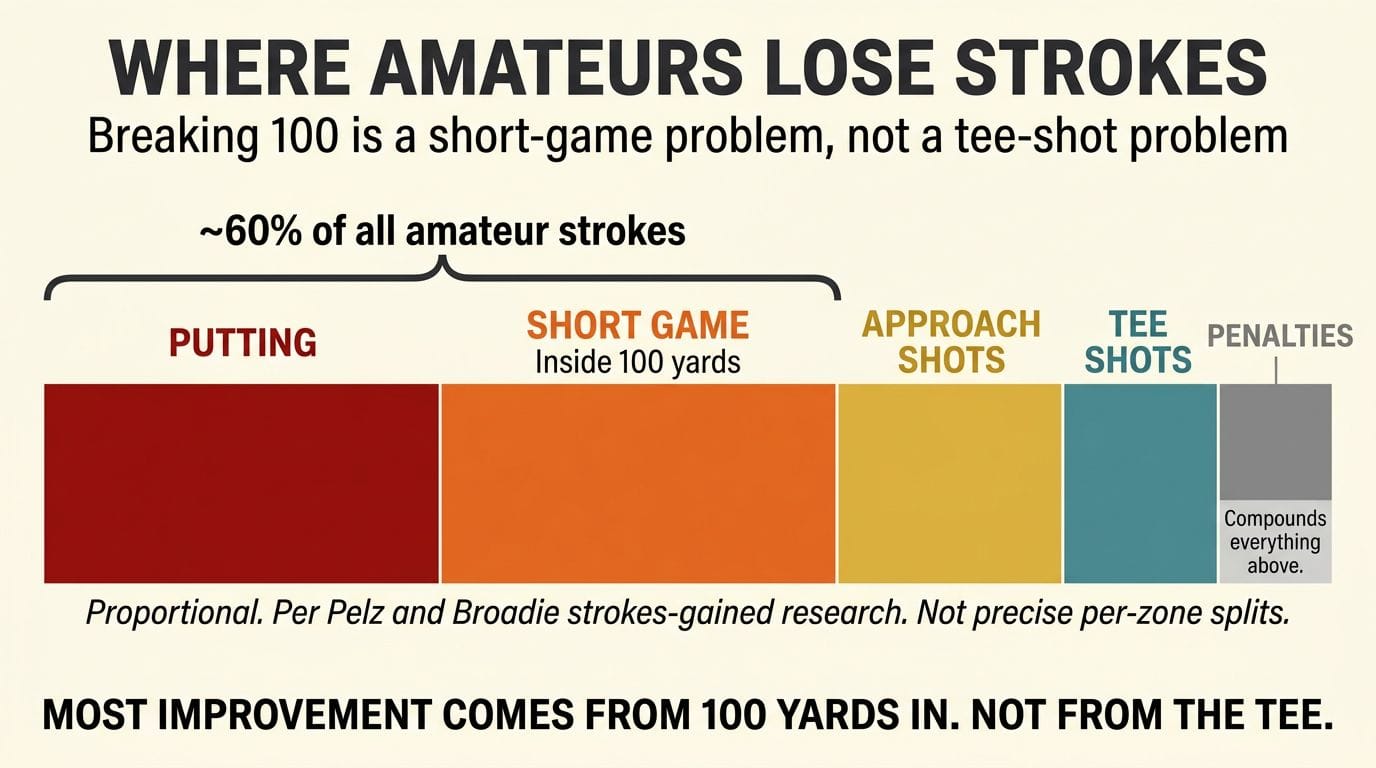
Mark Broadie's strokes-gained research, published in "Every Shot Counts," tracked where recreational golfers lose strokes relative to scratch. The finding that runs counter to most practice habits: full shots from 150 yards (137m) and beyond account for a smaller proportion of the gap than most golfers assume. Putting and the scoring zone inside 100 yards (91m) produce the majority of the difference.
Dave Pelz's research confirms the distribution from the other direction. Roughly 60 percent of amateur strokes happen inside 100 yards (91m). Not from 150 yards. Not off the tee. From distances where a decent chip or pitch is in play on nearly every hole.
The practical implication: a 100+ golfer who spends 90 percent of their practice time on the range hitting drivers is optimizing the smaller side of the equation. The short game, and the decisions around it, is where the score lives.
Penalty strokes sit on top of this. Each penalty stroke costs two: the stroke itself, plus the distance. A round with three penalty strokes adds six shots to the total. Penalty strokes don't appear in the ball-striking stats. They appear in the scorecard, compounding everything else.
Big-number avoidance: the highest-return fix
The scorecard damage from big numbers is asymmetric. A birdie saves one shot against a bogey. A triple-bogey costs two against a bogey. A quadruple costs three. The scale runs one direction much faster than the other.
Shot Scope's tracking data across millions of amateur rounds consistently shows the same pattern: the score difference between a 20-handicapper and a 10-handicapper isn't primarily explained by the good holes. It's the frequency of 6s, 7s, and 8s on holes where the lower-handicapper scores 5.
Breaking 100 requires reducing that frequency, not eliminating it. The system is triage, not perfection.
Three decisions produce most big numbers for 100+ golfers. First: trying a recovery shot that requires precision from a bad lie. Second: hitting driver when the trouble zone for a miss is a penalty stroke. Third: attempting a long carry over a hazard that's reachable about 60 percent of the time. Each of these looks like an aggressive play and each of them has a higher expected score than the conservative alternative.
The on-course game plan for big-number avoidance covers each of these in depth: How to Avoid Big Numbers: An On-Course Game Plan.
Putting: three fewer strokes without changing your swing
The three-putt is the most consistent stroke-waster in a 100+ golfer's round, and it's the most correctable. A player who three-putts from 25 feet (7.5m) didn't make a mechanical putting error. They attempted a 25-foot make and left themselves a 7-footer instead of a tap-in.
Lag putting, the discipline of rolling long putts to within 3 feet (90cm) rather than trying to hole them, eliminates most three-putts without requiring any improvement in putting mechanics. Broadie's strokes-gained work supports this: the gain from holing more putts is smaller than the gain from eliminating three-putts. The miss that costs you on a 25-footer isn't the putt you didn't make. It's the one you left 8 feet (2.4m) short or ran 6 feet (1.8m) past.
The pace-first framework for breaking the three-putt habit, including the pre-round drill that builds lag pace in five minutes, is at: How to Stop Three-Putting.
Tee strategy and club selection
The DECADE Golf research established that course management decisions (where you stand on the tee, which club you pull, where you aim) produce measurable stroke differences independent of shot quality. A well-aimed miss in the fairway is an easier recovery than a well-struck drive into trouble.
Two decisions dominate the tee box for 100+ golfers.
First: tee box position. The tee box gives you two club lengths of depth and the full width between the markers. Most golfers walk up to the same spot every hole. Trouble on the right? Tee on the right side of the markers and aim left. You've widened the playable fairway without changing the swing.
Second: club selection. A USGA survey of 2,263 golfers found players pull driver 84 percent of the time on par-4s and 91 percent on par-5s. For 100+ golfers, the question isn't "can I reach?" It's "where does my miss go?" A 3-wood that leaves a 50-yard (46m) longer approach from the fairway beats a driver by at least two strokes when the driver miss puts you in a penalty area even 5 to 10 percent of the time.
A slice off the tee compounds both problems: a driver slice that reaches the trees or water is both a direction problem and a penalty problem. The mechanical and strategic fix for a driver slice that doesn't follow the irons is covered here: Why Your Driver Slices When Your Irons Don't and How to Fix a Golf Slice.
For the five most common distance-costing decisions on the tee: 5 Driver Mistakes That Are Costing You Distance.
The short-game gap at 50 to 100 yards
The Pelz research on amateur stroke distribution identifies the 50 to 100 yard (46 to 91m) zone as the area of highest variance in 100+ golfers' games. Partial wedge shots, the half and three-quarter swings most amateur practice time ignores, produce more double and triple-bogeys than any other zone outside the chip-and-run around the green.
Two reasons. First, most 100+ golfers don't know their actual carry distances with their wedges at 50, 75, and 100 yards (46, 69, and 91m). They approximate. Approximation from 75 yards (69m) can put the ball short of the green and on the bunker face or long and on the back slope, both leading to a difficult chip and a realistic three-putt risk. Second, most amateurs have wedge loft gaps that leave them without a reliable club for specific distances in this range.
Knowing your actual half-wedge distances, from a launch monitor session or systematic on-course practice, turns a variable zone into a reliable one. The loft-gap problem that creates distance holes in the scoring zone is covered here: The Wedge Loft Gap Most Golfers Don't Know They Have.
A realistic target for the first round after reading this
The honest answer is that most of what's in this article will feel obvious to any 100+ golfer who's thought about it for five minutes. They know they took an 8 on the par-4 because they tried to punch out through a gap that wasn't there. The data just quantifies what they already suspect: the problem isn't the swing. It's the decisions around it.
A realistic first-round target isn't breaking 100. It's: pick one tee box per round where you consciously use a 3-wood or long iron instead of driver, and pick one recovery shot per round where you play back to the fairway instead of trying the hero shot. That's two decisions, not a swing overhaul. Done consistently over four rounds, those two decisions are worth four to eight strokes.
The Break 100 book covers the complete system: tee strategy, short-game priorities, putting framework, and the on-course decision model for getting under 100 with the swing you already have.
Frequently Asked Questions
What score do I need to consistently shoot to break 100?
You need to score 99 or better. On a par-72, that's 27 over par, or roughly 1.5 over par per hole across the round. A player who bogeys every hole scores 90, well under 100. Most 100+ golfers can make bogeys. The problem is the handful of holes per round where decisions lead to triples and quads that inflate the total.
How many rounds does it take to break 100 consistently?
The published data on handicap improvement (Arccos and Shot Scope tracking datasets) shows that the speed of improvement correlates directly with the consistency of on-course decision changes, not with practice time. Players who make systematic changes to their recovery-shot decisions and three-putt elimination first typically see meaningful score reduction within four to eight rounds. Players waiting for their swing to improve typically wait much longer.
Is putting or the short game more important for breaking 100?
They're the same zone. Dave Pelz's research shows roughly 60 percent of amateur strokes happen inside 100 yards (91m): putting and the short game combined. Mark Broadie's strokes-gained work confirms that recreational golfers lose more strokes to putting and short game than to full shots from distance. The practical priority: eliminate three-putts first (it's the fastest return), then shore up the 50 to 100 yard (46 to 91m) zone.
Should I take a lesson before trying to break 100?
A lesson targets swing mechanics, which is the smaller side of the equation for most 100+ golfers. The faster route is implementing the course management changes in this article and the linked how-tos first. If you've made consistent strategic changes and the score isn't moving, that's a reasonable time to look at mechanics. Lessons before strategic changes often teach a golfer to hit better shots into the same decisions, which doesn't lower the score.
What is the single biggest mistake 100+ golfers make on the course?
Attempting recovery shots that require more precision than the lie allows. When a ball is in the rough, behind a tree, or against the collar of a bunker, the instinct is to try something creative. The data is consistent: recovery shots that go wrong produce the triple-bogeys and quads that make up most of the gap between a 95 and a 105. Playing back to the fairway from trouble is the single highest-leverage decision change available without altering your swing.
Some links in this article are affiliate links. If you buy through them, I earn a small commission at no extra cost to you. This never influences what I cover or recommend. I link to gear I'd buy myself.









The golf newsletter that cuts the hype
Data-backed reviews and advice that works. No brand spin.
Recommended products