How to Stop One Bad Hole From Wrecking Your Round
A bad hole becomes a wrecked round because of tilt, the compounding emotional drift that turns one mistake into three. Here's the repeatable reset system that stops it before the next tee shot.

One poor hole doesn't have to define the scorecard. Golfers who protect a good round after a bad hole share a specific pattern: they run a short, repeatable reset before the very next shot instead of carrying the frustration forward. This piece breaks down the psychology behind that spiral and the reset system that stops it.
- A bad hole becomes a wrecked round because of tilt, the compounding emotional and mental drift that turns one mistake into three.
- The fix isn't willpower. It's a repeatable, physical reset process run on the walk to the next tee, paired with a habit that makes it automatic under pressure.
- Below: the psychology, the system, and what to do if the damage is already spreading mid-hole.
This is a strategic gap worth naming up front: my book, Course Management and Strokes Gained, goes deeper into the decision-making side of protecting a scorecard, built around the idea that smarter decisions, not better swings, are what separate rounds that hold together from rounds that come apart. This piece is the emotional half of that equation.
What tilt actually is, and why one hole triggers it
"Tilt" is a poker term before it's a golf term, and the borrowed word fits well because the mechanism is identical. A player takes a bad beat, a result that violates their sense of how the game should have gone, and the frustration doesn't stay contained to that one hand. It leaks into the next decision, and the one after that, each one made slightly worse by the emotional residue of the last.
Golf compounds this more than most sports because the format punishes you twice. First, the bad hole itself costs strokes. Second, and this is the part most golfers underrate, the bad hole changes how the next several shots get played. A double bogey doesn't just add two strokes to the card. It often triggers a decision to play the next hole more aggressively to "make it back," which is exactly the wrong instinct at exactly the wrong moment, since aggressive decisions carry more variance, and variance is the last thing a rattled player needs.
The psychology here has a name in sports psychology literature: performance researchers describe this as an emotional carryover effect, where the arousal and frustration from one outcome measurably change decision quality on the next task, independent of actual skill. Golf's slow pace makes it worse, not better. A tennis player gets a few seconds between points. A golfer gets a 10- to 15-minute walk with nothing to do but replay the bad shot, which is ample time for one mistake to calcify into a mindset.
Where this fits: before the shot versus after it
It's worth being precise about what this piece covers, because two other pieces on this site cover adjacent ground and this one is deliberately not repeating either.
A pre-shot routine that holds up under pressure covers the 20 to 30 seconds immediately before a shot: the routine that keeps a single swing clean under pressure. That's a real skill, and a different one from what's covered here. A perfect pre-shot routine still can't undo a hole that already happened five minutes ago.
Avoiding big numbers covers a different phase entirely: pre-round planning that designs the whole round around emotional risk before the first tee shot is struck, choosing targets and strategies that keep a bad break from snowballing in the first place.
Neither one covers what happens between those two moments: the walk from a wrecked green to the next tee, after the damage is already done and before the next shot is set up. That gap, the in-round emotional reset, is what this piece is built to close.
The reset system: a repeatable process for the next tee
The players who protect a round after a bad hole aren't relying on natural composure. They're running a process, and the process is the same every time, which is exactly what makes it work under pressure: a stressed brain follows a rehearsed sequence far more reliably than it improvises a calm one.
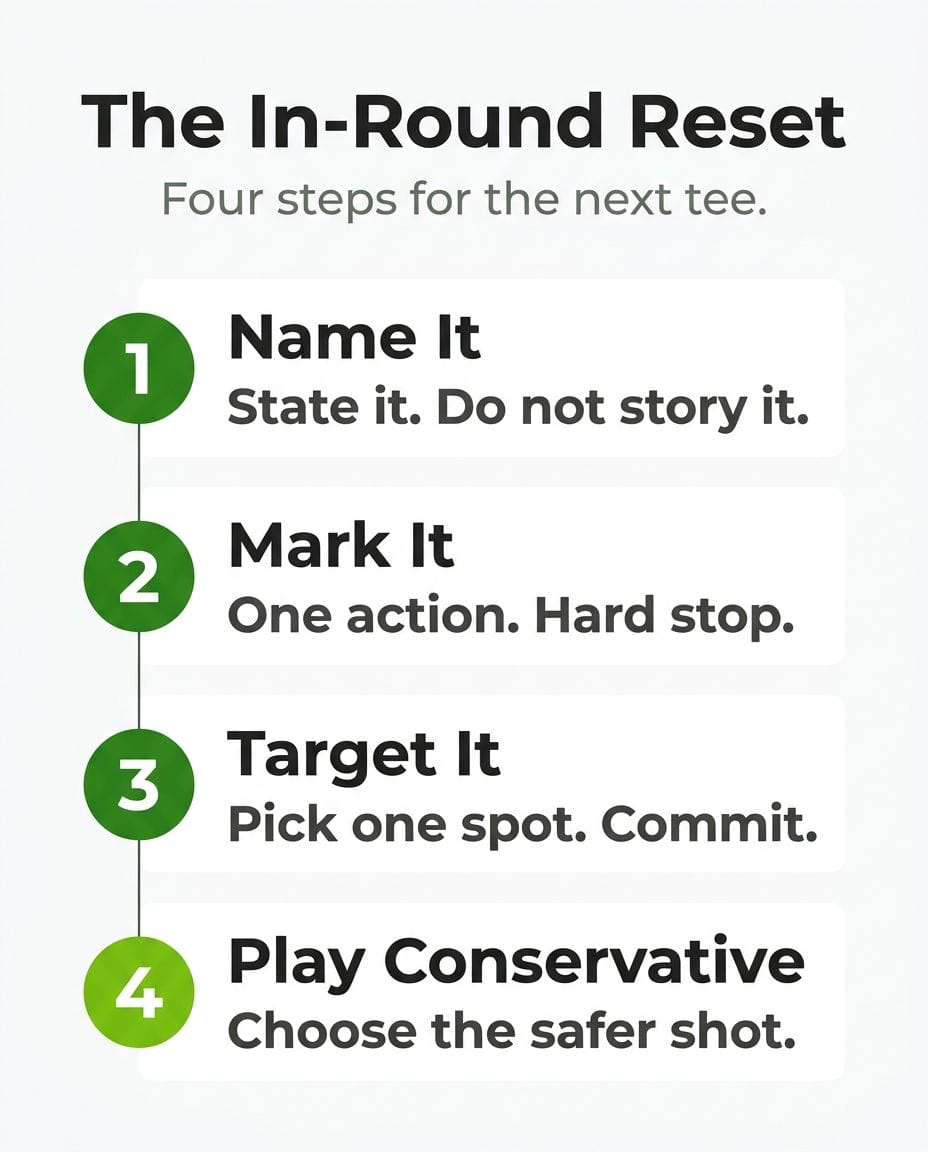
Name it, out loud or silently, in one sentence. "That was a double bogey" is a fact. "I always do this on par fives" is a story, and the story is what does the damage. The first step of a reset is separating the two: acknowledge the result without attaching a narrative to it.
Set a physical marker for the reset. Some players use the walk itself: the hole is over the moment their foot crosses onto the next tee box, and whatever happened before that line stays behind it. Others use something smaller and more repeatable, like tightening a glove or wiping down a grip, a two-second physical action that acts as a hard stop between what just happened and what happens next. The specific marker matters less than having one at all, since a defined boundary is what a drifting, ruminating mind actually needs.
Replace the story with a target. Before stepping onto the next tee, commit to one specific, external target for the very next shot: a section of fairway, a bunker to stay left of, a number on a sprinkler head. This isn't about visualization for its own sake. It's about occupying the same mental bandwidth the frustration would otherwise fill. A mind running a specific external target has no room left to keep replaying the last hole, and I'll admit that pull is one I still feel myself, wanting to force the next shot to fix the last one, even though I know better.
Play the conservative version of the next shot, on purpose. This is the step most golfers skip, because it feels like giving up ground after already losing strokes. It's the opposite. The instinct to "make it back" is the same aggressive decision-making that produces a second bad hole. Choosing the lower-variance play on the very next shot, even if it costs a theoretical half-stroke of upside, is what actually stops the bleeding.
Building the habit so the reset becomes automatic
A reset process that only gets used when a player remembers to use it isn't a system, it's a hope. The way this becomes reliable under real pressure is rehearsal away from a bad hole, not during one.
The most effective version of this, based on how habit formation research generally describes skill automation, is practicing the reset on ordinary holes, not just disastrous ones. Running the same name-it, mark-it, target-it sequence after an unremarkable par, or even a good hole, builds the pattern into muscle memory before it's ever needed under real emotional load. Waiting to test a new mental process for the first time in the moment it's needed most is a common mistake, and it's the same reason a fire drill happens on a calm day, not during an actual fire.
Consistency matters more than intensity here. A golfer who runs a simplified two-second version of this reset after every hole, for a full season, builds a far more durable habit than one who occasionally attempts an elaborate version only after a real disaster.
When you're already mid-meltdown: a shorter recovery move
Sometimes the reset doesn't happen in time, and a second bad hole is already unfolding. In that moment, the system above is too much to execute mid-swing thought, so it gets replaced with a single compressed version: one breath, one word, one target. Breathe out slowly enough to drop the shoulders. Say the target out loud, even under your breath. Hit to that target and nothing else.
This compressed version exists because a golfer standing over a shot with a spiral already in motion doesn't have the bandwidth for a four-step process. It has to be small enough to execute in the 10 seconds before a swing, which is also why it only works if it's been rehearsed on calm days first. A shortened version of an unfamiliar process is still an unfamiliar process; a shortened version of a rehearsed one is a genuine tool.
What is golf tilt?
How many strokes can one bad hole cost over a full round?
What should I do right after a bad hole in golf?
Can course management alone fix a tendency to blow up holes?








The golf newsletter that cuts the hype
Data-backed reviews and advice that works. No brand spin.
Recommended products