An At-Home Golf Mobility & Stretch Routine for More Distance
A step-by-step at-home mobility and stretching routine that builds the rotational range of motion behind more golf swing speed.
Swing speed has a ceiling that strength training alone doesn't move. A golfer can add pounds to a deadlift all winter and still lose distance if the hips and thoracic spine can't rotate far enough to let that strength reach the ball. Mobility work closes that gap, and it takes about fifteen minutes a day, no gym and no clubs required.
- 1.The goal: build the rotational range of motion in the hips, thoracic spine, and shoulders that a full, fast swing depends on, using six stretches done at home with no equipment.
- 2.The time: about 15 minutes a day, most days of the week, not a one-time session before a round.
- 3.Not a warm-up: this is an ongoing mobility program, separate from the short pre-round warm-up done right before you tee off.
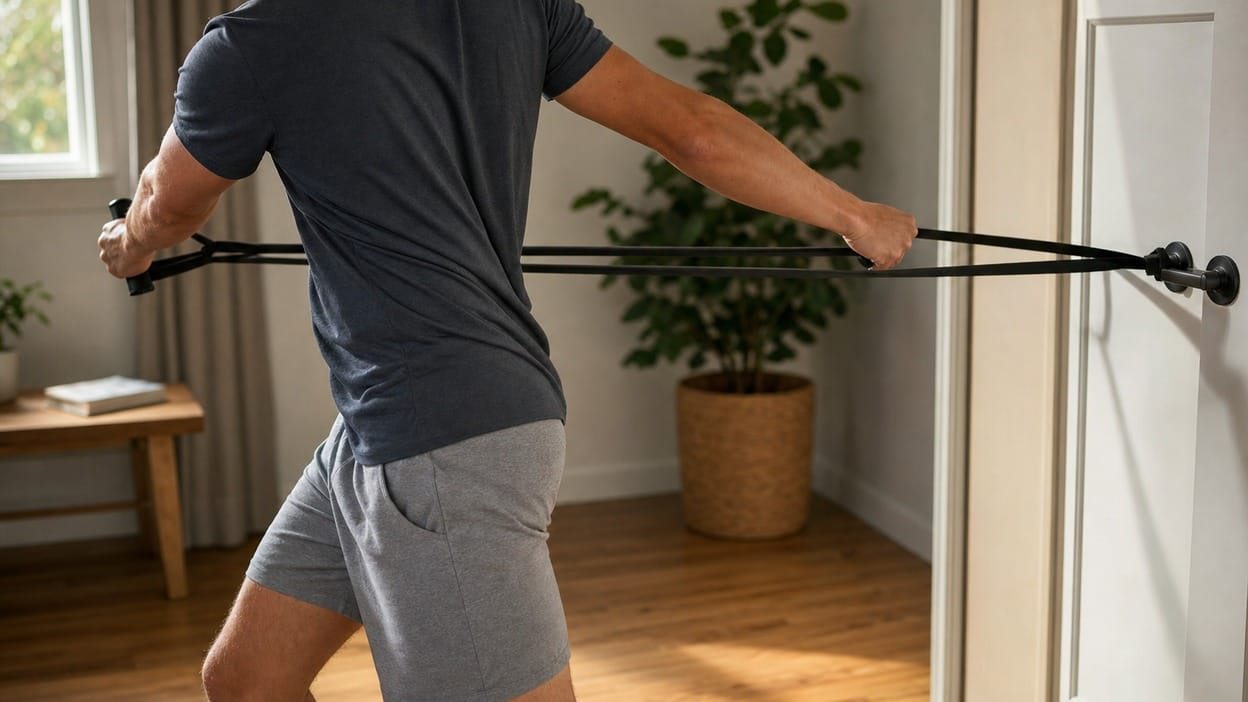
- 4.Optional upgrade: resistance bands add load to a few of the stretches once bodyweight range starts to feel easy, but the full program works without them.
Why mobility, not strength, is the missing piece
Clubhead speed comes from the kinetic chain: the hips turn first, the torso follows, the arms and club release last, each segment adding speed to the one before it. That sequence only works if each joint can actually rotate through its available range. A hip that stops turning at 30 degrees instead of 45 caps how much rotational force the torso ever receives, regardless of how strong the muscles around that hip happen to be.
This is the distinction that separates this program from a strength routine. Building a bigger hip turn is a range-of-motion problem first, a force problem second. A golfer who adds mobility work without touching a weight room often sees more speed than one who adds strength without addressing a restricted turn, because the restriction was the actual limiter the whole time. Strength training, covered in our guide to golf fitness exercises for distance, builds on top of that range once it exists. This program is what creates the range in the first place.
A quick self-test: is mobility really your limiter?
Not every distance problem is a mobility problem, so it's worth checking before committing fifteen minutes a day to this program. Three quick checks, done without a club, point to whether a restricted turn is actually holding your swing speed back.
The seated trunk rotation test. Sit on a chair with arms crossed over your chest, feet flat, and rotate as far as you can to one side without the hips moving. Most golfers with a full, fast turn can rotate 45 degrees or more this way. Stopping well short of that on either side, especially with a hard block rather than a gradual stretch feeling, points to a genuine thoracic restriction rather than a swing-mechanics issue.
The standing hip hinge check. Hinge forward at the hips with a soft knee bend, reaching toward the floor, and notice where the movement stops. A restriction that shows up as rounding through the lower back before the hands get anywhere close to the shins usually means the hamstrings and hips are the limiter, not the low back itself trying to compensate for it.
The overhead reach test. Stand with your back against a wall and raise both arms straight overhead, trying to keep the low back, upper back, and arms all in contact with the wall. Arms that drift forward off the wall before reaching full extension point to restricted shoulder and thoracic mobility, the same ranges steps 3 and 6 below target directly.
Failing any one of these tests is a strong signal that mobility, not strength or swing mechanics, is the more efficient place to spend training time for the next several weeks.
The routine: six stretches, done in sequence
Work through these in order. Each targets a specific joint in the kinetic chain, from the ankles up through the shoulders, and the sequence itself matters, since a restricted hip often shows up as a compensating twist somewhere else in the chain.
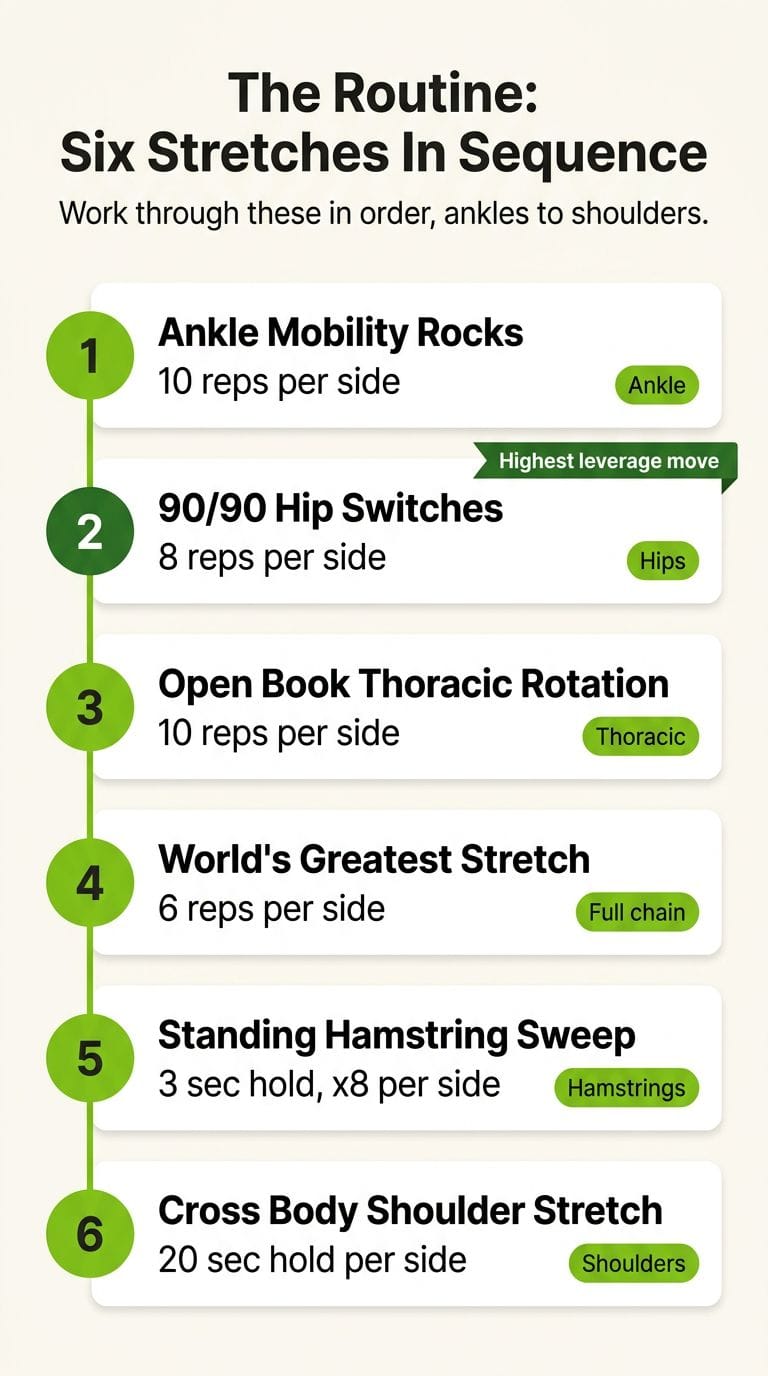
- Ankle mobility rocks. Kneel with one foot flat on the floor in front of you, knee over toes. Rock the knee forward over the ankle without the heel lifting, hold for two seconds, and return. Do 10 reps per side. Limited ankle mobility restricts how far the lead knee can drive forward on the downswing.
- 90/90 hip switches. Sit on the floor with both knees bent to 90 degrees, one leg in front and one to the side. Rotate through the hips to switch which leg is in front, keeping the chest tall. Do 8 reps per side. This is the single highest-leverage stretch in the routine for building hip rotation specifically.
- Open-book thoracic rotation. Lie on your side with knees stacked and bent, arms extended in front at shoulder height. Rotate the top arm across your body toward the floor behind you, following it with your eyes, then return. Do 10 reps per side. This targets the mid-back rotation that a restricted lower back often tries to fake.
- World's greatest stretch. From a low lunge, plant the opposite hand on the floor inside the front foot, then rotate the same-side elbow up toward the ceiling, following it with your eyes. Do 6 reps per side. This single move stretches the hip flexor, hamstring, and thoracic spine together, which is why it earns a spot even in a shortened version of this routine.
- Standing hamstring sweep. Stand tall, hinge at the hips with a soft bend in the knees, and let the arms hang toward the floor, sweeping side to side to load each hamstring in turn. Hold each side for 3 seconds and repeat 8 times. Tight hamstrings restrict how far the pelvis can tilt at address, which shortens the turn before the swing even starts.
- Cross-body shoulder stretch with rotation. Standing tall, bring one arm across your chest, use the opposite hand to gently deepen the stretch, and add a small torso rotation away from the stretched arm. Hold for 20 seconds per side. This adds shoulder range on top of the trunk rotation built in steps 2 through 4.
Building it into a weekly program
Fifteen minutes covers the full six-stretch sequence once through, and most golfers get the most out of doing it five to six days a week rather than saving it for the day before a round. Range of motion responds to frequency more than to any single long session, the same way a daily ten-minute walk beats one two-hour walk a week for general mobility.
A simple way to structure it: the full sequence on weekdays, and a shortened three-move version (the 90/90 switches, the world's greatest stretch, and the open-book rotation) on days when time is tight. I'll admit that on my own busier mornings the hip stretch is usually the one I'm tempted to skip first, which is exactly backward, since it's the highest-leverage move in the whole sequence for building the turn that actually adds distance.
This is deliberately separate from the RAMP-style warm-up covered in our pre-round warm-up routine, which is a five-to-ten-minute activation sequence meant for the moments before you tee off. That warm-up assumes the range of motion is already there and just needs to be switched on. This program is what builds that range over weeks, not minutes.
Adding resistance for more range over time
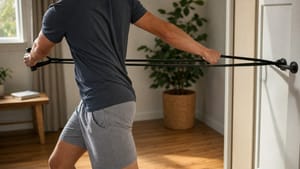
Bodyweight alone builds range of motion for most golfers, and nothing above requires equipment to be effective. Once the 90/90 switches and the open-book rotation start to feel easy through their full range, a light resistance band adds load at the end range of each stretch, which can deepen the gain over the following weeks rather than the movement simply staying at the same range indefinitely.
The Fit Simplify Resistance Loop Exercise Bands come as a set of five bands at different resistance levels, which makes it easy to match the band to the specific stretch, a lighter band for the shoulder stretch and a heavier one anchored under a foot for the hip switches. They're an add-in for golfers who want to progress the program, not a requirement for running it. Our guide to the best golf fitness exercises for distance covers the strength side of the same distance goal, for golfers ready to build on the range this routine creates.
Frequently Asked Questions
How long before this mobility routine shows up in my swing speed?
Is this routine a replacement for a pre-round warm-up?
Do I need resistance bands to get results from this routine?
Some links in this article are affiliate links. If you buy through them, I earn a small commission at no extra cost to you. This never influences what I cover or recommend. I link to gear I'd buy myself.








The golf newsletter that cuts the hype
Data-backed reviews and advice that works. No brand spin.
Recommended products