Pre-Round Warm-Up That Actually Works
A 10-minute pre-round golf warm-up using the RAMP framework and dynamic stretching. Includes a 5-minute version when you're running late.

Photo by Brandon Williams on Unsplash
A pre-round golf warm-up is a neuromuscular priming sequence, not a stretching session. The goal isn't flexibility. It's preparing your muscles, nervous system, and coordination for the rotational power a golf swing demands from the first tee.
Most golfers get this wrong. Kenny et al. (2003) surveyed 1,040 amateur golfers and found over 70% never or seldom warm up before a round. Only 3.8% warm up before every round. Of those who do something, most default to long static holds and then grab the driver. That's the worst possible sequence. Static stretching before explosive activity reduces strength by an average of 5.4% and power output by 2.6%, according to meta-analytic data across 109 studies reviewed by Behm et al. (2016). You're suppressing the neuromuscular output you need most on hole one.
Here's the routine the research supports, how long it takes, and why each phase matters.
- 1.Skip static stretching before your round. Holds over 60 seconds per muscle group measurably reduce power output. Save static work for after.
- 2.Spend 2 minutes raising muscle temperature first: brisk walk, arm swings. Muscles produce ~3.7% more fast-twitch force per degree Celsius of warming.
- 3.3 minutes of dynamic bodywork: hip circles, thoracic rotations, lateral lunges, and lunge-with-rotation. No clubs yet.
- 4.Build to driver progressively. Start with a wedge, finish with driver. Never open cold with the longest club in the bag.
- 5.Total time: 10 to 15 minutes. A compressed 5-minute version works if you’re running late, but 10 minutes is the research-backed minimum for measurable gains.
Why Your Pre-Round Stretch Is Making Your First Hole Worse
Static stretching before golf suppresses the exact neuromuscular qualities you need for a full swing. The mechanism is duration-dependent: holds over 60 seconds per muscle group cause measurable strength and power reduction. Holds under 45 seconds show no significant effect. The problem is that a typical pre-round stretch routine (quad holds, hamstring holds, shoulder pulls, hip flexor stretches) adds up to well over 60 seconds per group for most golfers.
The extreme end of the data makes the mechanism clear. Fowles et al. (2000), publishing in the Journal of Applied Physiology, found passive static stretching reduced voluntary muscle strength by up to 28% immediately after, with 9% suppression still measurable one hour later. That's an aggressive lab protocol, not a typical golfer doing a few toe touches. But the biology scales: static holds inhibit the neural signals that tell muscles to fire hard and fast. When you swing a driver at full speed after that, your central nervous system is fighting its own braking signal.
Behm and Chaouachi (2011) confirmed this across multiple meta-analyses. Prolonged static stretching (120+ seconds per muscle group) causes clear reductions in strength and power. Short holds (under 60 seconds total per muscle) produce either no change or a small benefit. The takeaway isn't "never stretch." It's "don't do long static holds before you need explosive power."
Oyama, Ishii et al. (2023), publishing in the Journal of General Physiology, showed that skeletal muscle proteins (myosin and tropomyosin-troponin complexes) function as temperature sensors. Warming activates contractile proteins, allowing muscle to contract faster even from slight warming due to light movement. Standing still and holding stretches does nothing for this system. A systematic review published in the Journal of Exercise Science (2025) quantified the effect: fast-twitch force production improves by about 3.7% per degree Celsius of muscle temperature increase. On a cold morning, that's the difference between flushing your opening drive and leaving it 15 yards (14m) short.
Your muscles need to be warm and neurally primed, not stretched into submission. Save the static stretching for your post-round cool-down.
Static vs Dynamic Stretching: What the Data Shows
| Factor | Static Stretching (Pre-Round) | Dynamic Stretching (Pre-Round) |
|---|---|---|
| Effect on power output | Reduces by 2.6% on average (Behm et al., meta-analysis of 109 studies) | Increases power output by up to 14% (Hadad et al., 2014) |
| Effect on strength | Reduces by 5.4% on average when holds exceed 60 seconds per muscle | No reduction; maintains or improves strength |
| Carry distance impact | Baseline or reduced | +17.4 yards (15.9m) vs static condition (Langdown et al., TPI-cited) |
| Clubhead speed | No improvement over control | +1.1% improvement with dynamic + club warm-up vs no warm-up (PMC6159497, 2018) |
| Self-reported shot quality | Not measured | 40% improvement: median 7/10 vs 5/10 with no warm-up (PMC6159497, 2018) |
| Injury prevention | May reduce flexibility-related injury over time (post-exercise) | Golfers warming up for 10+ minutes show lower injury rates (Kenny et al., 2003) |
| Mechanism | Neural inhibition of contractile force; reduced rate of force development | Raises muscle temperature, primes neural pathways, activates fast-twitch fibers |
| When to use | After golf. Cool-down routine. Maintenance flexibility work | Before golf. First thing you do at the course |
The Langdown, Wells, Graham, and Bridge study (cited by TPI) found dynamic stretching produced a carry distance increase of 17.4 yards (15.9m) compared to a static warm-up condition. That's the kind of number that changes your approach to the first three holes.
A systematic review of golf warm-ups by Cabri et al. (2019) put it plainly: "Dynamic warm-ups and those with resistance exercise tended to enhance measures of performance; static stretching was inferior to other methods and potentially detrimental to performance."
What the RAMP Framework Looks Like for Golf
The RAMP protocol, developed by strength scientist Ian Jeffreys (2007), is what most elite sports teams use for pre-activity warm-up. It stands for Raise, Activate, Mobilize, Potentiate. The golf warm-up below follows this structure.
Raise means increasing heart rate and muscle temperature through light aerobic movement. Activate targets the muscle groups you'll load hardest (glutes, core, shoulders). Mobilize works the joint ranges the swing demands (hip rotation, thoracic extension). Potentiate is the sport-specific phase: progressive club swings that prime your nervous system for full-speed output.
The research backs this structure. A 2025 study in Frontiers in Physiology confirmed RAMP-based warm-ups enhance fast-twitch fiber recruitment and outperform static stretching for sprint, jump, and change-of-direction tasks. Golf isn't sprinting, but a full swing draws on the same type II fiber system.
A study on elite golfers (PMC3735827, 2013) found that a functional resistance band warm-up combined with active dynamic club warm-up increased maximum driving distance by 14.98 yards (13.7m) versus active club warm-up alone, with smash factor improving by 0.021. That's the Activate phase doing measurable work before the Potentiate phase even starts.
The 10-Minute Pre-Round Routine (Timed and Sequenced)
Ten minutes, four phases, no equipment beyond your clubs.
Phase 1: Raise (2 Minutes)
Step 1: Brisk walk to the range or 2 minutes of light movement. Walk with purpose. Swing your arms. If the car park is right next to the range, do two laps of the putting green at a pace that gets your breathing up. The point is blood flow, not exertion. Cold muscles contract slower and produce less force. This isn't optional.
Phase 2: Activate and Mobilize (3 Minutes, No Clubs)

Step 2: Hip circles. 10 each direction. Stand on one leg, draw large circles with the opposite knee. This opens the hip rotation that drives your downswing.
Step 3: Thoracic spine rotations. Hold a club across your shoulders, feet shoulder-width apart. Rotate 15 times each side, focusing on turning from the mid-back, not the hips. This targets the X-factor separation between upper and lower body.
Step 4: Arm swings across body. 20 reps. Alternate arms crossing in front of your chest. Shoulder mobilization for the full swing arc.
Step 5: Lateral lunge with overhead reach. 8 each side. Step wide, sit into the lunge, reach the opposite arm overhead. Activates glutes and inner hip while opening the lateral chain.
Step 6: Forward lunge with rotation. 8 each side. Step forward into a lunge, rotate your torso toward the front knee. Full-body integration: hips, core, thoracic spine working together in a pattern that mirrors the swing's rotational demand.
Phase 3: Potentiate (5 Minutes, Progressive Club Warm-Up)

Step 7: 5 balls with a pitching wedge at 50 to 60% effort. Contact and tempo only. You're not trying to hit a number. The wedge has the shortest swing arc and lowest joint load, making it the safest starting point for a system that's warming up.
Step 8: 5 balls with a 7-iron at 70% effort. Pick a specific target. Controlled, deliberate swings. You're building rotational speed.
Step 9: 3 balls with a 5-iron or hybrid at 80% effort. Longer club, more speed, but still not maximum output. Your muscles and nervous system are now approaching playing temperature.
Step 10: 3 balls with your 3-wood or driver at 90% effort. Mirror the shot you'll hit on the first tee. Same club, same target shape. This is the Potentiate phase doing its job: the nervous system has been loaded through shorter, slower swings, and now it's primed for full-speed output.
Step 11 (optional, add 2 minutes): 5 putts at varying distances. Calibrate the greens, not your stroke. Roll a few 20-footers (6m), a few 6-footers (1.8m). Get a feel for speed on the surface you'll play today.
Why start with wedges? Shorter arc, lower peak speed, less rotational load on your joints. Going straight to driver cold means your muscles haven't reached temperature, your fast-twitch fibers aren't recruited, and your nervous system hasn't had sport-specific input. That's why so many golfers don't find their swing until the 5th or 6th hole.
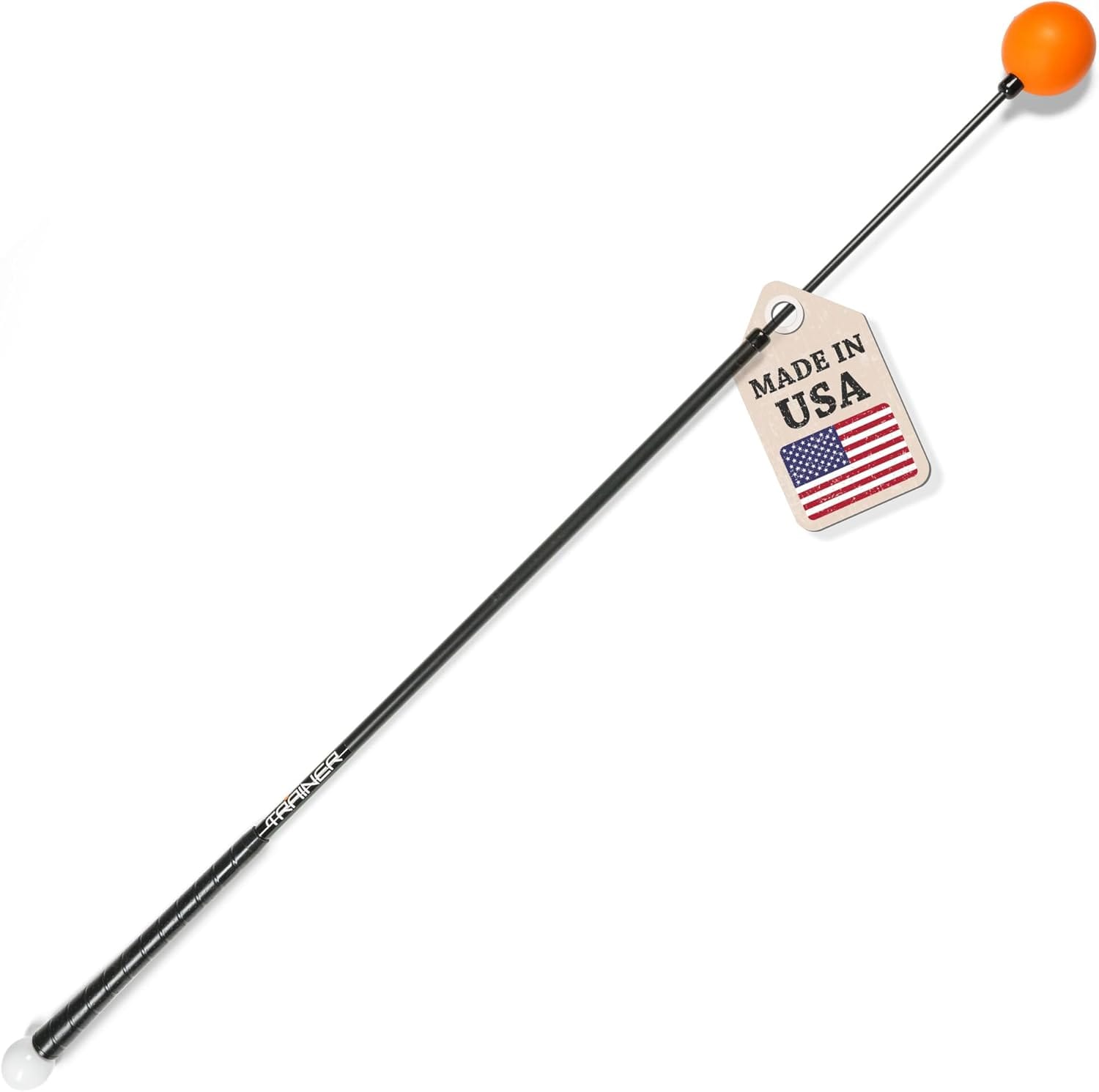
Orange Whip Golf Swing Trainer
The 5-Minute Version (When You're Running Late)
Sometimes you rock up with 10 minutes before your tee time and half of that goes to checking in and finding your pull cart.
Minutes 1 to 2 (Raise + Activate, combined): Walk briskly to the range while doing arm swings. On arrival, 8 hip circles each direction and 6 forward lunges with rotation. No standing around. Keep moving.
Minutes 3 to 5 (Potentiate): 3 balls with a pitching wedge (60% effort), 3 balls with a 7-iron (75% effort), 2 balls with your tee club at 85 to 90% effort.
You've cut the Mobilize phase and compressed the Raise. That's a trade-off. But a study in the Journal of Human Kinetics (PMC6561232, 2018) found a short 10-minute warm-up was as effective as a 20-minute warm-up for repeated sprint performance in national-level athletes. Something structured beats nothing. Five minutes of progressive, dynamic preparation beats walking to the first tee cold.
The non-negotiables, even in five minutes: at least some dynamic hip and trunk movement before touching a club, and starting with a wedge, not a driver.
The Three Mistakes Recreational Golfers Make
1. Static stretching before the round. The duration-dependent data is clear. Holds exceeding 60 seconds per muscle group suppress strength and power. If your pre-round routine involves holding your hamstring stretch while chatting to your playing partner for a minute or two, you're reducing your first-tee power output. Move those stretches to your cool-down.
2. Skipping bodywork and going straight to the range. Grabbing a bucket and hitting balls isn't a warm-up. It's practice. Your muscles aren't at temperature, your fast-twitch fibers aren't recruited, and the neural pathways for rotational speed haven't been primed. The Raise and Activate phases prepare the system before you load it.
3. Starting with driver. The driver swing produces the highest rotational speed and joint load in the bag. Hitting it first, cold, is like a sprinter running their 100m race as their warm-up. Start short, build to long.
What to Do If You Had Zero Warm-Up Time
You're on the first tee. No range session happened. No warm-up happened. Your partners are waiting. Three minutes in the car park or beside the tee box can still make a difference.
Do 10 hip circles each direction. Do 6 forward lunges with rotation, 3 each side. Take 5 to 8 full practice swings with your driver, building speed from 50% to 90%. That's it.
It's not the 10-minute routine. But even minimal movement raises muscle temperature, and Oyama et al.'s research showed skeletal muscle responds to slight warming with faster contractile activation. You won't be fully primed, but you'll be better off than the golfer who took two stiff practice swings and pushed their opening drive 20 yards (18m) into the trees.
One more thing: if you do get to the first tee cold, consider hitting a 3-wood or hybrid instead of driver. Less rotational demand, more margin for a neuromuscular system that hasn't been primed. Not exciting. Effective. If you want to understand where those first-hole bogeys are actually costing you, strokes gained is the framework that tells you.
No facility at all, not even the parking lot you just read about? Do this instead: the no-range warm-up routine condenses the same RAMP-based prep into ten minutes of movement alone, no balls, no range, nothing but a cart path and a club.
Frequently Asked Questions
How long should I warm up before a round of golf?
Ten to 15 minutes is the research-supported range. Sports science consensus, supported by multiple systematic reviews, suggests a 10-minute active warm-up is the minimum effective floor for anaerobic and explosive activities. Below that, muscle temperature and neural priming haven't shifted enough to produce measurable performance changes. If you only have 5 minutes, a compressed dynamic routine still beats no warm-up, but 10 minutes is the target.
Should I do static or dynamic stretching before golf?
Dynamic stretching before, static stretching after. A 2019 systematic review of golf warm-ups (Cabri et al.) concluded dynamic warm-ups enhanced performance while static stretching was inferior and potentially detrimental. The key detail: holds under 45 seconds per muscle group aren't harmful, but most golfers doing a "stretching routine" hold for 60 to 90+ seconds per group, which enters the range where strength and power suppression are measurable. Keep static holds for your post-round cool-down.
What happens if I skip the warm-up and go straight to the driver?
Your muscles are below optimal working temperature (about 38.5C / 101.3F), your fast-twitch fibers aren't recruited, and your nervous system hasn't received sport-specific input. The result: reduced clubhead speed, less carry distance, and poorer coordination. Golf coaches and fitters see it all the time: golfers who skip warm-up don't reach peak distance until the 5th or 6th hole. A dynamic warm-up with progressive club work addresses all three issues before you reach the first tee.
What order should I hit clubs during warm-up?
Start with your shortest club (pitching wedge or sand wedge) and work up to driver. The wedge swing has a shorter arc, lower peak speed, and less rotational load on your joints. By building through mid-irons to hybrids and then driver, you're increasing the demand on your neuromuscular system in stages. A study on elite golfers (PMC3735827, 2013) showed that combining resistance band activation with progressive club warm-up produced driving distance gains of nearly 15 yards (13.7m) over club warm-up alone.
Does warming up before golf reduce injury risk?
The data supports it. Golf's most common injury is low back pain, with annual incidence ranging from 15.8% to 40.9% in amateurs. Cabri et al. (2019) noted golfers warming up for more than 10 minutes show lower injury rates. A 2025 double-blind randomised controlled trial (Hamada et al., Translational Sports Medicine) found a structured golf-specific warm-up programme reduced low back pain incidents from 100 in the control group to 16 in the intervention group. That study used adolescent golfers, but the principle of preparing the musculoskeletal system before loading it applies across age groups.
Your pre-round warm-up isn't about loosening up. It's about switching on. Ten minutes of structured, progressive work gives your nervous system the input it needs to perform from the first swing, not the fifth hole.
The routine is simple. The hardest part is leaving the house 15 minutes earlier.
Some links in this article are affiliate links. If you buy through them, I earn a small commission at no extra cost to you. This never influences what I cover or recommend. I link to gear I'd buy myself.








The golf newsletter that cuts the hype
Data-backed reviews and advice that works. No brand spin.
Recommended products


Rukket SPDR Golf Net Review: 10x7 Bundle for Home Practice.
The Rukket 10x7 SPDR golf net bundle reviewed: what's actually in the box, what MyGolfSpy and PluggedInGolf found, and who it fits best.
Read review