Golf Fitness: 8 Exercises for More Distance
The 8 best golf fitness exercises for more distance, backed by research. Explosive power beats flexibility. Includes reps, sets, and a weekly programme.
- 1.Explosive power, not flexibility, drives clubhead speed. A 2024 Sports Medicine meta-analysis found jump impulse correlates with CHS at r = 0.68. Flexibility showed r = −0.04 (trivial).
- 2.The 8 exercises cover three pillars: power (box jumps, kettlebell swing), rotation (med ball throws, cable rotation, seated thoracic rotation), and foundation (trap bar deadlift, squat).
- 3.Combined training adds 10 to 12 yards in 8 weeks for a typical 12 to 15 handicapper (Uthoff et al., 2021, 4.1% CHS increase at 85 mph baseline).
- 4.Build a strength base first, then layer overspeed training. SuperSpeed Golf adds a further 2 to 5% on top of an established foundation.
- 5.Program structure: 2 to 3 sessions per week, 8 weeks minimum. Weeks 1 to 4 build foundation; weeks 5 to 8 add power and overspeed work.
Most amateur golfers looking for golf fitness gains that add distance spend their gym time stretching. The largest meta-analysis on physical characteristics and clubhead speed says that's the wrong approach.
Clubhead speed is the velocity of the clubhead at impact, measured in miles per hour, and is the primary determinant of carry distance. A 2024 Sports Medicine meta-analysis by Brennan et al. pooled 20 studies and 569 golfers, from 5-handicappers to PGA Tour professionals, and found that flexibility has a trivial, non-significant correlation with clubhead speed (r = −0.04). Balance is the same story (r = −0.06). What does correlate? Explosive force production: jump impulse (r = 0.68), upper body explosive strength (r = 0.58), and jump peak power (r = 0.58).
Every exercise in this list connects to a specific physical attribute that peer-reviewed research links to clubhead speed. No yoga. No generic "core work." Just the movements the data supports, with reps, sets, and an honest assessment of how much distance you can expect to gain. If you're over 60 and want a modified programme, there's a version built for senior golfers.
| Physical Attribute | Correlation with CHS (r) | Effect Size | Training Priority |
|---|---|---|---|
| Jump impulse | 0.68 | Large | High |
| Upper body explosive strength | 0.58 | Moderate | High |
| Jump peak power | 0.58 | Moderate | High |
| Jump displacement | 0.49 | Moderate | Moderate |
| Upper body strength | 0.45 | Small | Moderate |
| Lower body strength | 0.44 | Small | Moderate |
| Anthropometry (lean mass) | 0.41 | Small | Low (genetic) |
| Flexibility | −0.04 | Trivial | Low |
| Balance | −0.06 | Trivial | Low |
Source: Brennan et al. (2024), Sports Medicine, meta-analysis of 20 studies, 569+ golfers.
Why Most Golf Fitness Advice Misses the Point
The average male amateur carries the driver 214 yards (196m), according to Arccos's 2025 Driving Distance Report. The PGA Tour average is 300 yards (274m). That gap isn't technique alone. It's physical.
But "physical" doesn't mean what most golfers assume. The Brennan et al. (2024) meta-analysis is clear: the physical attributes with the strongest association to clubhead speed are explosive in nature. Jump impulse, upper body explosive strength, and jump peak power all showed moderate-to-large correlations. Maximal strength (squats, deadlifts) showed smaller but meaningful associations. Flexibility and balance showed nothing.
That last point matters. If you've been told that a more flexible body means a bigger turn and more distance, the data doesn't support it. A bigger turn might help your swing mechanics, but the physical capacity to swing faster comes from how quickly you can produce force, not how far you can stretch.
The authors' conclusion, quoted: "Explosive force production appears to be more important than maximal strength measures in both the lower and upper body."
This reframes the entire exercise selection. You need movements that train rate of force development, rotational power, and ground reaction force. The stretching can stay in your warm-up where it belongs.
Does Golf Fitness Training Actually Add Distance?
Can you train your way to more yards? Yes, with a realistic expectation of how many.
Uthoff et al. (2021) published a systematic review in the Journal of Strength and Conditioning Research covering 20 studies on resistance training and golf performance. Combined training (gym-based strength work plus golf-specific explosive movements) produced an average 4.1% clubhead speed increase and 5.2% distance improvement.
At a baseline of 85 mph (137km/h), typical for a 12-15 handicapper based on Trackman's published data, 4.1% is 3.5 mph (5.6km/h). Using Trackman's widely cited rule of thumb (1 mph of clubhead speed adds about 3 yards / 2.7m of carry distance), that's 10-11 yards (9-10m).
Non-specific training alone (general gym work without golf-specific movements) produced a smaller gain: 1.6% clubhead speed increase. The takeaway is that gym work helps, but gym work paired with movements that mimic the downswing pattern helps more than twice as much.
The optimal protocol across these studies: 8-week programmes, golf-specific movements performed at high velocities, 3-4 sets of 5-15 reps.
This isn't 50 yards overnight. It's 10-12 yards (9-11m) in 8 weeks if you stick to the schedule. For a 15-handicapper trying to reach more par-4s in two, that's the difference between a 7-iron and a 9-iron into the green.
The Power Exercises
Jump Training (Box Jump or Countermovement Jump)
Jump training has the strongest single association with golf clubhead speed of any measurable physical attribute. According to Brennan et al. (2024), jump impulse correlates at r = 0.68 (large effect). Oranchuk et al. (2020) found an even stronger correlation for the countermovement jump: r = 0.73 with clubhead speed in collegiate golfers.
The connection is direct. The golf downswing starts from the ground. Your lower body drives into the turf, generating ground reaction force that transfers up the kinetic chain through the hips, torso, arms, and club. Jumping trains that same explosive ground-force pattern.
How to do it: Stand in front of a box or sturdy platform at knee height, about 18 to 24 inches (45 to 60cm). Dip into a quarter squat, swing your arms, and explode upward. Land softly on the box with both feet. Step down (don't jump down, as the eccentric landing is where injuries happen).
Reps and sets: 3 sets of 5-6 jumps. Full recovery between sets (60-90 seconds). These are power reps, not cardio.
Modification: If box jumps feel risky, countermovement jumps on flat ground work the same pattern. Jump as high as you can, land softly, reset.
Power Clean or Kettlebell Swing
Of all the barbell exercises tested in published golf research, the power clean showed the strongest correlation with clubhead speed: r = 0.70 (p = 0.012) in Oranchuk et al. (2020). That's a stronger association than the back squat, deadlift, or any upper body lift in the same study.
Rate of force development is the speed at which a muscle generates force from zero, measured in newtons per second. The power clean trains it: a ballistic hip extension under load, generating maximum force in minimum time. The golf downswing lasts about 230 milliseconds, according to TPI, and peak muscular force takes around 300ms to develop from scratch. You can't grind your way to speed. You have to be explosive.
How to do it (power clean): Start with the bar on the floor, conventional deadlift grip. Pull the bar to mid-thigh, then explosively extend hips and shrug, catching the bar in a front rack position at shoulder height. The power clean is a technical lift. Learn it from a coach or use the kettlebell swing alternative.
How to do it (kettlebell swing): Stand with feet shoulder-width apart, kettlebell on the floor just in front. Hinge at the hips, grip the bell with both hands, and drive it forward by snapping your hips. The arms stay relaxed. All the power comes from the hip extension.
Reps and sets: Power clean: 4 sets of 3-5 reps. Kettlebell swing: 4 sets of 8-10 reps. Both movements demand full effort on every rep.
The Rotation Exercises
Medicine Ball Rotational Throw
The rotational medicine ball throw is the most direct simulation of the downswing power pattern you can do in a gym. Multiple studies cited in the Brennan et al. (2024) meta-analysis show a correlation of r = 0.67 with clubhead speed.
What makes this exercise valuable is specificity. The medicine ball throw creates lower-body power expressed through a rotational release pattern. You load through the backswing (coiling into the trail hip), then fire the hips and release the ball through the lead side. That's the same stretch-shortening cycle that drives the golf swing.
TPI recommends rotational medicine ball throws as one of their three core training tools for X-factor stretch development.
How to do it: Stand side-on to a solid wall, about 3 feet (0.9m) away. Hold a light medicine ball (4-8 lb / 2-4kg) at chest height. Rotate away from the wall (loading the trail hip), then rotate hard and throw the ball into the wall. Catch and repeat.
Reps and sets: 3 sets of 8-10 throws per side. Use a light ball. Velocity matters more than load here. If the ball is so heavy that you can't throw it fast, go lighter.
Seated Thoracic Rotation (Training the X-Factor)
The X-factor is the rotational separation between the hips and shoulders at the top of the backswing. The X-factor stretch, which is the increase in that separation at the start of the downswing, predicts clubhead speed more reliably than the static backswing turn. Cheetham et al. (2000), as cited by the Titleist Performance Institute, found that highly skilled golfers increase their X-factor by 19% during early downswing, compared to 13% for less skilled golfers. Meister et al. (2011), in the Journal of Applied Biomechanics, found peak X-factor correlated with clubhead speed at r = 0.943 among professional and amateur golfers.
Here's the practical insight: you can't always make your backswing turn bigger. But you can train the disassociation movement, where the hips fire first while the shoulders are still completing the turn. That's what creates the stretch-shortening cycle that generates speed.
Seated thoracic rotation isolates this. Sitting eliminates hip movement, forcing your mid-back to rotate on its own. No thoracic independence, no X-factor stretch.
How to do it: Sit on a bench with feet flat on the floor, knees together. Hold a club or dowel across your shoulders. Without moving your hips or lower back, rotate your upper body as far as you can to one side, hold for 2 seconds, then rotate to the other side.
Reps and sets: 3 sets of 10-15 reps per side. Slow and controlled. Treat it as mobility work, not power training.
Cable Rotation (Split Stance)
Cable rotations apply resistance to the downswing pattern, bridging the gap between isolated mobility work and full-speed medicine ball throws. TPI includes cable punches in their 14-exercise impulse and separation programme, prescribing 8-12 reps at 70% 1RM per side.
The split stance is what makes this golf-specific. One foot forward, one back, mimicking the weight transfer of the downswing. You're training rotational power and the lead-side posting movement in the same rep.
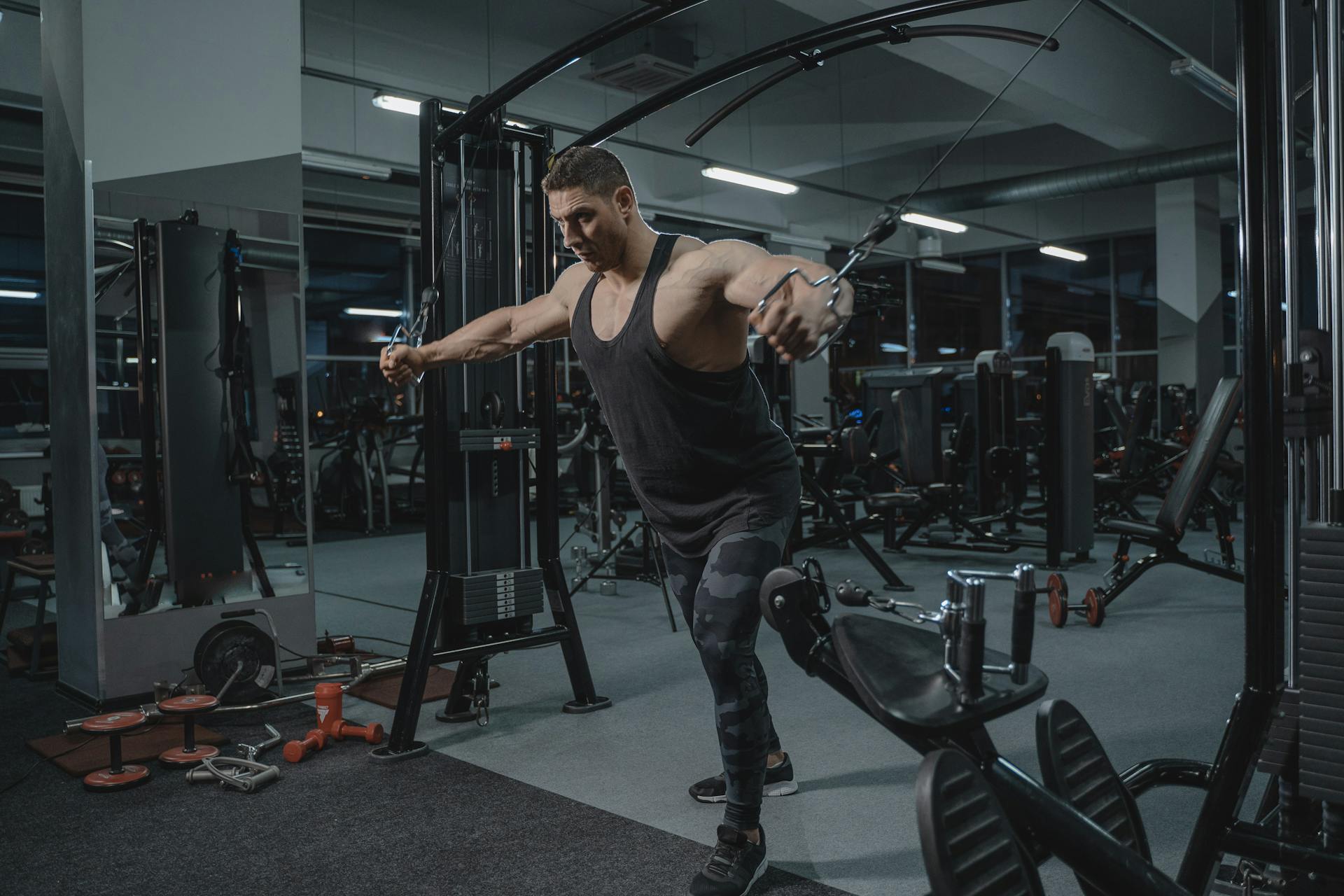
How to do it: Set a cable machine at waist height. Stand side-on to the stack in a split stance (lead foot forward). Grip the handle with both hands at the center of your torso. Press and rotate through to full extension, driving with the hips. Control the return.
Reps and sets: 3 sets of 10-12 reps per side. If you don't have cable access, any resistance band anchored at waist height works the same pattern.
The Foundation Exercises
Trap Bar Deadlift (or Conventional Deadlift)
The deadlift builds the posterior chain (glutes, hamstrings, and lower back) that generates ground reaction force at the base of the kinematic chain. Oranchuk et al. (2020) found a correlation of r = 0.54 between deadlift strength and clubhead speed, approaching significance (p = 0.068). TPI positions the deadlift as exercise number one in their impulse and separation programme.
The deadlift doesn't show up as flashy in correlation tables. Yet every golf fitness practitioner puts it at the foundation. Faster hip extension drives more explosive frontal-plane movements, and the glutes and hamstrings are the engine. Without a strong posterior chain, the explosive exercises above have nothing to draw from.
How to do it: The trap bar (hex bar) variant reduces spinal loading, making it the better entry point for golfers new to deadlifting. Stand inside the trap bar, grip both handles, brace your core, and drive through the floor until you're standing tall. Lower under control.
Reps and sets: 4 sets of 5 reps at heavy load. Treat it as a strength exercise. If you can do sets of 15, the weight is too light.
Back Squat or Goblet Squat
So why does the squat outperform dedicated golf stretching in the correlation data? Lower body strength has a moderate but meaningful association with clubhead speed. Oranchuk et al. (2020) found the back squat correlated at r = 0.64 with CHS (p = 0.025). Brennan et al. (2024) put lower body strength as a whole at r = 0.44 across their pooled analysis.
TPI's position: tour pros squat down during their downswing then use the ground to push up and increase clubhead speed. That ground reaction force needs a base of quad and glute strength. The squat builds it.
How to do it (back squat): Bar across the upper back, feet shoulder-width, squat to at least parallel. Drive through the floor. If you're new to barbell work, start with the goblet squat.
How to do it (goblet squat): Hold a dumbbell or kettlebell at chest height, close to your body. Squat to parallel or below, keeping the weight centered. This grooves proper hip mechanics before you load with a barbell.
Reps and sets: Back squat: 4 sets of 5-6 reps at moderate-to-heavy load. Goblet squat: 3 sets of 8-10 reps.
Overspeed Training with SuperSpeed Golf
Overspeed training does something different from lifting. Instead of building the engine, it resets your neuromuscular speed ceiling by swinging lighter-than-driver clubs faster than your current maximum.
The evidence is promising but not bulletproof. No peer-reviewed randomised controlled trial exists for golf overspeed training. The research base draws from analogous sports (sprinting, cricket, baseball) where overspeed methods show neuromuscular adaptation benefits.
What we do have: the Par4Success controlled study (2019) found an average clubhead speed increase of 1.8 mph (2.04%) across multiple protocol groups. Golf Insider UK published a case study with PGA coach Rob Pritchard: 9.5% CHS gain in 6 weeks following the 3x/week protocol, with an estimated 27.5 yards (25m) gained. That's a single case with no control group, but it corroborates the direction.
SuperSpeed Golf's own data claims 5-8% CHS gains in 4-6 weeks across 600+ tour professionals. That's brand data, and it should be treated as such.
Realistic expectation for most amateurs: 2-5% clubhead speed gain. At 85 mph (137km/h) baseline, that's 1.7-4.3 mph, or about 5-13 yards (4.6-11.9m). The research isn't as clean as the marketing implies, but the direction of effect is real.
Protocol: 3 sessions per week, 10 minutes each, using three weighted clubs in sequence (light to medium to heavy). 4-6 week initial block. The gain transfers to your driver only if you follow up sessions by swinging your actual club at maximum effort.
Honest framing: This is not a replacement for strength training. It's a speed-focused layer on top of it. If you haven't built a strength base with the exercises above, address that first. The research supports building force production before training speed.
How to Structure a Weekly Programme
Two to three sessions per week is enough. The goal is to stimulate adaptation, not exhaust yourself before a round.
Session A: Power and Strength
- Box jumps: 3 x 5-6
- Trap bar deadlift: 4 x 5
- Back squat or goblet squat: 3-4 x 5-8
- Duration: 35-45 minutes
Session B: Rotation and Explosiveness
- Medicine ball rotational throws: 3 x 8-10 per side
- Cable rotation (split stance): 3 x 10-12 per side
- Power clean or kettlebell swing: 4 x 3-5 (clean) or 4 x 8-10 (swing)
- Seated thoracic rotation: 3 x 10-15 per side
- Duration: 30-40 minutes
Session C (optional): Overspeed
- SuperSpeed Golf protocol: 10 minutes
- Follow with 10-15 full-effort swings with your driver
Weekly schedule example:
- Monday: Session A
- Wednesday: Session B
- Friday: Session C (or repeat A/B on a 2-session week)
Avoid heavy lifting the day before a round. Your pre-round warm-up is where activation drills live, not strength training.
Weeks 1-4: Focus on the foundation exercises (squat, deadlift) and learning the rotational patterns (med ball throws, cable rotations). Increase load each session.
Weeks 5-8: Add power emphasis (box jumps, power cleans) and layer in overspeed training if desired. The Uthoff et al. (2021) data suggests measurable clubhead speed gains start appearing around this mark.
Beyond week 8: Maintain the programme. Strength gains plateau without progressive overload, and overspeed gains fade without continued training. For golfers who stick with it, though, the improvements stack.
Frequently Asked Questions
Does resistance training add yards to your drives?
Yes. Uthoff et al. (2021) published a systematic review in the Journal of Strength and Conditioning Research covering 20 studies on resistance training and golf performance. Combined training (strength work plus golf-specific explosive movements) produced an average 4.1% clubhead speed increase and 5.2% distance improvement. At a baseline of 85 mph (137km/h), typical for a 12-15 handicapper, that translates to about 3.5 mph (5.6km/h) and 10-11 yards (9-10m) of additional carry. The gains require 6-12 weeks of structured training, performed 2-3 times per week. Non-specific gym work alone still helps, but at less than half the effect (1.6% CHS increase).
What physical attribute matters most for golf distance?
Explosive power, not flexibility or balance. The Brennan et al. (2024) meta-analysis in Sports Medicine pooled 20 studies and 569+ golfers and found that jump impulse had the strongest association with clubhead speed (r = 0.68, large effect size). Upper body explosive strength came second (r = 0.58, moderate effect). Flexibility showed a trivial, non-significant correlation of r = −0.04, meaning it has no measurable predictive relationship with how fast you swing. Lower body and upper body maximal strength showed small-to-moderate associations (r = 0.44 and r = 0.45), useful but secondary to explosive training.
What is the X-factor and how do I train it?
The X-factor is the rotational separation between the hips and shoulders at the top of the backswing. X-factor stretch is the increase in that separation at the start of the downswing, as the hips fire forward while the shoulders are still completing the turn. The stretch version is the stronger predictor of clubhead speed. Cheetham et al. (2000), as cited by TPI, found that highly skilled golfers increase their X-factor by 19% during early downswing compared to 13% for less skilled golfers. Meister et al. (2011) found peak X-factor correlated with clubhead speed at r = 0.943 among professional and amateur golfers. Train it with seated thoracic rotations (isolating mid-back rotation from hip movement) and rotational medicine ball throws (training the full stretch-shortening release pattern). Both target the disassociation that creates the stretch.
Is SuperSpeed Golf worth buying?
For golfers who already have a strength training base, the evidence leans toward yes. The independent Par4Success controlled study (2019) found an average 1.8 mph (2.04%) clubhead speed gain. Golf Insider UK published a case study with PGA coach Rob Pritchard showing 9.5% CHS gain over 6 weeks following the prescribed protocol (3 sessions per week, 10 minutes each). SuperSpeed Golf's own data claims 5-8% gains across 600+ tour professionals, though that's brand-produced data. No peer-reviewed randomised controlled trial exists for golf overspeed training. Realistic expectation: 2-5% improvement. At 85 mph (137km/h), that's 5-13 yards (4.6-11.9m). Available on Amazon, the cost per potential yard gained compares well to a new driver.
How long before I see distance gains from golf fitness training?
Most studies showing measurable clubhead speed improvements used 8-week protocols. Overspeed training with SuperSpeed Golf tends to show gains from weeks 4-6. Strength-based gains from exercises like deadlifts, squats, and power cleans take 8-12 weeks to transfer to clubhead speed, because the neuromuscular adaptations need time to integrate with your swing pattern. The Uthoff et al. (2021) systematic review found that the most effective protocols ran for at least 8 weeks with 2-3 sessions per week. Don't abandon the programme at week 4 because your launch monitor numbers haven't moved yet. Maintain training past week 8 and the gains compound.
Where to Start
If you're doing nothing right now, here's the order. Start with the squat and deadlift. These build the foundation of lower body strength that everything else draws from. After two weeks of consistent lifting, add medicine ball rotational throws to train the downswing pattern under load. At week 4-5, layer in SuperSpeed Golf or box jumps to train the explosive and speed components.
That three-part progression follows the research: build force production first, then layer in speed. Don't start with the speed sticks if you can't squat your bodyweight yet.
If you're setting up a home gym for these movements, our best at-home golf fitness equipment guide covers what is worth buying for this kind of training.
More clubhead speed also changes your equipment needs. As your swing speed increases, your current shaft flex might not be the right fit anymore. It's worth revisiting your shaft specs once your numbers move.
The most motivating thing you can do is measure your starting clubhead speed and re-test at 8 weeks. A launch monitor tells you exactly what you've gained, down to the tenth of a mile per hour. If you don't have one yet, the sub-$1,000 launch monitor guide covers what's worth buying. And if your speed numbers improve but your distance doesn't follow, the answer is almost always launch conditions. Understanding the ball flight laws will help you turn that extra speed into actual yards.
Some links in this article are affiliate links. If you buy through them, I earn a small commission at no extra cost to you. This never influences what I cover or recommend. I link to gear I'd buy myself.








The golf newsletter that cuts the hype
Data-backed reviews and advice that works. No brand spin.
Recommended products

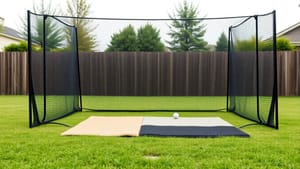
Rukket SPDR Golf Net Review: 10x7 Bundle for Home Practice.
The Rukket 10x7 SPDR golf net bundle reviewed: what's actually in the box, what MyGolfSpy and PluggedInGolf found, and who it fits best.
Read review