Most golfers who struggle with chip shot distance aren't hitting bad shots. They're picking the wrong club for the shot they just hit well. A clean strike with a lob wedge and a clean strike with a 7-iron travel to completely different landing spots and roll completely different distances, and if the club doesn't match the amount of green in front of you, a perfectly struck chip still finishes 15 feet (4.6m) short or long. Mark Broadie's strokes-gained research (Columbia University; Every Shot Counts) backs this up with numbers: the average greenside chip finishes about 7 feet (2.1m) from the hole on the PGA TOUR, roughly 15 feet (4.6m) for a 10-handicap, and 22 feet (6.7m) or more for a 20-handicap. PGA TOUR players scramble 60 to 70 percent of the time from greenside misses; most amateurs scramble well under 50 percent. That gap isn't primarily a contact problem.
This guide assumes your strike is already solid. If it isn't, the fundamentals live in our guide on how to improve your short game without taking lessons, and it's worth fixing contact before layering a distance system on top of it. It also assumes you've already decided a chip is the right shot for the lie you're standing over; if you're weighing a chip against a pitch, our chipping vs pitching guide walks through that call. What follows is the piece in between: once contact is solid and the shot is decided, how do you actually control how far the ball ends up rolling out?
Pick the club by how much green you have, not by habit: more green between your landing spot and the pin calls for less loft, since less-lofted clubs roll out further relative to how far they carry.
The ratio is the system: TrackMan's "Chip Shot Code" study found a 6 or 7-iron rolls 3.5 to 5.5 times as far as it carries, a gap wedge rolls 1.5 to 2.5 times as far, and a lob wedge barely outrolls its carry at all.
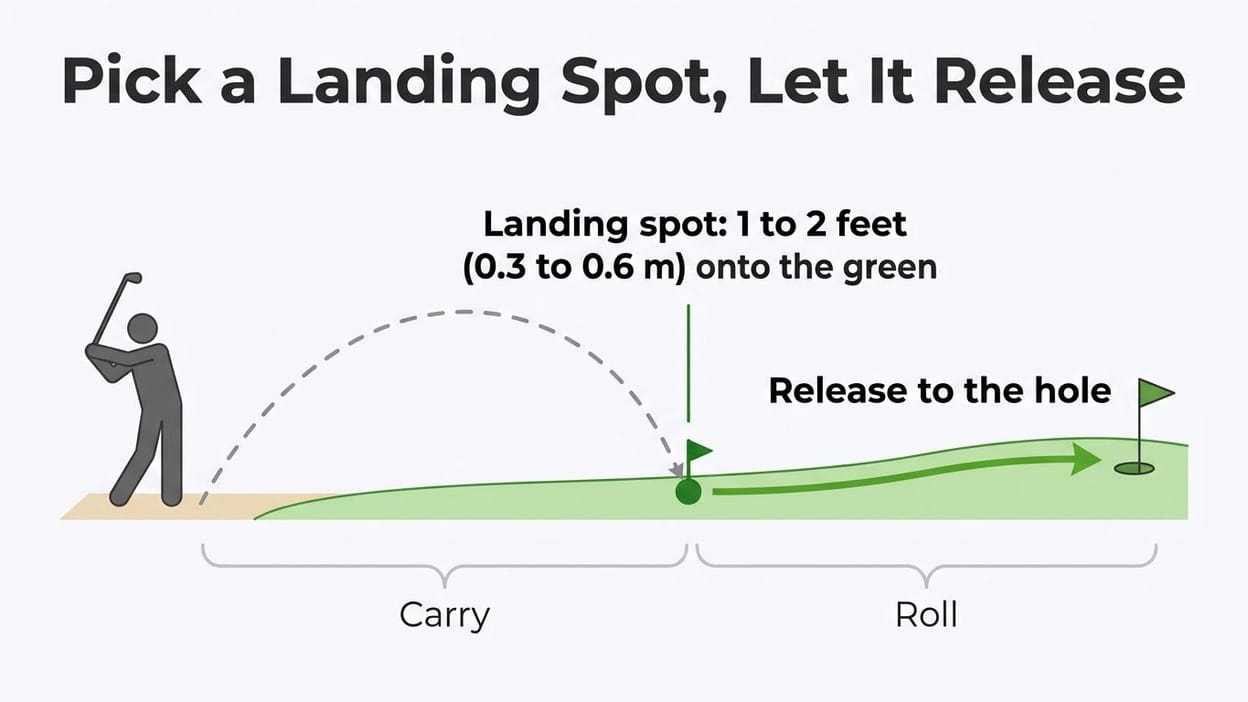
Land on a fixed spot, not a fixed swing: mark a landing point 1 to 2 feet (0.3 to 0.6m) onto the green and let the ratio do the rest of the math for you.
You don't need a launch monitor to calibrate this: a towel, a coin, and a spare ball reproduce the same feedback loop.
Stays inside 20 yards (18m): past that, the physics shift toward carry-dominant pitching, covered separately in our pitch distance guide.
Why club selection decides more strokes than contact does
Strokes-gained data makes the size of this gap explicit. Broadie's research puts the average golfer's strokes-gained-around-the-green deficit against a scratch player at 1.5 to 2.5 strokes per round for a 15-handicap, 1.0 to 1.5 strokes for a 10-handicap, and 0.5 to 1.0 strokes for a single-digit player. None of that is explained by whiffed or bladed chips. It's explained by a string of technically fine strikes that still finish the wrong distance from the hole, because the club selected didn't match the green available.
The reason this is fixable with a system, rather than more repetitions, is that the relationship between loft and rollout is remarkably consistent. TrackMan's "Chip Shot Code" study, led by Andrea Zanardelli and built from roughly 6,000 tracked chip shots, quantified exactly how much a given loft rolls relative to how far it carries. That ratio, not swing feel, is what tells you which club belongs in your hand once you know how much green you're working with.
The chip shot distance system: pick your club by how much green you have
Start by looking at the shot in front of you and estimating one number: how much green sits between the spot where the ball will land and the pin. That's the "green available," and it's the only input this system needs before you pick a club.
The TrackMan data breaks the carry-to-roll relationship into four bands by loft:
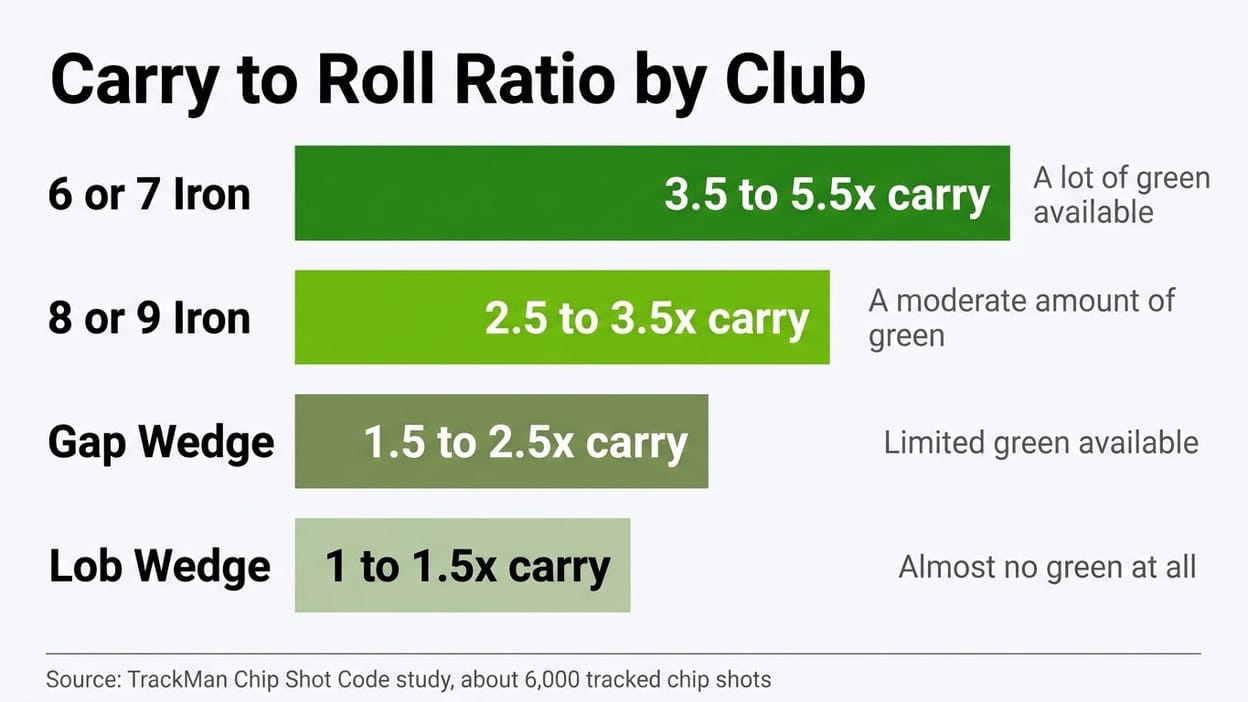
Green speed shifts these ratios day to day (a fast, firm green rolls out more than a soft, slow one), so treat the ranges as a starting framework to calibrate against the specific green you're playing, not a fixed table to apply blindly everywhere. I'll admit my own bias here: given a borderline choice between a gap wedge and a lob wedge, I default to the gap wedge more often than the ratio data would strictly recommend, mostly because carrying one fewer swing decision under pressure matters more to me than optimizing half a club's worth of roll.
This system only covers shots inside roughly 20 yards (18m), the window where the ball spends more time rolling than flying. Once you're regularly carrying the ball 30 yards (27m) or more, the physics flip toward carry-dominant pitching, which our guide on how to control your pitch shot distances covers on its own terms. It also isn't the only valid framework for chipping: our guide to chipping the lie in front of you builds club selection around difficult lies (tight, rough, hazards, downhill) rather than around green available, and the two systems are meant to complement each other, not compete. Use the lie-based system when the lie itself is the constraint; use this one when the lie is clean and distance control is the actual problem.
Your 5-step landing system
- Measure your green available. Stand behind the ball and estimate the distance between where you intend to land the ball and the pin, in feet or paces rather than a vague guess. This single number drives every decision that follows.
- Match the club to the ratio you need. Use the table above: a lot of green calls for a 6 or 7-iron, a moderate amount for an 8 or 9-iron, limited green for a gap wedge, and almost none for a lob wedge.
- Pick and mark a fixed landing spot. Choose a point roughly 1 to 2 feet (0.3 to 0.6m) onto the green past any fringe or rough, and commit to landing the ball there rather than aiming loosely at the pin. On the range or practice green, mark that spot with a coin or a tee so you have a visible target rather than an imagined one.
- Groove a repeatable "running" motion. TrackMan's data on running chips found the most predictable rollout happens with clubhead speed capped around 30 mph (48km/h), a landing angle of 37 degrees or less, and spin under 3,750 rpm. In practical terms, that means a shorter, more putting-like stroke with the hands leading slightly through impact, not a full-effort strike. Drop a second ball just ahead of your ball at address: if your club brushes or moves that second ball before reaching your actual ball, you're bottoming out too early, which steepens the landing angle and kills the predictable roll this system depends on.
- Calibrate without a launch monitor. You don't need TrackMan data of your own to use TrackMan's findings. Lay a towel or a hula-hoop down at three practice distances, say 10, 15, and 20 yards (9, 14, and 18m), and hit the same club to each one, watching where it lands versus where it finishes. A handful of reps per distance is enough to feel where your own strike and your own greens sit relative to the published ratios, and to notice, for instance, if your home course's greens run faster than average and shorten every ratio in the table.
Gear that speeds up the system
None of the five steps above require buying anything, and a towel, a coin, and a spare ball cover the calibration step just as well as any device. That said, a few tools make the system faster to build into a repeatable habit.
If a 52-degree gap in your bag needs filling, the Wilson Harmonized 52° Black Chrome wedge is a budget-friendly, versatile option that sits right in the gap-wedge band of the ratio table above.
 Buy now
For practicing the landing-spot drill at home or in a backyard, the SKLZ Quickster 6x6 ft net folds up in seconds and ships with a built-in chipping target, so Step 3's fixed landing spot has something to aim at even without a real green nearby.
Buy now
For the low-point check in Step 4, the Impact Press Training Aid gives direct feedback on strike position and low point, a distinct category from alignment or path trainers and from putting aids, and worth calling out separately since it's easy to lump all "training aids" together as one thing.
Buy now
P.S. if the strokes-gained math and scrambling percentages above have you curious about where else amateurs are actually losing shots, Break 100 walks through that strategy layer in more depth: Break 100 on Amazon.
Frequently Asked Questions
What's the difference between carry and roll on a chip shot?
Carry is how far the ball travels in the air before it first touches the ground. Roll is everything after that, how far it continues moving once it lands. TrackMan's "Chip Shot Code" study, based on roughly 6,000 tracked chip shots, found that ratio changes dramatically by club: a 6 or 7-iron rolls 3.5 to 5.5 times as far as it carries, while a lob wedge rolls only 1 to 1.5 times as far as it carries. Picking a club without accounting for that ratio is the single biggest reason a clean strike still finishes the wrong distance from the hole.
Which club should I chip with when I have a lot of green to work with?
A 6 or 7-iron, in most cases. With plenty of green between your landing spot and the pin, you want a club that carries a short distance and rolls out the rest of the way, which is exactly what the low-lofted end of the ratio table is built for. Land the ball 1 to 2 feet (0.3 to 0.6m) onto the green and let the roll cover the remaining distance rather than trying to fly the ball closer to the pin.
How far should a chip shot roll out after it lands?
It depends on the club and the green speed, which is exactly why this is a system rather than a fixed number. Using the TrackMan-derived ratios as a starting point, a 6 or 7-iron rolls 3.5 to 5.5 times its carry distance, an 8 or 9-iron rolls 2.5 to 3.5 times its carry, a gap wedge rolls 1.5 to 2.5 times its carry, and a lob wedge rolls 1 to 1.5 times its carry. Faster, firmer greens push every one of those ratios higher, so calibrate against the specific green you're playing rather than assuming the ranges hold everywhere.
Do I need a launch monitor to use this system?
No. The TrackMan data behind this system is already published, so you're borrowing the research rather than needing to reproduce it. To calibrate your own feel, lay a towel or a hula-hoop at a few practice distances, mark your intended landing spot with a coin or a tee, and place a second ball just ahead of your ball at address as a low-point check. That combination reproduces the same feedback a launch monitor gives, just without the price tag.
Some links in this article are affiliate links. If you buy through them, I earn a small commission at no extra cost to you. This never influences what I cover or recommend. I link to gear I'd buy myself.