If you've ever topped a drive, thinned an iron, or shanked a wedge and had no idea why, there's a decent chance the real cause has a name: early extension. It's the downswing move where the hips and spine thrust toward the ball instead of rotating, and it's common enough that a weekend round can turn into a guessing game of swing thoughts that don't fix the actual problem.
Early extension is the downswing move where the hips and spine thrust toward the ball instead of rotating, which is why it looks like the body is standing up through impact.
TPI has found the move in 67 percent of the more than 90,000 golfers it has screened, one of the most common characteristics in its database.
A phone video from down the line, checked against a line drawn from the back side to the ground at address, shows it without any special equipment.
"Stay down" rarely fixes it alone. Brian Mogg told GOLF.com that telling a golfer to keep the hips back "doesn't always work" because the move is usually a symptom of something else in the swing.
A chair drill and an alignment-stick drill retrain the feel, and a deep squat screen flags whether a mobility limit is part of the cause.
What early extension actually is
Early extension is a downswing fault: the hips and spine thrust toward the ball instead of rotating around the spine angle set at address. The Titleist Performance Institute describes it as "any forward movement of the pelvis toward the ball" during the downswing, and Me and My Golf describes the same motion: the hips push toward the ball and the torso rises to compensate.
That rise is what gets called "standing up out of posture" or "standing up through impact." It's not a separate problem. It's the visible result of the hips moving somewhere they shouldn't. The space between the body and the ball that existed at address starts to close before impact, and the arms and club have to find a new way to reach the ball. That's where the misses come from: a topped shot, a thin iron, a shank, a block, or a hook, depending on how the hands react to losing that space. Launch Point Golf's guide to topping the ball and guide to shanking both name early extension as a cause, and both describe it the same way: a thrust toward the ball, not a conscious choice to rise up.
A no-device check: film it from down the line
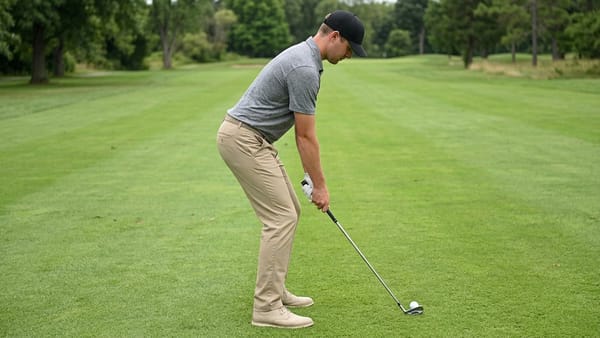
The clearest self-check doesn't need any training aids. Golflink instructor Nick Heidelberger recommends filming the downswing from directly behind, down the target line. At address, draw an imaginary line straight down from the back side to the ground. Through the downswing, that line should stay roughly where it started. If the hips push past it toward the ball before impact, that's early extension on camera.
The miss pattern backs up what the video shows. TPI links the move to blocks, hooks, fat and thin contact, and shanks, and Me and My Golf flags the shank specifically: "If you shank the golf ball, this could be the cause." A golfer who recognizes two or three of those misses in their own game has a reasonable head start before ever picking up a phone. I'm wary of how often early extension gets diagnosed from one freeze-frame at impact, since a body that looks like it's rising in a single photo can still be rotating correctly through the frames around it, which is exactly why the check above calls for video of the whole downswing rather than one frame of it.
Why it happens: setup, sequence, and physical limits
Three things tend to feed early extension, and they're rarely isolated from each other.
Setup. Tony Ruggiero, a GOLF.com Top 100 Teacher, points to weight sitting too far back on the heels at address. From there, the body has to move forward and up just to stay balanced through the swing, which shows up as early extension by impact. Launch Point Golf's posture guide makes the same point from the other direction: good posture at address doesn't prevent early extension by itself, but poor posture makes it an easier habit to fall into.
Sequence. Early extension in the downswing often traces back to what happens in the backswing and the first move down. GOLF.com Top 100 Teacher Dave Phillips describes the fix as "bumping the hips toward the target, not thrusting them toward the ball," which lines up with how Launch Point Golf's slice guide frames the first move down: a bump of the lead hip toward the target, not a push toward the ball. They're different directions entirely. One moves the pelvis laterally toward the target line; early extension moves it laterally toward the ball.
Physical limits. TPI's screening material ties early extension to limited hip and ankle mobility, since a body that can't rotate freely often compensates by thrusting toward the ball instead. Me and My Golf makes the same observation in plainer terms: "Mobility limitations in the lower body make it very difficult to start the downswing and maintain your posture." None of this is a medical claim. It's a reason some golfers can groove a technical fix in a lesson and lose it on the course: the body is working around a limit, not just a habit.
Why "stay down" doesn't fix it
"Stay down" and "you're standing up" are the most common cues attached to this fault, and improvers who've tried them usually report the same thing: it doesn't hold up under speed. Brian Mogg, who writes for GOLF.com, puts a finger on why: simply telling a golfer to keep the hips back "doesn't always work," because the standing-up look is often a symptom of another swing flaw rather than a standalone habit to think away.
That's the core issue with the cue. "Stay down" targets the visible result, the rise through the torso, rather than the thing actually moving: the hips and pelvis thrusting toward the ball. Fixing it means addressing the setup, sequence, or mobility factor pushing the hips forward in the first place, not bracing against the symptom at the top of the body.
Drills that retrain the movement
Two drills, both tied to a named source, give the body something to feel instead of something to think about.
The chair drill. GOLF.com's Alison Curdt has golfers set a chair directly behind their back side at address, close enough to feel if it's bumped. Taking slow, controlled downswings without knocking the chair back trains the body to rotate around its spine angle instead of pushing into it. The same idea works with a wall a few inches away from the back side for anyone without a spare chair nearby, which keeps the check gear-free.
The alignment-stick drill. Golf Monthly has golfers place an alignment stick in the ground just behind and to the side of the lead hip, then make downswings that stay in light contact with it, which trains the body to hold its posture instead of thrusting toward the ball. A spare iron laid across that same spot works the same way for anyone without a stick in the bag. Those weighing whether to add a set, Launch Point Golf's SKLZ Pro Alignment Rods review covers what they're useful for beyond this one drill.
Two more checks are already covered elsewhere on this site and are worth linking rather than repeating: the feet-together drill from Launch Point Golf's shanking guide, and the posture check in Launch Point Golf's posture guide.
The body-limit check: when it's not just technique
If the drills above feel right in a mirror but disappear the moment speed enters the swing, a physical limit is worth ruling out before spending more time on technique alone. TPI's deep squat screen, used widely in its golf-specific movement assessments, checks whether a golfer can squat to full depth with the feet flat, arms overhead, and spine in a neutral position. Trouble holding that position without the heels lifting or the lower back rounding often points to the same hip and ankle restrictions tied to early extension.
That's a question for a body, not a swing thought, and it's also where Launch Point Golf's own mobility coverage picks up: how to find your tightest link and the at-home golf mobility stretch routine both walk through self-checks and stretches for the hips and ankles that tend to limit this part of the swing.
A short practice plan: drill to full swing
Start with the chair or wall drill at well under full speed, making slow half-swings and checking that the back side stays in place. Once that feels automatic, add the alignment-stick version at a similar pace, since it adds a visual cue the chair drill doesn't give. From there, move to full swings only once both drills hold up without a miss, and use the same down-the-line video check from earlier to confirm the reference line is holding at impact, not just on the range at half speed.
Mogg's suggestion for troubleshooting the transition is useful here too: when a drill stops transferring to full swings, look at the backswing turn, the downswing path, and the pressure shift into the front foot, since any one of them can quietly reintroduce the same thrust toward the ball. No source gives a universal rep count for this progression, so this guide won't invent one. Let the chair or stick, not a number, decide when it's time to move on. For a longer framework on sequencing practice time like this into a full session, Break 100 walks through structuring range work from drill to course.
Frequently Asked Questions
What is early extension in a golf swing?
Early extension is a downswing fault where the hips and spine thrust toward the ball instead of rotating around the spine angle set at address. It's what makes a golfer look like they're standing up through impact, and it closes the space between the body and the ball that existed at setup.
Why doesn't "stay down" fix early extension?
"Stay down" targets the visible result, the body rising through impact, rather than the actual movement, which is the hips and pelvis thrusting toward the ball. GOLF.com's Brian Mogg notes that simply telling a golfer to keep the hips back "doesn't always work" because the standing-up look is often a symptom of a setup, sequence, or mobility issue rather than a habit to think away on its own.
How do I know if a mobility limit is causing it?
A simple screen is TPI's deep squat test: squatting to full depth with the feet flat, arms overhead, and spine neutral. Trouble holding that position, especially heels lifting or the lower back rounding, points to the same hip and ankle restrictions tied to early extension, and is worth addressing with mobility work rather than swing thoughts alone.
Some links in this article are affiliate links. If you buy through them, I earn a small commission at no extra cost to you. This never influences what I cover or recommend. I link to gear I'd buy myself.
Sources: TPI, early extension swing characteristic | Me and My Golf, do you early extend? | Golflink, Nick Heidelberger on stopping early extension | GOLF.com, Tony Ruggiero on setup causes | GOLF.com, Dave Phillips on the fix | GOLF.com, Brian Mogg on two reasons and the fix | GOLF.com, Alison Curdt's chair drill | Golf Monthly, preventing early extension