










how-to
How to Set Ball Position for Every Club
Ball position isn't a single spot you set once and reuse for every club in the

Most iron shots that go fat, thin, or weakly airborne share the same root: the club's lowest point arrives at or behind the ball instead of 2 to 4 inches (5 to 10cm) in front of it. Get the low point forward, with the hands ahead of the clubhead and your weight on the lead side at impact, and you'll compress the ball. Everything else in this guide is detail around those three facts.
"Compressing the ball" isn't a metaphor. When a clubface contacts a golf ball with a descending angle of attack, the ball physically deforms against the face for a fraction of a second before springing forward. That brief contact window determines how much of the clubhead's energy transfers into ball speed, and it's the difference between a shot that feels solid and one that feels like it came off the neck or the top of the face.
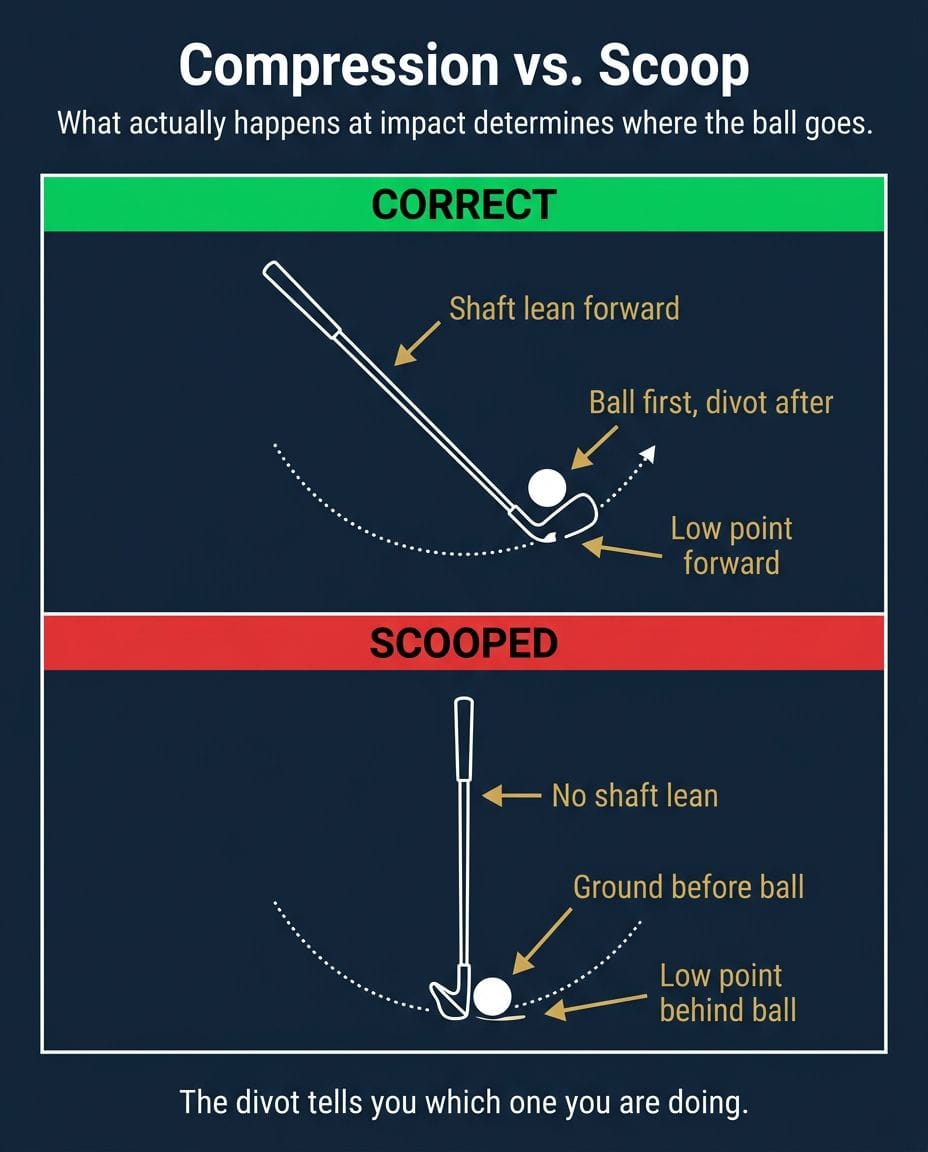
The physics requires two things to happen simultaneously: the clubface has to arrive at the ball before the turf (descending, not level or ascending), and the hands have to be ahead of the clubhead so the shaft is leaning forward rather than vertical or angled back. When both conditions are met, the loft is controlled, the strike is clean, and the ball comes off with consistent speed and spin.
Published launch-monitor data from TrackMan instruction research identifies the ideal angle of attack for a mid-iron (7-iron) as roughly -2 to -5 degrees, meaning the club is still moving downward at the moment of contact. Tour professionals hit mid-irons at a steeper angle than most recreational golfers, and that's the primary source of their distance and spin consistency, not a swing path difference most amateurs would recognize from watching.
These are the mechanical conditions that produce compression. They're sequential in terms of setup to impact, but they're all present at the moment the ball leaves the face.
1. Ball position: center to slightly forward
Place the ball in the center of your stance for short irons (9-iron, pitching wedge) and move it slightly forward, 1 to 2 inches (2.5 to 5cm) toward the lead foot, for mid-irons (6 through 8-iron). Long irons move slightly more forward still, roughly 2 to 3 inches (5 to 7.5cm) inside the lead heel for a 4 or 5-iron.
The reason the position differs by club is shaft length: a longer shaft requires a slightly shallower attack angle to catch the ball cleanly, and the forward position accommodates that. The hard limit in either direction: the ball should never sit so far back that a descending blow becomes impossible, and never so far forward that the club is already past its low point and moving upward when it arrives at impact.
A ball that's too far forward is one of the most consistent producers of a thin shot or a topped strike, because the golfer has to either reach to get there or let the arc bottom out early and catch the equator of the ball on the way up.
2. Forward shaft lean: hands ahead at impact
At the moment of impact, your hands should be slightly ahead of the ball, and the grip of the club should be ahead of the clubhead. This is forward shaft lean. You can pre-set a version of it at address (a slight forward press), but the critical point is that it's maintained through the ball, not given up in the final few inches of the downswing.
When the hands fall behind the ball at impact (the flip or scoop), the effective loft of the club increases sharply, the low point moves back, and the shot either goes fat or launches too high with too little spin. Five to 10 degrees of forward lean at impact is enough to produce a clean descending blow for most mid-iron shots. You don't need to look like you're delofting the 7-iron into a 5-iron; you need the hands to be leading, not following.
3. Weight on the lead side at impact
Lead-side weight (left side for right-handed golfers) at impact is what controls where the arc bottoms out. The lowest point of the swing arc follows the body's center of mass: if weight stays on the trail side through impact, the low point stays back, and the club hits the ground before the ball. Published instruction data puts the ideal weight distribution at impact at roughly 70 to 80 percent on the lead foot for a standard iron shot.
This doesn't require a dramatic lateral slide. A controlled weight shift that moves the pressure onto the lead side in the downswing is enough. The feel cue most published instruction sources use: at the finish of a well-struck iron, you should be balanced on the lead foot with the trail foot lifted onto its toe. Work backward from that finish position.
4. Low point forward of the ball
The four elements above produce this outcome together, but it's worth naming it explicitly because it's what you're actually trying to achieve. The swing arc's lowest point should occur 2 to 4 inches (5 to 10cm) in front of where the ball was. The divot starts there.
If you pull up after any iron shot and find the divot behind the ball, or no divot at all, the low point is too far back. If you find a divot that starts at or just in front of where the ball was, you've hit the target.
The most common compression failure is the flip or scoop: the hands slow down through impact, the right wrist (for right-handed golfers) uncocks prematurely, and the clubhead overtakes the grip before contact. The low point moves back. The effective loft skyrockets. The ball goes high and soft, or thin, or fat.
The flip happens because it works in a limited sense. It produces some height. It feels like it's helping the ball up. And it's the body's natural response to the instinct that a ball on the ground needs to be helped into the air. The problem is that the club's loft is already designed to produce height. Adding more loft through a scooping motion removes the compression, removes the spin control, and produces the weak, ballooning iron shots that characterize most recreational golfers' ball-striking.
The secondary cause is incorrect ball position. A ball placed too far forward in the stance forces the player to either reach to make contact or effectively turn a 7-iron into a driver setup, with the same ascending arc problem. Balls too far back create a different error: the club catches the ball correctly but the steep angle produces fat shots when the turf resistance is higher than expected.
Published instruction data consistently identifies weight distribution as the fastest leverage point: golfers who can't maintain lead-side pressure through impact will flip almost every time, regardless of what the hands are doing.
Draw a chalk line or lay an alignment stick flat on the ground, perpendicular to your target line. Place the ball 1 inch (2.5cm) forward of the line. Hit iron shots and watch where the divot begins.
That's the complete diagnostic. In my read of the published correction research, external references like this line outlast feel-based instruction for most recreational golfers in terms of retention under round conditions, because the feedback is immediate and unambiguous rather than proprioceptive.
Repeat this drill with 20 to 30 balls per session until the pattern of divots is consistently starting at or after the line. Track the drill, not just the feel.
Place a folded towel on the ground 3 to 4 inches (7.5 to 10cm) behind the ball. Hit iron shots without touching the towel.
Any contact with the towel confirms the clubhead reached its low point before the ball. A clean miss of the towel followed by a divot at or in front of the ball confirms the correct arc. The towel provides a physical consequence that pure feel instruction doesn't, which accelerates the correction for most golfers.
Both drills work best when practiced at partial speed first (50 to 75 percent swing), then built up to full speed once the arc pattern is reliable. Trying to groove a new low-point location at full speed before the pattern is established slows the learning.
Practice tool
A dedicated impact board reinforces the low-point correction with strike feedback after every rep, which is more precise than the towel or line drills for golfers who want to build speed into the movement. The Divot Board is widely used among published short-game instructors.
If you're also looking at which irons make this kind of ball-striking easier to develop: Best Game-Improvement Irons for High Handicappers (2026)
Better iron contact is a scoring lever. It's not the only one.
Published data on what drives scores for 90-to-110 handicappers consistently shows that ball-striking accounts for a smaller share of scoring improvement than most golfers expect. Short-game decisions, lag putting, and course management choices made before impact carry equal or greater weight at this level.
How to Break 100 With the Swing You Already Have works through the complete framework.
Compressing the golf ball means creating a descending angle of attack so the clubface contacts the ball before the turf, momentarily flattening the ball against the face before it springs forward. The four factors that produce it are ball position (center to slightly forward), forward shaft lean (hands ahead at impact), weight on the lead side, and a swing arc that bottoms out forward of the ball. When all four are present, you'll hear a different sound at impact and see a more consistent divot pattern.
Forward shaft lean means the grip of the club is ahead of the clubhead at impact. A neutral or backward shaft angle adds effective loft to the club and promotes a scooping motion. Forward lean delofts the club and drives the leading edge downward into the ball before the turf. Published launch-monitor research identifies it as one of the most reliable compression predictors in amateur iron play. You don't need a dramatic lean: 5 to 10 degrees is enough for a standard mid-iron to produce a clean descending blow.
Fat shots happen when the club's low point arrives behind the ball instead of in front of it. The most common cause is weight staying on the trail side through impact, which moves the arc's lowest point backward so the clubhead contacts the turf before the ball. Secondary causes are a ball positioned too far forward in the stance and a scooping motion that drops the right wrist (for right-handed golfers) through impact. The line-on-ground drill gives you the fastest diagnostic: mark where the ball was with a tee after each shot and check where the divot starts. If the divot starts behind the tee, the low-point error is confirmed.
The divot tells you. After each iron shot, look at where the divot starts relative to where the ball was sitting. A divot that starts at or just forward of the ball position confirms the correct low point. A divot that starts behind the ball confirms a low-point error. For a more structured test, draw a chalk line perpendicular to your target line, set the ball just forward of it, and practice making every divot start at or after the line. Clean, consistent divots forward of the line mean you're compressing. No device needed.
Yes, progressively. Short irons (9-iron, pitching wedge) sit closest to center in the stance; mid and long irons move slightly forward as shaft length increases. A practical starting reference: place a 7-iron ball 2 to 3 inches (5 to 7.5cm) inside the lead heel, then move shorter irons slightly toward center and longer irons slightly forward from there. The underlying rule doesn't change: the ball should never sit so far forward that a descending blow is geometrically impossible, and never so far back that the attack angle becomes excessively steep.
Some links in this article are affiliate links. If you buy through them, I earn a small commission at no extra cost to you. This never influences what I cover or recommend. I link to gear I'd buy myself.
Data-backed reviews and advice that works. No brand spin.