Round 1 at Shinnecock Hills is suspended, with fog halting play for about two hours and the late wave still on the course. Amateur Ryder Cowan holds the provisional lead at -3 through eight holes, ahead of seven players at -2, most still mid-round. Rory McIlroy's 69 (-1) is the marquee completed round. The full picture takes shape Friday morning.
- Round 1 at Shinnecock is suspended: amateur Ryder Cowan is the provisional leader at -3 through eight holes, with seven players at -2 and most still mid-round. The final leaderboard takes shape Friday morning.
- Among completed rounds, McIlroy's 69 (-1), featuring his first US Open eagle since 2017, is the day's strongest finished score.
- Scheffler's Grand Slam bid absorbed a double bogey at the 8th (72, +2); Koepka (+3, 73) is chasing; defending champion Spaun is in immediate trouble at 77 (+7).
- Keith Mitchell produced the day's most dramatic split: out in 41, back in 29, for a 70 (E).
- Fog suspended play for about two hours; positions at the top remain provisional until outstanding groups complete their holes Friday morning.
How the course played
The pre-tournament case for accessible scoring at Shinnecock was built around a softer setup: fairways averaging 40-plus yards (37-plus meters) wide, greens running at 11 on the stimpmeter. Our 2026 US Open field and storylines preview laid out that thesis before Thursday's first tee shot.
What the data didn't account for was the wind. The afternoon wave played into sustained gusts of 20 to 35 mph (32 to 56km/h), turning a theoretically accessible layout into something closer to Shinnecock's historical character in major play. Only a handful of players from the completed groups managed sub-par totals. At a par-70 venue, that figure says more about conditions than it does about ability.
Fog compounded the day's complications. Play halted for approximately two hours, pushing late starters into diminishing time. Several groups hadn't finished their rounds when the day ended and will return to complete Round 1 before the second round begins Friday. The leaderboard at the top remains provisional until those outstanding holes are played.
The Round 1 storylines
McIlroy's eagle and a 69
The headline completed score belongs to Rory McIlroy. He made his eagle during his round, his first in a US Open since 2017, and signed for a 69 (-1). A sub-70 opening round at Shinnecock in US Open conditions is rare; only two champions in five US Open editions at this course have finished the week under par. At -1, his is the strongest finished round of the day, though provisional leader Ryder Cowan sits at -3 through eight holes and the late wave hasn't yet come in.
Scheffler's double bogey at 8
Scottie Scheffler came to Shinnecock with the Grand Slam narrative intact. A double bogey at the 8th introduced the first visible crack: he signed for a 72 (+2). At a course where the 2018 championship was won at +1 over four rounds, a two-shot deficit after Round 1 doesn't leave much margin. Our pre-tournament preview had flagged a question about his iron play; Thursday's scorecard didn't answer it in the right direction.
Mitchell: 41 out, 29 back
Keith Mitchell produced the day's most extraordinary split. He turned at 41 on the front nine, came home in 29 on the back, and finished at 70 (E). A 12-shot swing between the two halves of a US Open round is the kind of number that sounds wrong when you say it aloud. The back nine 29 is the more remarkable half; Shinnecock's inward nine doesn't typically yield that kind of scoring at a US Open. Whatever Mitchell's leaderboard position looks like once the full Round 1 field is tallied, that back nine earned a second look.
Koepka at +3: keeping perspective
Brooks Koepka's 73 (+3) drew attention because of where it came: the course where he won the 2018 championship. The relevant figure is that Koepka's 2018 title came at a final total of +1, not at any number below par. A first-round 73 at a venue where the winning total last time was +1 over four rounds is a real deficit. Koepka withdrew from the RBC Canadian Open in early June with hand and grip numbness; how that condition affects his long-iron striking under tournament load is the secondary question his round raised.
Spaun and Kim
Defending champion J.J. Spaun's title defense is in immediate trouble: a 77 (+7) is the kind of first-round number that demands a near-perfect recovery over 54 holes at one of the game's most unforgiving venues. Tom Kim opened at 70 (E), level par. Kim came in as a consensus value pick among pre-tournament analysts; a 70 at a difficult Shinnecock setup is a steady start, but it isn't the separation from the field a value pick needs in a major.
What to watch
The immediate question is where Ryder Cowan's -3 and the seven-player cluster at -2 settle when they complete their holes Friday morning. Most of that group is mid-round and positions are genuinely provisional. Once the late wave finishes, the leaderboard will clarify whether McIlroy's 69 (-1) is a competitive position or a mid-pack result on a morning that could be scored under more aggressively than the afternoon suggested.
Scheffler at +2 needs a second-round move. At a par-70 venue where the winning total in 2018 was +1 over four rounds, a two-shot deficit after Round 1 doesn't dissolve passively. The double bogey at the 8th was exactly the kind of error Shinnecock administers for: at a course where the field clusters near par, avoidable mistakes compound. His iron play heading into Friday is the variable that determines whether the Grand Slam bid stays viable or shifts into longer-shot territory.
Mitchell's back nine gives the outstanding groups a number to aim at on the inward half. A 29 at Shinnecock suggests that even under difficult conditions, the back nine can be scored under. Whether that template holds for other players Friday, and whether Mitchell can build on it in Round 2, is the secondary storyline I'm most curious to see play out.
Frequently Asked Questions
Who is leading the 2026 US Open after Round 1?
Amateur Ryder Cowan is the provisional leader at -3 through eight holes, with seven players at -2 and most of that group still mid-round when play was suspended. Among players who completed their rounds, Rory McIlroy's 69 (-1) is the strongest finished score. Round 1 positions won't be final until outstanding groups complete their holes Friday morning.
Why was there a fog delay at the 2026 US Open?
Fog delays aren't unusual at Shinnecock given its coastal location on Long Island, New York. Thursday's suspension of approximately two hours pushed late starters' finishing times beyond the available daylight, and those groups will complete Round 1 Friday morning before the second round begins.
Did Rory McIlroy eagle in Round 1 of the 2026 US Open?
Yes. McIlroy made an eagle during his opening round, his first US Open eagle since 2017. He completed his round at 69 (-1), the strongest finished score among players who completed Round 1.
What did Scottie Scheffler shoot in Round 1 of the 2026 US Open?
Scheffler signed for a 72 (+2), with a double bogey at the 8th hole the key moment of his round. At a par-70 venue where the 2018 championship was won at +1 over four rounds, he's facing a deficit that requires an immediate response in Round 2.
What did Brooks Koepka shoot in Round 1 of the 2026 US Open?
Koepka opened with a 73 (+3). He won the 2018 US Open at Shinnecock Hills at a four-round total of +1, so his first-round 73 represents ground to make up at a course he knows well. Three shots back at a venue where par is the daily target leaves him with work to do over the remaining 54 holes.
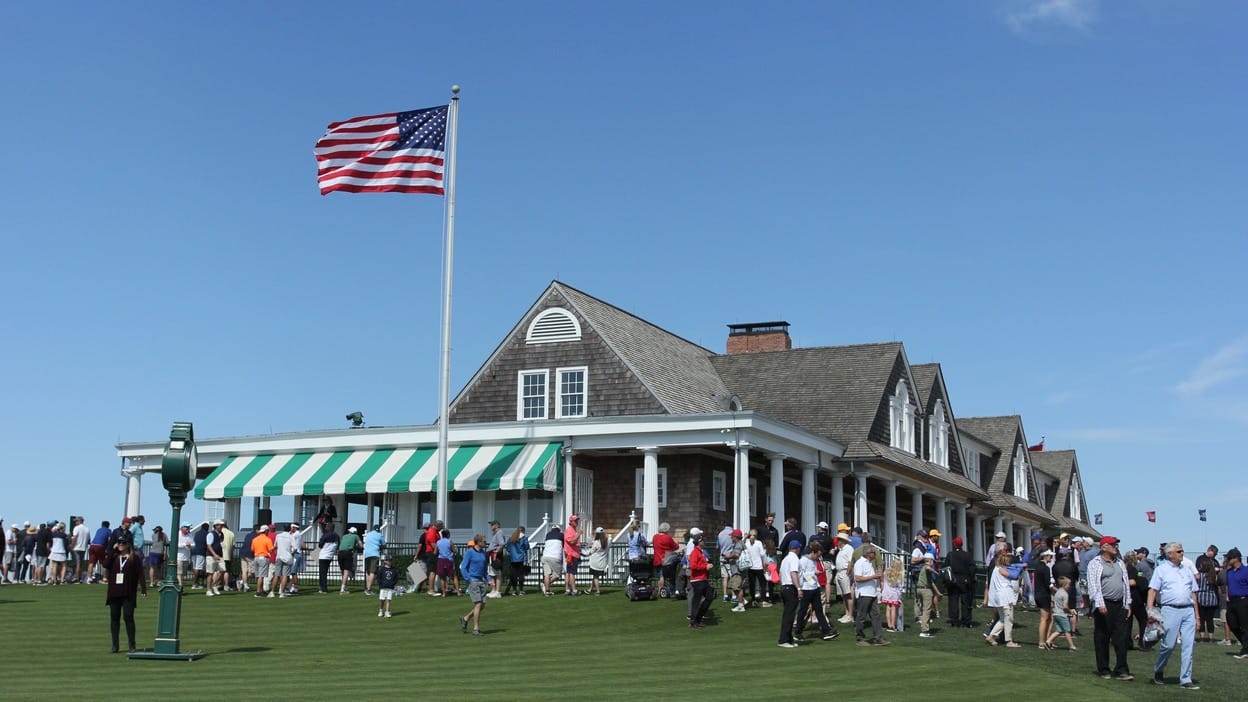
Shinnecock Hills Golf Club at the 2018 US Open. Peetlesnumber1, CC BY-SA 4.0, via Wikimedia Commons.