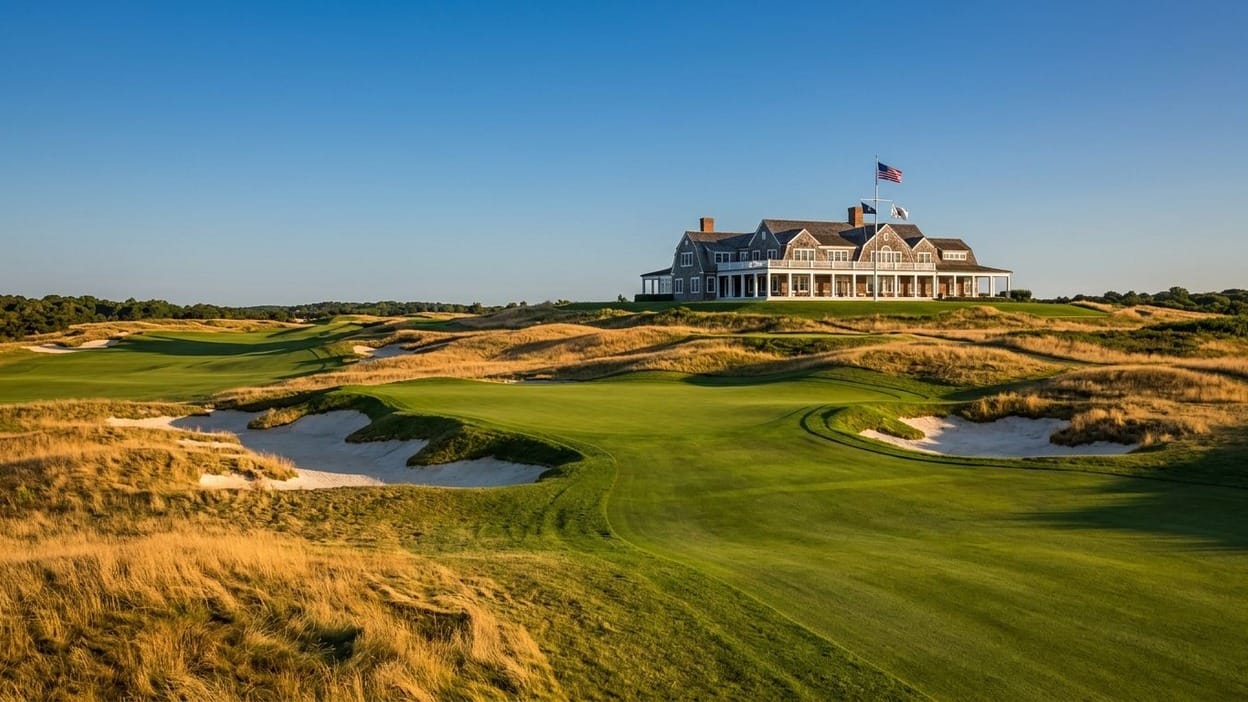
Shinnecock Hills returns as a US Open venue for the sixth time on June 18-21, and the course’s reputation among players and analysts is specific: this isn’t a course that rewards the boldest swing or the longest drive. It rewards the golfer who manages failure better than everyone else. Par 70, approximately 7,400 yards (6,767 m), designed by William Flynn on a triangular routing through the Southampton, New York, landscape. That routing is the central strategic fact of the week: unlike coastal links where a prevailing wind defines each day’s play, Shinnecock’s triangular layout means the wind hits from a different angle on every segment of the course. Golfers can’t read the forecast and pre-plan around it.
- 1.The 2026 US Open runs June 18-21 at Shinnecock Hills Golf Club in Southampton, New York. Par 70, approximately 7,400 yards (6,767 m). Coverage on NBC and Peacock.
- 2.USGA 2026 setup runs notably softer than Shinnecock’s punishing history: fairways averaging 40+ yards (37+m) wide (CBS Sports, Jun 2026) and greens measuring just above 11 on the stimpmeter, well below Oakmont 2025’s 15.5. R1 wind gusts to 33 mph (53km/h) can still bite. Expect a more accessible scoring window than the venue’s record of only two sub-par champions in five editions suggests.
- 3.Scottie Scheffler enters as the betting favorite (+490) chasing a career Grand Slam. The US Open is the only major he hasn’t won. His methodical course management is a strong fit for this venue.
- 4.Rory McIlroy (+950) arrives as reigning Masters champion but hasn’t won a US Open since 2011. In 2018 at this course, he missed the cut after shooting 80 in Round 1.
- 5.Koepka +2700-3300: only active player to win here (2018, +1). Playing confirmed for the US Open, but withdrew from the RBC Canadian Open (Jun 5-8) with a grip and hand numbness issue (ESPN, Jun 2026); undergoing medical treatment. Physical readiness is the open question.
The course: what Shinnecock asks of its winners
The historical scoring record answers the question plainly. Across five previous US Open championships at Shinnecock Hills, only two players finished under par: Retief Goosen at -4 in 2004 and Ray Floyd at -1 in 1986. Corey Pavin won in 1995 at even par. Brooks Koepka won in 2018 at +1. Winning here isn’t about accumulating birdies. It’s about limiting damage.
The 2004 championship is the instructive case. Goosen’s -4 winning total looks anomalous against the pattern until you account for the USGA’s intervention: conditions heading into the final round were severe enough that USGA officials moved the 7th pin to its most benign position and had crews water the 7th and several other greens between groups, the first time water had been applied to greens mid-competition in US Open history. Without that adjustment, the winning total would have been materially higher. The venue is capable of conditions that make scoring objectively unmanageable, and the USGA has returned to Shinnecock partly because of that capacity.
The conditions that define the course: firm and fast, balls rolling well past landing spots, fescue rough that makes recovery the primary objective after a missed fairway, and wind that rotates direction throughout the round rather than holding a constant bearing. Shinnecock rewards shot positioning and punishes impatience after bad breaks. Power is present in every Shinnecock champion but isn’t the differentiating factor.
The 2026 USGA setup is a deliberate departure from that pattern. CBS Sports reported in June 2026 that fairways average more than 40 yards (37m) wide across the layout, described as the widest in US Open history. Greens are measuring just above 11 on the stimpmeter, a significant reduction from the 15.5 readings at Oakmont in 2025 and well below what previous Shinnecock setups have produced. The USGA has dialed back the difficulty after sustained criticism of extreme greens speeds at recent championships. Wind and rough remain, and Thursday’s R1 forecast brings traditional Shinnecock conditions back into the equation. But the scoring floor is materially lower in 2026 than at any prior championship at this venue. The at-or-over-par framing that applied to four previous editions here needs revision this year.
Scottie Scheffler and the career Grand Slam
Scheffler is the betting field’s answer to who wins this tournament: approximately +490. He’s won three of the four majors. The US Open is the only one that’s missing.
The course-fit argument is straightforward. Scheffler’s game is built around decision-making that prioritizes position over aggression: he consistently ranks among the best in driving accuracy and approach proximity, and his course management is the quality most cited by those who analyze his play. Shinnecock rewards that profile specifically on approach shots, where landing position determines whether the ball holds the green or feeds into an unplayable location.
The Fried Egg noted heading into the week that Scheffler’s iron play has been “average, by Scottie standards” in recent outings (The Fried Egg, Jun 2026), a relevant caveat at a venue where precision from the fairway is the primary separator.
The complication in the narrative is a win drought since January 2026. Scheffler has been in contention across multiple events since then without converting. The broadcast will frame this as the central story through his first two rounds. It’s worth separating the narrative from the actual data: a win drought measured in months for a player at his caliber sits well within the statistical noise of a full PGA Tour season.
R4 falls on Sunday, June 21, which is both Father’s Day and Scheffler’s 30th birthday. If he’s in contention through the weekend, the broadcast storyline writes itself.
Rory McIlroy and 15 years
McIlroy won the US Open in 2011 at Congressional Country Club by eight strokes. He hasn’t come close since, and that gap is now 15 years.
He enters 2026 as the reigning Masters champion, which reframes the narrative entirely: instead of golf’s longest elite major drought, he’s a six-time major champion, with the 2026 Masters completing back-to-back titles. That’s a different position than Scheffler’s, who’s still chasing his first US Open. The history at this specific venue is what still works against him.
In 2018, on this course, McIlroy shot 80 in Round 1 and missed the cut. He didn’t contend at Shinnecock Hills. That’s the single most relevant data point for building an analytical case for his week, and it complicates the narrative significantly.
His game is built on distance leverage: the ability to attack approach shots from positions shorter hitters can’t access. That advantage is partially neutralized at Shinnecock. The fescue rough penalizes missed fairways more for longer hitters because the ball travels further into trouble. And the patient game Shinnecock demands runs counter to McIlroy’s natural aggression under pressure. His odds around +950 reflect genuine two-way uncertainty: the skill level is unquestionable, the course history and stylistic fit are genuine concerns.
The course specialists: Koepka and Fleetwood
Brooks Koepka won the 2018 US Open at Shinnecock Hills at +1 over par, with Tommy Fleetwood one shot behind. He’s the only active player in the 2026 field who has won at this venue.
Koepka has five major championships. His methodology at major setups is well-documented across enough examples to constitute a pattern: he manages his game to avoid large numbers, accepts bogeys as the cost of business at demanding setups, and executes on limited scoring opportunities when they appear. That profile fits Shinnecock specifically. His odds around +2700-3300 reflect uncertainty about his current form level, not about his course fit.
One significant caveat this week: Koepka withdrew from the RBC Canadian Open (June 5-8) citing grip and hand numbness, per ESPN. Golf Channel confirmed he intends to play the US Open while receiving medical treatment. His record of competing through injury in majors is well established, but his physical readiness entering Thursday is the variable his odds range (+2700 to +3300) may not fully reflect.
Fleetwood’s 2018 second-place finish at Shinnecock is worth reading beyond its leaderboard position. His game suits firm, windy, links-adjacent conditions: ball-striking precision and wind-reading under pressure are the qualities that separate his best weeks. Those are also Shinnecock’s requirements. His 63 in the third round of the 2018 US Open tied the all-time US Open single-round scoring record, previously shared by Johnny Miller (1973), Jack Nicklaus and Tom Weiskopf (1980), Vijay Singh (2003), and Justin Thomas (2017). His +2200 odds reflect the market’s rational skepticism about converting finishes into wins, but his course history and stylistic fit are genuine rather than constructed.
Fleetwood posted a T11 at the RBC Canadian Open (June 5-8), a useful recent data point heading into a course where he has already demonstrated he belongs.
Matthew Fitzpatrick finished runner-up at the RBC Canadian Open (June 5-8, Golf Channel), one of the stronger lead-in form lines in the field entering this week.
What to watch
Conditions forecast: Thursday is the most testing day of the week, with winds 8-22 mph (13-35km/h), gusts to 33 mph (53km/h), and a 40% chance of rain, predominantly from the SSW (Golf Channel/AccuWeather, Jun 2026). The Flynn routing means wind hits a different angle on each segment of the course; a SSW direction is among the more disruptive for the outward nine. Conditions ease through the weekend. Sunday R4 is forecast in the mid-70s°F (low-to-mid 20s°C).
USGA setup on Thursday morning. The setup decisions on opening day tell you more about the week’s potential scoring range than practice round reports do. If pins are placed in the most exposed locations on firm surfaces with wind up, the field will play over par from the start. Watch the Thursday scoring average, not the Thursday leader.
Wind sequencing within rounds. Shinnecock’s triangular routing means a player going out in benign conditions can come home in significantly harder ones, or vice versa. Tee time luck matters more here than at most venues. Early-round scoring sequencing is worth tracking rather than waiting for the end-of-day leader board.
Whether anyone reaches even par by the weekend. The historical data says par is a strong result here. A leader board sitting at +3 to +6 after two rounds is Shinnecock operating normally. If someone is at -4 after Round 2, the USGA may respond, as it did on Sunday in 2004.
Several names are absent from the field this week. Tiger Woods isn’t playing, continuing his recovery from a March car accident; his USGA exemptions have expired. Phil Mickelson sits out for the first time since 2017, and Sergio Garcia’s 25-consecutive US Open streak ends after missing final qualifying. Tony Finau and Max Homa also didn’t qualify (Golf Channel, Jun 2026).
Frequently Asked Questions
When and where is the 2026 US Open?
The 2026 US Open runs June 18-21 at Shinnecock Hills Golf Club in Southampton, New York. Coverage is on NBC and Peacock.
How has Shinnecock Hills played historically at the US Open?
Across five previous US Open championships at Shinnecock Hills, only two players finished under par: Retief Goosen (-4) in 2004 and Ray Floyd (-1) in 1986. Corey Pavin won in 1995 at even par; Brooks Koepka won in 2018 at +1. The 2004 edition is the notable exception: conditions heading into Sunday were severe enough that USGA officials moved the 7th pin to its most benign spot and had crews water multiple greens between groups, the first time water had been applied to greens mid-competition in US Open history. Expect the winning score to be at or above par.
Who are the players to watch at the 2026 US Open?
Scottie Scheffler enters as the market favorite at approximately +490, chasing the career Grand Slam. Rory McIlroy (+950) is the field’s most prominent storyline as reigning Masters champion seeking to end a 15-year US Open drought. Brooks Koepka (+2700-3300) is the only active player who has won at Shinnecock Hills. Tommy Fleetwood (+2200) finished solo second in 2018 and his game suits the course’s demands.