- 1.The SkyTrak+ ($1,995) and Garmin R50 ($4,999.99) solve the same problem differently: the SkyTrak+ needs an iPad or PC to run, the R50 has everything built in with a 10-inch touchscreen.
- 2.SkyTrak+ uses photometric technology better for outdoor use and portable setups. R50 uses radar, better in lower-ceiling rooms with no special balls needed for basic metrics.
- 3.R50 spin tracking indoors requires Garmin RCT golf balls (~$55/dozen). SkyTrak+ measures spin directly from any ball.
- 4.For a garage bay or sim room where you want zero computer hassle, the R50 is simpler. For flexibility across multiple devices and outdoor use, the SkyTrak+ wins.
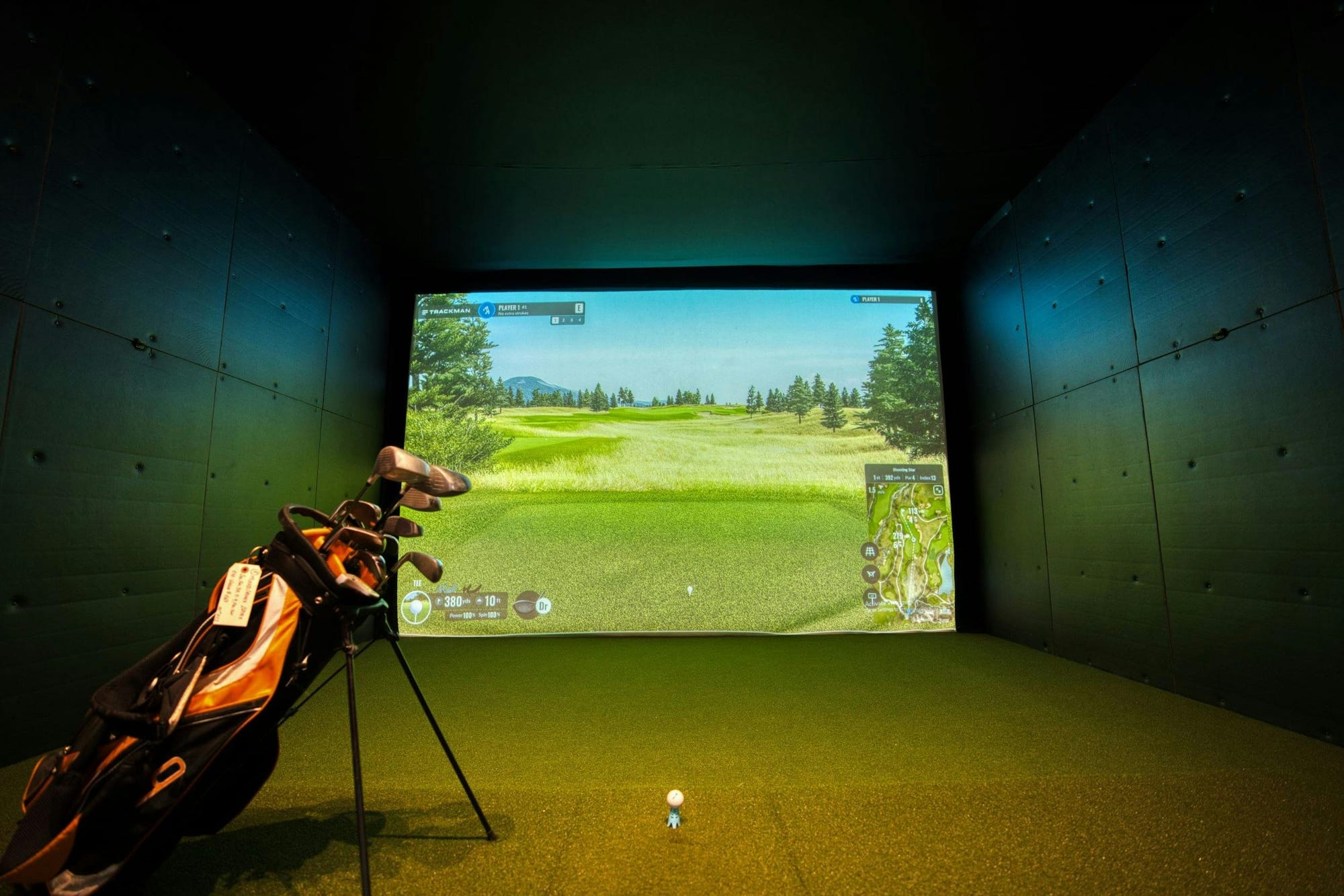
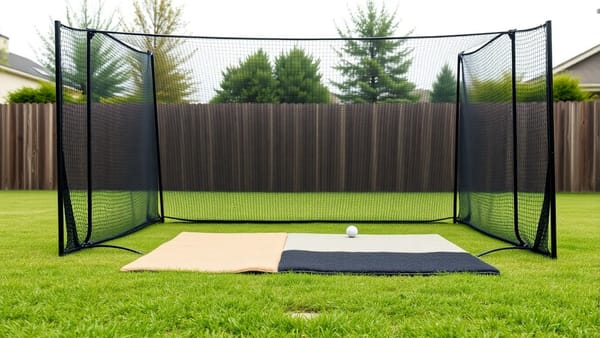
- 5.The $3,000 price gap funds a complete SkyTrak+ sim build with screen, enclosure, and mat.
Quick Picks
- Buy the SkyTrak+ if you want solid indoor ball data on a budget, you're comfortable using your phone or tablet as the interface, and you don't need outdoor capability. At $1,995 (on Amazon), it's the strongest value in the mid-range.
- Buy the Garmin R50 if you want a plug-and-play simulator that works without a phone, PC, or subscription. Its accuracy is within 4% of Trackman (Carl's Place, 2025) and matches the Foresight GC3 according to MyGolfSpy's 2025 Best Overall rating. Worth every dollar if your budget stretches to $5K.
- Skip the SkyTrak ST MAX ($2,995). Same accuracy as the SkyTrak+. The only extra is a Speed Training module most home golfers won't use. That's $1,000 for a niche feature.
- The Bushnell Launch Pro is discontinued (2025). If you're still seeing it in old comparison articles, cross it off your list.
- The right choice depends on one question: do you want a portable data tool, or a self-contained home simulator?
The Core Difference: Standalone vs. Device-Dependent
Most comparison articles bury this under spec tables, but it's the thing that actually determines which one you should buy.
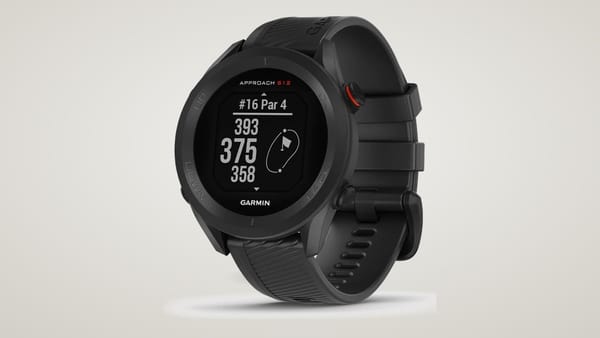
The Garmin R50 has a built-in 10-inch touchscreen running Garmin's Home Tee Hero software. You unbox it, set it on the floor, and you're hitting shots on virtual courses within minutes. No phone. No laptop. No app subscriptions to configure. It's a complete simulator in one unit.
The SkyTrak+ is a launch monitor. It captures ball data with dual Doppler radar and a photometric camera, then sends that data to your smartphone or tablet via the SkyTrak app. Without a connected device, it does nothing. You're also tethered to the SkyTrak software ecosystem, which means additional subscription costs if you want simulation features beyond basic practice mode.
For a lot of golfers, this distinction matters more than the accuracy numbers. If you want to walk into your garage, press a button, and play 18 holes, the R50 does that. The SkyTrak+ requires a workflow: find your tablet, open the app, connect via Bluetooth, load the software. It's not a dealbreaker, but it's a different experience.
Specs at a Glance
RCT (Radar Capture Technology) is Garmin's proprietary ball-tracking system that uses metallic-dot balls to capture spin rate via radar rather than calculating it. The R50 requires these RCT balls for accurate indoor spin measurement. These run about $50 per dozen. It's an ongoing cost, but the tradeoff is spin data captured by radar rather than calculated estimates.
Accuracy: What the Data Shows
This is where the R50 pulls away, and the data is consistent across multiple independent sources.
Garmin R50 accuracy benchmarks:
Carl's Place ran a controlled indoor test comparing the R50 against a Trackman unit. The average driver carry difference was 4.01% (Carl's Place, 2025). For context, that's the kind of variance most golfers wouldn't notice on the course.
Independent Golf Reviews found the R50's ball data was "almost [matched] GCQuad" (Independent Golf Reviews, 2025). The GCQuad is a $15,000+ unit used by PGA Tour fitters. Getting comparable numbers from a $5,000 consumer device changes the math for anyone who assumed they'd need five figures for tour-level data.
MyGolfSpy named the R50 their Best Overall personal launch monitor for 2025, noting that its indoor accuracy matched the Foresight GC3 (MyGolfSpy, 2025). The GC3 costs $7,500 and has been the accuracy benchmark in this price range for years.
SkyTrak+ accuracy:
The SkyTrak+ delivers reliable indoor ball data. Multiple reviewers (Breaking Eighty, Golfstead) confirm it's accurate enough for productive practice sessions and casual simulation, and its dual Doppler plus photometric approach gives it a wider hitting zone than the R50. That matters if your setup space is tight.
Where it falls short is spin measurement. Photometric spin measurement is a calculated spin estimate derived from sequential camera images, as opposed to direct radar or dot-capture measurement. The SkyTrak+ relies on this approach rather than capturing spin with radar. For most recreational golfers, the difference is marginal. But if you're serious about dialing in wedge distances or working on shot shaping, radar-captured spin is the better data.
The Price Gap: $3,000. Is It Justified?
Here's the honest answer: it depends on what you're buying it for.
The R50 is more capable by every measure. It's more accurate, it's standalone, it works outdoors, and it captures spin via radar. If you're building a dedicated home simulator space and you want the best data you can get under $5,000, the R50 is the better product. That's not a close call.
But "better product" and "right product" aren't the same thing.
A golfer who wants to practice at home a few times a week, track ball speed and launch angle, and play some simulated rounds on a tablet doesn't need the R50's capabilities. The SkyTrak+ handles that use case well, and the $3,000 you save could go toward a quality impact screen, a hitting mat, and a projector setup. All-in, you could have a functional simulator room for around the same money as the R50 unit alone.
The R50 makes the most sense when you value standalone operation, outdoor portability, or accuracy that approaches what a professional fitter uses. The SkyTrak+ makes the most sense when you want good-enough data at a price that leaves room in the budget for the rest of your setup.
No. Not for most people.
The SkyTrak ST MAX costs $2,995, which is $1,000 more than the SkyTrak+. Every reviewer consensus (Breaking Eighty, Simulator Golf Pro) confirms the accuracy is identical between the two models. The only differentiator is the ST MAX's exclusive Speed Training module, which provides specific metrics and drills for increasing clubhead speed.
If you're working with a swing coach on speed training, that module has value. For the other 95% of home golfers, you're paying $1,000 for a feature you'll try once and forget about. Put that money toward your enclosure setup instead.
At $2,995, the ST MAX sits in an awkward price bracket too. You're only $2,000 below the R50, which is a far more capable unit in every measurable way. Too expensive to be the budget pick, not capable enough to compete with the R50.
Who Should Buy the SkyTrak+
The SkyTrak+ is the right call if you fit most of these:
- Your budget is $2,000 to $3,000 for the launch monitor, with separate budget for enclosure and screen
- You already own a tablet or smartphone you're happy to use as your interface
- Your primary use is indoor practice and casual simulation
- You don't need to take the unit to the range or the course
- You want the widest possible hitting zone (helpful in tighter garage setups)
- You're comfortable with a subscription-based software model for simulation features
- You want to pair with third-party simulator software like GSPro, E6 Connect, or TGC 2019
The SkyTrak+ paired with GSPro on a decent laptop is one of the most cost-effective simulator setups you can build. If you're leaning this direction, sort out your room dimensions and enclosure plan before you commit to any hardware.
Who Should Buy the R50
The Garmin R50 makes sense if:
- Your budget can handle $5,000 for the unit, separate from your enclosure costs
- You want a plug-and-play experience with zero device dependency
- Accuracy is a priority, particularly for wedge work and short game practice where spin data matters
- You want to use the same unit outdoors at the range or on the course
- You prefer owned software (Home Tee Hero) over monthly subscriptions
- You value the peace of mind that comes with a MyGolfSpy Best Overall rating and data that matches a $15,000 GCQuad
I've said it before and the data keeps backing it up: the R50 is the best mid-range value in the launch monitor market right now. Standalone operation, accuracy that holds up against units three times its price, and no mandatory subscriptions. If you can afford it, it's the one to get. I dig into the accuracy numbers further in my R50 review.
What About the SkyTrak+ Bundle Discount?
The SkyTrak+ bundle is available on Amazon. At this price point it is the strongest value in the mid-range launch monitor category.
Common Room Setups
Both units work in a standard garage or basement simulator setup, but the requirements differ.
SkyTrak+ setup: The SkyTrak+ sits on the floor to the right of the ball (for right-handed golfers). It needs about 5 feet (1.5m) of clearance behind the hitting position. The wider hitting zone is forgiving if your mat placement isn't dead-center. You'll need your tablet or phone mounted somewhere visible, a Wi-Fi connection for the app, and a projector or screen if you want full simulation visuals. Total room requirement: 10 feet (3.0m) wide by 16 to 18 feet (4.9 to 5.5m) deep, with 9 to 10 feet (2.7 to 3.0m) of ceiling height.
Garmin R50 setup: The R50 sits behind and to the right of the golfer. It needs a clear line of sight to the ball and the impact screen. The built-in 10-inch touchscreen means you don't need a separate display for data, but most sim golfers will still want a projector for course visuals. Because the R50 works outdoors too, you can move it between your indoor setup and the range without recalibrating. Room requirements are similar to the SkyTrak+: 10 feet (3.0m) wide, 16 to 18 feet (4.9 to 5.5m) deep, 9 to 10 feet (2.7 to 3.0m) ceiling.
I've got a full breakdown of room dimensions, electrical, and enclosure options if you want the full picture before measuring your garage.
Ready to Buy?
SkyTrak+: SkyTrak+ on Amazon
Garmin R50: Garmin R50 on Amazon
If you're still on the fence, answer one question: do you want a data tool that needs your phone, or a standalone simulator that works the moment you plug it in? Everything else follows from that.
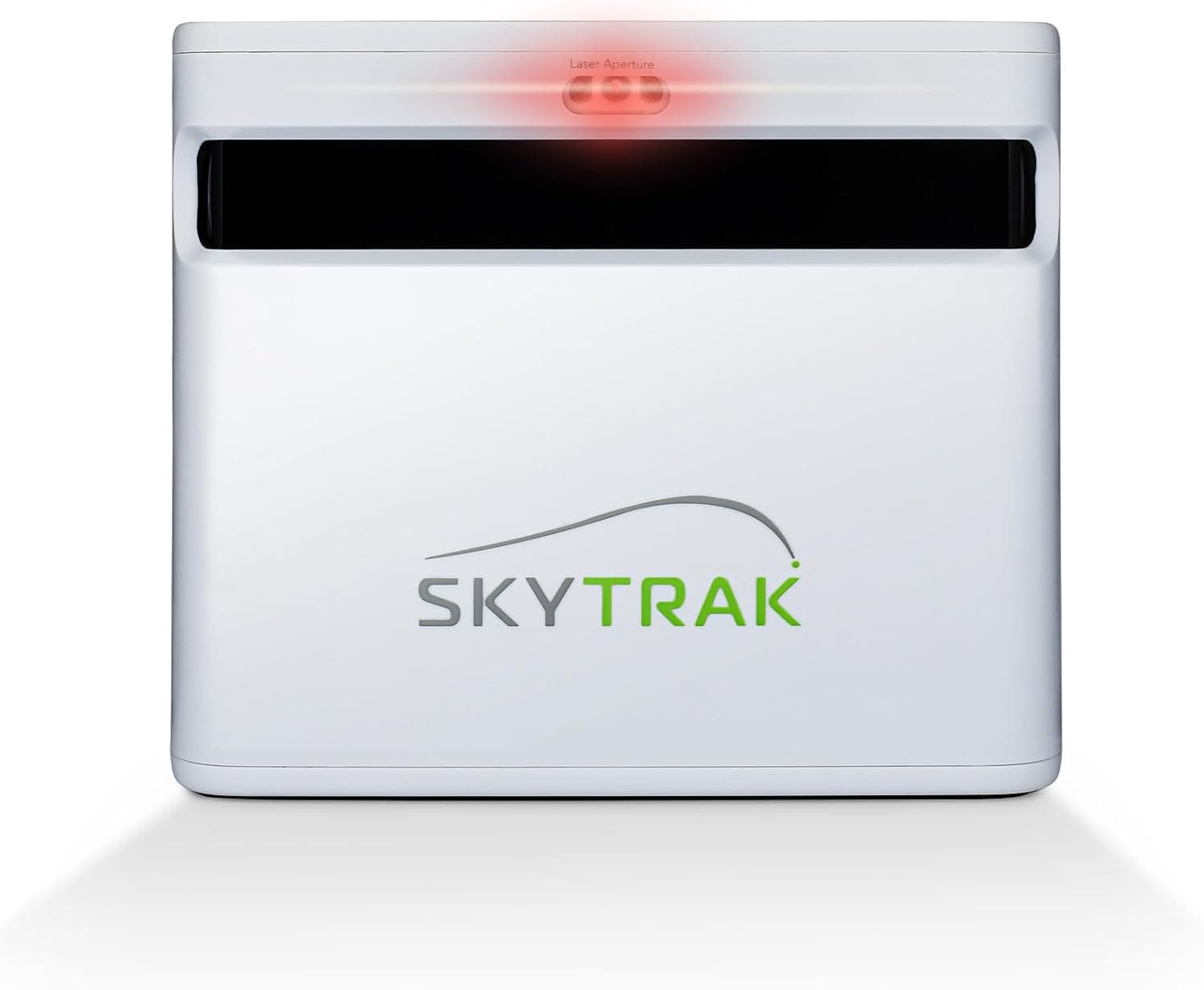
SkyTrak+ Launch Monitor (bundle)
Sold as a bundle with a rangefinder. Photometric launch monitor with dual-radar and camera fusion. Measures spin directly from any ball. iPad/PC required. Works outdoors. $1,995 plus software subscription.
Check Price on Amazon
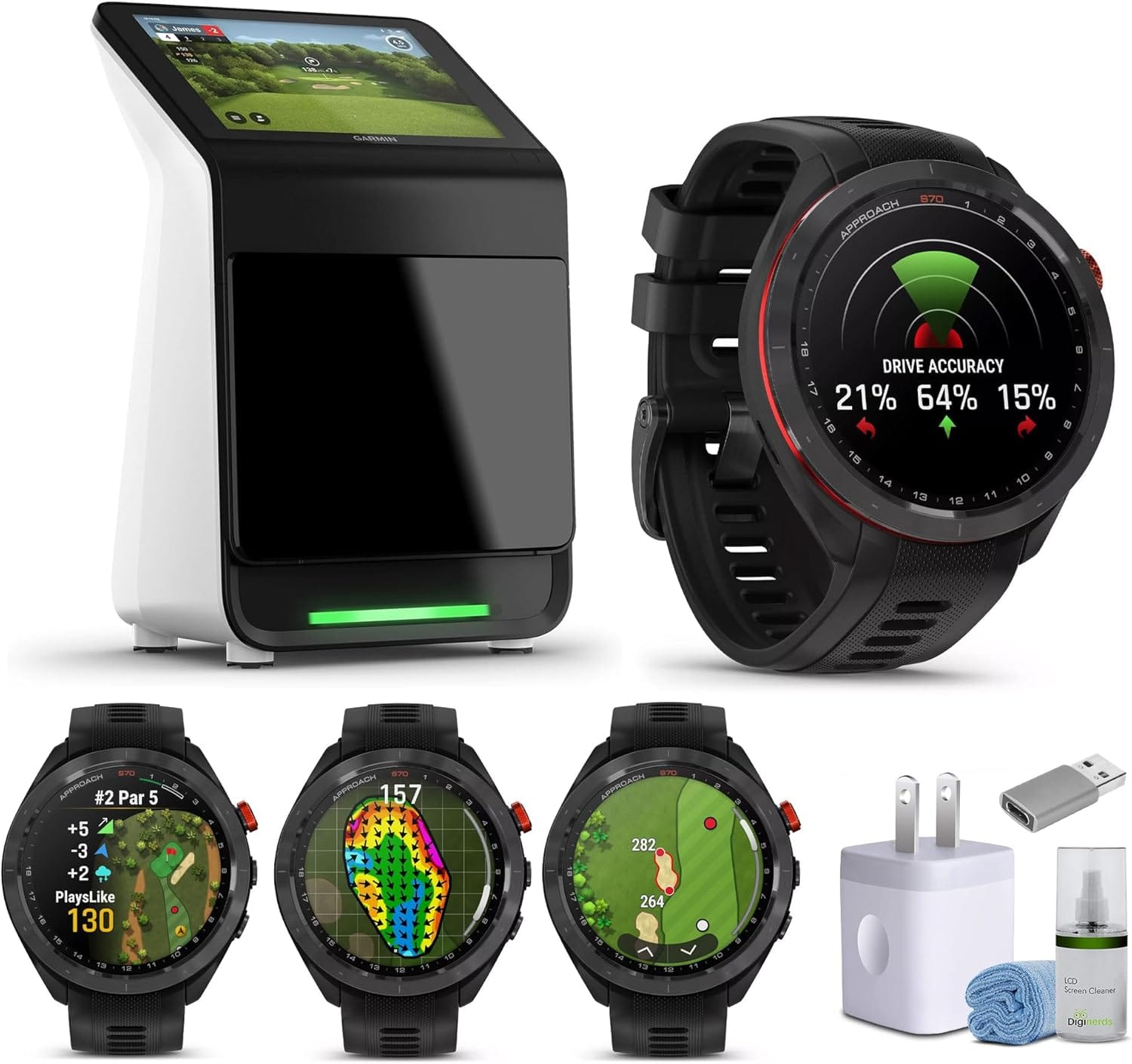
Garmin Approach R50
Radar-based all-in-one simulator with built-in 10-inch touchscreen and 42,000+ courses via Home Tee Hero. No PC or subscription needed. Spin tracking indoors requires RCT balls. $4,999.99.
Check Price on Amazon
Building or buying a home golf simulator? I put the research most buyers do the hard way into one place. The Home Golf Simulator Handbook walks through picking the right launch monitor, fitting the setup to your actual space, and building a practice plan that pays off, without the brand loyalties or affiliate pressure that shape most buying advice.
Frequently Asked Questions
Is the SkyTrak ST MAX worth $1,000 more than the SkyTrak+?
No. The SkyTrak+ and ST MAX deliver identical accuracy according to every independent review (Breaking Eighty, Simulator Golf Pro). The only difference is the ST MAX's Speed Training module, which provides drills and metrics for increasing clubhead speed. Unless you're on a structured speed training program with a coach, that $1,000 premium buys a feature you'll try once and forget about. Put the savings toward your enclosure or a better hitting mat.
Does the Garmin R50 match the accuracy of units costing $15,000+?
The data says yes, within a narrow margin. Independent Golf Reviews (2025) found the R50's ball data was "almost [matched] GCQuad," a $15,000+ unit used by PGA Tour club fitters. MyGolfSpy's 2025 testing confirmed its indoor accuracy matched the Foresight GC3 ($7,500). Carl's Place measured a 4.01% average driver carry difference versus Trackman. That's not identical, but it's close enough that the R50 produces useful, actionable data for practice, fitting, and course simulation.
Can I use the SkyTrak+ outdoors?
The SkyTrak+ is built for indoor use. It uses photometric camera technology alongside Doppler radar, and camera-based systems are sensitive to lighting conditions. You can use it outdoors in controlled conditions (overcast days, shaded areas), but it's not designed for bright, direct sunlight the way the radar-based R50 is. If outdoor range sessions are part of your plan, the R50 is the better choice.
What are RCT balls, and do I need them for the R50?
RCT stands for Radar Capture Technology. These are Garmin-specific golf balls with a metallic dot on the surface that allows the R50's radar to capture spin rate indoors. Without RCT balls, the R50 can still capture ball speed and launch angle indoors, but spin data won't be accurate. A dozen RCT balls costs about $50. For outdoor use, the R50 works with any standard golf ball. Think of it as an ongoing consumable cost, similar to buying range balls.
Is the Bushnell Launch Pro still worth considering at this price point?
The Bushnell Launch Pro was discontinued in 2025. If you're seeing it recommended in comparison articles, those articles are outdated. The Launch Pro was a rebranded Foresight GC3 and was a strong competitor when it was available, but you can no longer buy it new. The closest current alternative in that accuracy tier is the Garmin R50 itself, which MyGolfSpy rated as matching the GC3's indoor accuracy.
Some links in this article are affiliate links. If you buy through them, I earn a small commission at no extra cost to you. This never influences what I cover or recommend. I link to gear I'd buy myself.