 Buy now






articles
Golf Formats Explained
Stroke play, match play, Stableford, and scrambles: the scoring, handicap allowance, and strategy for each.
Blade, players-cavity, or game-improvement: the mechanism behind each iron design, the real tradeoffs, and the myth about ball-striking no iron head can fix.
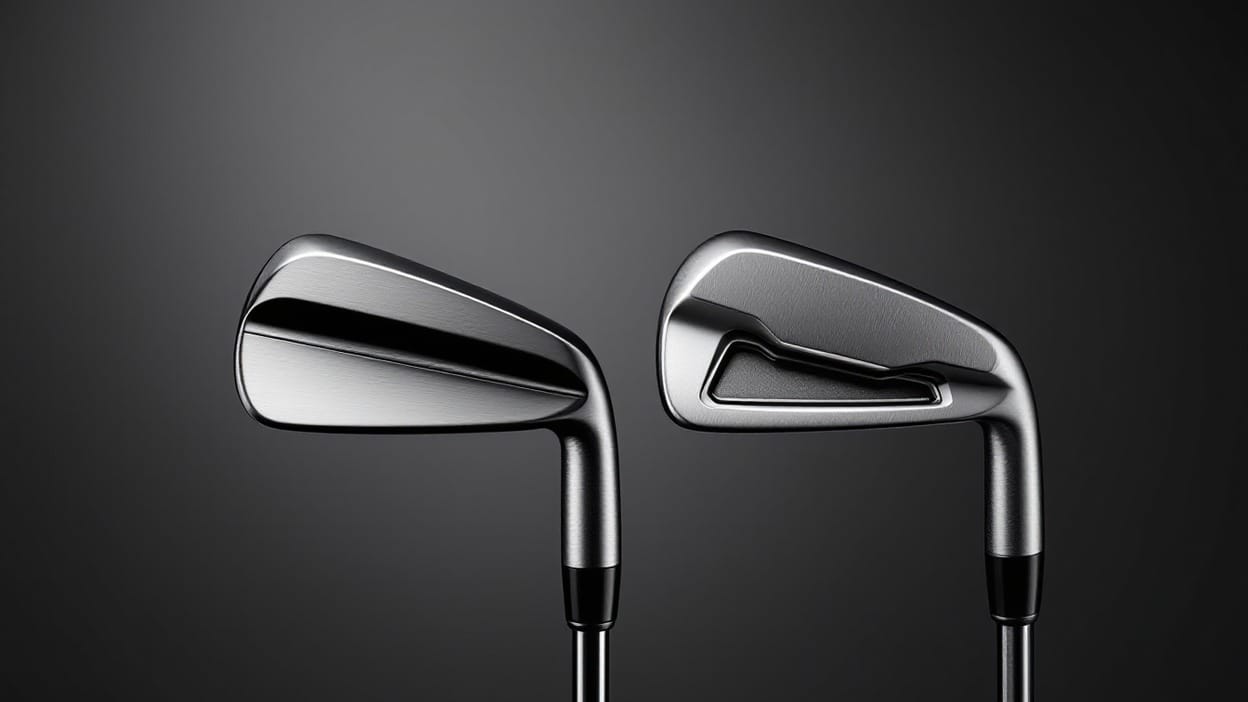
Iron shopping usually starts with a marketing term, not a swing profile. "Players iron," "game-improvement," "tour blade": the labels imply a hierarchy, better players at the top, higher handicaps at the bottom, when the real question is narrower and more mechanical. Where does the head put its mass, and what does that do to a mishit versus a flush strike? Answer that, and the blade-versus-cavity-back decision mostly answers itself.
A blade, also called a muscle-back, puts almost all of its mass directly behind a small hitting area. The topline is thin, the sole is narrow, and there's little to no offset between the leading edge and the hosel. That concentration of mass behind the center gives a skilled, centered striker maximum feedback and control over trajectory and shot shape. It also means a strike even a few grooves off center loses ball speed and distance fast, since there's no extra mass at the perimeter to bail out the miss.
A game-improvement iron does close to the opposite. Mass moves to the perimeter of the head, the sole widens, and offset increases. Spreading weight to the edges raises the head's moment of inertia, or MOI, which is the resistance to twisting when the strike misses the center. Higher MOI means a mishit keeps more ball speed and starts closer to the target line than the same miss would off a blade. That forgiveness comes at a cost to feel and, historically, to workability, since a wider, more perimeter-weighted head doesn't move through impact the same way a compact one does.
Players-cavity, or players-distance, irons sit between the two, and the category has moved further toward the game-improvement side of that line than it used to. A hollow, foam-injected body, the approach TaylorMade uses in the P790, lets a manufacturer build a head that looks compact enough to pass as a players iron at address while packing perimeter weighting and a flexible face inside a shell most golfers can't see. The result is a head that plays more forgiving than its shape suggests, without the sole width and offset that make a pure game-improvement iron look bulky in the bag.
Three variables move together whenever mass shifts inside an iron head: forgiveness, workability, and feel. None of them changes in isolation.
Forgiveness tracks directly with perimeter weighting, sole width, and offset. A blade's small sweet spot and centered mass punish mishits; a game-improvement iron's wide sole and perimeter weighting absorb them.
Workability used to belong to blades outright. A compact head, a thin topline, and low offset give a consistent striker more room to work the ball left or right or flight it lower into the wind, and clubfitters still document that edge for players who can find the center of the face reliably. But hollow-body players-distance irons have closed most of that gap. A player who wants shot-shaping control no longer has to accept a blade's mishit penalty to get it, which is why fitters increasingly steer even single-digit handicaps off pure blades unless feel and feedback are the explicit priority rather than a side effect.
Feel still separates cleanly. A forged blade transmits the most direct feedback at impact, for better and worse; you feel a flush strike and you feel a miss just as clearly. Game-improvement irons deliberately dampen that feedback in the pursuit of consistency, which is exactly what a less consistent ball-striker wants and exactly what a feel-first player finds numb.
Blade or muscle-back, roughly 0 to 5 handicap. This category rewards a repeatable strike more than it rewards a specific skill level, but in practice that combination is rare below a single-digit handicap. The Mizuno Pro 221 is the current reference point in this category, and GolfWRX's forum consensus keeps landing on it as the modern muscle-back that better players actually put in play rather than just admire in a case.
Mizuno Pro 221
Buy nowPlayers-cavity or players-distance, roughly 5 to 15 handicap. This is the largest band of golfers, and it's also where the hollow-body category has done the most to change the old advice. The TaylorMade P790 is MyGolfSpy's Most Wanted pick in the Player's Distance category, and its foam-injected hollow body is the clearest example of a head giving up almost nothing in looks while adding real forgiveness underneath.
TaylorMade P790
Buy nowGame-improvement or super game-improvement, 15-plus or inconsistent strikers. Handicap alone doesn't sort a golfer into this band; strike consistency does. A low single-digit player who still catches the ball all over the face belongs here as much as an 18-handicapper does. The Cleveland Launcher XL Halo is MyGolfSpy's Most Wanted winner in the Super Game Improvement category and is already this site's established pick in that space.
Cleveland Launcher XL Halo
Buy nowWhichever band you land in on paper, a fitting settles what strike-quality guesswork can't. The iron-fitting piece goes deeper on why shaft choice inside any of these three head categories matters as much as the head decision itself.
| Attribute | Blade / muscle-back | Players-cavity / distance | Game-improvement |
|---|---|---|---|
| Mass placement | Concentrated behind a small hitting area | Hollow, foam-injected body with hidden perimeter weighting | Spread to the perimeter, wide sole |
| Forgiveness | Lowest; mishits lose speed fast | Meaningfully higher than it looks at address | Highest; built for off-center contact |
| Workability | Highest, if you find the center | Close to blade-level for most golfers | Lowest; built for consistency over shaping |
| Feel | Most direct feedback, good and bad | Blended: solid but not numb | Deliberately dampened |
| Best fit | Repeatable strikers, roughly 0 to 5 handicap | Roughly 5 to 15 handicap, the largest band | 15-plus or inconsistent contact at any handicap |
| Reference model | Mizuno Pro 221 | TaylorMade P790 | Cleveland Launcher XL Halo |
No, and the consensus among fitters and testers is consistent on this point. A blade doesn't teach a swing anything. It removes the forgiveness that was hiding a mishit, which makes the mishit visible and often makes the scorecard worse, not better. That visibility can be useful as a diagnostic tool for a golfer who's already a consistent ball-striker and wants sharper feedback on small strike-location misses, but it isn't a training method for golfers who miss the center by a wide margin. Buying a blade because a better player plays one gets the causation backward: the good player's swing let them choose a blade, the blade didn't build the swing. Category choice should follow how consistently you already find the center of the face, not the player you'd like to be.
Match the category to the strike pattern, not the ambition. If a launch monitor or a fitter's notes show a tight, repeatable pattern near the center of the face, a blade like the Mizuno Pro 221 rewards that with feel and workability a wider head can't match. If the pattern is good but not that tight, which is most golfers between 5 and 15, a players-distance iron like the P790 gives up little of that control while forgiving the misses a blade would punish. If contact is inconsistent at any handicap, a game-improvement iron like the Cleveland Launcher XL Halo is the honest choice, and I'd rather see a low-single-digit player admit that and pick up real dispersion than keep a blade in the bag for the way it looks over the ball.
None of these three categories fixes a swing. They only decide how visibly the swing you already have shows up on the scorecard. If the game-improvement route interests you and you want a closer look at a current option in that space, the Callaway Elyte X iron set review covers one from a different manufacturer worth weighing against the Launcher XL Halo.
Some links in this article are affiliate links. If you buy through them, I earn a small commission at no extra cost to you. This never influences what I cover or recommend. I link to gear I'd buy myself.
Data-backed reviews and advice that works. No brand spin.