Best At-Home Golf Fitness Equipment 2026
Five pieces of home equipment, backed by published research, that build golf-specific strength and distance without a gym membership.
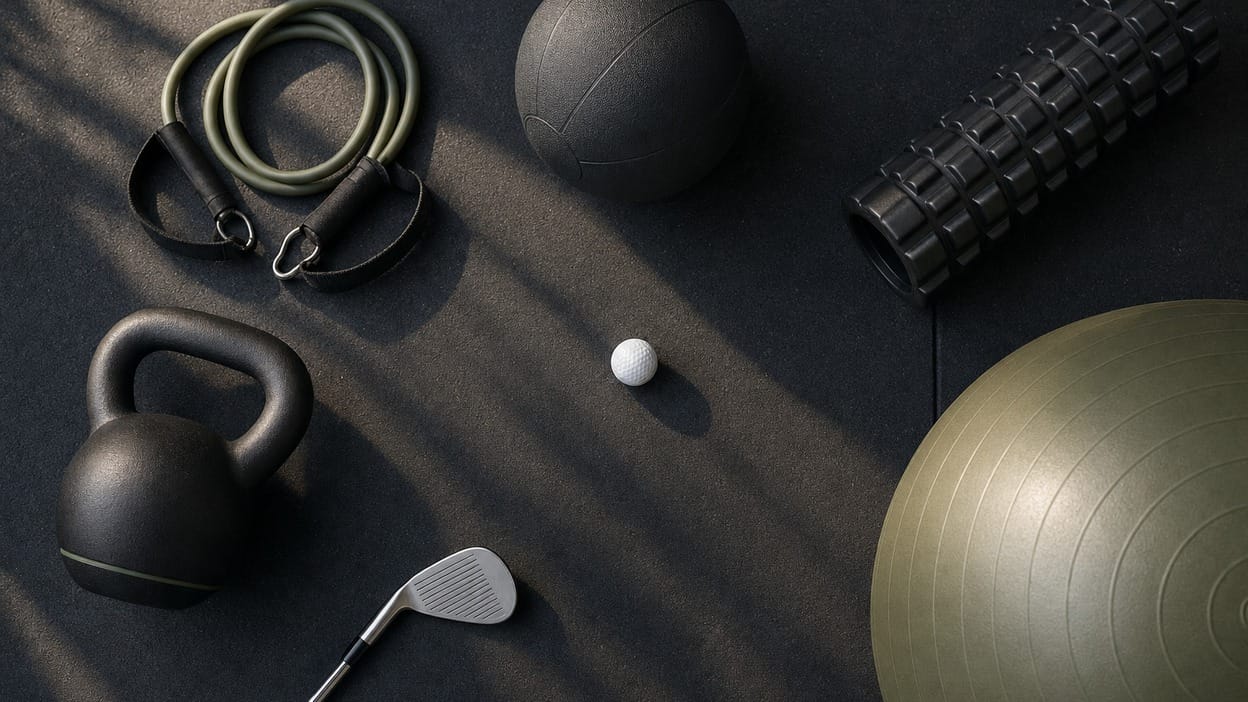
Five pieces of equipment turn a living room or garage into everything most golfers need for golf-specific strength: resistance bands, a medicine ball, a foam roller, a kettlebell, and a stability ball. None of them need a gym membership, and together they cover activation, rotational power, mobility, and posterior-chain strength.
- No gym required: all five picks fit in a closet and cover activation, power, mobility, and strength without a membership or a home-gym buildout.
- Research-backed, not marketing-backed: published studies link trunk rotational strength to clubhead speed, which is the throughline connecting every pick below.
- Different from a swing trainer: this list is strength and conditioning gear, not tempo or overspeed devices like Orange Whip or SuperSpeed.
- Scales with the season: pair this equipment with the no-equipment bodyweight routine for full-year coverage, gym-free.
- Entry-level pricing: every pick here is a modest one-time cost compared to a swing-trainer system or a gym membership.
Why golf-specific strength equipment is worth the closet space
Doan et al., publishing in the Journal of Strength and Conditioning Research in 2006, put Division I golfers through an 11-week strength, power, and flexibility program and measured a 1.6 percent increase in clubhead speed, which works out to roughly 5.4 yards (4.9m) of added carry distance from strength training alone. That's a real intervention result, not a correlation, and it's the clearest evidence that off-course strength work translates directly to on-course distance.
The supporting research points the same direction without overclaiming. A 2024 Sports Medicine meta-analysis by Brennan links explosive strength to clubhead speed across a wide range of studies, and a 2020 JSCR study by Oranchuk found golfers who completed an 8-week strength program posted significant clubhead speed gains compared to a control group that didn't train. None of this says strength training is the only path to more distance, but it's consistent enough that equipment built around trunk rotation, hip strength, and posterior-chain power earns a place in a golfer's routine.
There's a durability case too. A 2024 British Journal of Sports Medicine meta-analysis covering 9,221 golfers found a 73.5 percent lifetime injury prevalence among professionals and 56.6 percent among amateurs, with the lower back and the hand or wrist the most common sites. Strength and mobility work, done consistently, is one of the more direct ways to build resilience against exactly those injuries. And consistency is the part I'll admit I fall down on myself: it's much easier to spend an evening hitting balls into a net than to put in 10 unglamorous minutes with a resistance band, even though the band work is very plausibly what keeps a golfer swinging pain-free into their next decade.
What this guide leaves out, and why
This list is strength and conditioning equipment, not swing-mechanics gear. Devices like the Orange Whip, SuperSpeed's overspeed sticks, or a putting trainer solve a different problem: tempo, sequencing, and technique feedback rather than the underlying strength that a swing runs on. The training aids guide covers that category in depth. If a swing feels technically sound but short on power, or the goal is protecting a back that already logs a lot of range time, the equipment below is the more direct fix.
This list also skips the routine itself. For a no-cost starting point using nothing but bodyweight, the no-equipment strength and stability article covers the same three-pillar approach (anti-rotation core work, hip and glute strength, rotational power) without needing to buy anything. The five picks here are what to add once bodyweight work stops being enough resistance, or once a golfer wants to layer in the specific tools below.
Resistance bands: the fastest way to warm up correctly
The Fit Simplify Resistance Loop Bands come as a set of five bands at different resistance levels, built for glute and hip activation before a round and light shoulder or rotator-cuff warm-up work. Loop bands are the lowest-barrier item on this list: they roll up small enough for a golf bag, need no setup, and target the same hip and glute muscle groups that anchor the trunk-rotation work behind the clubhead-speed research above. A 2-minute activation set before the first tee shot is a realistic habit in a way a full gym session isn't, which is a large part of why this is the easiest of the five picks to actually stick with.
Best for: a 5-minute pre-round activation routine or building the hip and glute strength that underpins a stable lead side through impact.
Medicine ball: building the rotational power that adds distance
An AmazonBasics Medicine Ball at 8 lb (3.6kg) is built for wood-chop and rotational-throw drills, the exercises that most directly train the explosive trunk rotation feeding clubhead speed. It's the piece of equipment on this list most directly tied to the Doan et al. distance numbers above, since rotational power output is exactly what that study's strength program targeted. An 8-pound ball is enough resistance for a wood-chop or a rotational slam without turning the drill into a strength-training session on its own, which keeps the movement fast and explosive rather than slow and grinding.
Best for: a golfer who has the mobility and stability basics down and wants to convert them into the rotational power that shows up as extra yards.
Foam roller: unlocking the hips and thoracic spine that limit turn
The TriggerPoint Grid 1.0 Foam Roller, 13 in (33cm) targets the hips and thoracic spine, the two areas that most commonly cap a golfer's rotational range before strength ever becomes the limiting factor. A tight hip or a stiff mid-back caps shoulder-hip separation (the X-Factor) no matter how strong the underlying muscles are, so mobility work here often unlocks gains that strength training alone can't. It's a fair question whether foam rolling belongs on a strength-equipment list at all, but the honest answer is that a strong golfer with a locked-up thoracic spine still turns less than a mobile one, so the roller earns its spot as a prerequisite rather than an afterthought.
Best for: a golfer whose backswing feels physically restricted rather than weak, or anyone adding a 5-minute mobility pass before or after a strength session.
Kettlebell: posterior-chain and rotational strength in one tool
The Bowflex SelectTech 840 Adjustable Kettlebell dials from 8 to 40 lb (3.6 to 18.1kg) in a single unit, which matters in a home gym where space for a full kettlebell rack usually isn't there. Kettlebell swings and rotational kettlebell work train the posterior chain (hamstrings, glutes, lower back) that anchors a golf swing's power source, and the adjustable range lets the load scale up as strength improves rather than requiring a second purchase. A golfer starting out has no reason to load anywhere near the 40-pound top end; the point of the adjustable design is that the same tool still has room to grow a year or two into a strength routine, long after a fixed-weight kettlebell would have been outgrown.
Best for: a golfer with limited space who wants one tool that scales from a beginner weight to genuinely challenging posterior-chain strength work.
Stability ball: core and balance work that doubles as office furniture
The Trideer Exercise Ball comes with a pump included and is built for core stability and balance training, the kind of low-impact work that reinforces the anti-rotation foundation covered in the no-equipment companion article. It also functions as an office chair, which is a practical way to sneak in core-activation time during a workday rather than treating it as one more scheduled session. Balance and anti-rotation drills done on an unstable surface ask the core to work harder than the same drills on solid ground, which is useful for a golfer who has the basic bodyweight core work down and wants a next step without adding load.
Best for: a golfer building core stability and balance without dedicated workout time, or looking for a low-impact addition to an existing routine.
How to combine these five without overcomplicating it
None of this requires a structured program to be useful. A realistic starting point is the resistance bands before every round for activation, since that's the lowest-effort habit and the one most likely to survive a busy week. From there, two or three short sessions a week rotating between the medicine ball for rotational power, the kettlebell for posterior-chain strength, and the foam roller plus stability ball for mobility and core work covers the same three pillars (anti-rotation stability, hip and glute strength, rotational power) the no-equipment companion article builds entirely around bodyweight. The equipment here doesn't replace that routine so much as add resistance to it once bodyweight work alone stops being enough of a challenge.
For a golfer who eventually outgrows this list and wants to layer in real gym equipment, the golf fitness exercises for distance piece covers that next step.
Picks by use case
- Warming up before a round: the resistance bands, for fast glute and hip activation.
- Adding distance through rotational power: the medicine ball, paired with the Doan et al. protocol's rotational focus.
- Unlocking a restricted backswing: the foam roller, for hip and thoracic mobility.
- Building strength in a small space: the adjustable kettlebell, for posterior-chain and rotational work in one tool.
- Protecting a lower back that logs a lot of range time: the stability ball, for the core and balance work tied to the injury-prevalence research above.
Do I actually need equipment, or is bodyweight training enough?
Bodyweight training covers real ground on its own, and the no-equipment companion article walks through a full anti-rotation, hip and glute, and rotational-power routine using nothing but bodyweight. Equipment adds resistance and specificity once bodyweight work stops providing enough of a training stimulus, which is why this list is a next step rather than a replacement for that starting point.
What's the single best piece to start with?
Resistance bands are the lowest-barrier starting point: low cost, no setup, and directly useful for the hip and glute activation that underpins the trunk-rotation work behind the distance research above. A golfer who wants to add one thing before adding five should start there.
How is this different from a swing trainer like SuperSpeed or Orange Whip?
Swing trainers work on tempo, sequencing, and technique feedback. This equipment builds the underlying strength, mobility, and stability a swing runs on. The training aids guide covers the swing-mechanics category in full; the five picks here are strength and conditioning tools, not swing feedback devices.
Does strength training actually add distance, or is that just marketing?
Published research supports it. An 11-week strength, power, and flexibility program in Division I golfers produced a measured 1.6 percent clubhead speed increase, and separate research links explosive strength and short-term strength programs to clubhead speed gains as well. It's not the only variable in distance, but it's a documented one.
How often should this equipment actually get used?
There's no single prescribed frequency here since the research pack behind this guide covers program-length studies rather than a weekly minimum, but a realistic pattern is bands before most rounds and two or three short strength or mobility sessions a week with the rest of the equipment. Consistency over months is what the underlying research is measuring, not any single session.
Some links in this article are affiliate links. If you buy through them, I earn a small commission at no extra cost to you. This never influences what I cover or recommend. I link to gear I'd buy myself.






The golf newsletter that cuts the hype
Data-backed reviews and advice that works. No brand spin.
Recommended products