No-Equipment Golf Strength: Stability First
A no-gym, no-gear strength routine that leads with anti-rotation stability, then hip/glute and rotational power, so any golfer can build swing consistency and speed at home.
Most golfers reach for a stretching routine when their swing feels short or their back complains after 18 holes, and stretching helps, but flexibility alone doesn't build the strength and stability that actually hold a swing together. A golfer with excellent flexibility and no core stability still loses power to compensation, and still wears down a lower back that has nothing to brace against. The exercises below don't require a gym membership or a rack of equipment: bodyweight and, where noted, a resistance band are all that's needed, which matters because most golfers who'd benefit most from this work are the weekend players without a home gym, not the ones already training. Everything here scales from a first-timer to a serious amateur chasing more clubhead speed. If a gym and equipment are already part of the routine, the gym-based power program covers the same territory with barbells and cables; golfers over 50 will find a routine built specifically around that stage of life in the senior-focused version.
- No gym required: every exercise here uses just bodyweight or a resistance band, so equipment is never the barrier to getting stronger for golf.
- Stability comes first: anti-rotation core work is the lead pillar, not an afterthought, because it's what lets hip and shoulder power actually reach the clubhead.
- Hip and glute strength builds the base: single-leg work stabilizes the lead side through impact and correlates with faster swing speeds.
- Rotational power caps the sequence: once stability and strength are in place, explosive rotational drills convert that base into distance.
- The plan scales with the calendar: a heavier off-season build and a lighter in-season maintenance schedule keep gains without burning out a golf season.
Why strength and stability matter more than flexibility alone
Research on amateur golfers backs up what a stiff-but-strong player already suspects: trunk rotational power and chest-press strength correlate more closely with swing speed than most golfers assume, with one study of amateur players finding trunk power correlated at r=0.63 and chest strength at r=0.69, while leg and hip power showed a more modest r=0.37 relationship, according to Torres-Ronda et al., published in the Journal of Sports Science and Medicine in 2011. The same research found low-handicap and high-handicap golfers differed significantly in glute strength and pelvis rotation speed. None of this proves strength training causes a lower handicap on its own, the relationship is correlational, but it's a consistent enough pattern across the data that "get stronger" is a more useful instruction than "get more flexible" for most golfers looking for extra speed and a swing that holds up over 18 holes.
The three pillars below build in a specific order on purpose. Anti-rotation and core stability come first because they're the foundation everything else transfers through. Hip, glute, and lead-leg strength come second because they're what actually generates and stabilizes force through impact. Rotational power comes last because explosive, uncontrolled rotation without a stable base underneath it is how golfers strain a lower back rather than build a faster swing.
Pillar 1: anti-rotation and core stability
Every golf swing is built on a paradox: the trunk needs to resist rotation on the way down so the hips and shoulders can rotate against something solid, generating what's known as the X-Factor, the separation between hip and shoulder turn. Skilled golfers increase that separation by roughly 19 percent as they start the downswing, compared to about 13 percent for less skilled players, according to the Titleist Performance Institute's "X-Factor Essentials." A core that can't resist unwanted rotation leaks that separation, and with it, power.
None of the exercises that build this need equipment beyond, at most, a resistance band:
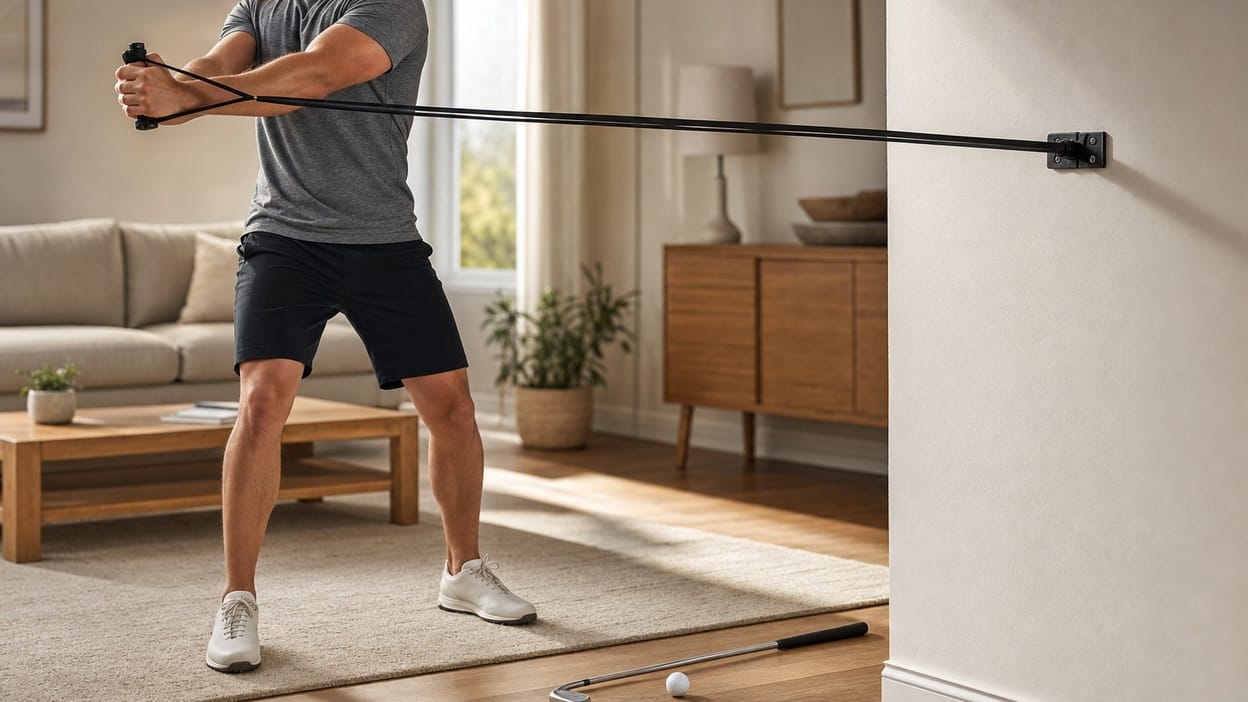
- Kneeling Pallof Press: Anchor a resistance band at chest height, kneel side-on to the anchor, and press the band straight out from the chest without letting the torso rotate toward the anchor. 3 sets of 8 to 10 reps per side.
- Split-Stance Pallof Press: Same press, performed from a split stance instead of kneeling, adding a lower-body stability demand. 3 sets of 10 reps per side.
- Standing Pallof Press: The most advanced version of the same movement, standing tall with feet together. 3 sets of 10 reps per side.
- Plank Up-Downs: From a forearm plank, alternate pressing up to a hand plank and back down, one arm at a time, without letting the hips rock side to side. 3 sets of 30 to 45 seconds.
This TPI-sourced anti-rotation family is also the pillar most golfers skip first when time is short, since holding a position against a band doesn't feel as satisfying as swinging something fast, even though it's the work the other two pillars depend on.
Pillar 2: hip, glute, and lead-leg strength
The lead hip and leg absorb and redirect a significant amount of force through impact, and a weak or unstable lead side is a common source of both lost power and compensatory strain elsewhere in the swing. The same amateur-golfer research cited above found leg and hip power correlated with swing speed, and separately found glute strength and pelvis rotation speed distinguished low-handicap golfers from higher-handicap ones. Two exercises cover most of what a golfer needs here, both from TPI's no-equipment fitness library:
- Single-Leg Hip Thrust: Shoulders on a couch or low step, one foot planted, the other leg extended, drive the hips up until the body forms a straight line from shoulder to knee. 3 sets of 10 to 12 reps per side.
- Single-Leg Romanian Deadlift: Standing on one leg, hinge at the hip and lower the torso toward the floor while the free leg extends behind for balance, then return to standing. Hold a light household object or loop a band under the standing foot for extra resistance once bodyweight feels easy. 3 sets of 8 reps per side.
Both exercises train the lead hip to stabilize under load in something close to the position it holds at impact, which is exactly the transfer this pillar is built for.
Pillar 3: rotational power
Only after stability and strength are in place does rotational power work make sense to add. Ground reaction force through the lead leg, the push against the ground that transfers up into the swing, plays a meaningful role in clubhead speed, with peak vertical force during a driver swing reaching roughly 1.6 times bodyweight, according to Watson et al., published in Sports Medicine. Two exercises build that explosive transfer without any equipment beyond an optional band:
- Resistance-Band Rotational Chop: Anchor a band low, stand side-on, and pull the band up and across the body in one explosive motion, rotating through the trunk and hips together. 3 sets of 8 reps per side.
- Skater Hops: Bound laterally from one leg to the other, landing softly and holding each landing for a beat before the next hop. 3 sets of 10 hops per side.
Both drills ask the body to produce and absorb force quickly, which is the actual skill a faster swing depends on, not just raw muscle.
A simple weekly plan: off-season build vs. in-season maintenance
Nobody needs a fully periodized program to get real value from this routine, but the cadence should change with the calendar. The Titleist Performance Institute's guide to off-season periodization lays out a useful shape for a 12- to 16-week off-season block:
- Weeks 1 to 3, screen and prepare: Learn each movement with lighter volume, focusing on form before load or speed.
- Weeks 4 to 9, build strength: Progress the three pillars with more sets and added resistance, training 3 to 4 times a week.
- Weeks 10 to 16, add power: Keep the strength work but add more of the Pillar 3 rotational drills, still 3 to 4 times a week, converting the strength base into speed.
Once the season starts, the goal shifts from building to maintaining. A secondary coaching source, Fit For Golf, recommends trimming in-season training to roughly 1 to 2 sessions a week, a pattern consistent with TPI's own periodization guidance even though it isn't itself a peer-reviewed source. Two short sessions a week, hitting all three pillars at lower volume, is generally enough to hold onto an off-season's gains without adding fatigue that shows up in a Saturday round. For a shorter, day-of complement rather than a training session, the pre-round warm-up routine covers what to do in the 15 minutes before a tee time, and the mobility and stretch routine pairs well alongside this strength work on rest days.
Protecting your lower back
The lower back is the most common injury site in golf, with amateur incidence estimates ranging from 15 to 34 percent and lifetime prevalence as high as 56.6 percent across the amateur golfing population. Limited hip rotation and hip strength are consistently linked to compensatory lumbar loading, meaning a stiff or weak hip forces the lower back to twist further than it should to complete the swing, according to research published in the British Journal of Sports Medicine in 2024 alongside broader amateur-injury surveys. That's the direct link back to Pillar 2: building hip and glute strength isn't just about power, it's about giving the lower back a rotating joint to share the load with instead of absorbing all of it alone.
None of this is a substitute for a proper evaluation if pain is already present, and it's a line I'll admit I defer to a physio on rather than try to coach around myself, especially once numbness, radiating pain, or symptoms that don't ease with rest enter the picture. General strength and stability work is prevention, not treatment.
Frequently Asked Questions
Do I need a gym or any equipment to build golf-specific strength?
No. Every exercise in this routine uses bodyweight alone or, for a few, a single resistance band. Nothing here requires a gym membership, a rack, or free weights.
How is this different from a general fitness routine?
It's built around golf-specific transfer rather than general fitness. Anti-rotation core stability is the lead pillar because it's what lets hip and shoulder rotation build power instead of leaking it, followed by hip and glute strength for the lead side through impact, then rotational power drills that convert that base into clubhead speed.
How often should I do these exercises?
During the off-season, 3 to 4 sessions a week across a 12- to 16-week block builds real strength and power. Once the season is underway, cutting back to 1 to 2 sessions a week is generally enough to maintain those gains without adding fatigue to a weekly round.
Is stretching enough to build more swing speed?
Flexibility helps, but it isn't the same as strength or stability, and research consistently links trunk rotational power and strength, not flexibility alone, to faster swing speeds. A golfer who is flexible but unstable through the core still loses power to compensation elsewhere in the swing.







The golf newsletter that cuts the hype
Data-backed reviews and advice that works. No brand spin.
Recommended products