






reviews
Torrey Pines South Course Review
Torrey Pines South is a municipal golf course that any golfer can book, and it has still hosted
Speed training aids rarely survive contact with independent reviewers who actually log the sessions. The SuperSpeed Golf Swing Speed Training System has survived, with caveats. Five independent reviewers report gains in the 3 to 10 mph (5 to 16km/h) range across six to ten weeks of the published protocol. That range reflects one thing above all else: how much adherence matters. The system costs $199.99. Whether it makes sense depends on your current speed, your physical profile, and whether you'll keep training after the first protocol ends.
The mechanism is neuromuscular. Swinging a lighter club at maximum effort teaches the nervous system that the golf swing can move faster than it currently does. The brain updates its motor pattern speed ceiling. Returning to a standard driver, the nervous system applies the updated ceiling, and clubhead speed increases.
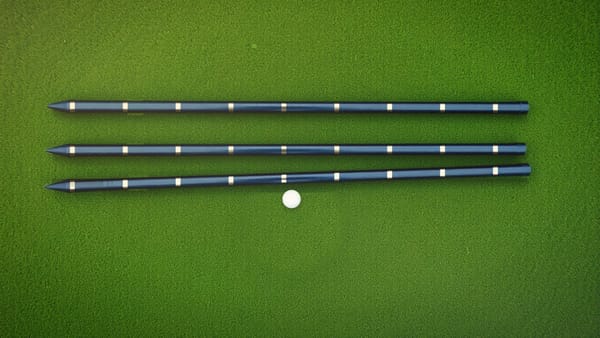
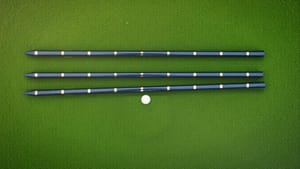
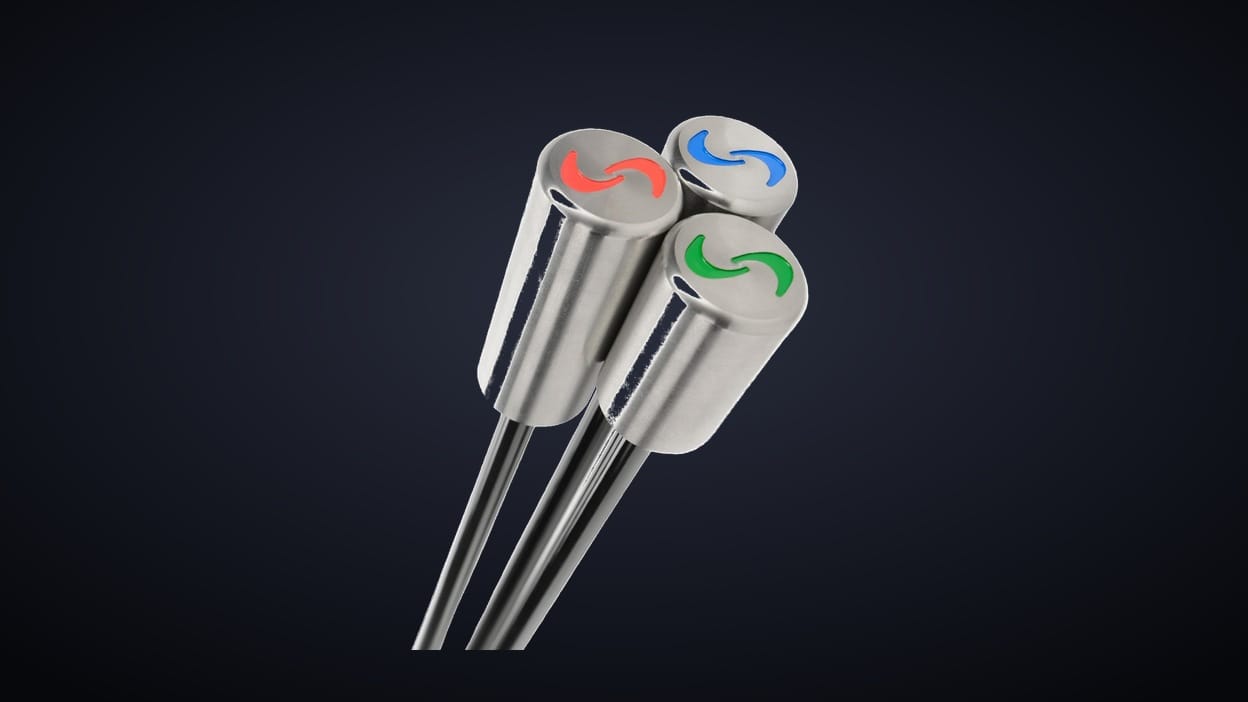
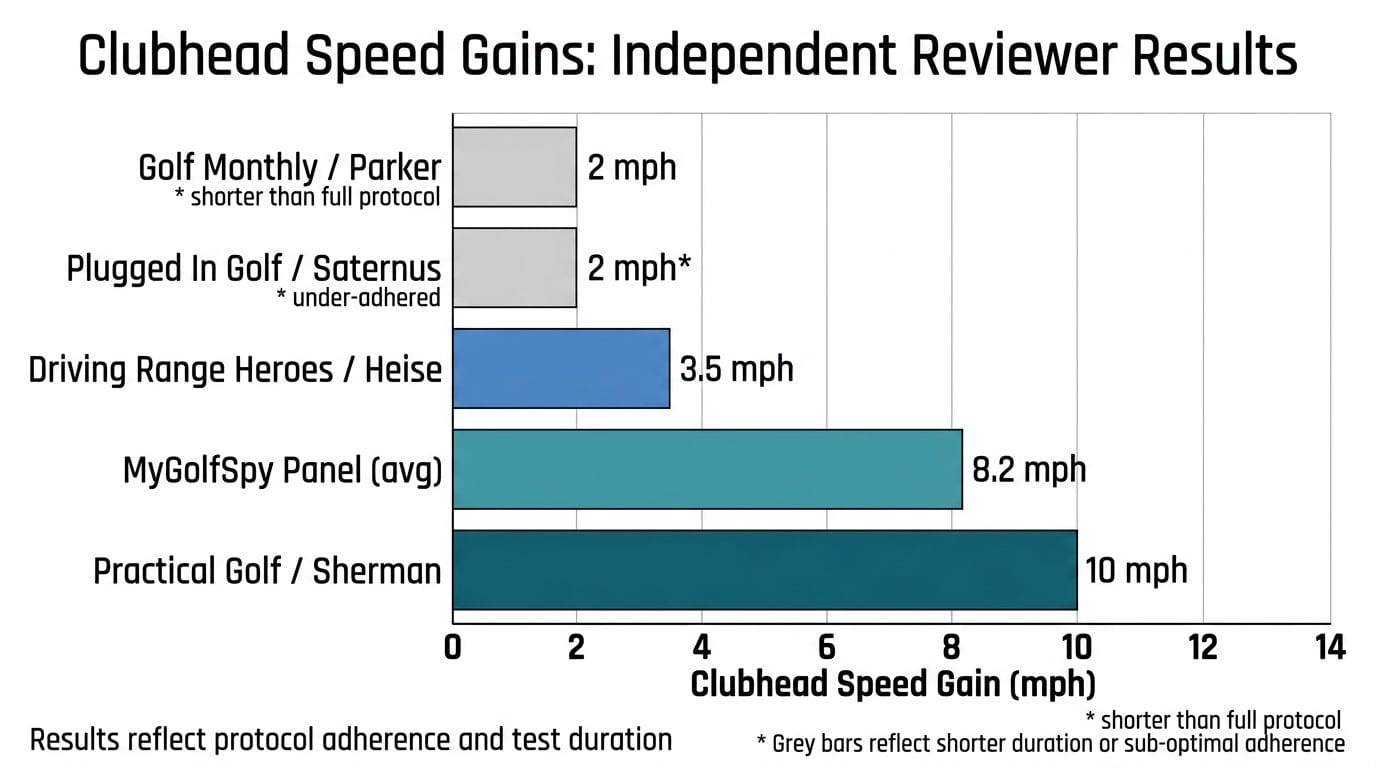
SuperSpeed Golf's system brackets that effect with three sticks: one approximately 20 percent lighter than a standard driver, one approximately 10 percent lighter, and one approximately 5 percent heavier, per their published product specifications. Swinging the lighter sticks at maximum effort creates the overspeed stimulus; the heavier stick trains the force production to sustain it. Alternating between underload and overload is the system's architecture.
One peer-reviewed study exists. Bliss et al. (2021), published in the Journal of Sport and Exercise Science, found that a speed-stick warm-up protocol produced a statistically significant increase in clubhead speed versus a control condition (p=0.003) and more carry (p=0.030). That finding is specific to acute warm-up effects, not the six-week adaptation SuperSpeed Golf's training program is designed to produce. It confirms that overspeed swings affect clubhead speed in the short term; it does not validate the longer-term training claims.
This is not swing mechanics work. The drills don't address your grip, your path, or your impact position. Physical therapist Chris Finn (PT/CSCS/TPI Medical Provider) describes the system as contraindicated for golfers whose swing speed already exceeds their power and mobility base. His clinical framing is direct: speed training amplifies the existing pattern. If that pattern has structural problems, the protocol makes those problems faster.
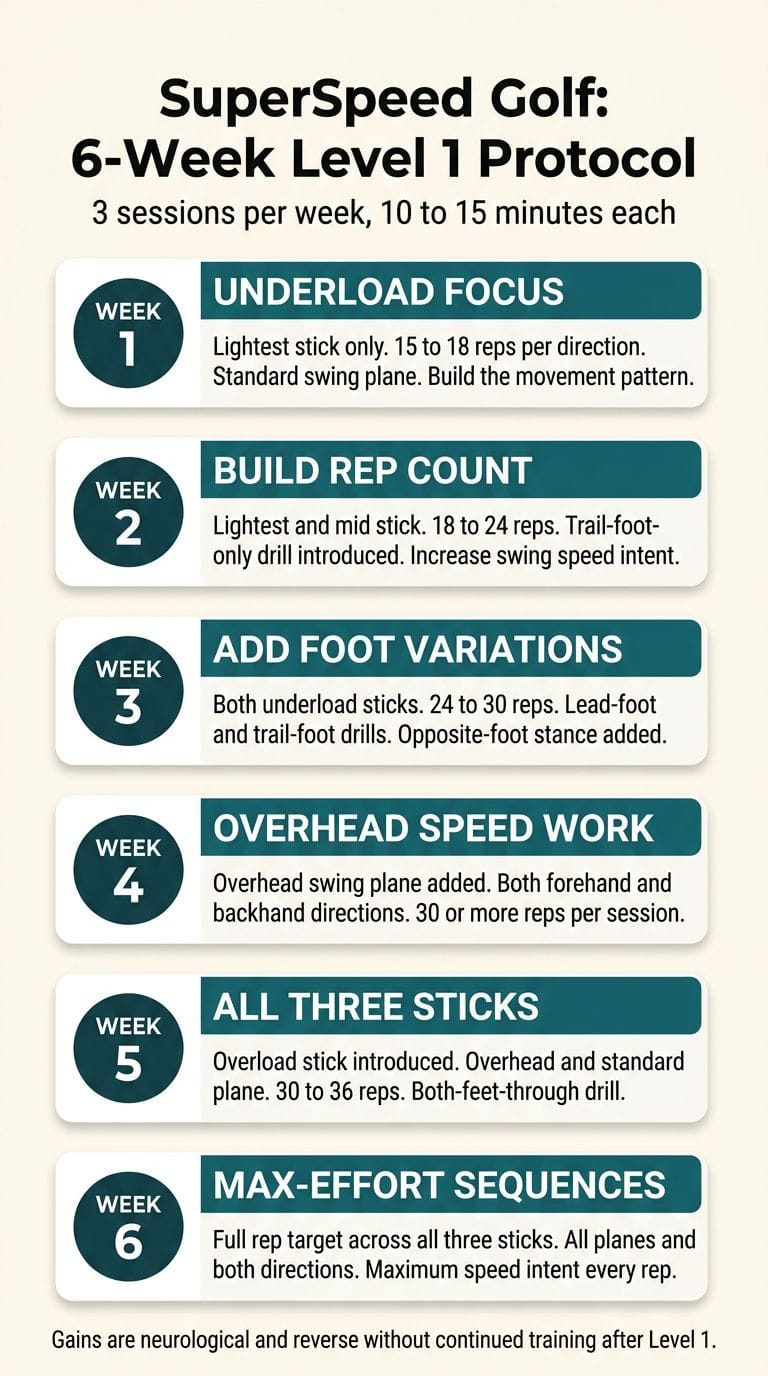
The Men's system is built for standard driver weights of 300 to 325 grams. Training is structured through the free SuperSpeed app, which assigns drill sequences and rep counts across the six-week Level 1 protocol. Sessions run ten to fifteen minutes, three days per week; further levels extend beyond Level 1.
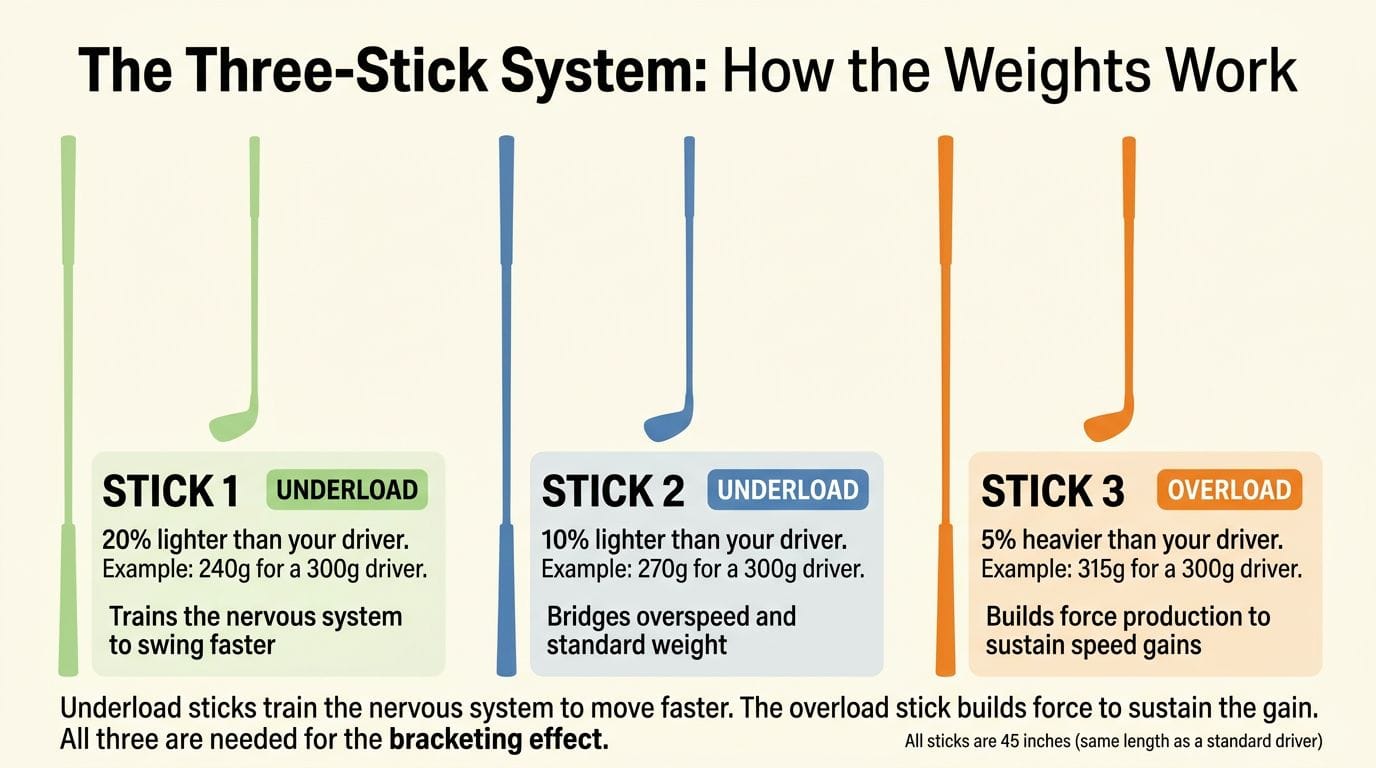
Three sessions per week is the stated minimum for the neurological adaptation to take hold. The independent testing makes clear how much this matters. Jon Sherman at Practical Golf ran three sessions per week for six weeks with strict adherence and recorded a gain from approximately 102 to 112 mph (164 to 180km/h), his strongest documented result. Matt Saternus at Plugged In Golf ran two sessions per week over two months (under the published minimum) and saw a +2 mph sustained gain, with his later update noting that full commitment produced gains above 10 mph (16.1km/h). The gap between those two outcomes is largely the gap in adherence, not in the system.
One constraint that rarely appears in the marketing materials: three sticks at roughly 45 inches, swung at full speed, don't fit most indoor home settings. A standard suburban living room or garage won't work. Golfers whose only accessible space is outdoors or at a gym will find this adds a logistical step to every session, and that step, over weeks, matters for adherence.
Across five reviewers, the independent consensus range for the first protocol under full adherence is 3 to 10 mph (5 to 16km/h) over six to ten weeks.
The most rigorous structured test is MyGolfSpy's nine-tester community panel, which ran Level 1 over ten weeks with self-reported adherence. Average gain: 8.2 mph (13.2km/h). Range: 5 to 13 mph (8 to 21km/h). Every participant recorded improvement. MyGolfSpy noted that faster starting speeds tended to produce smaller percentage gains.
Jon Sherman's Practical Golf result, approximately +10 mph (16.1km/h) from strict three-sessions-per-week adherence, is the upper bound of the independent range and the most committed single-tester account. Driving Range Heroes' Jon Heise ran Level 1 for six weeks at the published frequency and landed at +3 to 4 mph (5 to 6.4km/h), short of the manufacturer's stated 5 percent target. Golf Monthly's Dan Parker tested Level 1 for four weeks (less than the full protocol) and reported "a couple of extra mph."
The maintenance requirement appears across multiple reviews. Sherman notes the gains reverse quickly without continued training: the adaptation is neurological, not structural. Plugged In Golf's Saternus makes the same observation. The protocol is not a six-week fix that sticks; it is an ongoing training commitment.
On Tour usage, the strongest independent confirmation is Billy Horschel. He documented a retail purchase in mid-2015 and posted his own training video before any ambassador program was established, per The Hackers Paradise's brand history reporting. Phil Mickelson's driver speed increased from approximately 115 mph (185km/h) in 2016 to around 122 mph (196km/h) in 2019, during a period when he was using the system; he was simultaneously running a full TPI program, and no source isolates SuperSpeed as the cause of that increase. Padraig Harrington became a paid ambassador in May 2023, per PR Newswire; he has led PGA Tour Champions in driving distance at age 52, which is a verifiable output, not a claim, but the ambassador relationship applies to every citation.
SuperSpeed Golf states that over 1,000 tour professionals have used the system, per their website. That figure is self-reported.
For a comparison of this system alongside other training aids reviewed on this site, see the speed training aid roundup.
The case for buying it is clearest for one specific profile: you're consistently under 100 mph (161km/h) driver speed, speed is a genuine limiting factor in your scoring, you have outdoor or gym space to swing three long sticks at full effort, and you're prepared to maintain training after the initial protocol, not because the marketing says so, but because every independent reviewer who documented a gain also documented that the gain requires continuation.
The evidence against buying it is more specific than a standard caveat. Chris Finn identifies a clinical contraindication: golfers whose swing-speed percentile already exceeds their power percentile, or who fail TPI rotary mobility screening, are not appropriate candidates. His clinical observation is that this profile describes the large majority of golfers who sustain overspeed training injuries. If you've had shoulder or elbow problems during golf, or if your speed already outpaces your physical stability, the protocol's three-days-per-week structure does not resolve that mismatch.
Jon Sherman's guidance at Practical Golf adds a sequencing note: if there are swing mechanics that need addressing, those come first. Adding speed to a swing with unresolved technical issues produces faster expressions of those issues. That isn't a criticism of the system; it's a description of what speed training does.
The maintenance commitment is part of the purchase calculation. Multiple reviewers confirm the gains are neurological and reverse without continued training. If the realistic outcome is six weeks of adherence followed by stopping, the evidence from Saternus and others suggests the gain will not persist.
For players already above 115 mph (185km/h), the MyGolfSpy data indicates smaller percentage gains are likely. The Men's system reviewed here is calibrated for standard driver weights; faster, stronger players may find the upper-range sticks insufficiently challenging over time.
Pick: SuperSpeed Golf Swing Speed Training System (Men's) at $199.99
For: Golfers under 100 mph (161km/h) who have the space, the schedule, and the intention to maintain training after Level 1
The independent evidence says yes. Five reviewers testing the Level 1 protocol across six to ten weeks found gains of 3 to 10 mph (5 to 16km/h). That range is a function of adherence, not randomness in the system. Jon Sherman at Practical Golf ran strict three-sessions-per-week adherence for six weeks and gained approximately 10 mph (16.1km/h). Matt Saternus at Plugged In Golf averaged fewer sessions per week over two months and saw 2 mph (3.2km/h) sustained, with his later update putting full-adherence gains above 10 mph (16.1km/h). The MyGolfSpy nine-tester community panel averaged 8.2 mph (13.2km/h) across ten weeks. Every tester in that panel recorded a gain with adherent protocols.
The Level 1 protocol is six weeks. Sessions run ten to fifteen minutes, three days per week. The per-session time is low; the consistency requirement isn't. Three sessions per week is the stated minimum for the neurological adaptation to take hold, and the gap in the independent results between two-per-week and three-per-week adherence is substantial: roughly 2 mph (3.2km/h) versus 10 mph (16.1km/h) in Saternus's own before-and-after comparison. The other constraint: gains from overspeed training are neurological and reverse without maintenance. Level 1 is the starting point, not the finish line.
Three groups where the evidence argues against it. First, golfers whose swing speed already exceeds their power and mobility base. Physical therapist Chris Finn (PT/CSCS/TPI Medical Provider) identifies this as a clinical contraindication, and his observation is that it describes a large portion of golfers who sustain overspeed training injuries. If you've had shoulder or elbow problems during golf, or you fail TPI rotary mobility screening, this isn't the right tool. Second, golfers with unresolved swing mechanics issues. Speed training amplifies whatever pattern you've got, including its flaws. Jon Sherman at Practical Golf is direct: mechanics first, then speed. Third, players who'll realistically complete the six-week protocol and then stop. Multiple independent reviewers confirmed the neurological gains reverse without continued training. If that's the honest projection, the math on $199 doesn't work.
The system won't alter your swing mechanics directly. It doesn't address grip, path, or impact position. What it trains is your nervous system to move faster through the swing. That's also where the safety question sits: a faster expression of a flawed pattern is a more forceful one, and a more injurious one. Golfers without TPI rotary mobility issues, without shoulder or elbow history, and whose swing-speed percentile is within their physical base are appropriate candidates. For that profile, the peer-reviewed literature (Bliss et al., 2021) confirms the acute overspeed effect on clubhead speed, and the five independent reviewers confirm the longer-term adaptation holds with adherent training. The risk is in misjudging which category you're in.
The system's main distinction from single-stick alternatives is the bracketing architecture: three sticks at different weights (approximately 20 percent lighter, 10 percent lighter, and 5 percent heavier than a standard driver), combined with a structured progressive protocol in the free app. Single-stick overspeed tools can produce a short-term speed bump, but the independent testing base that exists for this specific system, across five reviewers and multiple levels of adherence, doesn't exist for most cheaper options. That said, the real investment is the ongoing time, not the $199. The value case holds for golfers who'll maintain training beyond Level 1. For those who'll complete one six-week block and stop, the gains won't stick and neither will the value.
Some links in this article are affiliate links. If you buy through them, I earn a small commission at no extra cost to you. This never influences what I cover or recommend. I link to gear I'd buy myself.
Data-backed reviews and advice that works. No brand spin.