Independent testing from National Club Golfer and Plugged In Golf backs up the Ai Smoke MAX's forgiveness, now at roughly half its 2024 launch price. Here's what the data shows.
A 2024 flagship now selling for less than half its launch price, and independent testing says the forgiveness held up
The Callaway Paradym Ai Smoke MAX launched in 2024 at $599, priced and marketed like every other flagship driver that year. Callaway has since released two full generations on top of it: the Elyte in 2025, and the Quantum in 2026, its current flagship. Two years and two Callaway product cycles later, it's selling for roughly half that. That's the usual fate of a flagship two generations back once newer models take the top shelf, but a discount that size still raises a fair question: did the club get worse, or did the price just catch up to reality? National Club Golfer and Plugged In Golf both tested it independently, and both point to the same answer. The forgiveness that earned it a five-star review in 2024 hasn't gone anywhere.
The verdict: two-generations-back flagship forgiveness at a mid-tier price, with off-center consistency as the standout trait across two independent reviews.
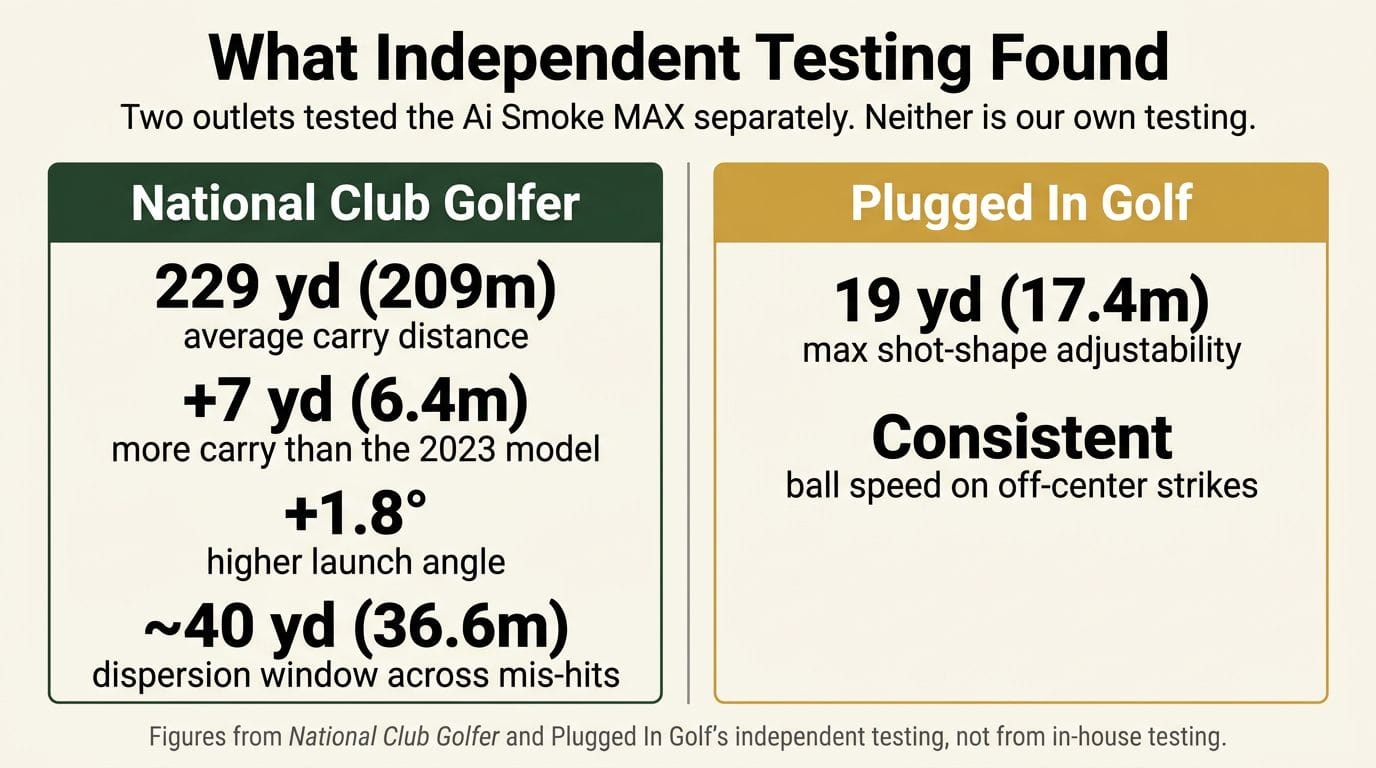
National Club Golfer measured 229 yd (209m) average carry, 7 yd (6.4m) more than the predecessor, at a higher launch and lower spin.
Plugged In Golf found strong ball-speed consistency on off-center strikes and up to 19 yd (17.4m) of shot-shape adjustability.
Who it's for: budget-minded golfers who want flagship forgiveness without flagship pricing, and improvers who mishit the center of the face more often than they'd like.
Who should skip it: golfers who specifically want a men's Regular-flex option, since this model ships in Stiff only (plus Ladies).
What the Ai Smoke MAX actually is
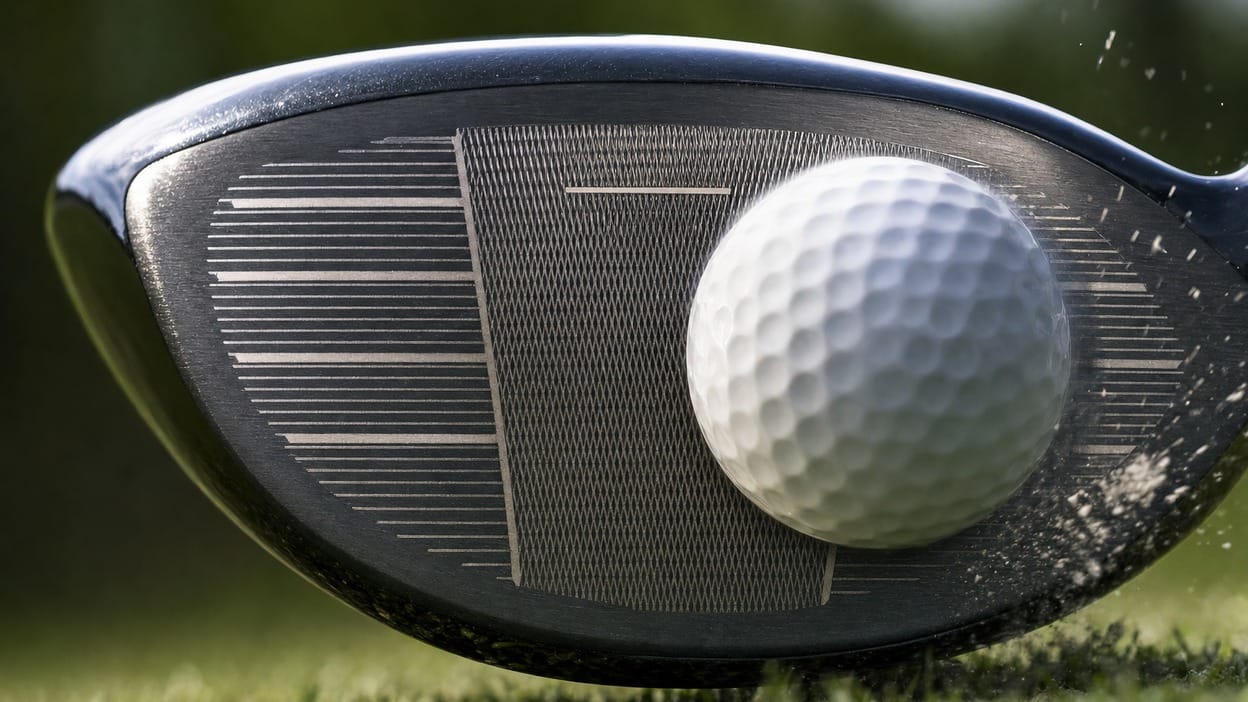
The Ai Smoke MAX is built around what Callaway calls the Ai Smart Face, a machine-learning-driven design process that maps micro-deflection points across the face to create several effective sweet spots rather than one. The idea is that a strike an inch off-center still compresses against a face section that was engineered for it, instead of losing ball speed the way an off-center hit does on a traditional single-sweet-spot face. Adjustable perimeter weighting rounds out the design, letting a fitter or golfer bias the head toward a draw or fade shape without changing swing mechanics.
Per Callaway's spec sheet, the model is available in right- and left-hand, in lofts of 9, 10.5, and 12 degrees, in Stiff flex only. There's no men's Regular-flex option on this driver, a detail worth knowing before shopping by loft alone. The configuration linked below, and the one most of the independent testing cited in this review centers on, is right-hand, 10.5 degrees, Stiff, the most common build sold. This review synthesizes that published testing rather than a hands-on test of one specific club, but the buying decision (forgiveness, adjustability, price) holds across the loft and hand options Callaway offers.
What independent testing shows about forgiveness
Forgiveness is the strongest, best-corroborated claim in this review, and it's the reason the angle leads with it. National Club Golfer's five-star test measured an average carry of 229 yd (209m), 7 yd (6.4m) longer than the 2023 predecessor, at a launch angle 1.8 degrees higher and roughly 300 rpm less spin. Higher launch paired with lower spin is the combination that keeps a driver in the air longer without ballooning it, and NCG's testers saw that show up as a wider, more usable carry window across a round rather than just a longer number on a good swing.
Plugged In Golf's independent test corroborates the same trait from a different angle. Their testers reported consistent ball speed even when they missed the center of the face, the kind of real-world forgiveness that matters more to most golfers than peak numbers from a flush strike. That consistency is what separates a genuinely forgiving driver from one that's only long when everything goes right, and having two separate outlets land on the same conclusion independently is stronger evidence than either review alone.
Test findings sourced from National Club Golfer and Plugged In Golf's independent reviews, not our own testing.
Shot-shape adjustability, and the one trade-off testers flagged
Plugged In Golf also tested the adjustable perimeter weighting directly, and found up to 19 yd (17.4m) of shot-shape movement available between the draw- and fade-biased settings. That's a wide enough window to correct a genuine two-way miss without needing a full re-fit, though it's worth pairing with an actual fitting process rather than guessing at settings; the right order to fit your own driver walks through length, loft, shaft, and face angle in the sequence that actually matters, which applies to dialing in this driver's adjustability just as much as buying a new one.
Neither review came back without a knock. National Club Golfer's only real criticism was a slightly larger clubhead at address compared with the 2023 model, a look-and-feel note rather than a performance one. Plugged In Golf's was sound: the strike is "more ordinary" than the outgoing driver, less of the sharper crack some golfers specifically shop for. Separately, MyGolfSpy's published testing has the Ai Smoke MAX ranked in the top four for accuracy among mid-swing-speed golfers, a result that shows up consistently across search results referencing their test data even though this review didn't pull the full report directly. It's a notch behind the very top of that ranking, not a category leader on that specific metric, which is worth knowing if outright accuracy ranking is the deciding factor over forgiveness.
Who it's built for
Budget-minded weekend golfers get the clearest win here. A driver that tested as forgiving as this one, at roughly half its original price, is hard to beat on value alone. There's no premium being paid for last year's marketing cycle, only for the club itself.
Improvers and mid-to-high-handicap golfers are the audience the forgiveness data speaks to most directly. A driver that keeps ball speed up on a missed strike is worth more to a golfer who doesn't find the center of the face every time than raw distance ever is. Golfers fighting a slice specifically should also read why a slice with the driver doesn't always match well-struck irons; a forgiving, adjustable head like this one can mask some of that gap while the underlying swing pattern gets fixed. The same forgiveness-first logic is why a set like the ones in the game-improvement irons guide tends to pair naturally with this kind of driver, both built around the same forgiving mishit rather than a flush one.
Serious amateurs get a legitimate spec sheet, not a compromise. The Ai Smart Face design and 19 yd (17.4m) of adjustability are genuine game-improvement-and-beyond technology, not a scaled-down version of what the current flagship offers. The tradeoff is the sound and the slightly older shaping, both cosmetic rather than performance issues.
Price: what "flagship at half price" actually gets you
A "last year's flagship, half the price" pitch is one of the more overused lines in golf equipment marketing, and it's usually a sign that a decent driver got outpaced by whatever replaced it, not that the golfer got a deal. I'll admit that skepticism is my default reaction to any driver marketed that way, which is exactly why two independently corroborated forgiveness results matter here more than they normally would. At $599 in 2024, the Ai Smoke MAX was priced like every other flagship on the shelf. At roughly $300-400 in current street pricing, it's priced like a mid-tier driver while testing like the forgiving flagship it was built to be. That gap, not the original launch price, is the number worth paying attention to.
The verdict
Two independent reviews, testing separately, landed on the same conclusion: this is a genuinely forgiving driver, corroborated on carry distance, launch and spin numbers, and off-center ball-speed consistency. The knocks are real but minor, a slightly bigger head and a more ordinary sound, not anything that touches how the club actually performs. At current street pricing, it's a strong buy for a budget-conscious golfer or an improver who mishits more often than they'd like, and a legitimate option for a serious amateur who doesn't need the newest badge on the crown to be interested. The one buyer it doesn't serve is anyone shopping specifically for a men's Regular flex, since this model doesn't offer one.
Pros and cons
Pros:
Off-center ball-speed consistency corroborated independently by both National Club Golfer and Plugged In Golf
National Club Golfer measured 7 yd (6.4m) more carry than the 2023 predecessor, at a higher launch and lower spin
Up to 19 yd (17.4m) of shot-shape adjustability via the adjustable perimeter weighting
Roughly half its 2024 launch price at current street pricing
Cons:
No men's Regular flex; Stiff only (plus Ladies)
Slightly larger clubhead at address than the 2023 model, per National Club Golfer
Strike sound rated "more ordinary" than the outgoing driver, per Plugged In Golf
A notch behind the top of MyGolfSpy's mid-swing-speed accuracy ranking, not a category leader on that specific metric
For a budget-conscious golfer or an improver who mishits more often than they'd like, the Ai Smoke MAX's corroborated forgiveness at current street pricing is a well-supported buy.
Is the Callaway Paradym Ai Smoke MAX still worth buying in 2026?
Yes, based on independent testing. National Club Golfer and Plugged In Golf both found strong forgiveness and off-center consistency, and at current street pricing of roughly $300-400 it's selling well below its 2024 launch price of $599 for the same tested performance.
Does the Callaway Paradym Ai Smoke MAX come in a Regular flex?
No. This model is available in Stiff flex only, plus a Ladies flex option. There's no men's Regular-flex version of the Ai Smoke MAX.
What's the difference between the Ai Smoke MAX and the Ai Smoke MAX D?
They're different clubheads built for different misses. The MAX is the standard forgiveness-focused build covered in this review. The MAX D adds draw bias for golfers working to eliminate a slice, and is a separate SKU with its own listing.
How much does independent testing say the Ai Smoke MAX helps on mishits?
National Club Golfer measured a roughly 40 yd (36.6m) dispersion window across mis-hits in testing, and Plugged In Golf found ball speed held up consistently even on strikes that missed the center of the face. Both point to forgiveness as the driver's strongest trait.
Some links in this article are affiliate links. If you buy through them, I earn a small commission at no extra cost to you. This never influences what I cover or recommend. I link to gear I'd buy myself.
The golf newsletter that cuts the hype
Data-backed reviews and advice that works. No brand spin.
James WhitfieldGolf writer
James Whitfield plays off a 7 handicap in the Pacific Northwest. A former tech pro, he reads what independent tests show, cross-references owner reports, and turns the evidence into buying advice. He's happier with a spec sheet than a putt.
Donald Ross's turtleback greens, a Coore-and-Crenshaw restoration, and the real cost of playing a course the USGA has locked in as a rotating U.S. Open host through 2047.
Pebble Beach and St Andrews are bucket-list courses most golfers will never book. TPC Sawgrass's Stadium Course is the rare exception: the same tournament fame, and a tee sheet a regular golfer can actually get on.
Pebble Beach Golf Links doesn't need another postcard write-up. It needs an honest answer to one question: does $695 for one round make sense, against a once-in-a-lifetime trip or a week of golf you could buy instead?
Five 2026 drivers built to bail out mishits rather than reward a perfect strike, ranked from budget-friendly to premium so golfers at every stage of the forgiveness spectrum have a real option.
Srixon officially unveils the ZXi RKT metalwood family, the same driver line Ryan Fox used to win the 2026 Open Championship weeks before it existed at retail.
Donald Ross's turtleback greens, a Coore-and-Crenshaw restoration, and the real cost of playing a course the USGA has locked in as a rotating U.S. Open host through 2047.
 Buy now