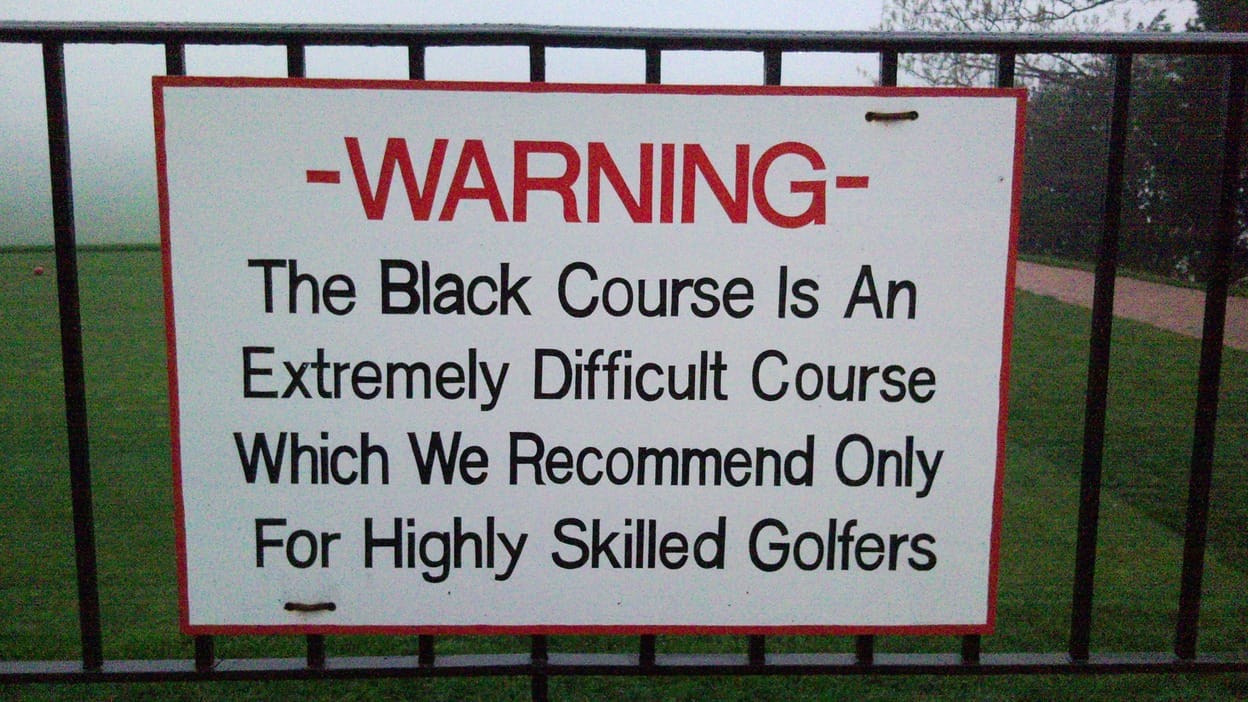
Bethpage Black is the closest thing public golf has to a rite of passage. It's a municipal course anyone can book, sitting on the same tee sheet as four easier siblings at Bethpage State Park, and it has hosted two US Opens, a PGA Championship, and a Ryder Cup anyway. The sign fixed to the fence behind the first tee spells out exactly what that history means for the golfer standing there about to play: "WARNING The Black Course Is An Extremely Difficult Course Which We Recommend Only For Highly Skilled Golfers." That's not marketing copy. It's an accurate preview, and understanding the gap between "anyone can book it" and "almost no one walks off it happy" is worth doing before chasing a tee time here.
Legendary and genuinely public: a Tillinghast-designed championship course anyone can book, not a private-club fantasy.
The warning sign at the first tee isn't marketing, it's an accurate preview of eighteen brutal holes.
Championship pedigree runs deep: the 2002 and 2009 US Opens, the 2019 PGA Championship, and the 2025 Ryder Cup.
Booking is its own test: non-residents reserve five days out, and fees split sharply by New York residency.
It rewards committed golfers and punishes everyone else, so who should play matters as much as the course itself.
What makes the Black legendary
Bethpage Black earns its reputation the hard way: a genuinely brutal championship test that happens to be open to the public, not a private-club myth passed around by people who've never played it. A.W. Tillinghast designed the course, which opened in 1936 as part of a Depression-era state park project meant to bring championship-caliber golf to ordinary golfers, and that founding idea, real difficulty without a private membership attached, is still the entire pitch nearly a century later. The warning sign itself dates back to the 1960s, which means generations of golfers have walked past the same blunt promise before finding out for themselves whether it held up. Most courses this hard exist behind a gate. Bethpage Black exists behind a tee sheet.
The design and the difficulty
The numbers alone explain a lot. Bethpage Black plays to a par 71 across 7,468 yards (6,829m) from the championship tees, with a course rating of 77.5 and a slope of 155, figures that sit among the toughest ratings in American public golf. Length is only part of the story. Reviewers who've walked the course describe fairways pinched down to roughly 26 yards (23.8m) wide in spots, greens set on plateaus that repel anything short of a precise approach, and native rough thick enough to turn a small miss into a lost hole entirely. GolfWRX, National Club Golfer, and The Wandering Golfers all land on the same verdict from different angles: brutal, but genuinely one of the best pure designs in the world, not difficulty for its own sake.
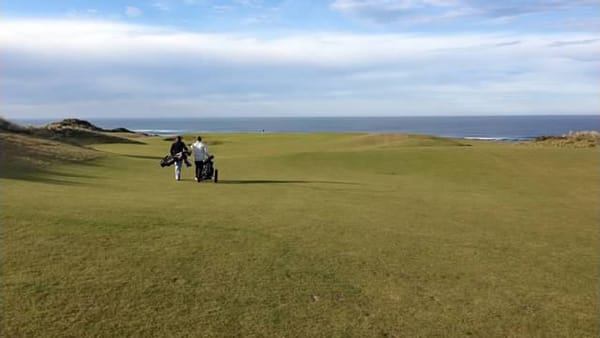
It's also walking only. Carts simply aren't offered on the Black, medical exemptions aside, so a round means carrying, pulling, or hiring a caddie for the full distance across a layout with real elevation change built into several holes. More than one reviewer has called it a long day's march rather than a round, and that's before factoring in how much concentration the course demands from hole to hole. The rule shapes the experience as much as the yardage does: this is a course that asks for a golfer's legs as well as their swing.
Championship pedigree
Bethpage Black has hosted the US Open twice. Tiger Woods won the rain-delayed 2002 edition at 3 under, and Lucas Glover won in 2009 at 4 under, both champions finishing under par on a course built to make that hard. Brooks Koepka added a third major to the résumé, winning the 2019 PGA Championship at 8 under over Dustin Johnson. Most recently, the Black hosted the 2025 Ryder Cup, where Team Europe won 15 points to 13, an away win and the first time a visiting team had taken the Ryder Cup since Medinah in 2012. Few public-access courses anywhere carry that combination of USGA, PGA of America, and Ryder Cup pedigree, and fewer still let a member of the public book the same tees the professionals played that same week.
Read before you book: the tee-time reality
This is the part that catches first-time visitors off guard. Bethpage Black runs through New York State's own park reservation system, and the rules differ by residency. Non-residents can book a tee time five days in advance, with the reservation window opening at 7:00pm Eastern each night, so a Saturday round opens for booking the prior Monday at 7pm. There's a $5 per-player reservation fee charged on site, cancellations are free up to six hours before the round, and a no-show costs $15 per player once that window closes. Golfers who miss the reservation window, or want to chase a same-day slot, still have a shot: the first hour of tee times is held for walk-ups, and the long-standing local ritual for landing one is camping out in the parking lot overnight.
Fees split just as sharply. For the 2026 season, per Golf.com, non-residents pay $140 on a weekday and $160 on a weekend, with twilight rates of $88 and $100. New York residents pay substantially less: $70 on a weekday and $80 on a weekend. There's no cart fee to budget for, since the walking-only rule applies to every golfer regardless of residency. Booking friction like this is exactly why Plan a Golf Trip Worth the Money: Choosing Courses, Timing, and Budget So Every Round Counts exists: a practical framework for building a trip around a course that won't guarantee a date, rather than hoping a five-day reservation window cooperates with a schedule set months in advance.
Who it's for, and who should skip it
Bethpage Black rewards a golfer who wants the championship experience on their own terms: someone with the game to avoid the rough, the legs for a walking round on a hilly layout, and the patience for a reservation process that isn't built for spontaneity. It's a poor match for a beginner chasing a scenic, relaxed day, or for a golfer who wants to ride rather than walk. I'll admit part of the appeal for me is exactly that gatekeeping, a course that makes a golfer earn the round before they've even teed off, though that instinct is worth checking against what will actually make a given golfer's day enjoyable rather than punishing.
The verdict
Bethpage Black is what public golf looks like when it refuses to apologize for being hard. The design, the championship history, and even the booking process all point the same direction: this course was built to test golfers who want to be tested, not to entertain everyone who shows up. For the right golfer, that's exactly the draw. For anyone else, the warning sign at the first tee is doing its job.
Frequently Asked Questions
Is Bethpage Black hard to book?
Yes, for non-residents especially. Reservations open just five days ahead, at 7:00pm Eastern, through New York's state park system, and the window fills quickly during peak season. Golfers who miss it can try for a walk-up slot, since the first hour of tee times is set aside for golfers willing to arrive early, and the local workaround is camping out in the parking lot overnight.
Can I walk Bethpage Black, or is a cart available?
Walking only. Carts aren't offered on the Black, aside from a documented medical exemption, so golfers should plan to walk, carry or pull their clubs, or arrange a caddie for the full round.
What are the green fees at Bethpage Black?
For the 2026 season, per Golf.com, non-residents pay $140 on a weekday and $160 on a weekend, with twilight rates of $88 and $100. New York residents pay $70 on a weekday and $80 on a weekend. There's no separate cart fee, since carts aren't offered regardless of residency.
What is the course rating and slope at Bethpage Black?
From the championship tees, the Black plays to a par 71 across 7,468 yards (6,829m), with a course rating of 77.5 and a slope of 155, numbers that rank among the toughest in American public golf.
Is Bethpage Black too difficult for a high handicapper?
It can be. The combination of length, thick rough, and narrow, plateaued greens is unforgiving for a golfer who doesn't already play from tees suited to their game, and choosing the right tee box matters more here than at most public courses. A high handicapper can still enjoy the round by playing conservatively and treating it as an experience rather than a scoring opportunity.
Some links in this article are affiliate links. If you buy through them, I earn a small commission at no extra cost to you. This never influences what I cover or recommend. I link to gear I'd buy myself.