Rukket SPDR Golf Net Review: 10x7 Bundle for Home Practice
The Rukket 10x7 SPDR golf net bundle reviewed: what's actually in the box, what MyGolfSpy and PluggedInGolf found, and who it fits best.

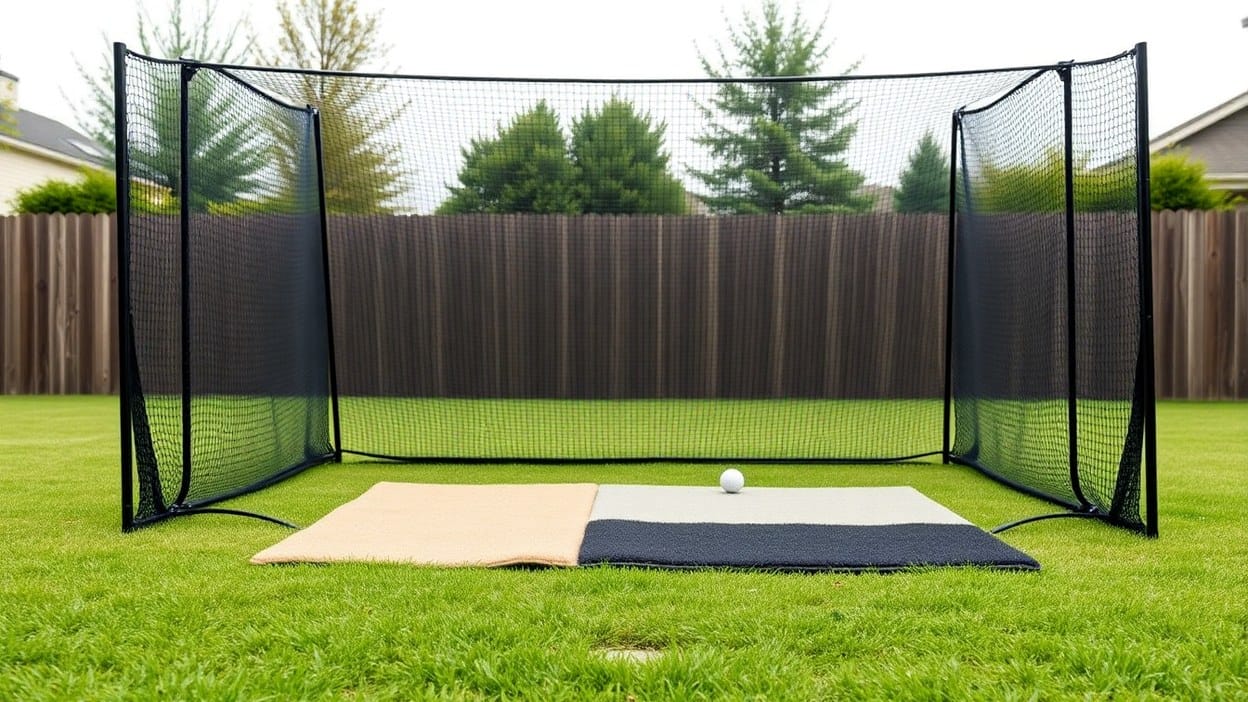
The Rukket 10x7 SPDR is sold as a four-piece bundle, not a bare net: the net itself, a Tri-Turf hitting mat, barrier protective wings, and a carry bag, all under one ASIN. That matters for how it should be judged. Against a bare net, $320 to $360 looks steep. Against a mat-and-net combo, it sits at the low end of the roughly $300 to $1,000 that mat-and-net combos run at US retailers, and the published data backs up why MyGolfSpy and PluggedInGolf both rate it as one of the more durable options at that price.
- Bottom line: A genuinely four-piece bundle (net, mat, wings, bag), not a net-only listing, and it's priced and built accordingly.
- MyGolfSpy score: 9.6 overall, Most Wanted 2022 and 2023, second for durability.
- Setup: Rukket states 2 minutes; one published reviewer's first setup ran closer to 20.
- Catch style: stop-and-drop, not a ball-return funnel. The ball lands and stays put.
- Best for: full-swing practice at home, with or without a launch monitor, in a space that can fit the 10-foot (3m) opening.
Rukket SPDR 4pc Golf Practice Bundle
Pros:
- Catches full-swing shots from every club in the bag without the net flexing back into the hitter
- Mat is rated higher-grade than most bundled mats at this price point
- Lifetime warranty on the frame and other structural parts
- Fourteen40Golf reported no fraying, pole bend, or grommet failures on this generation
Cons:
- Side wings attach manually, an extra step most bare nets don't require
- Poles can resist seating properly under net tension during assembly
- Needs ground anchors in any wind, which cuts into how portable "portable" really is
- Netting warranty runs a shorter 6-month window than the frame, and needs registration within 30 days to activate at all
What's in the Rukket SPDR box and key specs
The hitting opening measures 10 feet (3m) wide by 7 feet (2.1m) tall, big enough to swallow a mis-hit from a driver without the ball skipping past the edge. The frame is a metal folding design, which is most of why the warranty on structural parts is lifetime rather than limited.
| Component | What you get |
|---|---|
| Net | 10-foot (3m) by 7-foot (2.1m) stop-and-drop hitting net, metal folding frame |
| Mat | Tri-Turf hitting mat, rated higher-grade than most mats bundled at this price |
| Wings | Barrier protective wings, attached manually after setup |
| Bag | Carry bag for the full bundle |
| Warranty | Lifetime on frame and structural parts; 6-month window on netting, 30-day registration required to activate |
Two things worth being precise about before buying. First, this is a stop-and-drop net: the ball hits the mesh and falls straight down into the base, not a ball-return funnel that rolls it back to your feet. If you're picturing a net that feeds balls back to a tray, that's a different category of product. Second, Rukket states a 2-minute setup, but at least one published reviewer's first assembly ran closer to 20 minutes, mostly fighting the poles into place under the net's own tension. Expect the first setup to land somewhere between those two numbers, and faster on the second and third try.
What the published reviews agree on
MyGolfSpy gave the SPDR a 9.6 overall score and named it to its Most Wanted list in 2022 and 2023, ranking it second for durability, fourth for stability, and third for ease of use among the nets it tested that year. Its one real knock: the side wings attach manually, which MyGolfSpy counts against ease of use even with the net's other scores high.
PluggedInGolf's review lands in a similar place from a different angle. It found the net absorbs full-swing shots well regardless of club, enough that testers reported confidence taking real swings rather than easing off for fear of missing the net. It rated the included mat higher-grade than most mats bundled at this price point. Its complaints: assembly is fiddly because the poles resist seating properly while the net is under tension, the net needs ground anchors in any real wind, and it's less portable in practice than "portable" suggests on the box.
Fourteen40Golf, comparing this generation against Rukket's older Rukk Net, found faster ball drop and a better carry bag, and reported no fraying, pole bend, or grommet failures on the SPDR specifically. That's worth flagging because durability complaints do exist for Rukket nets generally online; the ones tied to a different generation or an unverifiable shot count aren't carried into this review, since they don't hold up as evidence against this specific product.
Setup, space, and launch monitor use
For straight full-swing practice with no device, the space math is simple: give the net enough room in front for your swing and the 10-foot (3m) width, and you're set. Rukket's 2-minute setup claim and the reported 20-minute first attempt bracket what to expect; budget the longer number the first time.
Pairing it with a launch monitor changes the room math, not the net choice. Our garage setup guide's room-depth framework holds here: a radar-based unit (like a Mevo+ or Trackman) needs roughly 6.5 to 8.5 feet (2 to 2.6m) of clearance behind the ball plus about 8 feet (2.4m) of ball flight in front, for a workable 14.5 to 16.5 feet (4.4 to 5m) of total room depth. A camera-based unit (like a SkyTrak+ or GC3) needs that same total depth, it just needs its clear sightline beside the ball rather than behind it. Either way, that's a room-depth question, not something specific to this net.
If you're building toward that setup, the "$500 to $1,500 DIY net plus launch monitor" tier is where a bundle like this one actually lives, paired with something like a Garmin R10. Our guide to the best launch monitor under $1,000 walks through the options that fit that tier.
One more point worth being direct about: a hitting net and an impact screen aren't the same experience, and it's an easy thing to conflate when shopping. A net stops the ball and shows you nothing. You're looking at mesh, not a projected course. If what you actually want is the visual of a simulated hole, that's an enclosure-and-screen setup, not this bundle.
Who it's for, and the alternatives worth knowing about
This fits the golfer who wants to hit real full swings in a garage or backyard and get the feel, contact, and start-line read off the mat, no launch monitor required. It also fits someone building toward a launch monitor setup later, since the net and mat don't need replacing when a device gets added. I'll admit a stop-and-drop net isn't what I'd reach for if I wanted the ball fed back to my feet between shots, and whether that bothers you is really a question about how you like to practice, not about this product's quality.
Two alternatives are worth knowing about before buying. If all you need is a net, with no mat or wings, the GoSports 10x7 net (around $81 to $90) is a cheaper option. It isn't a like-for-like comparison since it skips the mat and wings entirely, but it's the right call if you already have a mat and just need something to catch the ball. At the other end, Carl's Place's DIY golf simulator enclosure (roughly $1,000 to $1,875 depending on size) is a genuinely different category: it comes with an impact screen, so you get the course visuals this bundle doesn't, at several times the cost.
Verdict
As a four-piece bundle, not a bare net, the Rukket 10x7 SPDR earns its price with a frame built to last, a mat better than most at this level, and shot-absorption that two independent published reviews both confirm. The real tradeoffs are the manual wing attachment, a first setup that can run well past Rukket's 2-minute claim, and a netting warranty shorter than the frame's. None of that changes who it's built for: someone who wants full-swing practice at home now, with the option to add a launch monitor later without buying a second net.
Frequently Asked Questions
Is the Rukket SPDR just a net, or does it come with anything else?
It's a four-piece bundle: the 10-foot (3m) by 7-foot (2.1m) net, a Tri-Turf hitting mat, barrier protective wings, and a carry bag, all under one listing.
How long does setup actually take?
Rukket states 2 minutes. At least one published reviewer's first setup took closer to 20 minutes, mostly from the poles resisting seating under the net's tension. Expect somewhere between those two figures on your first try, faster after that.
Does the ball roll back to me, or do I have to pick it up?
Neither automatically. This is a stop-and-drop net: the ball hits the mesh and drops straight down into the base rather than rolling back to your feet. It's not a ball-return funnel.
Can I use this with a launch monitor?
Yes. The net and mat don't limit which launch monitor you pair with it; what matters is room depth, not the net itself. A workable minimum is roughly 14.5 to 16.5 feet (4.4 to 5m) depending on whether your unit is radar or camera-based.
What's covered under warranty?
The frame and other structural parts carry a lifetime warranty. The netting itself has a shorter, reported 6-month window, and you need to register the product within 30 days of purchase to activate coverage at all.
Some links in this article are affiliate links. If you buy through them, I earn a small commission at no extra cost to you. This never influences what I cover or recommend. I link to gear I'd buy myself.








The golf newsletter that cuts the hype
Data-backed reviews and advice that works. No brand spin.
Recommended products