This week's Alfred Dunhill Links Championship rotates its field through three courses, and Carnoustie is the one that changes the leaderboard. The Old Course and Kingsbarns reward good ball-striking; Carnoustie punishes a single loose swing on the closing holes hard enough to end a tournament. That reputation is the whole reason to review it now: is a course built almost entirely around one brutal finishing stretch actually worth building a Scotland golf trip around, or is it a one-trick test that wears thin after a single round?
- The defining stretch: Holes 16 through 18 run back and forth across the Barry Burn, and that water has shaped three Open finishes across different decades.
- Open pedigree: Carnoustie has hosted eight Open Championships plus two Women's Opens and two Seniors Opens, and its reputation as "golf's greatest test" traces back to a 1920s rebuild aimed squarely at major-championship difficulty.
- What it costs: 2026 green fees run from £249 in April to £360 in peak season (May through October), with reduced junior rates and multi-course packages available.
- Who it's for: Carnoustie rewards a golfer who wants to be tested, not coddled. It's a poor fit for a first trip to Scotland built around scenery and forgiving fairways, and a near-mandatory stop for anyone chasing championship venues.
The finish that decides everything
Carnoustie's front nine and much of its back nine are a legitimately good, occasionally overlooked Scottish links. Almost nobody talks about them, because holes 16 through 18 overwrite the memory of everything before them.
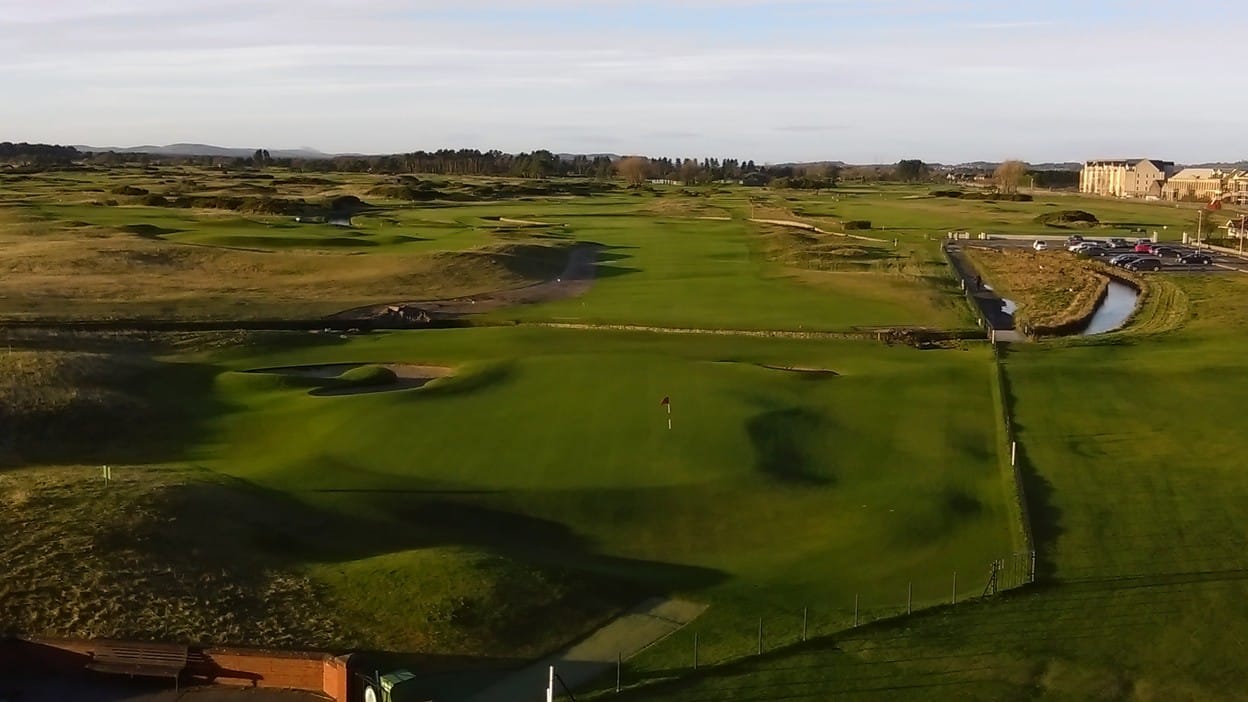
The 16th, named Barry Burn, is a long par 3 stretching 245 yards (224m) from the back tees and is often played directly into the prevailing wind, with the burn guarding the front of the green as the only real hazard. Miss short and the ball is in the water before it reaches the putting surface; miss anywhere else and a three-shot hole becomes a four. The 17th, Island, runs 433 yards (396m) and asks the tee shot to carry or skirt the Barry Burn as it winds through the fairway, punishing anything pulled left. The 18th, Home, closes at 444 yards (406m) with the burn crossing directly in front of the green and running down both sides of the fairway, which means a player protecting a lead has to commit to a second shot over water with nowhere safe to bail out short.
For the improving golfer studying this hole rather than just fearing it, the strategic lesson is straightforward: the Barry Burn punishes indecision more than bad swings. A committed layup short of the water on 17 or 18 is a far better score-saver than a half-committed shot that ends up wet trying to carry it. I default to treating a famous finishing stretch as overrated until the scoring record backs it up, and Carnoustie is one of the rare cases where it does. The Barry Burn has swung a collapse, forced a playoff, and loomed over a clean win across three different Opens, which is a harder reputation to earn than one dramatic afternoon.
Three Open finishes the Barry Burn shaped
The 1999 Open is the one most golfers know, fairly or not. Jean van de Velde arrived at the 18th tee needing only a double bogey to win, then put his second shot off the grandstand and into the burn, made a seven, and lost a three-man playoff to Paul Lawrie, who had started the final round 10 shots behind the lead.
The 2007 Open is the better strategic lesson. Padraig Harrington found the Barry Burn twice on the 18th in regulation and still made the playoff, then beat Sergio Garcia, who had bogeyed the same hole moments earlier, in a four-hole playoff by a single stroke. The burn nearly cost the eventual champion the tournament and did cost his closest rival.
The 2018 Open belongs to Francesco Molinari, who played the closing stretch cleanly under pressure across four rounds, closed with a 69, and won outright at eight under, two clear of a chasing group that included Rory McIlroy, Justin Rose, Kevin Kisner, and Xander Schauffele. It remains the calmest of the three finishes and the reason Carnoustie's reputation isn't only about collapses.
From Robertson's 10 holes to a Braid-shaped major test
Allan Robertson, generally credited as golf's first professional, laid out Carnoustie's original 10 holes around 1839. Old Tom Morris extended the course to a full 18 in 1867. The version that produces today's scoring drama dates to 1926, when James Braid oversaw a significant rework aimed specifically at preparing the course to host the Open, which it did for the first time in 1931.
That history matters for trip planning, because it explains why Carnoustie plays differently from a links like the Old Course at St Andrews. The Old Course rewards local knowledge, blind shots, and patience built up over repeat visits. Carnoustie was shaped by a championship committee with one goal: make the best players in the world earn every shot on the way in. There's less charm to discover on a first look and more of a direct physical test, which is exactly what this week's Alfred Dunhill Links Championship field faces as it rotates through the rota.
Planning a Carnoustie trip
Green fees for 2026 start at £249 for an April round and rise to £360 during peak season from May through October, with junior and juvenile rates reduced and multi-course packages available that bundle Carnoustie with other Angus links. Those figures come directly from the club's current published rates, not a third-party estimate, so they're the numbers to plan a budget around rather than a starting point for negotiation.
May through September is the sensible booking window for weather that won't actively work against a Barry Burn round, though a links this exposed is never fully sheltered and a set of quality rain gear belongs in any Scotland golf bag regardless of month. Book well ahead of the Open Championship dates when Carnoustie is in the rota, since the course closes to outside play for tournament preparation.
Pros:
- One of the most genuinely demanding finishing stretches in championship golf, with real strategic decisions rather than just difficulty for its own sake
- Deep Open Championship history that's still actively being added to, including this week's Dunhill Links rotation
- Published green fees and tee data are current and specific, which makes trip budgeting easier than at clubs that only quote ranges
Cons:
- The front two-thirds of the course, while solid, live entirely in the shadow of the finish and get little attention in most coverage
- A single round won't fully reveal the course; the closing stretch's difficulty is best appreciated across multiple attempts at it
- Not a beginner-friendly introduction to links golf, given how unforgiving the Barry Burn is on a mis-hit approach
Frequently Asked Questions
How hard is Carnoustie's finishing stretch, really?
Hard enough to have shaped three Open finishes across different decades. The 1999 collapse is the one most golfers remember, but it's not the only one. Holes 16 through 18 cross the Barry Burn repeatedly, and all three require a committed shot over water with minimal bailout room.
What are the green fees at Carnoustie in 2026?
2026 green fees run from £249 for an April round up to £360 during peak season from May through October, with reduced junior and juvenile rates and multi-course packages available.
Who designed Carnoustie's Championship Course?
Allan Robertson laid out the original 10 holes around 1839, Old Tom Morris extended the course to 18 holes in 1867, and James Braid carried out the major 1926 rework that shaped the course into the Open Championship test it's known as today.
How many Open Championships has Carnoustie hosted?
Eight, starting in 1931, along with two Women's Opens and two Seniors Opens. The most recent men's Open at Carnoustie was in 2018, won outright by Francesco Molinari.
Is Carnoustie worth playing if you're not a strong golfer?
It's playable from forward tees at 5,987 yards (5,475m), but the Barry Burn doesn't get easier from a shorter tee box, since it's positioned by the greens rather than the fairways. A golfer who wants a forgiving first taste of links golf will have a better time at a less championship-focused course first.
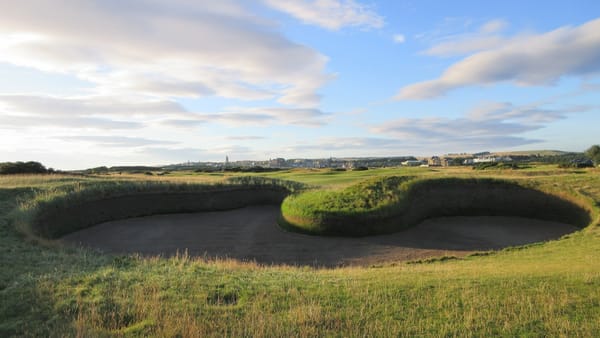
Feature photo: The 18th green on Carnoustie's Championship Course, with the Barry Burn crossing the fairway short of the green. Photo: Jim Smillie, CC BY-SA 2.0, via Geograph / Wikimedia Commons.