








reviews
Torrey Pines South Course Review
Torrey Pines South is a municipal golf course that any golfer can book, and it has still hosted
Is the Scotty Cameron Phantom 9 (2024) worth its $380 to $450 price? Here's what independent reviews and published specs show, and who should buy it.
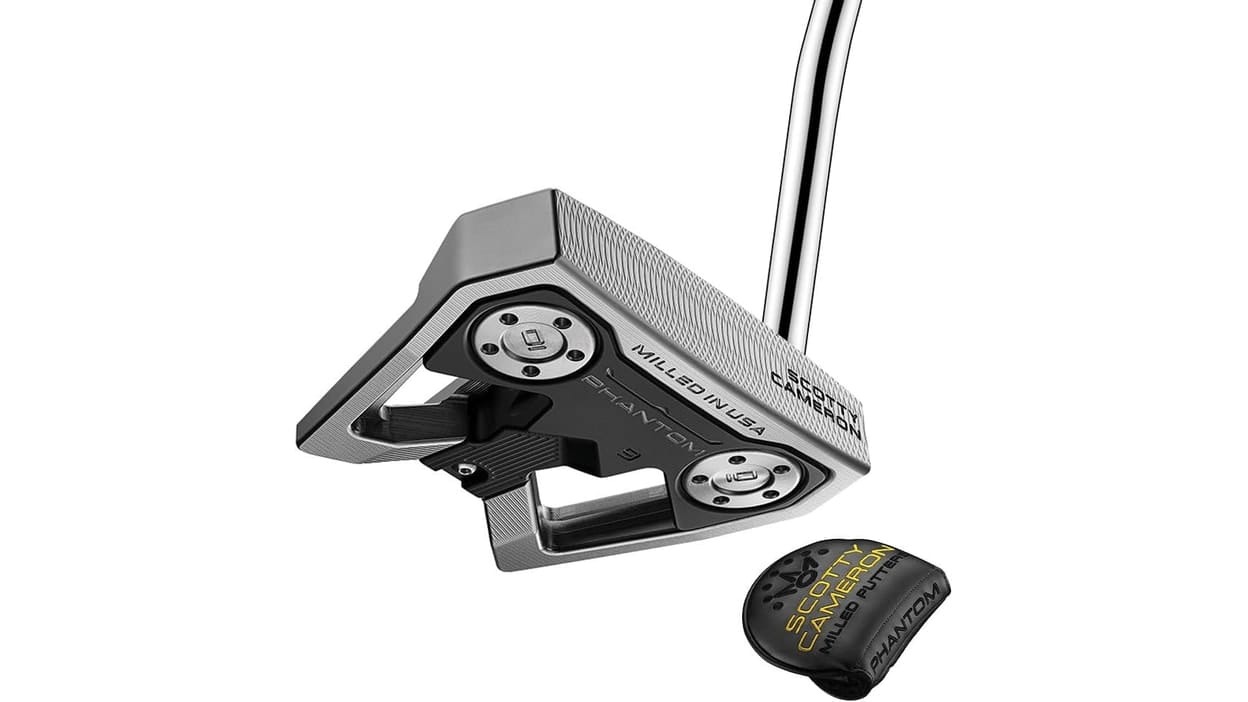
The Scotty Cameron Phantom 9 is a premium mallet putter for players who want high-MOI stability and clean alignment at address. At $380 to $450, it's a deliberate investment in the short game. Whether it earns that price depends on your fitting history and what you're actually bringing to the putting green. Scotty Cameron has since added the Phantom 12 and Phantom 3.2 to the lineup, so this review covers the Phantom 9 specifically, not the full current range.
The Phantom 9's design is organized around three features Scotty Cameron describes in the published specifications: the T-bar chassis, multi-material head construction, and sole geometry.
The T-bar chassis runs along the topline from face to rear flange and serves two purposes. The first is visual: the bar creates a clear alignment reference at address, giving the player a defined line to square the putter face to the intended start line. The second is structural: the T-bar moves mass toward the heel-toe axis, which increases MOI (moment of inertia) and reduces face rotation on off-center strikes. More mass at the perimeter of the head means the face resists twisting when ball contact falls outside the geometric center, per Scotty Cameron's published specifications.
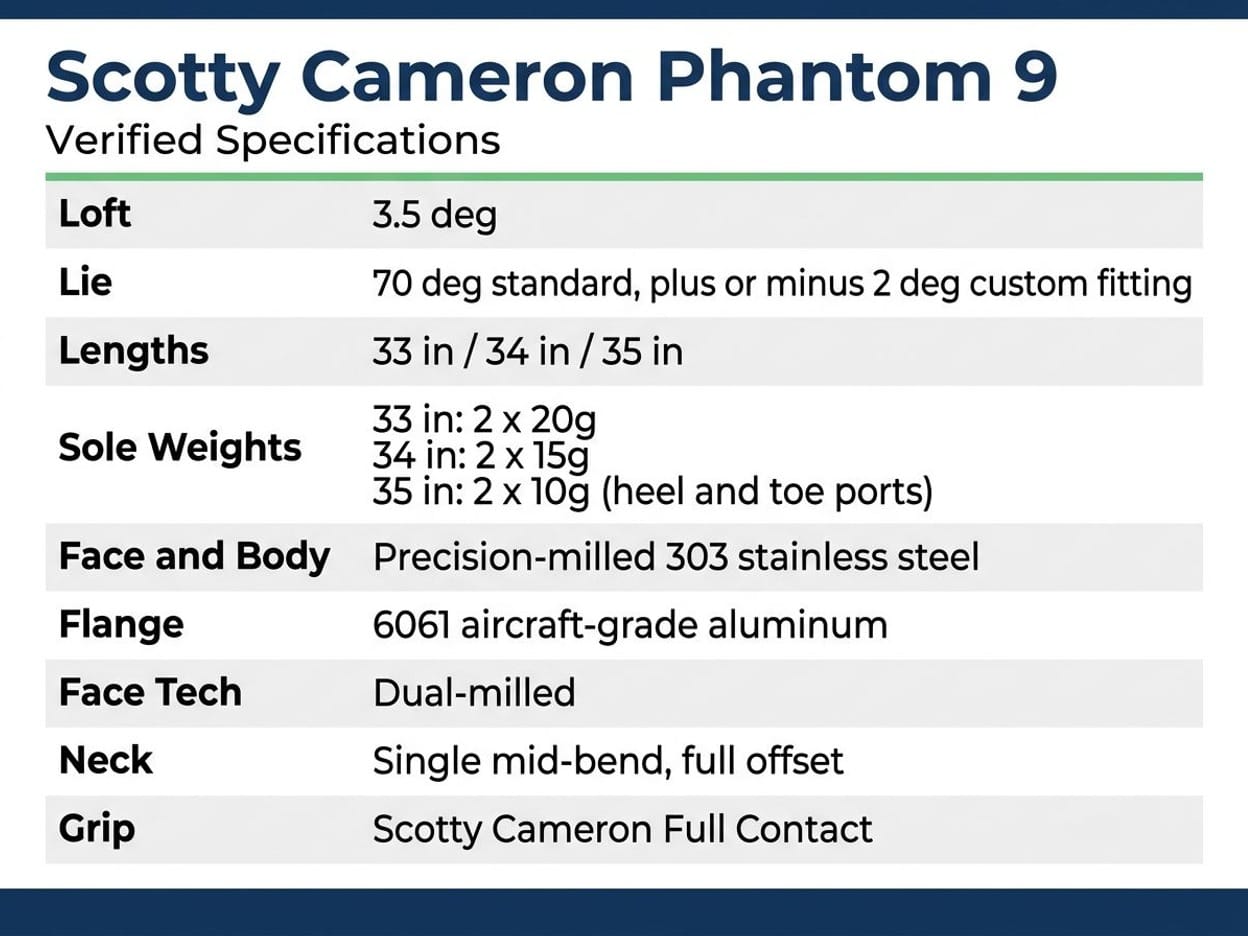
The head uses precision-milled 303 stainless steel for the face and body, with a 6061 aircraft-grade aluminum flange at the rear (black misted, anodized). The stainless steel provides the hard, precise contact surface Scotty Cameron's milling is known for; the aluminum flange saves mass at the rear and allows redistribution toward the perimeter weighting. The face itself is dual-milled: a deep-mill profile for softness of feel and a mid-mill layer for stroke feedback. The neck is a single mid-bend with full shaft offset. Grip is the Scotty Cameron Full Contact, per the confirmed published specifications.
Sole geometry: the Phantom 9's sole runs two weight ports, positioned at the heel and toe. Port weights are calibrated to length: the 33-inch (83.8cm) version ships with 2x20g ports (40g total), the 34-inch (86.4cm) with 2x15g ports (30g total), and the 35-inch (88.9cm) with 2x10g ports (20g total). At address, the sole geometry determines how the putter sits on the putting surface, which influences effective lie angle and where the face points relative to the player's eye line. Players who've been custom-fitted to a specific lie angle will want to confirm the Phantom 9's standard geometry matches their stroke before purchasing. For guidance on establishing the right length and lie before buying, see the putter length guide.
Available lengths in the standard retail configuration are 33, 34, and 35 inches (83.8, 86.4, and 88.9cm). Standard loft is 3.5° and standard lie is 70°, with custom lie available from 68° to 72°. The 3.5° loft is within the standard range for a mallet putter designed to promote forward roll on greens running between 10 and 12 on the stimpmeter.
Scotty Cameron has since expanded the Phantom line with two additions at a higher $499 price point; our Scotty Cameron Phantom 12 and 3.2 coverage looks at how the larger, higher-MOI Phantom 12 compares to the Phantom 9's profile here.
The performance measures that matter at this price are alignment confidence at address, roll start consistency off the face, feel across distances, and off-center forgiveness.
Alignment. The T-bar chassis is the design's defining feature at address, and independent reviews are genuinely split on it. Golf Monthly's Joel Tadman (Apr 8 2024) describes the alignment lines as a "track system," rating them as effective for squaring the face to the intended start line. Plugged In Golf's Matt Saternus (Jan 1 2026) reaches a different conclusion: the two full-length sight lines "command too much attention" at address, and he found the putter "looks cheap" for a construction priced at $380 to $450. Both assessments matter. If you've tried the Phantom 9 on a practice green and the alignment lines worked for you, that's useful data; if the address look put you off, that's useful data too.
Roll start consistency. The dual-milled face, combining deep-mill softness with mid-mill feedback, is the mechanism for consistent ball contact, per the confirmed published specifications. Golf Monthly's Tadman (Apr 8 2024) found the roll on longer putts smooth and consistent, which aligns with what high-MOI mallet geometry and a precision-milled face are designed to produce. The Phantom 9 earned the 2025 Golf Digest Hot List Gold Medal, reflecting recognition at category level across Golf Digest's independent testing panel.
Feel across distances. The Phantom 9's mallet geometry is most relevant from 15 feet (4.6 meters) and beyond, where off-center contact is more likely and the high-MOI benefit is measurable. From inside 8 feet (2.4 meters), feel sensitivity is the dominant variable, and players whose stroke is calibrated to blade or mid-mallet feedback may find the Phantom 9's dampened contact character takes adjustment. Tadman (Golf Monthly, Apr 8 2024) frames this as a category characteristic of large mallets rather than a Phantom-specific limitation.
The honest version of the fit question. A correctly fitted Phantom 9 performs at the level the price implies; one chosen by brand preference and generic length off the shelf can underperform a correctly fitted $150 alternative, though the fitting data matters more than the new-gear confidence for players who respond to the latter over a launch-monitor session at a fitting studio.
Serious amateurs, handicap 22 and below, with a professional fitting. This is the putter's primary audience. If a fitting has identified face alignment inconsistency or off-center strike pattern as a contributing factor in your putting numbers, and the Phantom 9's head shape and length match your stroke arc, the investment is justified. The putter performs at the level you're paying for.
Players who've traced three-putting to mechanical issues. If your three-putting comes from stroke path errors, poor distance control on lag putts, or deceleration through impact, the Phantom 9 doesn't fix any of that. Equipment is the last variable to change when the stroke is the underlying cause. Work through the how to stop three-putting guide first, then revisit equipment once the mechanical source is identified.
Weekend golfers without fitting data. The Phantom 9 can work for this group, but the risk is real: you're paying for precision engineering optimized for a specific stroke type, and without fitting data you may not know whether that stroke type is yours. A fitting session at a local golf retailer typically runs $50 or less and is worth the time before committing to a $400 putter.
Players better served by alternatives. If budget is a consideration and your putting improvement isn't tied to a fitting-confirmed equipment gap, the Odyssey Tri-Hot 5K and TaylorMade Spider Tour series offer strong alignment and high-MOI geometry at significantly lower price points. There's no editorial point in recommending the Phantom 9 to a player whose game doesn't call for it.
Not the right starting point. At $380 to $450, the Phantom 9 is optimized for players who've identified specific needs through fitting (alignment, off-center forgiveness, stroke arc match) and have fitting data to support the purchase. Beginners are better served by a correctly fitted mid-range mallet from Odyssey or TaylorMade, which leaves budget for fitting and lessons.
The Phantom 9's standard loft is 3.5° and standard lie is 70°, with custom lie available from 68° to 72°. Both figures are confirmed across retailer specifications. The 3.5° loft is within the standard range for a mallet putter designed to promote forward roll on greens running between 10 and 12 on the stimpmeter. If you've been fitted to a specific dynamic loft at impact, compare that to the 3.5° standard before purchasing.
Both share the T-bar chassis and multi-material construction, per Scotty Cameron's published lineup documentation. The key difference is head shape: different model numbers in the Phantom line correspond to different head geometries. For a side-by-side visual comparison of the 9 and 5 head shapes for the 2024 lineup, Scotty Cameron's product pages and authorized retailers carry fitting notes alongside images, and it's worth reviewing those before deciding between models.
The Phantom 9 is built to tighter manufacturing tolerances with precision milling on the face and multi-material construction that redistributes mass more precisely. Whether that precision advantage translates to better putting depends heavily on fit. A correctly fitted Odyssey Tri-Hot 5K at around $200 can outperform an off-the-shelf Phantom 9 for a player whose stroke doesn't match the Phantom 9's geometry. The Phantom 9 wins when the fit is confirmed and the player's game calls for it.
The Scotty Cameron Phantom 9 (2024) is available on Amazon with Prime shipping. Scotty Cameron putters are also sold through authorized golf retailers. If you're buying for the first time, a retailer with a fitting bay is the better route. The fitting is worth more than the convenience of online ordering on a $400 purchase.
Some links in this article are affiliate links. If you buy through them, I earn a small commission at no extra cost to you. This never influences what I cover or recommend. I link to gear I'd buy myself.
Data-backed reviews and advice that works. No brand spin.