The Most Common Golf Injuries (and How to Actually Prevent Them)
A breakdown of golf's five most common injuries, lower back, elbow, shoulder, wrist, and hip/knee, and the free prevention work that beats any recovery gadget.

Golf has a reputation as a low-impact sport, and compared to contact sports it is. But the numbers tell a different story about wear and tear. A 2024 British Journal of Sports Medicine meta-analysis covering 9,221 golfers found a 73.5 percent lifetime injury prevalence among professionals and 56.6 percent among amateurs, with the lower back and the hand or wrist the most common sites. The repetitive, asymmetrical swing is the common thread across nearly every injury below, whether it lands in the low back, elbow, shoulder, wrist, or hip and knee.
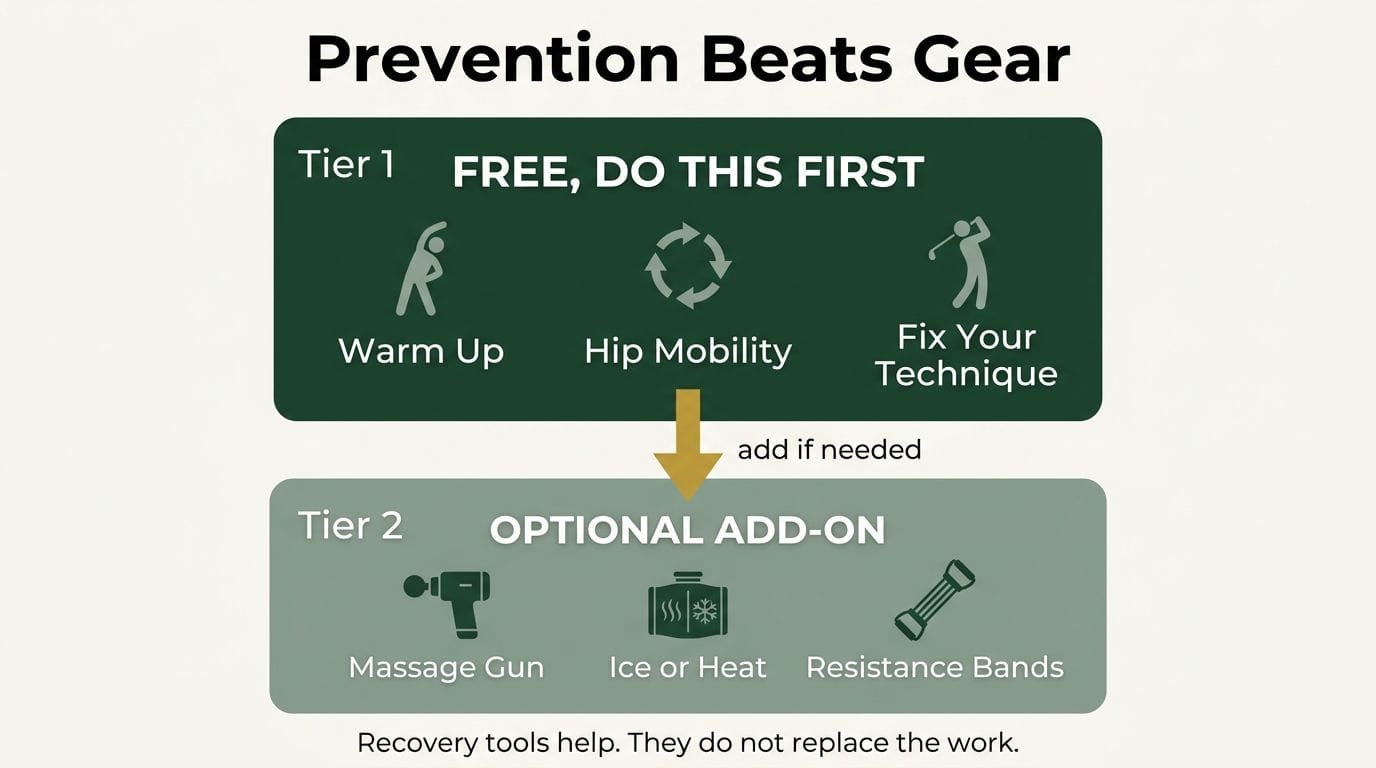
Most of what actually prevents these injuries costs nothing. Warm-up, mobility work, and technique adjustments do more for durability than any piece of gear, so each section below covers mechanism first, risk factors second, and free prevention third. Recovery tools show up at the end, as an add-on to that foundation, not a substitute for it.
This is general information drawn from published sports-medicine sources, not a diagnosis. Persistent or acute pain is worth a physical therapist's or physician's opinion rather than training through it.
- The lower back is the single most commonly injured area in golf, with the hand and wrist close behind, per a 2024 meta-analysis covering 9,221 golfers.
- Free prevention beats gear: warm-up, mobility work, and technique fixes address the actual mechanics behind each injury, and none of it costs anything.
- Limited hip mobility is a recurring root cause across lower back, hip, and knee injuries, showing up as a compensation pattern before pain does.
- Recovery tools like massage guns, ice/heat wraps, and resistance bands are an add-on, not a substitute for the free prevention work that actually reduces injury risk.
- Persistent or sharp pain calls for a physical therapist or physician, not more rounds of training through it.
Lower back
The lower back is the single most commonly injured area in golf, and by a wide margin. Depending on the study, lower back pain accounts for 18 to 54 percent of all documented golf-related injuries, a range reflecting differences in how each study counted and defined an injury. That's a different measure from prevalence, how many golfers report ever having had the problem, which a biomechanical risk-factor review in the journal Sports Medicine and Health Science put at around 55 percent among professional golfers and 15 to 35 percent among amateurs.
The mechanism comes down to rotational force through the spine, repeated thousands of times a season. Research tracking golfers who developed lower back pain over a six-month period found measurable swing differences before the pain even started: excessive side-bend, over-rotation, restricted lead hip internal rotation, and poor trunk endurance. Heavy playing and practice volume, especially at an elite level, raises the exposure.
Free prevention starts with hip mobility, not back strength. If the lead hip can't rotate internally through impact, the lumbar spine picks up the slack, which is the pattern researchers keep finding in golfers who go on to develop pain. Our tightest link guide walks through a simple screen for finding which joint is actually limiting your rotation, a more useful starting point than generic back stretches. Trunk endurance work (planks, side planks, dead bugs) and warming up hip rotation before you swing address the pattern directly, at no cost.
Golfer's elbow (medial epicondylitis)
Golfer's elbow is inflammation where the forearm tendons attach to the inside of the elbow, at the medial epicondyle. It's a repetitive-stress injury, and the golf-specific mechanism usually traces to the pronator teres and forearm flexor muscles absorbing excess load during the downswing's acceleration phase.
Novice golfers carry a disproportionate share of the risk. An incorrect weight shift, or a tendency to "throw the club down" at the ball, increases stress on the inside of the forearm. A wrist that flexes too hard through the follow-through, or turns over aggressively, can produce the same injury on the lead arm instead of the trail arm, and an incorrect grip compounds it by keeping the forearm muscles under tension longer than they need to be.
The free fix is mechanical before it's physical. A lesson that corrects an early release or an over-active wrist through impact removes the repeated stress at its source, which no amount of forearm strengthening fully offsets if the swing fault stays in place. Light resistance work for the forearm flexors and pronators, plus managing practice volume so the tendon gets recovery time, round out the free approach.
Lead shoulder and rotator cuff
The shoulder is one of the more commonly injured areas in golf, and the rotator cuff, the group of four muscles stabilizing the joint, takes the brunt of it. The most common patterns are rotator cuff strain from overuse and shoulder impingement, where the tendons get pinched inside the joint during the swing's repetitive overhead-adjacent motion.
Risk climbs with poor technique and with volume: golfers who swing repeatedly without breaks, or who compensate for weak scapular stabilizers by loading the shoulder joint itself, tend to develop pain first. Left untreated, impingement raises the risk of a genuine rotator cuff tear.
Prevention is almost entirely strength and posture work, and it's cheap. Light external and internal rotation exercises, done with nothing more than a resistance band, build rotator cuff stability without adding bulk. Rows and reverse flyes targeting the shoulder blade muscles support the same stability from another angle, and a stronger core reduces how much the shoulder compensates for a wandering posture. None of that requires equipment beyond a band, and a proper warm-up beats any single exercise on its own.
Wrist
Wrist injuries in golf split into two categories: acute jarring injuries and repetitive-strain tendinitis. The acute version happens on a fat shot, when the club catches the ground, a buried root, or a rock before it reaches the ball, and the wrist absorbs that sudden deceleration first.
The repetitive version is more common and shows up as tendinitis, inflammation where the tendons crossing the wrist attach to the hand. It appears on the thumb side (De Quervain's tendinitis) or the pinky side, where the extensor carpi ulnaris tendon stabilizes the joint, and it tends to build from overuse rather than a single bad strike. A wrist that stays over-flexed or over-extended through the swing, rather than neutral, puts extra strain on those tendons every rep.
Grip pressure is the free variable most golfers overlook, and it's an easy one to let creep back up over a season without noticing. Gripping the club too tightly forces the wrists to absorb more shock than they should, and a neutral wrist position through the swing, rather than an extreme flexed or extended one, removes much of the strain at the source. Cleaning up strike quality so you're catching the ball before the turf cuts down on the acute version too.
Hip and knee
Hip and knee injuries build up slowly rather than happening on a single swing. The hip absorbs enormous rotational force over thousands of reps across a season, and the most common resulting injuries are labral tears, hip bursitis, and hip flexor strain. Research on lower-limb biomechanics has also found that golfers with a history of knee injury move differently through the downswing, particularly in how much the trunk leans forward and how the front foot rotates.
Limited hip mobility is the risk factor that shows up most consistently. When the hip can't rotate through its full range, the body compensates somewhere else in the chain, and that compensation often turns into hip impingement or a labral tear over time. The same restriction shifts extra rotational and lateral stress onto the knee, which wasn't built to be the primary rotating joint in the swing.
Free prevention centers on mobility, not strength alone: hip rotation drills, ankle mobility work, hamstring flexibility, and thoracic spine rotation address the actual limitation rather than just building muscle around it. Technique matters too. Avoiding excessive forward trunk lean and keeping the front foot from rotating in or out excessively both reduce the load on the knee every downswing.
Recovery and pain management
Free prevention comes first, but a few recovery tools fill a real gap once soreness or minor strain shows up.
Percussive massage guns deliver rapid, targeted pressure into a muscle, a reasonable option for post-round soreness in the back, shoulders, or forearms without needing a table and a therapist. The Therabody Theragun Mini (3rd Gen) is compact enough for a golf bag or a car, which matters more than raw power for something you'll actually use after a round.
Ice and heat aren't interchangeable. Ice is the better choice in the first 48 to 72 hours after an acute strain, since it limits inflammation while tissue is still reacting. Heat works better on chronic stiffness, the kind of tight lower back or hip that shows up before a round rather than after an injury, since it increases blood flow to tissue that's stiff rather than actively inflamed. A wrap like this adjustable hot and cold back wrap with a gel pack covers both uses with one piece of gear.
TENS units deliver a low-level electrical current through the skin to interrupt pain signals, and some golfers use them for chronic soreness in the lower back or shoulder. They don't address the underlying mechanical cause the way mobility work does, so they're better thought of as short-term relief than a fix.
Resistance and mobility bands do double duty for prevention and recovery. A set like the Thera-Band Professional Non-Latex Resistance Bands covers the rotator cuff and hip strengthening work described above, and the same bands work for gentle mobility movement while recovering from a minor strain. For a broader home routine, our at-home golf fitness equipment guide covers foam rolling as a companion to the strength work here.
None of this replaces seeing a professional. Persistent pain, or any pain sharp enough to change how you're moving, is worth a physical therapist's or physician's opinion rather than another week of icing and hoping. I'd rather see a golfer spend on a lesson to fix the swing fault than on another recovery gadget chasing the symptoms that fault keeps creating, since the evidence behind most of these tools is thinner than the marketing around them.
Frequently Asked Questions
What is the most common golf injury?
Can I keep playing golf with golfer's elbow?
Should I use ice or heat for golf-related pain?
Do I need to buy equipment to prevent golf injuries?
How much does hip mobility actually matter for injury prevention?
Some links in this article are affiliate links. If you buy through them, I earn a small commission at no extra cost to you. This never influences what I cover or recommend. I link to gear I'd buy myself.








The golf newsletter that cuts the hype
Data-backed reviews and advice that works. No brand spin.
Recommended products