Club Path vs Face Angle: Reading Your Launch Monitor Data
Club path and face angle explain every shot shape. Face angle controls 85% of start direction. Here's how to read both on your launch monitor.
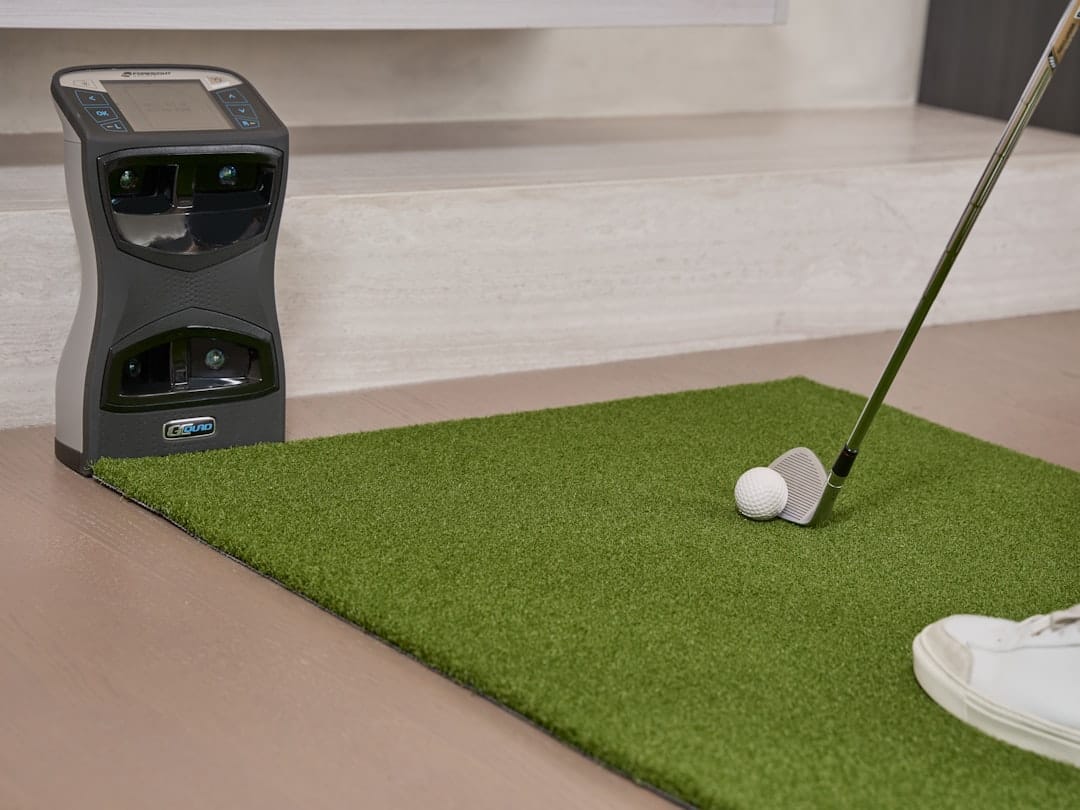
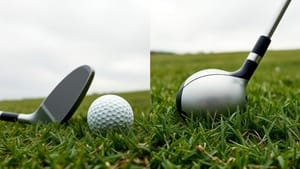
Photo by Chiputt Golf on Unsplash
Club path describes your clubhead's horizontal heading through impact, measured in degrees relative to a chosen target line. Face angle pinpoints where your clubface points at that same moment, also expressed in degrees off aim. Most amateurs read these figures as if interchangeable, and such single misreading explains why so many range sessions end with whatever slice their owner walked in carrying.
If you own a Garmin R10, a Rapsodo MLM2PRO, or have been fitted on a Trackman, you've seen this pair side by side. They aren't hard once you understand which metric starts a shot, which one curves it, and how both combine to create every shape you've ever hit.
TL;DR
- 1Face angle drives roughly 85% of driver start direction and 75% with a mid-iron (Titleist Learning Lab, citing Trackman). Head movement does not begin the shot.
- 2Face-to-path, the gap between those two readings, governs curve shape. Negative differentials yield draws; positive numbers send up fades.
- 3A typical slicer reads -5° travel, +2° clubface, +7° differential. Quick "path fixes" applied without correcting orientation worsen outcomes.
- 4Most consumer launch monitors infer this number rather than capture it. MLM2PRO skips reporting altogether; R10 carries a 1.5° to 4° error band against Trackman.
- 5Session targets for a mid-handicapper: clubface inside ±1.5°, head movement between -2° and +2°, differential under 3° (CT Golf Reviews, Feb 2026).
- 6Steady your clubface number first, differential second, raw heading last.
What Is Club Path? (And What It Isn't)
Club path describes your clubhead's horizontal heading at impact, expressed in degrees off aim. Trackman defines positive values as in-to-out (head moving right of your line for a right-hander) and negative values as out-to-in (heading left).
Here's where folks trip up. Such readings show clubhead destination, not where the ball departs. Ball direction follows whatever the leading edge does. A figure of -5° tells you the head is moving 5° left of aim. It says nothing about where the ball will start.
Anything between -2° and +2° counts as workable straight-shot territory. Beyond those bounds, you're playing a shape on purpose, or you've got a swing pattern needing attention. Tour stock draws run about +3° to +4° with a closed clubface relative to aim but open versus head movement. Stock fades sit around -2°, faces splayed against that motion.
Most amateurs hunt for a "neutral path" when orientation is the real culprit. You can post a perfect 0° reading and still slice the ball 30 yards (27m) right, because your blade stayed splayed open versus aim at impact. Path is one ingredient, not the cake.
What Is Face Angle? The Number That Starts the Ball
Face angle captures clubface orientation at impact, expressed in degrees off your target line. Trackman calls this the most important figure for starting direction, and research backs that claim. According to Titleist Learning Lab, citing Trackman, it contributes about 85% of driver launch line and 75% for mid-irons. Head travel covers the remainder.
CT Golf Reviews (Feb 17, 2026) cites Wood et al. (2018), who found blade orientation alone explains 61% to 83% of launch variance across club types. A separate citation references Miura (2002), where this metric accounted for 82% of spin-axis variance at impact. Longer clubs lean even more heavily on this reading. With wedges, loft does some lifting and head travel matters more. Drivers? Orientation is nearly the whole story.
If every swing sends balls right of aim, your blade sat splayed at impact. Travel may shape curve, but orientation set that starting line.
Quick device note. Trackman and Foresight GCQuad (with their Clubhead Measurement add-on) directly observe blade position at impact. Most consumer monitors estimate that figure from ball flight, so any number shown on a Garmin R10 or SkyTrak is calculated, not measured. More below.
What Is Face-to-Path? The D-Plane Explained
Face-to-path is face angle minus club path. It is a single number that tells you how much the ball will curve. Trackman publishes this metric on every shot for a reason: it's the cleanest predictor of shape you'll find on a launch monitor.
The physics behind it is the D-Plane, first described by Theodore Jorgensen in The Physics of Golf (1991) and brought into golf coaching by the TrackMan newsletter in 2009. The short version: the ball curves toward whatever the face is doing relative to the head's travel.
Map the differential to a shape. Numbers are face-to-path values in degrees, right-handed player.
| Face-to-path | Shot shape |
|---|---|
| 0° | Straight |
| -1° to -3° | Draw |
| -4° or more negative | Hook |
| +1° to +3° | Fade |
| +4° or more positive | Slice |
Trackman's published curvature data on a 275-yard (251m) driver: a -2° differential produces about 19 yards (17m) of left curvature; a +5° differential produces about 44 yards (40m) of right curvature. That's the gap between a playable draw and a ball lost in the trees.
Two takeaways from this curve data, both worth keeping in mind on the range. First, slices don't grow in a straight line. On a driver, the gap between +3° and +5° is much bigger than the difference between +1° and +3°. Once you're past about 4°, the ball goes off in a hurry, and a tweak that reduces a +6° miss to +4° still leaves you with a slice. Second, the same differential produces less curve on a shorter, more lofted club. A 6-iron is more forgiving on a face-to-path miss than a driver because higher loft puts more backspin and less side spin on the ball. Practical implication: dial in your driver face-to-path on the range, and your iron shapes will sort themselves out with the same swing.
Reading Typical Patterns in Your Data
A classic slicer pattern looks like this: club path -5°, face angle +2°, face-to-path +7°. Read in that order, the data tells a story.
Path is sharp out-to-in, so the slicer thinks the answer is to swing more in-to-out. Fair enough. But the face is +2° open to the aim, so the ball doesn't start where they're aiming, it starts right of it. The differential is +7°, well into slice territory, so once the ball starts right, it curves further right.
If a slicer fixes path alone and gets to 0° without changing where the face points, the new pattern becomes: path 0°, face +2°, face-to-path +2°. The slice becomes a fade, the start direction stays right, and the player wonders why "fixing my path" half-worked. That's two problems in one hat.
Pull-versus-hook is the same idea in reverse. A pull goes left and stays left because the face is closed at address but the differential is near zero. A hook goes left and gets worse because the face is closed to the path, producing draw spin that keeps turning the ball over.
Single shots are noisy. Golf Insider UK's October 2023 head-to-head, run by Britt Olizarowicz, put the R10's face-side error against Trackman 4 at 2.76° on driver, 2.04° on 7-iron, 1.51° on pitching wedge. Path-side errors came in at 2.98°, 3.77°, and 3.09° on the same clubs. Use rolling 10-shot averages. Patterns over ten shots are signal. One reading is noise.
Which Consumer Launch Monitors Truly Measure Face Angle?
Two groups of devices: those that measure where the face points through cameras or club tracking, and those that estimate it from ball flight using algorithms. The numbers mean different things in each case.
Foresight GCQuad measures the face reading, but only with the Clubhead Measurement add-on, priced at about $2,000 over the base unit. The standard GCQuad is a ball-data unit.
Foresight GC3 does not provide face data at all. If you want it on a GC3, you're inferring it from ball start direction.
Garmin Approach R10 estimates both numbers via Doppler radar. Golf Insider UK's October 2023 study put the error at 1.5° to 4° against Trackman 4 depending on the club. Enough range to confuse a single-session diagnosis, though trends over multiple sessions are usable. At $399, a reasonable trade.
Rapsodo MLM2PRO added club path and attack angle in May 2025. Rapsodo's validation study (May 28, 2025) put the MLM2PRO's path mean absolute error at 1.19° against a GCQuad across 1,021 shots. Tighter than the R10 on travel direction. But the MLM2PRO does not report face data (Golficity, May 29, 2025). Cleaner travel data and no face data, which is the wrong half if the face was what you wanted.
Bottom line: ball flight is the most honest feedback on the face you have access to. If the ball starts 10 yards (9m) right of where you aimed, the face was open. Your monitor's face reading is directional, useful as a trend, less so as a single absolute value.
What to Fix First, Face Angle, Club Path, or Both?
Priority order: face variance, then differential, then raw travel direction.
Variance comes first because consistency beats geometry. A face reading that swings between -2° and +5° across ten shots produces ten different shot shapes, and no swing change builds on top of that. CT Golf Reviews (Feb 17, 2026), citing Brennan et al. (2023), pegs recreational face inconsistency at ±4° to ±6° per session. Trackman's elite-tolerance data lands at 1° face-to-path for repeatable 300-yard (274m) driving. What separates recreational and elite golfers is variance, not direction. Translation: a 12-handicap who steadies their face inside ±2° picks up more strokes than one who hunts a "perfect" 0° path with a face number that still wanders ±5°. Repeatability comes before refinement.
That same source notes a 2° face error produces 33 feet (10m) of lateral deviation at 280 yards (256m). Two degrees doesn't sound like much. Ten yards (9m) off line at 256m is the difference between fairway and trouble. Picture a wedge from 130 yards (119m) instead of a punch-out from rough or trees: that's the strokes-saved math behind face consistency.
Session targets for a mid-handicapper, drawing on Trackman synthesis in CT Golf Reviews:
- Face reading: ±1.5° across ten shots
- Path reading: -2° to +2°
- Differential: under 3° in either direction
Hit those, and you have a swing the launch monitor agrees is repeatable. Jon Sherman at Practical Golf framed it well: use the data to guide you toward a functional range and a ball flight you can repeat, not perfect numbers. Tour averages aren't a target for a 14-handicap. A repeatable shape is.
Three-step sequence on a home setup:
- Hit ten driver swings with the same target. Look at the standard deviation of the face reading across those ten. If it's over 2°, your priority is grip and setup work, not path work. Variance kills consistency before angle matters.
- Once the face holds inside ±1.5°, look at the differential. If it's over 3°, work on matching the head's travel to where the face is pointing. A common amateur fix is closing the stance to encourage in-to-out travel, which moves the differential without forcing a face change.
- Then, address raw direction. By now your shape is repeatable, and changing direction is a fine-tune rather than a rebuild.
Most amateurs flip this on its head. They go after the path reading first because it's the obvious one, and they end up with a different problem instead of a fixed one. If you're going to spend an hour on the launch monitor, the cheapest gain is locking in a face number you can repeat. Everything else builds on top of that. I've gone deeper on the slice version in how to fix a golf slice.
One last thing worth tracking alongside path: attack angle shifts the path numbers in ways most golfers don't expect. With a driver, a positive attack angle pulls path inside-out by geometry alone. For the whole impact picture in one place, the ball-flight laws covers it end to end.
Frequently Asked Questions
What is club path and why does it matter?
Club path is the horizontal direction the clubhead is traveling at impact, measured in degrees relative to the target line. Positive values are in-to-out, negative values are out-to-in (Trackman). It matters because it's one of the two inputs that determines shot shape, alongside face angle. Path on its own does not start the ball; it influences curve when combined with the face position. A neutral path for straight play sits between -2° and +2°.
What is face angle and how does it affect ball flight?
Face angle is the direction the clubface is pointing at impact, in degrees relative to the target line. It controls roughly 85% of where the ball starts on a driver and about 75% on a mid-iron, according to Titleist Learning Lab data citing Trackman. If the face is open to the target at impact, the ball starts right of the target for a right-handed player. If it's closed, the ball starts left.
What is face-to-path and how do I read it?
Face-to-path is face angle minus club path, and it controls how much the ball curves. A face-to-path of 0° produces a straight ball. Negative differentials (-1° to -3°) draw the ball; -4° or more produces a hook. Positive differentials (+1° to +3°) fade the ball; +4° or more produces a slice. On a driver carrying 275 yards (251m), Trackman data shows a +5° differential produces about 44 yards (40m) of right curve.
What do my numbers mean if I'm a slicer, and what should I fix first?
The classic slicer pattern is club path around -5°, face angle around +2°, face-to-path around +7°. The face is open to the target, so the ball starts right. The face is also open to the path by 7°, so the ball curves further right. Fix face angle before path. Within face angle, work on variance before geometry: a face holding within ±1.5° across ten shots is more useful than a face that averages 0° but swings between -3° and +3°. Once the face is consistent, address face-to-path. Raw path direction is the last priority. Workable session targets for a 10 to 22 handicap are face angle within ±1.5°, club path between -2° and +2°, and differential under 3° (CT Golf Reviews, Feb 2026, synthesising Trackman).
Does my launch monitor accurately measure face angle and club path?
It depends on the unit. The Foresight GCQuad measures face angle only with the Clubhead Measurement add-on (about $2,000 extra). The Foresight GC3 does not provide face angle. The Garmin Approach R10 estimates both via Doppler radar, with face angle error of 1.5° to 4° and club path error of 3° to 4° against a Trackman 4 (Golf Insider UK, October 2023). The Rapsodo MLM2PRO measures club path with a 1.19° mean absolute error against GCQuad (Rapsodo validation study, May 2025) but does not measure face angle at all. Use consumer-monitor numbers as trends across ten shots, not as single absolute readings.
Why does my ball still curve right even when my club path looks neutral?
Because curve is set by face-to-path, not path alone. A 0° club path with a +3° face angle produces a +3° face-to-path differential, which fades or slices the ball depending on club. The face is open to the path even though the path is on line. Look at the face-to-path number; that's the curve.
If you want path data that holds up against a Trackman, the Rapsodo MLM2PRO ($699) is the better-pathing consumer option, with the caveat that it doesn't report face angle. If you want both metrics on a budget and you're willing to read the numbers as trends, the Garmin Approach R10 ($399) is the entry point most amateurs land on. Neither replaces a Trackman bay session if you're chasing a 1° tolerance; both are honest practice tools if you read them as directional. Pick the one that matches the data you actually want.
Some links in this article are affiliate links. If you buy through them, I earn a small commission at no extra cost to you. This never influences what I cover or recommend. I link to gear I'd buy myself.








The golf newsletter that cuts the hype
Data-backed reviews and advice that works. No brand spin.
Recommended products

Rukket SPDR Golf Net Review: 10x7 Bundle for Home Practice.
The Rukket 10x7 SPDR golf net bundle reviewed: what's actually in the box, what MyGolfSpy and PluggedInGolf found, and who it fits best.
Read review