Golf Balls by Handicap: Which Tier Should You Buy?

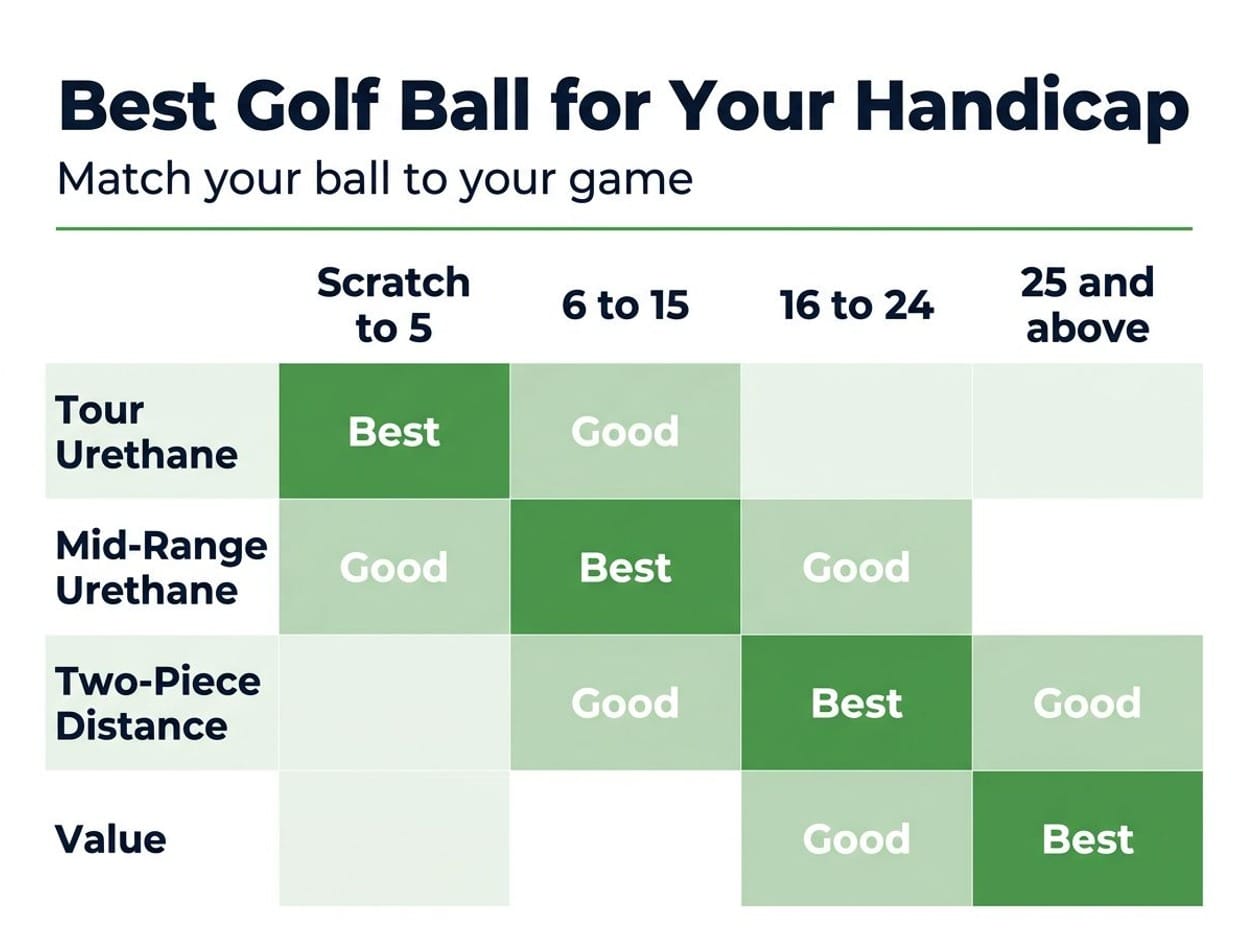
The right golf ball for your game is determined by one number: your handicap. Under ten, cover material and spin separation between clubs matter. Over 20, compression and “feel” become factors that get in your way more than they help. This guide maps four handicap brackets to four ball tiers, with a specific purchasable pick in each.
- Scratch to 5: TaylorMade TP5x (2025)
- 5 to 15: TaylorMade Tour Response (2025)
- 15 to 25: Callaway Supersoft (2025)
- 25 and up: Callaway Warbird
Scratch to 5: Tour urethane
The case for a tour ball is specific and has a hard prerequisite: you need to generate enough clubhead speed to compress it properly. TaylorMade positions the TP5x around distance, ball speed, and a penetrating lower-spinning flight through the long game, framing it as the choice for players who prioritize distance and a penetrating ball flight over maximum short-game spin. They publish no swing-speed cutoff for the ball. Independent reviewers suggest the TP5x’s construction advantages come through most clearly above 100 mph (161km/h) in driver clubhead speed, and note that the ball’s lower long-game spin can work against players who don’t generate sufficient speed to compress it. Above that threshold, a five-piece cast urethane ball like the TP5x (2025) responds differently from club to club, producing more backspin from a wedge than from a 7-iron, and more from a 7-iron than from a driver. That’s spin separation, and it’s what the five-piece architecture is designed to create.
The TP5x is built around a five-layer core-to-cover system and a cast urethane cover, per TaylorMade’s published specifications. The urethane cover compresses against your wedge grooves at impact in a way that ionomer covers don’t, and the result is more friction, more spin, and more stopping distance on approach shots. The 2025 version earned a place on Golf Digest’s annual Hot List, consistent with the ball’s position across multiple prior iterations.
At this handicap level, the short-game performance is measurable, not theoretical. A scratch to five player is regularly shaping shots, pitching to tight pins, and expecting the ball to stop on command. That’s the use case the TP5x is built for.
For comparison on how a tour urethane stacks up against the market benchmark, see the Titleist Pro V1 review.

TaylorMade TP5x (2025)
Five-piece cast urethane: spin separation for players above 100 mph (161km/h)
 Buy on Amazon
6 to 15: Mid-range urethane
This is the bracket where golfers most often overbuy into a tour ball or underbuy into a two-piece. The Tour Response (2025) lands exactly in the gap.
The Tour Response is a three-piece ball with a cast urethane cover, per TaylorMade’s published specifications. The urethane cover is the part that matters for this bracket: it generates real short-game spin, the kind that produces check on pitch shots and feels different from ionomer on a bump-and-run. A 10 handicap is chipping and pitching from around the greens regularly enough that cover material translates to strokes.
What the Tour Response doesn’t do is deliver the full spin-separation architecture of the TP5x. Three pieces versus five means less differential between your driver spin and your wedge spin. For a player in this bracket, that’s an acceptable trade. At 6 to 15, the short-game feel gains from urethane are accessible; the advanced spin-separation gains from a five-piece require a swing that most players in this bracket are still developing.
Price is part of the argument. Tour balls typically run around $49 a dozen as of June 2026. The Tour Response comes in at roughly $42. If the urethane benefit is what you’re buying, you get it from the Tour Response without paying for engineering you won’t fully activate.

TaylorMade Tour Response (2025)
Cast urethane cover at mid-range price: real short-game feel without the tour-ball premium
Buy on Amazon→ Prefer picking by what you want more of (distance, feel, spin, forgiveness) instead of by handicap number? See the mid-handicap balls compared by priority.
16 to 24: Two-piece distance
At 16 to 24 handicap, the scoring priorities shift. Consistency of flight, carry distance for moderate swing speeds, and durability matter more than short-game spin from a urethane cover. A two-piece ball is designed for exactly this.
The Callaway Supersoft (2025) is Callaway’s low-compression two-piece, with a large soft core and a cover featuring their HEX aerodynamic pattern, per published specifications. Low compression means the core deforms more easily at impact, which produces better energy transfer and launch at lower swing speeds. For players in this bracket, where driver swing speeds tend to sit below 90 mph (145km/h), that difference in ball launch is measurable in carry distance.
The HEX pattern is Callaway’s implementation of aerodynamic dimple design, intended to reduce drag and extend flight in crosswinds, per their published product documentation. Whether the specific geometry produces a measurable advantage over a standard dimple pattern is a question for independent ball testing; the Supersoft’s established position in this bracket is based on its compression profile and flight consistency rather than any single aerodynamic claim.
For the technical side of compression and what it means for swing speed matching, the golf ball compression guide covers the framework in detail.
One note on ionomer covers: the Supersoft’s cover generates less backspin from wedges than a urethane cover would. For a player in this bracket, that’s not the trade-off it sounds like. Excess backspin on partial wedge shots and chips is a consistency problem as often as it’s an asset; the Supersoft’s lower short-game spin is more predictable for players still developing contact quality.

Callaway Supersoft (2025)
Low compression matched to moderate swing speeds, consistent flight without short-game spin complications
Buy on Amazon→ Prefer picking by what you want more of (distance, feel, spin, forgiveness) instead of by handicap number? See the mid-handicap balls compared by priority.
25-plus: Value and durability
A golfer at 25-plus handicap loses more balls than they spin. That’s not a criticism; it’s a statement about where the scoring gains are, and it points clearly away from cover material and toward consistency and affordability.
The Callaway Warbird is a two-piece distance ball with a high-energy core designed for maximum flight on full shots, per Callaway’s published specifications. It’s their most durable construction, built for players who prioritize consistent distance over short-game spin. At this bracket, buying a dozen Warbirds and playing freely is a better strategy than protecting a sleeve of Pro V1s, and if I’m being honest, that change in mindset tends to produce better swings on tee shots, not just better accounting at the pro shop.
The Warbird isn’t a ball for players who are working on their short game in ways that require short-game spin. But at 25-plus handicap, the short game’s limiting factor is contact quality, not cover material. A correctly struck wedge shot with a Warbird stops on the green. The issue at this handicap is rarely the ball.

Callaway Warbird
Two-piece durability, distance-focused core, the right combination when consistency of striking is still developing
Buy on AmazonWhen to move up a tier
Two signals suggest it’s time to trial the next tier up.
The first is swing speed. If your driver speed has pushed consistently above 90 mph (145km/h) and you’re playing in the two-piece tier, a session with a mid-range urethane is worth running. Higher swing speeds can compress a urethane cover enough to access the short-game spin it provides; below that threshold, you’re paying for material behavior you can’t activate.
The second is scoring pattern. If you’re regularly shooting in the low 80s from the 16-to-24 bracket, your short game has probably reached the level where cover material starts to matter. The Tour Response becomes worth trialing at that point, not as a reward for good scores but as a test of whether the short-game differences translate to further improvement.
Moving down a tier is worth considering too. A player who’s been playing tour balls out of habit rather than fitting-confirmed need is often better served by a mid-range urethane: same feel characteristics, real cost saving per round, no performance cost.
Frequently Asked Questions
What golf ball should a high handicapper use?
At 25-plus handicap, a two-piece distance or value ball is the right tier. The Callaway Warbird is the pick in this guide: two-piece construction, durable cover, and a high-energy core for consistent distance. Urethane cover balls generate short-game spin benefits that require consistent contact to activate; at high handicaps, developing that contact is the priority, and a value ball lets you work on it without protecting the sleeve.
Is the TaylorMade TP5x worth it for a 15 handicap?
Not as a default. TaylorMade frames the TP5x as the choice if you prioritize distance and a penetrating ball flight over maximum short-game spin, and publishes no swing-speed threshold for the ball. Independent reviewers suggest its construction advantages come through most clearly above 100 mph (161km/h) in driver speed; many golfers playing off 15 aren’t swinging at that speed. The better starting point for this bracket is the Tour Response: cast urethane cover for real short-game feel at a significantly lower price point.
What is the difference between tour urethane and mid-range urethane golf balls?
Both use a cast urethane cover, which generates more short-game spin than ionomer covers. The difference is construction depth: a tour ball like the TP5x has five layers engineered to create different spin rates from different clubs (spin separation), while a mid-range ball like the Tour Response uses three pieces and a simpler architecture. Tour balls cost more and fully deliver their benefits only to players with the swing speed to compress them. Mid-range urethane gets you the cover material at a lower price with less spin-separation complexity.
Can a Callaway Supersoft improve my distance?
Potentially, if your current ball has a compression rating higher than your swing speed can efficiently use. The Supersoft’s low compression allows it to deform more easily at impact, which can improve energy transfer and launch for moderate swing speeds. If you’re already playing a low-compression ball, switching to the Supersoft is unlikely to produce a distance gain. For the full framework, see the golf ball compression guide.
What is the best golf ball for a beginner?
The Callaway Warbird. It’s a two-piece distance ball at a low price point, built to last a round longer than premium constructions and fly consistently on full shots. Beginners are developing swing consistency before short-game contact quality; the Warbird’s value-tier construction matches that priority. A urethane cover ball bought at the beginner stage is paying for performance that the player’s swing isn’t yet able to activate.
Some links in this article are affiliate links. If you buy through them, I earn a small commission at no extra cost to you. This never influences what I cover or recommend. I link to gear I'd buy myself.







The golf newsletter that cuts the hype
Data-backed reviews and advice that works. No brand spin.
Recommended products