








how-to
How to Hit a Fairway Wood Off the Ground
You can smash a 3-wood off a tee. Put the same club on the turf and the
The first tee feels harder than any other hole because of a spike in arousal, not a character flaw. A five-step, research-backed routine for the two minutes before your name gets called.
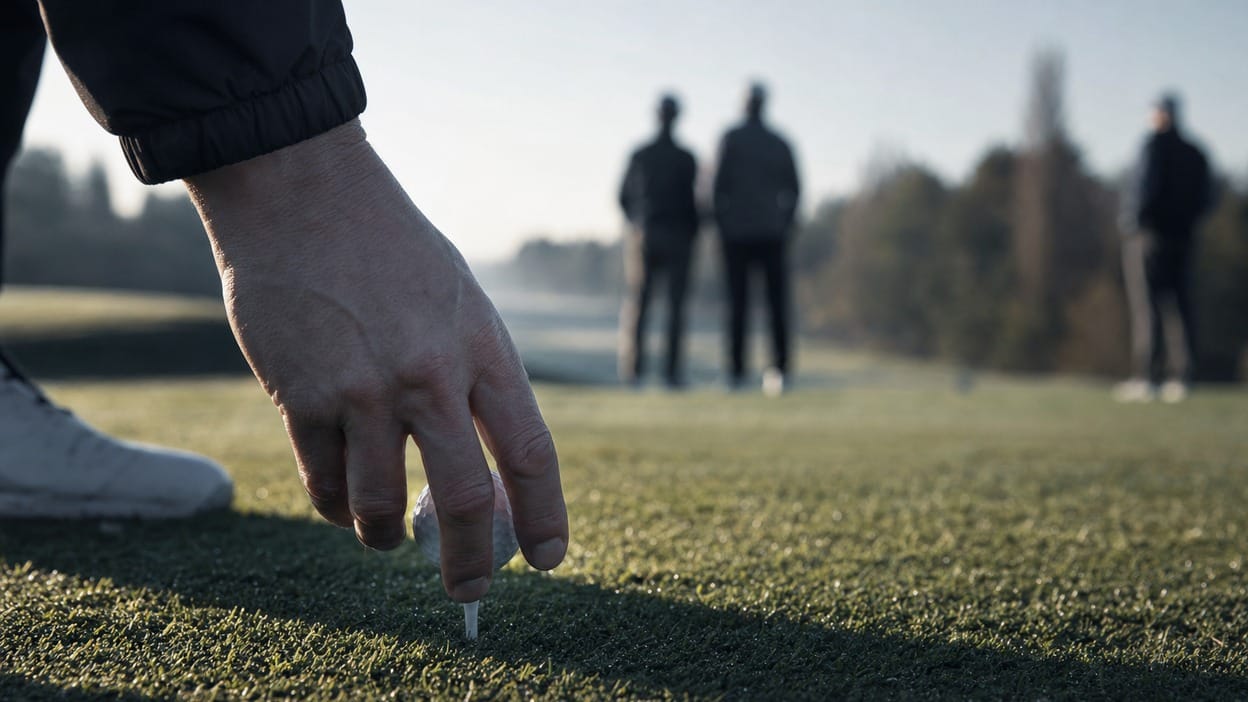
There's a reason the first tee feels harder than the 14th, even though it's usually the easiest hole on the course. A wide fairway, a short iron, no water in play, and still the ball ends up thin, or blocked right into the trees, or topped 30 yards (27.4m) down the cart path in front of everyone waiting to go off after you. That gap between how easy the shot actually is and how badly it can go is the first-tee problem, and it's specific enough that treating it like generic pre-round jitters misses what's actually happening.
This guide works from what the research on performance under arousal actually says, not from a collection of parking-lot tips, and it ends with a five-step routine built specifically for the walk from the range to the tee box. It also does something most first-tee advice skips: it's honest about where the science stops and the practical golf-instruction advice starts.
Psychologists Robert Yerkes and John Dodson described a relationship between arousal and performance more than a century ago that still holds up: performance improves as arousal rises, up to a point, and then falls off sharply once arousal passes that point. The shape is an inverted U, not a straight line. A completely flat, unaroused golfer plays worse than one who's alert and a little keyed up. But past a certain threshold, the same arousal that sharpens focus on hole six starts working against you, and that's the zone the first tee tends to push people into.
It's worth being precise about the difference between arousal and anxiety here, because the two get used interchangeably and they're not the same thing. Arousal is the general state of physiological activation, elevated heart rate, quickened breathing, a jump in alertness, and it's not inherently bad; a certain amount of it is exactly what a good shot needs. Anxiety is arousal paired with a specific, threat-focused thought: people are watching, this could go badly, I'll look foolish if it does. The first tee doesn't just raise arousal. It adds the audience and the stakes that turn ordinary arousal into anxiety, which is why a shot that's mechanically no harder than the one on 14 can feel like it carries 10 times the pressure.
None of the research behind the Yerkes-Dodson Law was built around a golfer standing over a tee shot with a group watching from the clubhouse deck. No study has isolated first-tee anxiety as its own subject. What follows applies a well-established, general finding about arousal and performance to a specific golf moment, which is a reasonable thing to do, but it's a different claim than saying science has measured the first tee directly, and it's worth saying so plainly rather than letting the citation do more work than it's earned.
The first-tee miss isn't just in your head, and it isn't random either. Golf Digest reported on swing data gathered by Tim Mahoney, a Golf Digest Top-50 Teacher, who used Trackman and SportsBox AI to compare roughly 100 students' range swings against their first-tee swings. The pattern held across most of them: about 80% showed a measurable reduction in hip and chest turn on the first tee compared to their range swing. The swings got shorter and more "hands-and-armsy," meaning the arms and hands started doing work the body's rotation should have been doing, and whatever flaw a player already carried in their swing tended to get exaggerated rather than smoothed out under that added tension.
That detail matters because it reframes what's actually breaking down. A tense first-tee swing isn't a different, worse swing showing up out of nowhere. It's your existing swing with less body turn and more hand action, which is exactly the kind of change a golfer can watch for and consciously counteract, rather than treating the whole thing as an unpredictable case of nerves.
This isn't a full pre-shot routine rebuild. If you want the general framework for what to do in the 20 to 30 seconds before every shot of the round, how to build a pre-shot routine that holds up under pressure covers that in depth. What follows is narrower: five things to do specifically in the two minutes between putting your range bucket down and hitting your opening tee shot.
Don't stand still holding your driver while you wait to be called. Shake out your arms, roll your shoulders, walk a few steps rather than freezing in place. Physical tension that builds up while you're waiting doesn't disappear once you step onto the tee; it comes with you into the swing. Golf.com's instruction desk and the SCGA's coaching blog both recommend this kind of deliberate physical release, staying loose rather than staying still, as a first move before any breathing work.
Box breathing is a simple pattern: inhale for a count of four, hold for four, exhale for four, hold for four. Golf.com's instruction desk recommends it specifically as a pre-tee tool, something to run once, right before you step up, rather than something to practice mid-swing. One full cycle is usually enough. The point isn't to relax completely; it's to bring your breathing rate down from wherever the waiting and the audience pushed it, back toward the range of arousal where you actually play well.
Under pressure, the instinct is to aim generally down the fairway and think about several things at once: tempo, grip pressure, not losing it right. That's the opposite of what helps. Pick one specific, small target, a tree branch, a sprinkler head, the left edge of a bunker well past the landing area, rather than "the fairway." Pair it with exactly one swing thought, the same one you'd use on the range. If you spend range time narrowing your focus down to specific targets rather than a general direction, something like the SKLZ Pro Rods Alignment Set can help build that habit before you ever get near a first tee, since it forces you to commit to a precise line rather than a rough one.
This borrows directly from the standard pre-shot routine principle: the decision gets made from behind the ball, not while you're standing over it. Pick your target and your shot shape, then step in only once that decision is settled. A golfer who's still negotiating between two swing thoughts while standing over a nervous first tee shot has split their attention at the exact moment it needs to be single-tracked, and that split attention is part of what produces the shorter, hands-heavy swing the Mahoney data describes.
The first tee feels like the biggest moment of the round because it's the most watched one, not because it's the one that decides your score. The shot that actually wrecks a round is rarely the opening tee ball; it's the blow-up hole three or four holes later that turns one bad swing into a 10-minute unraveling. If protecting your score is the real goal, how to avoid big numbers covers the game plan for the shot that matters more than this one. A mediocre first-tee shot that finds the rough is a normal outcome you'll recover from, and I'd rather a golfer pick just one of these five steps and run it the same way every single time, nervous or not, than try to remember all five under pressure. It stops being a technique once it's just what you do before you hit, which is the real gap between a tip that sounds good in the parking lot and one you actually reach for 40 seconds before your name gets called.
The same arousal spike that hits the first tee shows up anywhere a single shot suddenly carries more weight than the one before it, not just at the start of the round. How to convert short putts under pressure applies a version of the same commit-before-you-strike principle to a different high-pressure moment, if that's the pattern you're actually trying to solve.
If first-tee nerves are one symptom of a broader pattern rather than an isolated problem, Dr. Bob Rotella's Golf Is Not a Game of Perfect is the standard starting point for the mental side of the game generally. For something built more specifically around managing arousal and pressure, Dr. Patrick Cohn's The Mental Game of Golf works through the sport-psychologist framing in more depth than a single article can. And if the anxiety around the first tee is really anxiety about your score more broadly, Break 100 works through the course-management side of that same problem: Break 100 on Amazon.
Nervousness, or arousal, is the physical state itself: elevated heart rate, quickened breathing, heightened alertness. It's not automatically bad and a moderate amount actually helps performance. Anxiety is that same arousal paired with a threat-focused thought, like worrying about who's watching or what a bad shot will look like. The first tee tends to add that threat-focused layer on top of ordinary arousal, which is what pushes a normal amount of nerves into something that hurts your swing.
Not directly. No study has isolated first-tee anxiety as its own subject. What exists is well-established general research on arousal and performance, including the century-old Yerkes-Dodson Law, applied to a specific golf moment. That's a reasonable application of established science, but it's a different claim than saying the first tee itself has been studied and measured.
Golf.com's instruction desk recommends it specifically as a pre-tee tool, and the mechanism is straightforward: a slow, structured breathing pattern brings your breathing rate down before you swing. It's a practical golf-instruction technique rather than a clinically studied intervention, and it's presented here as exactly that. One cycle right before you step up is usually enough; it's not meant to be run mid-swing.
Pick a smaller target and commit to it before you step over the ball. Of the five steps, narrowing your focus to one specific spot and one simple swing thought does the most to counteract the shorter, hands-heavy swing that shows up under first-tee pressure, even if you skip the breathing and the physical release entirely.
Mostly because it's the most watched shot of the day, not because it's the most important one. The shot that actually costs you strokes is more often a blow-up hole a few holes later than the opening tee ball. Treating the first tee as a normal shot that you'll recover from, rather than a defining moment, takes some of the pressure out of it before you've even swung.
Some links in this article are affiliate links. If you buy through them, I earn a small commission at no extra cost to you. This never influences what I cover or recommend. I link to gear I'd buy myself.
Data-backed reviews and advice that works. No brand spin.