







how-to
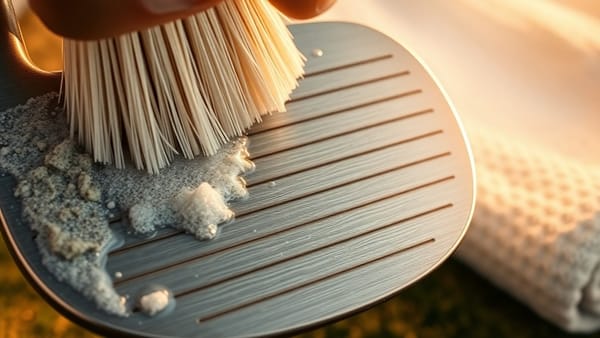
How to Clean Your Golf Clubs
A dirty groove face costs you spin before you even make a bad swing. Golf Digest's
Shot Scope data shows a 25-handicapper is 3x more likely to get up and down with a 9-iron than a lob wedge. Here is the home practice system that fixes it.
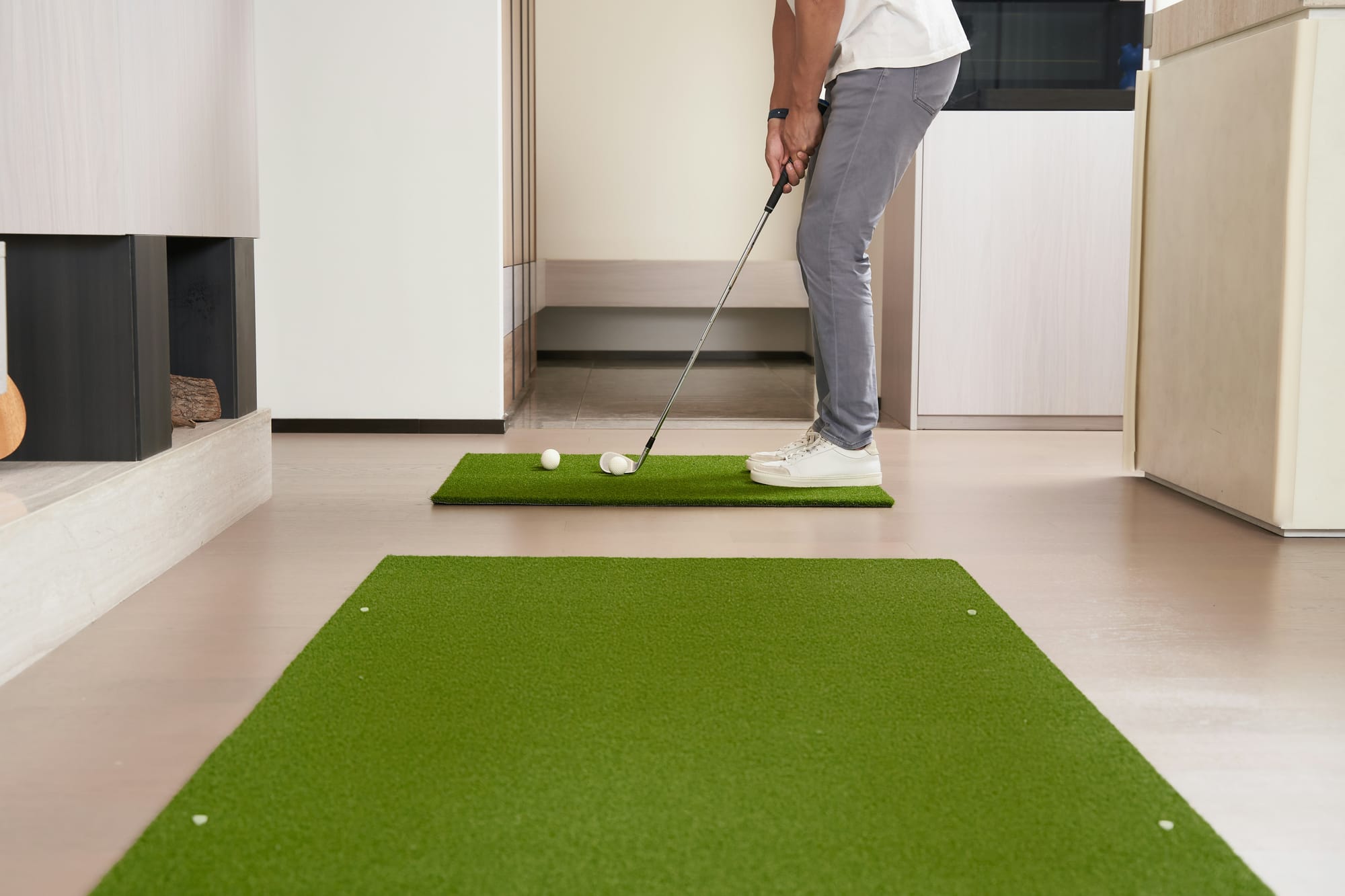
According to Shot Scope's database of 870,000+ rounds, a 20-handicapper converts about 1 in 3 up-and-down attempts. A 25-handicapper is three times more likely to save par with a 9-iron chip than a sand wedge, yet most still grab the wedge by reflex. The data has been consistent for years. Here's the good news: you can fix this without a teacher standing behind you. What you need is the right session structure, honest feedback, and a club selection rule that ignores what looks impressive on TV. Block out 20 minutes a day for two weeks and you'll see a measurable jump in conversions.
TL;DR
The gap between a 25-handicap and a 10-handicap isn't driver distance. It's the wedge in your hand from 30 yards (27m) and the putter from 8 feet (2.4m). Shot Scope's per-handicap data makes that explicit.
| Handicap | Up-and-down % | Three-putts/round | Sand save % |
|---|---|---|---|
| 10 | 39% | 3.0 | 20% |
| 15 | 34% | 3.8 | 18% |
| 20 | 31% | 4.6 | 15% |
| 25 | 25% | 5.8 | 10% |
Source: Shot Scope database (870,000+ rounds), via MyGolfSpy, October 2025.
Read the table sideways. Moving from 25% to 34% up-and-down conversion is worth two to three strokes per round. Cutting three-putts from 5.8 to 3.8 is another two strokes. That's a four-to-five-stroke handicap drop sitting inside your short game, and none of it needs more clubhead speed or a new $700 driver. It needs time spent on the parts of the bag that score, and reps that transfer.
The honest question is whether you're already grinding around the green and not seeing results, or skipping it for the range. Either answer points to the same fix: change what your reps look like.
There's a reason a golfer can stripe chips on a backyard mat and then duff three in a row on the first hole. The format is wrong.
Blocked practice is hitting 50 chips from the same spot, with the same club, to the same target. It feels productive. Strikes get tidier. Bottom of the arc gets more consistent. Trouble is, the course doesn't give you 50 reps from one spot. It gives you one shot, from a lie you've never seen, with a number you have to guess. Blocked reps train mechanics in a vacuum. They don't train decision making, calibration, or recovery from a miss-hit.
Variable practice rotates clubs, distances, lie conditions, and targets every shot or every few shots. It's harder. Strikes look messier in the moment. Retention is better.
The research backs this up with caveats. Barzyk and Gruber (2024), published in Frontiers in Sports and Active Living, ran a controlled study on golf chipping skill acquisition. Random practice produced superior retention and transfer compared with blocked practice. Distributed practice (60 reps spread across four days) outperformed massed practice (240 reps in a single day) by a meaningful margin. A 2023 ScienceDirect meta-analysis on the contextual interference effect found only about 21% of outcomes agreed with the textbook claim. The science is messier than the textbooks suggest.
The practical argument holds even when the experimental evidence is mixed. Course performance is the test that matters, and the course is variable by design. Practice formats that look like the course transfer to the course. Blocked practice has a place when you're learning a new movement pattern and need to feel the same shape over and over. Once it's grooved, vary everything: the club, the distance, the lie, the target, the order.
If you take one thing from this section: stop hitting 50 chips in a row. Hit one chip, walk back, switch clubs, change targets, hit another.
You can have the perfect practice plan and the right club and still skull every chip into the back bunker if your hands flip through impact. According to HackMotion, drawing on a sample of more than 1 million swings (December 2025), 56.68% of golfers in the 10 to 25 handicap range flip at impact.
A flip is when the lead wrist cups, or extends, through the impact zone. Clubface adds loft. Arc bottom rises. You catch the ball thin, skull it across the green, or hit it fat and watch it dribble five feet (1.5m). Professionals begin extending their wrists about 0.02 seconds before impact, a controlled release timed to a flat or bowed lead wrist at strike. Amateurs start the same motion at 0.07 seconds, far too soon, which produces the cup-and-flip you can see on any range.
Drill that fixes it: the lead-hand-only chip. Take a pitching wedge or 9-iron. Remove your trail hand from the grip. Set up to a ball at the bottom of your stance with the shaft leaning forward. Swing waist-high to waist-high, brushing the grass. Your lead wrist has no choice but to stay flat through the strike, because the trail hand isn't there to flip it shut.
Progress in three stages. First, no ball, just brushing the carpet or grass. Second, a teed-up ball on a hitting mat. Third, a ball on the ground. Fifteen minutes of this, three times a week, transfers faster than 200 two-handed chips, because it retrains the impact pattern at source. HackMotion's chipping data (November 2025) shows lead-wrist extension at impact correlates with strike inconsistency more than any other variable they measure.
This is the drill I'd run first. Not because it's complicated, but because if your hands flip you can't out-strategy the flaw. Fix the strike, then worry about distance control.
For a deeper technical breakdown of the wrist mechanics behind this drill — common miss patterns and a second gate drill for ball-first contact — see how to chip in golf.
What's the worst piece of conventional wisdom in amateur golf? "Use a 60-degree from anywhere around the green." It's wrong, and the data is unkind to it.
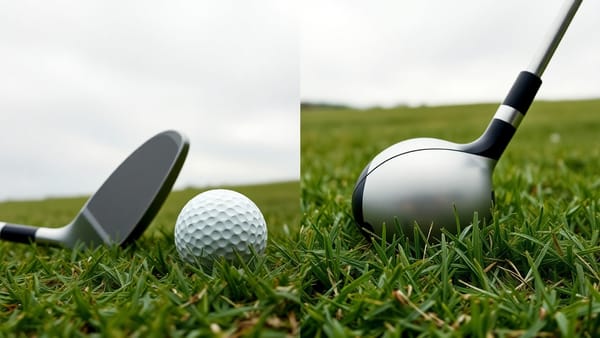
Shot Scope's per-club analysis, published via Troon, found that a 25-handicap golfer is three times more likely to get up and down with a 9-iron chip than with a sand wedge. The 9-iron isn't a magic club. It rolls more, flies less, and forgives a thin or fat strike better than a high-loft wedge. A skulled 9-iron from 15 yards (14m) tends to find the green. A skulled lob wedge ends up in the next county.
Here's the hierarchy I run by, and the one I'd teach a beginner on day one:
Putt when you can putt. Fringe, tight collars, and mowed first cuts are putter territory for most amateurs. A bad putt finishes nearer the hole than a bad chip in almost every case.
Chip when you can't putt. Bump-and-run with a 7, 8, or 9-iron. Land it on the green, let it roll. Strike margin is huge.
Pitch only when you must. Tall rough, no green to work with, ball above your feet on a downslope. Lob wedge earns its place when there's no alternative. It does not earn the default slot.
Practice the lower-loft chip more than the high-loft pitch. That's the inversion most amateurs need. For a deeper breakdown of where the line sits between the two, here's the decision framework I use for choosing between chips and pitches. Short version: distance to the pin and distance to the green's edge dictate the choice, not what looks cool.
A practice plan you skip is worse than a flawed plan you finish. Keep it short and frequent. Fifteen to twenty minutes a day beats ninety minutes on Saturday, and there's solid acquisition science behind that. Distributed reps stick. Massed reps fade by Tuesday.
Rotate through four drills. Don't do them in the same order every session. Mix the clubs and distances every time.
Landing Spot Drill: pick a small target on the floor, a towel, an upturned frisbee, or a chalk circle. Chip ten balls and count how many land within one putter-length of the target. Track the number week by week. Works fine into a chipping net if outdoor space isn't an option, with the net's catch zones acting as the proximity scoring.
Par 18 Game: nine chip-and-putt scenarios, par 2 each. Different lie, different distance, different club every scenario. Score yourself. Pressure builds, focus sharpens, and you start to learn which shots you own. Played to a net with proximity-based scoring, you can run this in a garage.
Ladder Drill: hit progressive distances, 10, 15, 20, 25 yards (9, 14, 18, 23m), then reverse the ladder. One target, variable distance, same club. This is the random-practice structure the science supports, and it builds calibrated touch faster than any single-distance routine I've used.
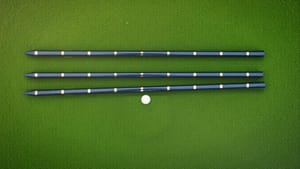
Gate Putting Drill: two tees forming a gate just wider than the putter head, set 3 feet (0.9m) from a cup. Ten putts each from 3, 6, and 9 feet (0.9, 1.8, 2.7m). On carpet, set up an upside-down glass as the hole and a coaster as the gate. Gate teaches square face delivery, distance change teaches calibration.
Here's a session split that works for me, scaled by the time you've got:
| Session length | Chipping/pitching | Putting | Warm-up |
|---|---|---|---|
| 30 min | 15 min | 10 min | 5 min |
| 60 min | 25 min | 20 min | 15 min |
HackMotion's January 2026 practice analysis recommends short-game time at no less than 50% of total practice volume for sub-90 amateurs. Jon Sherman of Practical Golf has run a 20/20/20 framework for years (20 minutes short game, 20 minutes putting, 20 minutes full swing). Both arrive at the same conclusion from different angles. Spend more time on the range than around the green and you're optimizing the wrong stat.
The minimum kit is a chipping net and a hitting mat. With those two items, you can run every drill in this article in a garage, basement, backyard, or living room.
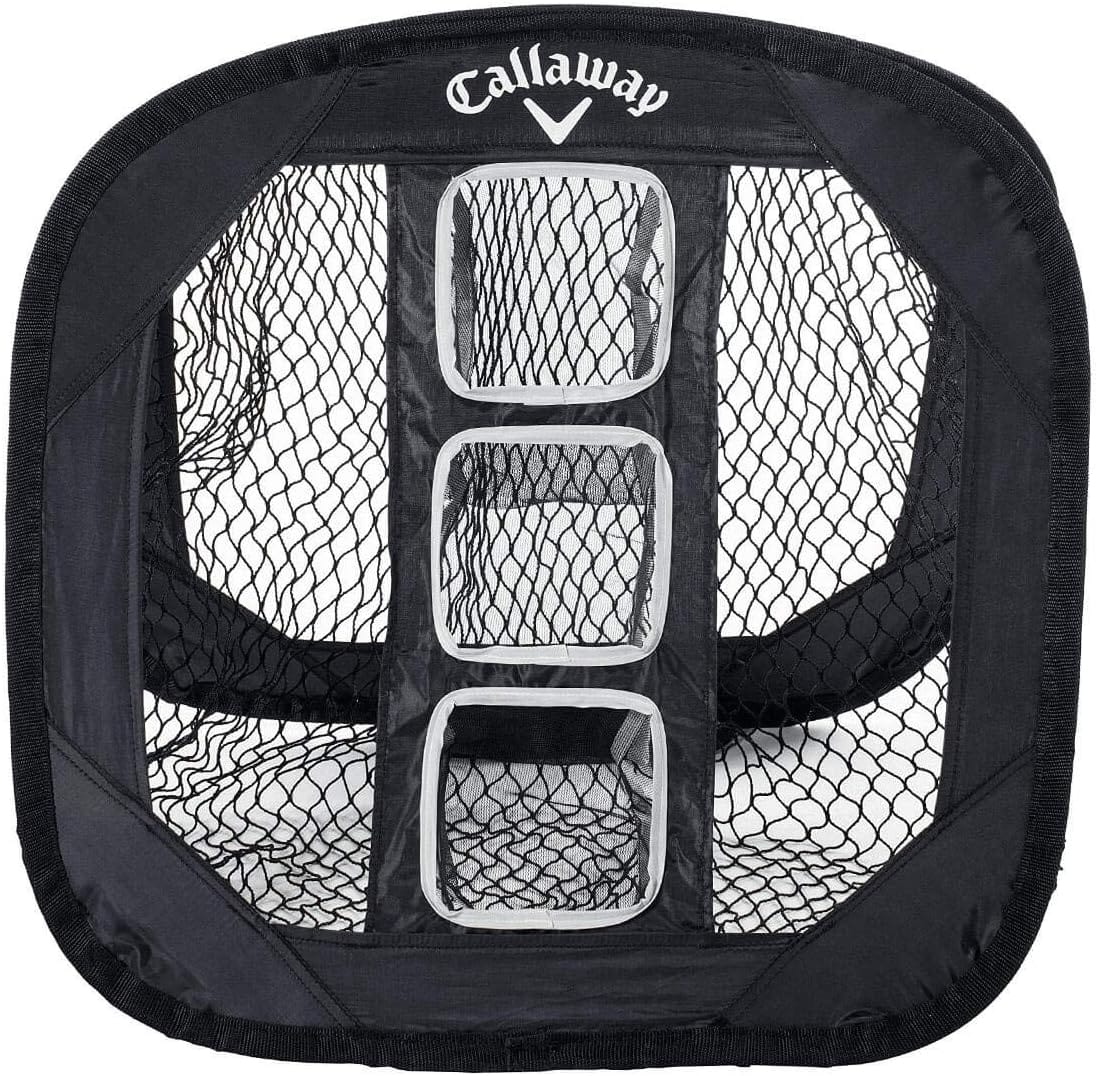
A chipping net is a target that catches the ball so you can practice in a small space. Without one, home short-game practice degrades into lobbing balls into the lawn and hunting them down, and the search time kills the rep count. A net with multiple target zones gives you proximity feedback on the spot, which is what variable practice needs to score itself. The Callaway Chip-Shot is the one I'd pick first.
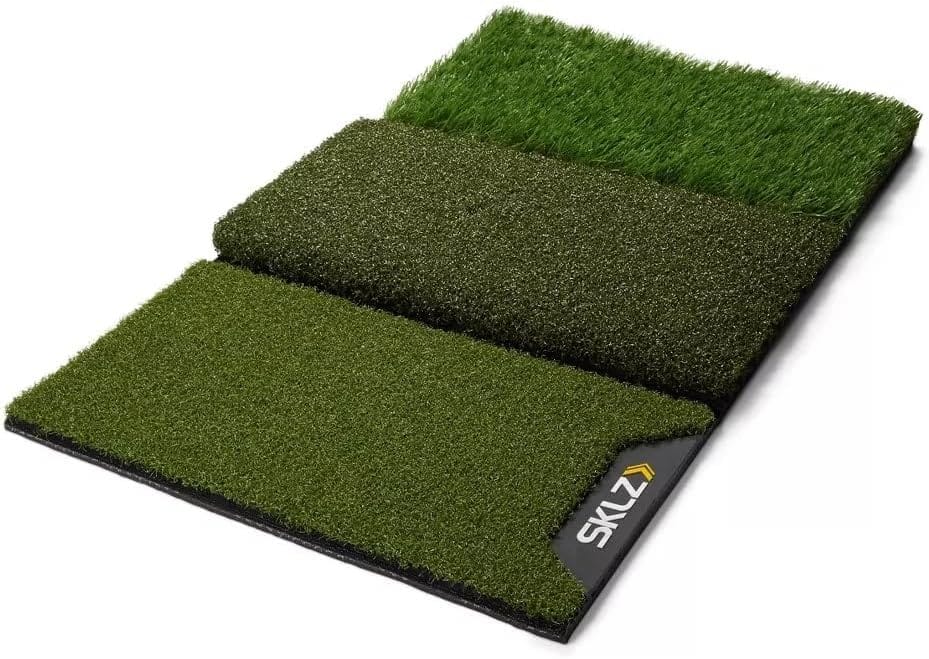
A hitting mat gives you a realistic surface for chip and pitch practice. A towel on carpet works for the lead-hand drill. For anything where strike quality matters, a multi-zone mat (tee turf, fairway, rough) gives steady feedback on bottom-of-arc position. The SKLZ Pure Practice Mat is the one I'd pair with the Callaway net.
For putting, a basic putting mat on any flat floor gets the job done. Nothing fancy required. If you want the longer view on practice gear, here's the broader list of training aids I'd actually buy. Most aren't worth the money. A few are paying their way.
You'll see strike-quality changes in 7 to 10 days of daily 15-minute sessions, even more so if you're running the lead-hand drill. Scoring changes on the course tend to show up over 4 to 6 weeks, because course transfer requires variable practice and a few rounds where you trust the new pattern under pressure. Barzyk and Gruber's 2024 study found measurable retention gains within 2 weeks of distributed practice protocols. The rate-limiting step isn't physical, it's reps that look like the course.
Yes. A hitting mat with a multi-turf surface gives you enough strike feedback for the lead-hand drill, ladder drill, and basic chip mechanics. A chipping net adds the proximity feedback you'd get from a real green. The one thing you can't simulate at home is reading lies, the difference between a tight fairway lie, fluffy rough, and a buried ball in a collar. Half an hour at a short-game area once a week is enough to keep the lie-reading skill alive while you do the bulk of the work indoors.
For most 15+ handicap golfers, yes, when used as the default. Shot Scope's data shows a 25-handicap is three times more likely to get up and down with a 9-iron chip than a sand wedge. The 60-degree has a place for short-sided pitches over bunkers and into tight pins with no green to work with. The mistake is reaching for it from any lie 30 yards (27m) and in. Practice the bump-and-run with a 7, 8, or 9-iron until it's your default. Keep the 60-degree for the situations that need it. For a full club-by-club system built on carry-to-roll ratios rather than a single wedge default, see our guide to controlling chip shot distance.
Quality over count. A 15-minute session might be 30 to 50 balls if you're running variable practice in good faith, because changing clubs and targets between shots takes time. That's the point. Don't chase rep counts. Chase varied reps. The Barzyk and Gruber data showed 60 distributed reps outperformed 240 massed reps for retention, and the same logic applies to a single session.
A chip is a low-flight, high-roll shot played with a less-lofted club (7, 8, 9, or PW) with a putting-style stroke and minimal wrist action. A pitch is a higher-flight, lower-roll shot played with a 50 to 60-degree wedge, with more swing length and active wrist hinge. For home practice with a chipping net, chips are easier to control and give cleaner feedback. Pitches need more vertical space and a softer landing area. Start with chips, master the strike and the landing-spot calibration, then add pitches once you've got the basics dialed in.
Start with one thing. Run the lead-hand-only drill today, fifteen minutes, no ball at first. Add the landing spot drill tomorrow. By the end of the week, work in the variable ladder drill and score yourself. Two weeks of that and you'll have a measurable baseline. The next leverage point sits in the broader handicap-lowering plan I lay out next, but the short game work is what makes that plan stick. Skip it and you're optimizing the wrong end of the bag.
Some links in this article are affiliate links. If you buy through them, I earn a small commission at no extra cost to you. This never influences what I cover or recommend. I link to gear I'd buy myself.
Data-backed reviews and advice that works. No brand spin.