Wedge Grinds Explained: What the Letters Mean
Wedge grinds explained without the jargon. What F, S, M, D, K and T mean on a Vokey, and how to pick the right shape for your swing and turf.
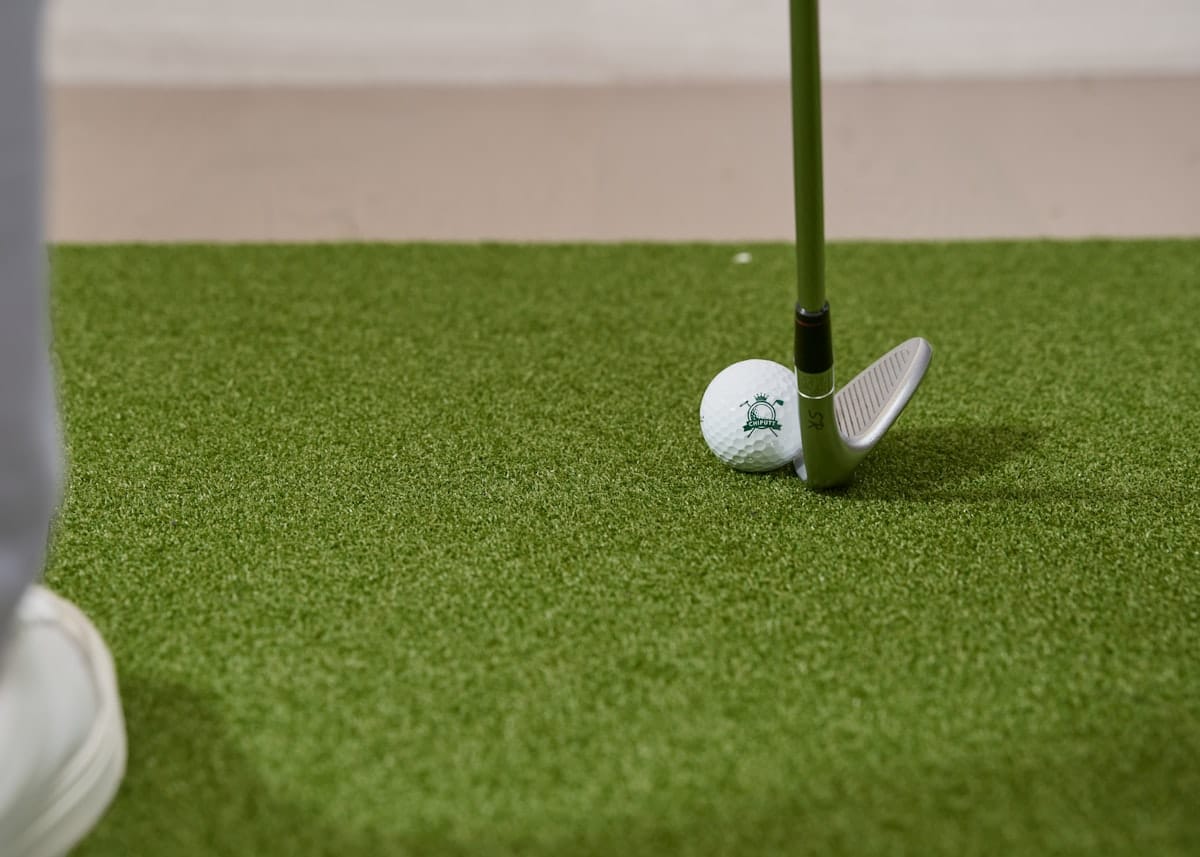
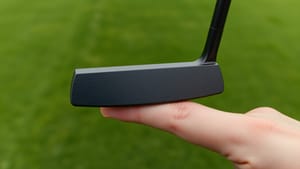
Photo by Chiputt Golf on Unsplash
You see "56/10/S" stamped on a Vokey, and most golfers in a pro shop can read those first two numbers. Loft is 56. Bounce is 10. Then eyes glaze over at that final character. That stamp names a sole shape, and it's the part of any spec sheet nobody talks about even though it dictates how your club behaves on every shot around a green. If you've already read the bounce primer, this piece picks up from there. If lower scores are your goal, scoring clubs matter more than your driver, so spend ten minutes getting this one right.
- 1.The letter code (F, S, M, D, K, T) names the sole shape, not the bounce angle
- 2.S is the correct default for most mid-handicappers: versatile, all-conditions, no face manipulation needed
- 3.M suits players who open the face often: flop shots, cut bunker shots, bump-and-runs
- 4.F is the firm/links option for square-face full shots only, not a creative shape
- 5.K is the bunker specialist: wide sole, high forgiveness on inconsistent entry angles
- 6.T is for low handicappers on firm ground only, steer away from it at 10+ HCP
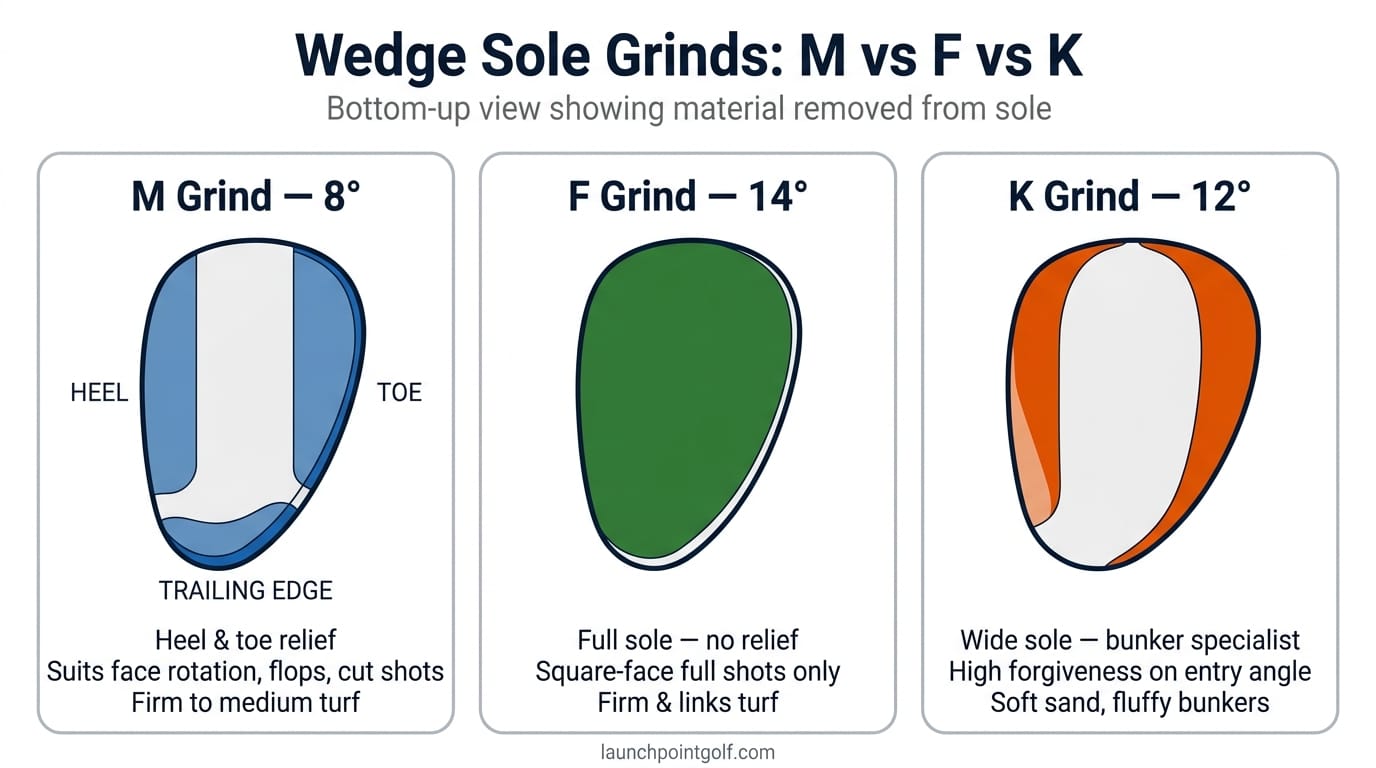
What wedge grind means
Bob Vokey's own working definition is the cleanest one out there: it is "the manipulation or removal of material on the sole of the wedge designed to improve contact with the turf." That's it. Bounce is an angle. The cut on the underside decides how that angle behaves once you start rotating the clubface open or closed.
Open up a Vokey carrying a heavy full sole, and the front edge lifts off the ground. Not what you want when you're trying to slip a head under a ball sitting on a tight lie. Now take an identical 56 degrees on a model with relief ground out of the heel, toe or trailing portion, and that front lip stays low. Same numbers stamped, very different result. The cut on the base of the club is doing its job. Need the angle side of this puzzle first? My bounce guide is here.
What the three-part code means
Titleist stamps three numbers in a fixed order: loft, bounce, grind. Once you know that order, it never confuses you again.
Loft is the first number. 56 means 56 degrees. Same figure you've been reading on irons your whole life. Higher number, higher launch, shorter carry.
Bounce is the second number. Measured in degrees between the leading edge and the lowest point of the underside when the club rests square. More of it keeps that front lip higher off the turf at impact. Less drops it closer to the deck.
Grind is the character at the end. S in this case. It tells you which sections of the base have been milled away. A 56/10/S and a 56/10/M share an identical loft and nominal bounce reading, but the M has more material taken from the heel and toe, so it plays lower-bouncing the moment you rotate the head open.
The six Vokey grinds
F grind. Full sole, no relief. This is the shape you want for square-face full swings, the wedge you hit from 100 yards with a stock motion. Available in lofts from 44 degrees up to 60. F suits firm and links turf, square-face deliveries, and any attack angle from shallow to steep, because the full sole forgives a heavy strike. It is not the option to pick if you like opening the face for creative shots. Most players carry an F in their pitching and gap wedges and switch profiles for the higher lofts.
S grind. The all-conditions default. The S has a touch of heel relief, runs 10 degrees of bounce, and is offered from 54 to 60. If you're a 10 to 20 handicapper and you've never thought hard about grinds before, this is the right answer. It works on neutral turf, handles a steep-ish attack angle, takes a bit of face opening when you need it, and doesn't punish you for inconsistent entry. Pick S if you don't have a clear reason to pick something else.
M grind. Bob Vokey's own preferred grind, according to the Titleist SM11 announcement. The M takes material out of the heel, toe and trailing edge for a crescent-shaped sole, runs 8 degrees of bounce, and is offered from 54 to 62. It rewards players who rotate the face open and shut. Cut bunker shots, flop shots over a bunker lip, low spinners with a closed face, all of those play better with an M underneath you. Conditions: firm to medium turf. Attack angle: neutral to shallow. Avoid the M if you take big divots, because the relief geometry can let the leading edge dig.
D grind. Twelve degrees of bounce with full heel and trailing-edge relief, offered from 54 to 60. Pick the D if your attack angle is steep, you take a deep divot, and you play soft turf. UK parkland in winter, anywhere with thick rough, courses with lush rye fairways. The D gives you the high bounce you need to keep from digging, but the relief means you can still open the face when the situation calls for a flop. Players who carry an S today but find it digging in soft conditions are D candidates.
K grind. The bunker wedge. The original K runs 12 degrees of bounce on a wide sole, available at 58 and 60. SM11 added a 06K option for firm sand and tight lies. Pick the 12K if your home club has soft, fluffy sand or you struggle to get the club through bunker shots. The wide sole means the entry angle is less critical, the club skips through rather than stabbing in, and a thin strike still gets the ball out. Some players carry a K as a dedicated sand wedge and a separate M or S for greenside chips. That's a reasonable setup if you're playing a course with serious bunkers.
T grind. Four degrees of bounce, narrow sole, heavy relief everywhere. This is a specialist grind for low handicappers playing firm ground, and that's it. Available at 58 and 60. The T sits the leading edge low to the ground, which is exactly what you want on a tight Australian fairway in February or a links course in August, and exactly what you don't want if your strike pattern is anything less than tour-quality. At 10 handicap and above, the T will hurt you more than it helps.
| Loft | SM11 configurations |
|---|---|
| 44 degrees | 10F |
| 46 degrees | 10F |
| 48 degrees | 10F |
| 50 degrees | 08F, 12F |
| 52 degrees | 08F, 12F |
| 54 degrees | 08M, 10S, 12D, 14F |
| 56 degrees | 08M, 10S, 12D, 14F |
| 58 degrees | 04T, 06K, 08M, 10S, 12D, 12K |
| 60 degrees | 04T, 06K, 08M, 10S, 12D, 12K |
The two-tour-setup test. Look at how Jordan Spieth and Max Homa build their wedge bags, sourced from a Golf.com piece by Jonathan Wall (Jan 22, 2024). Spieth runs 46.10F, 52.08F, 56.10S and 60.04T. Homa runs 46.10F, 50.12F, 56.14F and 60L. Two top-30 players. Two opposite grind philosophies. Spieth runs an S and a T because he opens the face on the lob wedge for greenside creativity. Homa runs three F grinds because he prefers a square face on full shots and uses an L grind only on the lob. The lesson: grind selection is about how you play, not about copying what looks tour-correct.
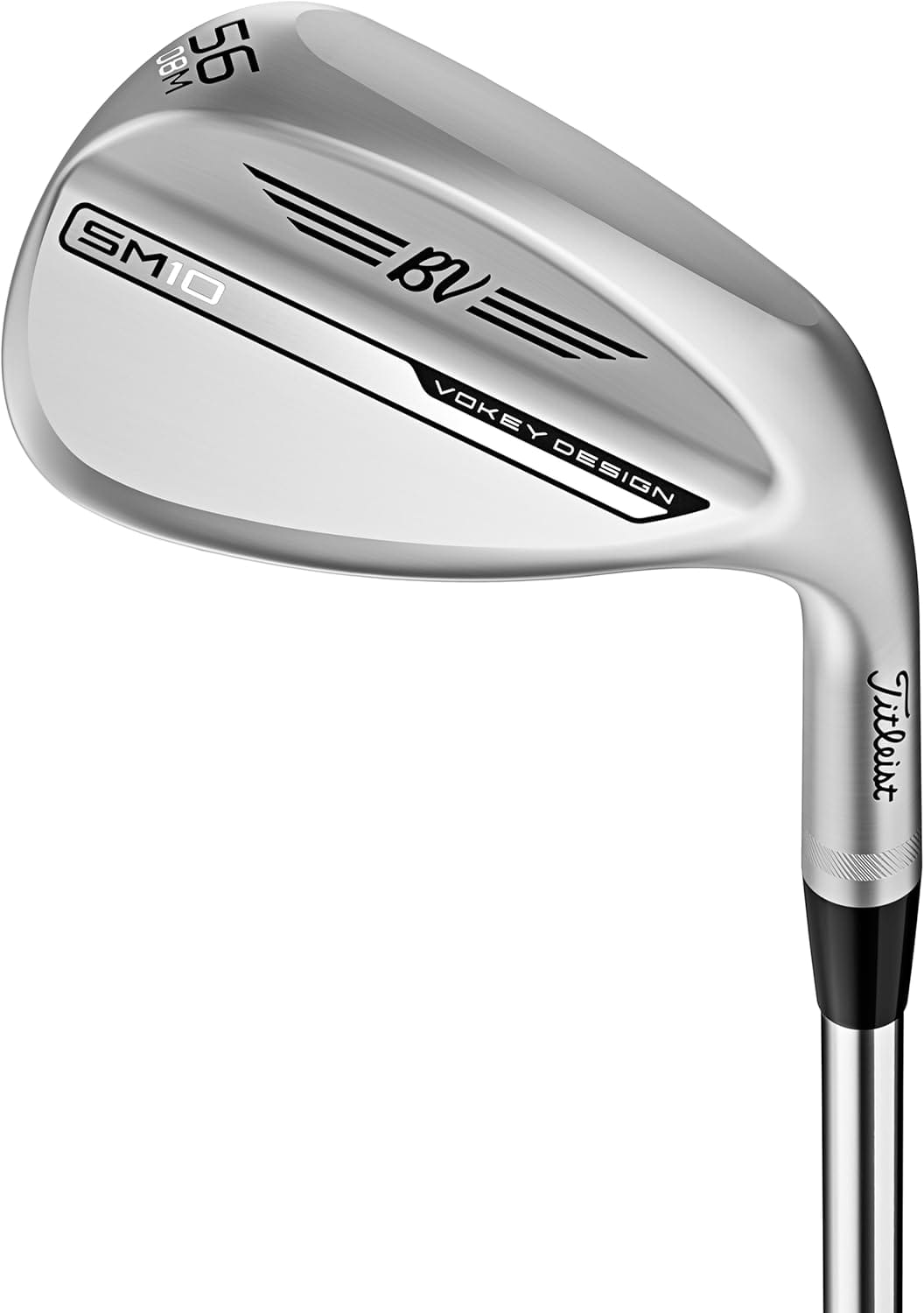
Titleist Vokey SM10 Wedge : 56° / 08° / M Grind
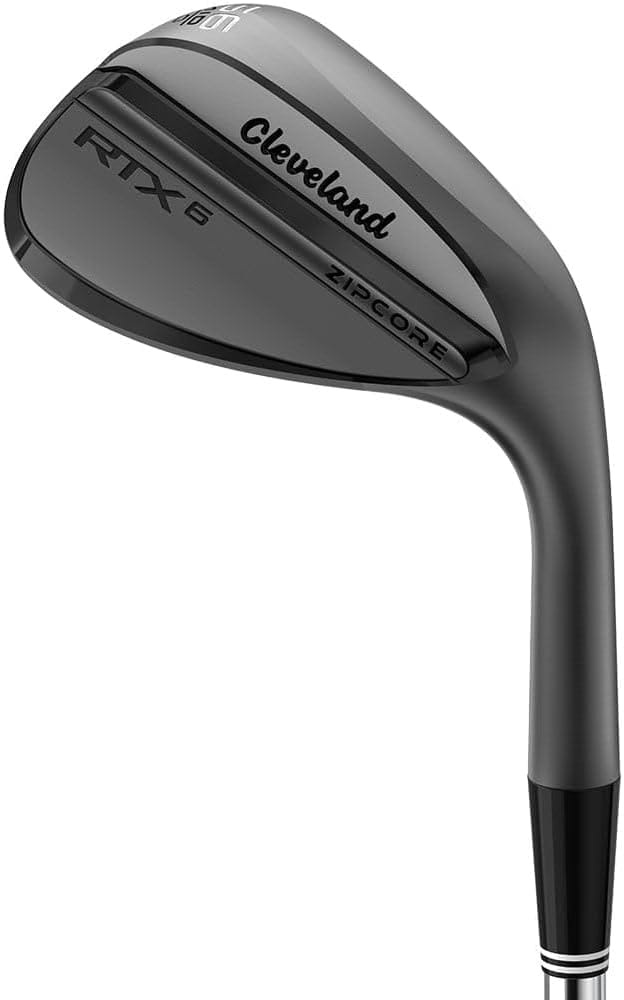
Cleveland RTX6 ZipCore Wedge : 56° / Low+ Grind
Titleist Vokey SM10 Wedge : 52° / 08° / F Grind
The full-sole gap wedge option for square-face swings on firm and links turf. Produces consistent loft with no face manipulation needed.
 Buy now
Cleveland RTX 6 ZipCore Wedge : 56° / Mid Grind
Mid-bounce rounded heel for players who play both square and slightly-open face on firm to medium turf. A versatile all-conditions sand and approach wedge.
Which grind is right for you
Three questions. Answer them in order and the grind picks itself.
Question one: do you ever open the face? Flop shots over a bunker lip, cut shots that land soft, chips played with the face wide open to take spin off. If yes, you want an M. If no, your face stays square or close to it, and an S is the right call.
Question two: what's your typical divot? Dig deep with the wedges and you need bounce, which points you to a D (12 degrees) or an F (14 degrees) on the higher lofts. Brush the turf or take no divot at all, and you can run lower bounce, which points you to an M or a T. The middle ground is the S at 10 degrees, which is why it's the default.
Question three: what conditions do you play most weeks? Soft UK or Pacific Northwest parkland in winter pushes you toward S or D. Firm Australian summer turf or links pushes you toward M or F. Bunkers are a separate question: if your home club has soft sand and you struggle to escape, add a K to the bag.
If you can't answer all three with confidence, start with the S. It's the right answer for the vast majority of mid-handicappers, and it lets you play every shot well rather than two shots great and the rest like a hack job. You can always change later when you know your game better. A proper fitting will confirm your actual attack angle and divot pattern, and a fitter will spec the grind to match. A fitting session is worth more than reading another article like this one.
How other brands label their grinds
Vokey isn't the only wedge maker, and every brand uses its own letters. Cleveland publishes bounce angles on the spec sheet. TaylorMade and Ping use descriptive category names ("Standard Bounce", "S grind") without always publishing the exact angle, so you have to map by intent rather than degree. The table below covers the current generation models on shelves in early 2026.
| Grind category | Vokey SM11 | Cleveland RTX6 | TaylorMade MG4 | Callaway JAWS Raw | Ping Glide 4.0 |
|---|---|---|---|---|---|
| Versatile all-conditions | S (10°) | Mid | Standard Bounce | S grind | S grind |
| Face rotation / shot variety | M (08°) | Low+ | Standard-C | C grind | S grind (closest) |
| High bounce / steep swing | D (12°) | Full | High Bounce | X grind | S grind (12°) |
| Full sole / forgiveness | F (14°) | Full | High Bounce Wide | W grind | W grind |
| Bunker specialist | K-12 (58 to 60°) | Full | High Bounce Wide | W grind | E grind |
| Firm / tight lies | T (04°), 06K | Low | Low Bounce | Z grind | T grind |
Quick note on currency. Callaway JAWS Raw launched in 2022 and is still the current model in early 2026, no confirmed successor announced. Ping Glide 4.0 is the current iron-style cast wedge. Ping Glide Forged Pro is a separate forged premium model with its own grind range. If you want a second read after this one, Plugged In Golf goes grind-by-grind on the Cleveland line, Golf Insider UK matches grinds to swing types, and Today's Golfer has the longest single piece on the current Vokey lineup.
Frequently Asked Questions
What wedge grind should a mid-handicapper use?
The S grind is the right default for the vast majority of 10 to 20 handicappers. It carries 10 degrees of bounce, has light heel relief, works on most turf conditions, and forgives an inconsistent entry angle. Move off the S only if you have a specific reason: very steep divots (go to D), regular face-opening creativity (go to M), or firm links turf with a tour-level strike pattern (go to T).
Is M grind or S grind better?
Neither one wins for every player. The M has 8 degrees of bounce with heel, toe and trailing-edge relief, which suits players who open the face for cut shots, flops and bump-and-runs. The S has 10 degrees of bounce with light heel relief, which suits players who keep the face closer to square and want a single grind that works in mixed conditions. Mid-handicappers who don't manipulate the face: pick S. Players with a good short game who want shot variety: pick M.
What grind do most tour pros use on lob wedges?
There's no single answer. Jordan Spieth uses a 60.04T because he opens the face for greenside creativity on firm ground. Max Homa uses a 60L because he prefers a square face. Across the PGA Tour, T, M and L grinds dominate the 60-degree slot, with low bounce being the common factor because tour pros play firm conditions and have the strike quality to use a low-bounce sole. None of that translates to a 15-handicap in soft parkland conditions, where an S or D at 58 degrees is a better answer.
Does grind matter more than bounce?
They're two parts of the same answer and neither one matters in isolation. Bounce is the angle, grind is the shape that controls how that angle behaves when the face is open or closed. A 56/10/S and a 56/10/M both have 10 degrees of bounce on the spec sheet, but the M plays as if it has 6 degrees the moment you open the face. Pick bounce for your divot pattern and conditions, then pick the grind for whether you open the face or not.
What is the difference between F grind and D grind?
The F has a full sole with no relief. The D has 12 degrees of bounce plus heel and trailing-edge relief. The F is the grind for square-face full shots in firm conditions and is offered through the lower lofts (44 to 60). The D is the grind for steep swings and soft turf at 54 degrees and up, with enough relief to still open the face for short shots. Steep, soft, want a sand wedge that handles flops too: D. Shallow, firm, square face on full shots: F.
The honest answer on wedge grinds is that most golfers are overthinking the letter and underthinking the bounce. Pick the bounce that matches your divot, pick the S if you don't open the face and the M if you do, and spend the money you saved on a fitting session or a half-hour with a short-game coach. If your current wedges are more than four years old and the grooves look polished rather than sharp, the grind on the spec sheet is academic. A worn wedge is a worse wedge regardless of how clever the sole shape is on paper.
Some links in this article are affiliate links. If you buy through them, I earn a small commission at no extra cost to you. This never influences what I cover or recommend. I link to gear I'd buy myself.







The golf newsletter that cuts the hype
Data-backed reviews and advice that works. No brand spin.
Recommended products